
10 Pumpkin Carving Hacks to Make Your Halloween Less Scary

2021-10-14T07:01:00

(BPT) – Hacking away aimlessly is best left for the Halloween horror films. To help create your best Jack-O’-Lantern this fall, consider the following tips from the experts at Pumpkin Masters®, creators of the world’s first pumpkin-carving kit.

“Pumpkin carving is a fun, but sometimes frustrating tradition when we focus on trying to create the picture-perfect pumpkin,” says Patsy Fox, chief marketing officer, Pumpkin Masters. “At Pumpkin Masters, we believe the key is to make it easy for families to enjoy their time together by trying a few simple hacks so they can focus on the moment, not just the masterpiece.”

  1. Pick the right pumpkin: Pick a pumpkin with a nice, flat surface that can stand upright. Match the pumpkin to your pattern to get the right proportion.
  2. Prep your table: Save yourself time and mess by covering your table with a tablecloth or newspapers before you start carving. Keep a pack of wipes handy for easy clean-up.
  3. Bottoms up: When you’re carving an opening in your pumpkin to scoop out the seeds, carve out the bottom of the pumpkin — not the top.
  4. Get rid of the guts: Kids love getting messy, so let them scoop out the seeds! Scrape the pumpkin wall to about an inch thick before carving. Roast the seeds for a special treat.
  5. Grab the right tools: Pumpkin Masters® offers a variety of tools, decorations and patterns to make carving a masterpiece easy and safe.
  6. Apply your pattern: Cover the cut lines of your pattern with transparent tape. This will waterproof the pattern and reinforce it, so you can carve right through it.
  7. Get carving: When carving your pumpkin, start from the inside and carve the outermost edges last. Pumpkin Masters® patterns are numbered according to the order you should carve, making it easy.
  8. Light it up: Never use a candle! Keep your family safe by using a battery-powered pumpkin light, which come in a variety of fun colors and effects.
  9. Preserve your pumpkin: Cover your carved pumpkin in plastic wrap and refrigerate it when not on display. You can also spritz it with water to refresh it.
  10. Don’t have time to carve or decorate? Download the Pumpkin Masters® Carve Your Selfie App to create a fun and shareable pumpkin with your face on it! The app is available on the Apple App Store https://apps.apple.com/us/app/id1491958901 or Google Play https://play.google.com/store/apps/details?id=com.wwapps.pumpkinmasters.

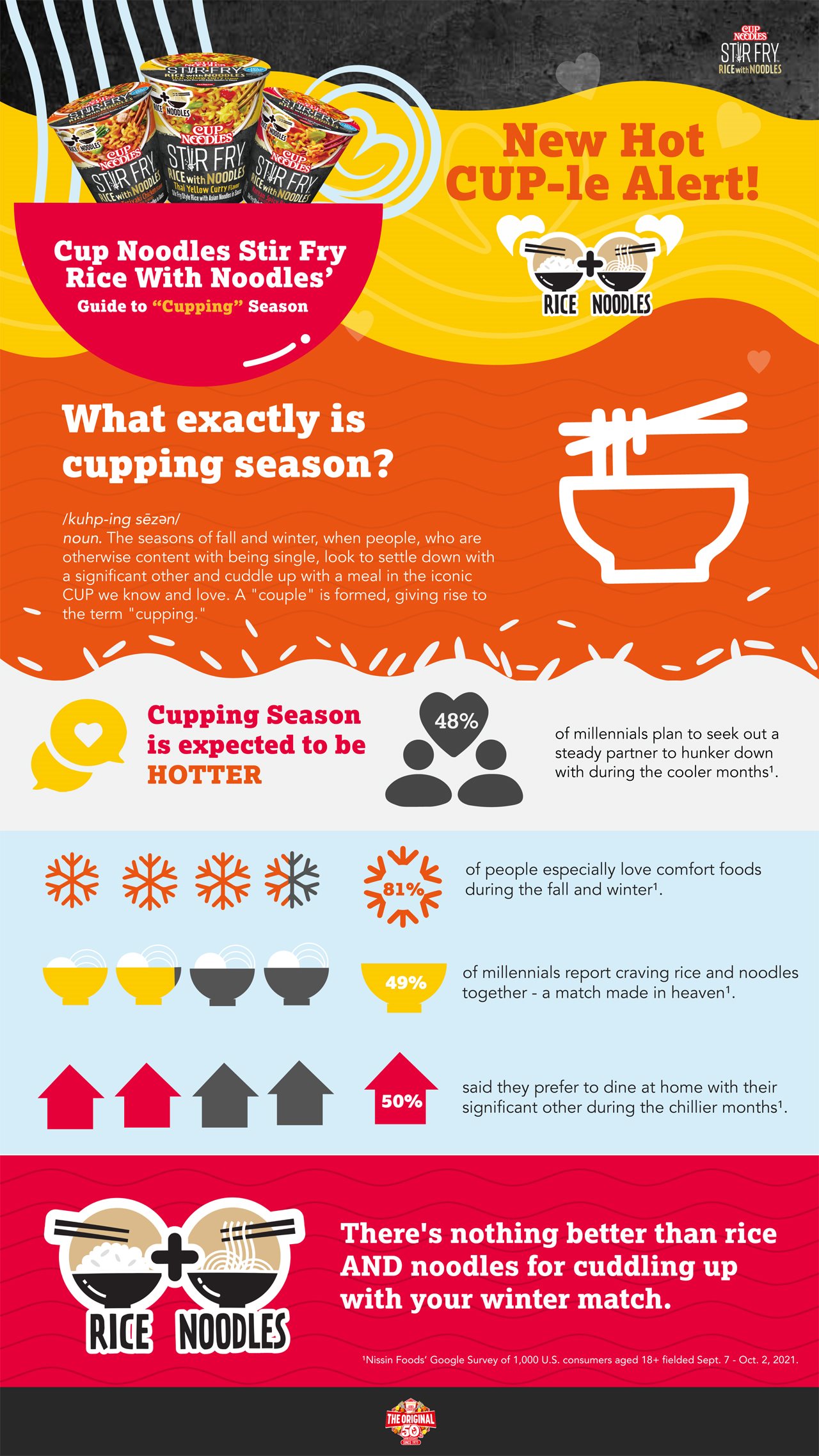
Winter is coming, are you ready for cuffing season?

2021-10-14T08:01:00

(BPT) – It’s that time of year when the leaves change color, the days begin to get a little shorter, sweater weather commences and the desire to hibernate with a winter fling sets in. Cuffing season is here.

Whether it’s exhaustion from the summer dating scene or proactively searching for your cuffing mate, if last year’s unprecedented rise of engagement across dating apps is any indicator, this cuffing season is sure to be hotter than ever. In a recent survey1, nearly half (48%) of millennial respondents plan to participate in the well-known seasonal romance this year. So, swipe right to spark that budding romance, and hopefully, you’ll find one lucky match and be cuffed to a new significant other before the first leaves start to fall.

One new pairing is creating some buzz and it’s an unexpected new couple, or better yet CUP-le, with the matchup between rice and noodles. That’s right, Nissin Foods, the inventor of the original Cup Noodles®, has launched its latest innovation — Cup Noodles Stir Fry Rice With Noodles. The pairing of rice with noodles is not new per se. For years, at-home chefs and internet foodies have been adding their prepared instant ramen noodles to a steaming bowl of fluffy rice. Finally, Cup Noodles is giving the people what they want — serving us the first-ever rice with noodles in one perfect, on-the-go cup that we can cozy up with during this year’s cuffing cupping season.

The hot new CUP-le, Cup Noodles Stir Fry Rice with Noodles, is sharing its secrets to navigating “cupping” season.

Comfort food during winter isn’t groundbreaking, but with 81% of consumers leaning into those nostalgic cravings when the temperature drops below 601, the convenient Asian takeout alternative is the ultimate comfort food that’s ready in minutes — perfect for keeping you and your cuffing buddy warm and satisfied. While many might think it’s an obvious match made in heaven, one in three respondents (34%) said rice with noodles is an unexpected mashup that’s worth trying1.

Celebrating its 50th anniversary and a history of bold invention and creativity, Cup Noodles is no longer in the business of just noodles. The stir fry-style rice with noodles tossed with assorted vegetables comes in three bold flavors, including Thai Yellow Curry, Japanese Teriyaki Chicken and Korean Spicy Beef. Find it in the ramen aisle at select Walmart stores nationwide.


1 Nissin Foods’ Google Survey of 1,000 U.S. consumers aged 18+ fielded Sept. 7 – Oct. 2, 2021.

America’s favorite chili styles by region unveiled in chili heat map [Infographic]

2021-10-14T08:03:01

(BPT) – Just in time for chili season, football games and tailgating, Bush’s Beans has identified the most popular chili styles by region across the country to inspire chili-lovers everywhere! Featuring chili beans ranging from pinto beans and great northern beans to kidney beans, Bush’s has you covered for all your chili fan favorites no matter which region of the country.

6 ways to keep your pets safer this fall

2021-10-14T07:01:00

(BPT) – Americans are passionate about many things — but would it surprise you to learn that pets rank at the top of the list? A whopping 90.5 million households, or approximately 70% of all American households, own at least one pet, and they play a significant role in our lives. So it’s no surprise that 95% of owners consider their pets to be family members, investing in their care, training, comfort, health and happiness. As the seasons change, this is the perfect time to protect your furry family members from fire and carbon monoxide (CO) risks that come along with this time of year. Follow these tips to keep your pet safer as temperatures start to drop.

1. Install “pets inside” window clings

Attaching a decal to a window near doors and exits that indicates pets are inside is an easy way to let first responders know about your pets. In an emergency, first responders quickly assess occupants, and this helps to let rescuers know animals are inside. Window clings are available for purchase through online retailers or ask your local fire department (many make these available).

2. Pet-proof your home

Be familiar with common fire risks. Pets are naturally curious, and accidentally start nearly 1,000 home fires each year. Pet-related fires typically involve cooking appliances, wiring, fireplaces, heaters and candles.

Avoid things like:

  • leaving leftover food on the stovetop (where pets can jump or turn on burners)
  • walking away from hot appliances like clothes irons (that easily tip over)
  • leaving lit candles in easy reach of probing paws

Also keep smoke alarms and home fire extinguishers up-to-date and in working order.

3. Familiarize your pet with alarms

Ensure that your home has working smoke and carbon monoxide alarms. You can also condition your pet to the sounds and actions associated with alarms. Pets may become unsettled or anxious at the sound of an alarm, hiding under beds rather than exiting the home. Through positive training, it’s possible to teach many pets to stay calm and head for safety outside — this could help save their lives in case of an emergency. To train your pet, check with a trainer for more information or watch a full demonstration online from Kidde featuring celebrity pet trainer Sara Carson from “America’s Got Talent.”

4. Replace alarms every 7-10 years

If you didn’t know alarms need replacing, don’t worry, you are not alone. In a recent Harris Poll survey, only 21% of respondents answered this correctly. Every smoke alarm must be replaced every 10 years, and carbon monoxide (CO) alarms every 7-10 years (depending on the model). If you aren’t sure when alarms were installed, use the manufacturing date on the back of the alarm.

Gain peace of mind by opting for an alarm with a 10-year sealed battery, like Kidde’s Worry-Free Smoke Alarm or Kidde’s Worry-Free CO alarm, available for each room of the house.

5. Include pets in escape plans

Assign one family member for each pet to make sure the entire family gets out. Stay aware of your pets’ typical hiding spots or where they nap in case you must evacuate quickly.

Remember the 2’s for fire safety practice:

  • Practice 2 times annually
  • During 2 times of the day (morning and night)
  • Know 2 ways out of each room

When you leave home, keep pets in areas near entrances where firefighters can easily find them.

6. Learn about carbon monoxide (CO) poisoning

Like humans, pets are also susceptible to CO poisoning. According to a recent survey commissioned by Kidde and conducted online by The Harris Poll, 53% of pet owners aren’t confident they could identify the symptoms of CO poisoning in their pets.

Common symptoms for this “silent killer” can include:

  • vomiting
  • weakness
  • coma
  • seizures
  • labored breathing

Visit Kidde.com/petsafety for a full list of symptoms. If you suspect your pet has suffered CO poisoning, immediately move your pet and your family outside and dial 911. Also consider contacting your veterinarian immediately and asking for a CO poisoning evaluation.

“Home safety planning is important for every member of the family, including your four-legged family members,” said Sharon Cooksey, fire safety educator for Kidde. “With planning and the right home equipment, you can have peace of mind that you’re prepared for these emergencies.”

Visit Kidde.com/petsafety to learn more.

Kidde.com/Pet-Safety

How to transform your garage into a multi-purpose powerhouse

2021-10-14T08:01:00

(BPT) – A garage is no longer just a place to park your car. Today’s garages are agile and multifunctional, extending living space and elevating a homeowner’s lifestyle.

The desire to use the garage for new purposes is a top trend with homeowners nationwide. During the pandemic, 78% of homeowners across generations intend to make changes to their garage, according to the New American Home Study. Furthermore, 49% of millennial homeowners have already transformed their garage into a gym, home office or for additional storage space.

Are you ready to transform your garage into a multifunctional powerhouse? Here are three tips for upgrading your garage and helping you design a space ideal for your needs while enhancing your home’s value:

Add storage

One of the primary things that separates a stereotypical garage from an enviable one is the organization. Clutter on top of clutter inhibits the multifunctional potential of the space. To start, get rid of junk, sort through necessities and transform the space to optimize organization.

That means installing shelving and utilizing vertical space. Enclosed cabinets are ideal for limiting dust and keeping personal items out of sightlines from the road. Label and use storage boxes as needed to stay organized, especially with seasonal supplies only needed at certain times of year. Toolboxes and pegboards are ideal for keeping tools and hobby supplies conveniently on hand. Creating a system with these elements may take time, but it’s worthwhile because the benefits are lasting.

Upgrade your garage door opener

It’s time to ditch the loud, dated garage door opener for a stylish modern option with technology enhancements. Turn your garage into the envy of the neighborhood with the new LiftMaster Secure View garage door opener that looks like a sleek smart home device and does more than just open and close your garage door. This new opener comes with a built-in camera, corner-to-corner LED lighting and it works with the with the myQ® app so you can control, secure and monitor your garage door from anywhere. The built-in camera enables live video streaming and 2-way communication so you can see when the kids get home from school or tell your neighbor where to find the ladder.

Additionally, the powerful myQ app acts as command central, allowing homeowners to easily share and manage home access without interrupting their day, as well as enabling smart access experiences like Amazon Key In-Garage Delivery as well as Smart Vehicle Access capabilities within select vehicles. Visit Liftmaster.com for additional information.

Make it a multifunctional space

Multifunction is the key for the ultimate garage, and no matter what your interests, you can customize the space to fit your needs. A workbench is a must-have for many, with ample space to tinker and make. For gearheads, a car lift might be a worthy investment. For those focused on health, installing workout equipment makes sense. Adding a TV might be a given, whether it’s to stream workouts or to watch the game.

Keep in mind, you should add extras to enhance your comfort so you can get the most out of your time in the garage. Proper task lighting is essential. Depending where you live, adding fans to cool and heating elements to warm helps make the garage a year-round retreat. Finally, upgrading flooring turns any garage into an eye-catching hot spot, so research options including epoxy coatings and garage floor tiles.

Here’s why four-wheel drive won’t keep you safe on winter roads

2021-10-14T09:01:00

(BPT) – Winter is near, and with it comes the most challenging season for driving. Snow, ice and slush make journeys treacherous during one of the busiest travel periods of the year.

To make matters worse, many drivers have a false sense of security that four-wheel drive is enough to keep them safe when smooth roads turn slick. And that couldn’t be further from the case.

“Many drivers think four-wheel drive is sufficient to keep them safe in tough winter conditions,” said Steve Bourassa, director of products for Nokian Tyres, which invented the winter tire. “Unfortunately, that can lead to a false feeling of confidence that could actually reduce their safety.”

What’s wrong with four-wheel drive?

Drivers of pickup trucks and SUVs love touting their advantages on snowy and icy roads. Their typical message: that four wheels in motion provide their vehicles with more momentum to get up hills and through accumulated snow and slush.

But what about when those drivers need to stop or steer?

Then, that same momentum can turn into disaster when a heavier vehicle tries to stop quickly on a slick surface. And four-wheel drive does little to stabilize the vehicle on tight turns — it can keep you moving forward, but without an ideal level of precision.

Tires play a vital role

To maximize your chances of staying safe in tricky winter conditions, take a close look at the tires you’re putting on those four wheels. They are the ultimate key to traction, handling and braking, whether you’re relying on two wheels or four.

All-season tires harden like hockey pucks in cold temperatures and lose a significant amount of traction. That’s right: The term “all-season” is a misnomer. Unless you live in the extreme southern U.S., all-season tires aren’t ideal for winter use.

On the other hand, winter tires have softer compounds that remain flexible in frigid temperatures, allowing for more precise contact with snowy, icy and cold surfaces. In some conditions, a two-wheel-drive vehicle with winter tires can be safer than a four-wheel-drive vehicle riding on all-season tires.

Which winter tires should you choose?

Some winter tires even come with metal studs that dig into ice and packed snow. Studded tires, like the Nokian Hakkapeliitta 10, dramatically improve grip and make acceleration and braking much easier than with a four-wheel-drive vehicle on all-season tires. But high-quality non-studded winter tires also thrive when conditions are at their worst; and unlike studded tires, which are restricted in some states, non-studded winter tires are legal everywhere.

If you live in an area that experiences sustained wintry conditions, consider using a set of winter tires when temperatures drop consistently below 45 degrees Fahrenheit. If you only visit winter — or winter visits you — all-weather tires are another good option. They are certified for winter driving but suitable for year-round use, unlike winter and all-season tires.

“It’s easy to confuse all-weather with all-season, but all-weather tires are truly meant for driving in any type of weather,” Bourassa said. “While nothing is safer than a winter tire in snow and ice, all-weather tires are great for drivers who want to upgrade their four-wheel-drive vehicles to a true four-season option.”

Nokian Tyres just introduced a new studded winter tire that provides the next generation of safety for drivers who face sustained winter weather — the Nokian Hakkapeliitta 10. Drivers interested in equipping their four-wheel-drive vehicles with the ultimate in winter driving safety can learn more at NokianTires.com/10.

Best careers for military spouses [Infographic]

2021-10-14T05:01:00

(BPT) – Military spouses often face hiring challenges due to their spouse’s occupation, and the global pandemic has exacerbated this even more. According to Navy Federal Credit Union’s research, 13% of military spouses are unemployed, and 43% of military spouses are under-employed. In both unemployment and under-employment, military spouses cited specific challenges around relocation, childcare responsibilities and the economic impact of the COVID-19 pandemic. To help them navigate these challenges and enjoy long-term career success, Navy Federal and Hire Heroes USA® teamed up to identify industries and career paths that meet the values that matter most to this community.

Flu Can Still Make Children Sick

2021-10-14T08:31:00

(BPT) – While the COVID-19 pandemic is ongoing, fall typically marks the beginning of flu season in the United States. What do parents of young children need to know about the upcoming flu season?

CDC is preparing for a flu epidemic this fall and winter

While it is not possible to predict what will happen with flu this season, the Centers for Disease Control and Prevention (CDC) is preparing for an epidemic of flu this fall and winter, as children are back in school, and families may be traveling and socializing once again. The agency is especially concerned about what this could mean for children, especially those aged 5 and younger who are at higher risk of potentially serious complications from flu.

“Flu can be dangerous for children, and each year, flu places a large burden on the health and well-being of children and their families. In 2019-2020, a record number of flu deaths in children were reported to CDC. With little flu activity since March 2020, it is possible that immunity to flu may be lower than usual. Lower immunity could lead to a severe flu season, especially for children younger than 2 years, who may not have natural exposure to flu viruses or been vaccinated previously,” Dr. David Shay, a pediatrician and medical officer with CDC’s Influenza Division, says.

Protect your kids against flu, get them vaccinated now

An easy way to counter the threat of flu is an annual flu vaccination, which is the best way to protect against flu and its potentially serious complications.

“We want everyone to get vaccinated, including all children aged 6 months and older. Some kids are at higher risk for complications from flu, including kids with certain underlying conditions, like asthma or diabetes, and all children younger than 5 years, but most especially those younger than 2 years. Getting those kids vaccinated this season is especially important,” Shay says.

Some kids need two doses of a flu vaccine

While every child needs a flu vaccine, some children need two. Children 6 months to 8 years who are getting vaccinated for the first time will need two doses of flu vaccine, spaced at least four weeks apart.

Shay adds, “We know flu vaccines are not perfect, and it is possible for vaccinated kids to get flu. However, we also know that getting a vaccine reduces the risk of flu, including its serious complications. There are abundant data demonstrating that flu vaccination reduces the risk of flu infection and serious outcomes from flu. Getting a flu vaccine can be lifesaving in children. We want everyone to know and act on that information.”

Vaccinating caregivers protects young children too

Vaccinating caregivers is another way to provide some protection to young children, especially for those younger than 6 months old who are too young to get a flu vaccine. Additionally, pregnant people who get a flu vaccine also are helping to protect their babies from flu illness for the first several months after their birth. Failure to immunize young children and those who care for them can lead to serious, even deadly consequences.

CDC estimates that up to 20,000 children are hospitalized from flu annually. During 2019-2020, a single flu-season record of 199 flu deaths in children were reported to CDC. Statistical modeling suggests more deaths may have occurred.

“About 80% of the child deaths reported to CDC each season occur in children who were not fully vaccinated,” Shay says. “We’re acutely aware of that and work alongside many partners each year to raise awareness about the importance of annual flu vaccination for children.”

Additional information about the seriousness of flu and the benefits of flu vaccination is available on the CDC website at www.cdc.gov/flu, or call CDC at 1-800-CDC-INFO.

5 expert tips to help your toddler get recommended nutrients

2021-10-14T09:01:00

(BPT) – As your baby becomes a toddler, it can be challenging to make sure they’re getting the recommended amounts of nutrients for healthy growth and development — like vitamin D, DHA and iron. Toddlers are notoriously picky, and some use mealtime as an opportunity to assert their independence, which makes meals more challenging.

Concerns about nutrition for young children

An analysis of nutrient intake of children 1-6 years old using data from the National Health and Nutrition Examination Survey (NHANES) concluded that most children did not consume enough of several important nutrients:

  • 87% had inadequate vitamin D, a nutrient that helps children build strong bones
  • Over 7% may be iron deficient; iron is an important nutrient that supports brain development and helps carry oxygen through the body
  • Universally low intake of DHA (a fatty acid important for brain development)
  • Very few consumed adequate amounts of fiber, while less than 50% consumed adequate amounts of choline and potassium
  • Fiber deficiency and inadequate calcium were seen in a significant percentage

“All these nutrients are important to help growing toddlers develop physically and cognitively,” said Katina Langley, MS, RDN, CLC, a registered dietitian/nutritionist and Medical Science Liaison for Reckitt. “And it gets harder to ensure children get adequate nutrition as they become more particular about what they eat.”

Tips for ensuring toddlers eat a nutritious diet

Langley recommends persistence, plus trying several approaches, from modeling healthy behavior to offering nutritious — but limited — choices. “Toddlers can be overwhelmed by too many choices,” said Langley. “Provide a few healthy options to give them a sense of control.”

Try these tactics to help keep your toddlers developing as they should.

1. Lead by example

Toddlers watch what you do more than they listen to what you say. Fill your own plate with the same healthy foods you want them to eat, including a variety of fruits, vegetables, dairy, proteins and whole grains.

2. Let kids help

From growing food in your garden to preparing food together, inspire curiosity about where food comes from and how it’s prepared. Take kids to a farmers market or pick-your-own farm. Let kids help wash fresh fruits and veggies, then measure or mix ingredients. Limit tasks to safe and easy things to do — adding to what they can handle as they get older. They’ll be more likely to try food they helped make.

3. Keep portions small

Introduce small amounts of new items alongside familiar foods. Choose or cut food to the appropriate size for toddlers to avoid choking hazards. Don’t stress if they won’t eat new food right away, but keep trying. Over time they may become curious about it.

Offer easy-to-chew-and-swallow finger foods:

  • Eggs contain high-quality protein, choline and vitamin D.
  • Cut berries can provide fiber, potassium and antioxidants, like vitamin C, that can help the body absorb iron.
  • Cooked butternut squash, sweet potatoes, carrots and chopped bananas are good sources of potassium.
  • Cut or mashed black beans and garbanzo beans are good iron sources.

Cut foods into bite-sized portions or gently bake, sauté or steam them to make them easy to eat and more appealing.

4. Use a supplement

For toddlers with low variety in their diets or who may be particularly picky, try adding a toddler nutritional drink to help fill any nutrient gaps. This can help ensure they’re getting important vitamins and minerals to help support their growth and brain development. For example, Enfagrow Premium Toddler Nutritional Drink is made with real milk and contains nutrients like vitamin D, DHA and iron.

Two servings have 70% of the daily value of iron toddlers need for development, and it helps support growth with as much iron as over two gallons of milk (based on 2.27mg of iron per two gallons of milk when compared to 2.5mg of iron in one serving of Enfagrow). Serve as a drink on-the-go, or use the powder in baking or a smoothie.

5. Get creative

Try blending nutrient-dense, vitamin-rich foods into items they’re already eating: Add spinach or cauliflower to pasta sauce, blend frozen berries into yogurt or add egg whites or milk to oatmeal.

It’s normal for toddlers to have narrow food preferences, and some days they may be more picky than others. Think of a child’s nutritional intake over a week — rather than per day — to decrease the stress of needing them to eat every food, every day.

Learn more about toddler nutrition and Enfagrow recipes at www.Enfamil.com.

Ready for adventure? Consider exploring this network of spectacular drives

2021-10-13T18:04:29

(BPT) – There’s nothing quite like packing up your car and heading out onto the open road. With over four million miles of road crisscrossing the country, how do you choose where to go?

In much the same way Congress set aside lands to be protected as national parks, the Department of Transportation has designated a network of spectacular drives that are protected as part of the America’s Byways collection. The collection contains 184 National Scenic Byways and All-American Roads in 48 states. To become part of the America’s Byways collection, a road must have features that don’t exist anywhere else in the United States and be unique and important enough to be a destination.

In support of the great American road trip, Toyota Motor North America has become the official automotive partner of the National Scenic Byway Foundation. Included in Toyota’s support is $50,000 to fund the inaugural year of the Love Our Byways micro-grant program, to help support local conservation and beautification programs that will be amplified by grassroots volunteers. Find out how you can get involved at NSBFoundation.com, where you can join, volunteer or donate today!

“America’s Byways are roads that take you to the very heart and soul of America, connecting us to this country’s beauty, history and culture,” said National Scenic Byway Foundation president Chris Sieverdes. “Whether you’re looking for a bit of nostalgia on Historic Route 66 or culturally relevant exploration by touring the Selma to Montgomery March Byway, the collection has a road that’s sure to stir your soul. As the national voice of scenic byways and roads, we’re excited to partner with Toyota and look forward to working with them to preserve the grand drives that are part of our nation’s automotive heritage.”

If you’re searching for great road trip ideas, visit TravelByways.com to scout routes all over the country. Just click on the states that interest you and you’ll find myriad choices to begin the trip of a lifetime.