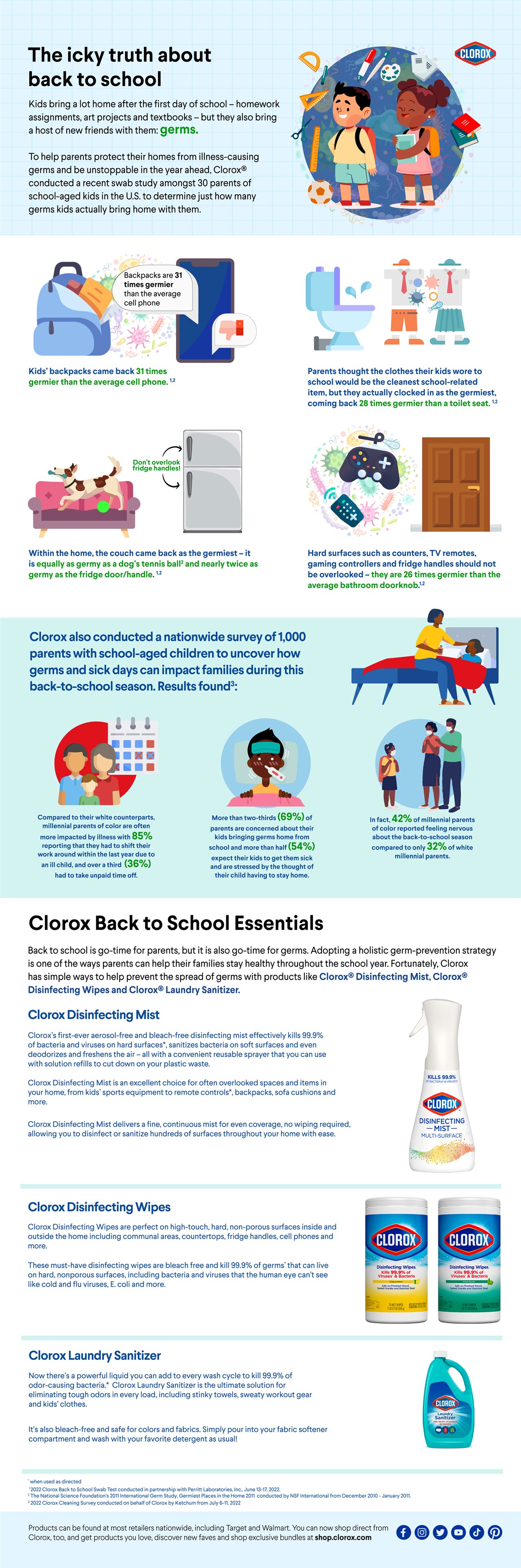
New Research Reveals The Germy Truth About Back-to-School [Infographic]

2022-09-15T07:31:00

(BPT) – To help parents protect their homes from illness-causing germs and prepare for an unstoppable school year, Clorox conducted a recent swab study with parents of school-aged kids to determine just how many germs are hitching a ride home with kids. And you may find the results surprising. Clorox knows that parents can’t afford to be slowed down by illnesses like the common cold and flu, and is dedicated to educating parents on the importance of a holistic germ prevention strategy in helping keep their families healthy in the year ahead.

3 reasons why young adults should invest in a life insurance policy

2022-09-15T12:59:00

(BPT) – Life insurance is for people of all ages, not just parents and grandparents. While life insurance needs vary by age and stage of life, it’s a good idea to invest in a life insurance plan while you’re young.

If you’re in your 20s and 30s, life insurance may not seem necessary, but it’s a useful tool to have at any age. Check out these three reasons provided by State Farm® why life insurance should be a priority for young adults.

1. The best time to get coverage

As a young adult, life insurance probably isn’t top of mind, but it’s the best time to get coverage. Since you’re young and likely healthy, you’ll typically qualify for more affordable premiums. Because you have a relatively long life expectancy, insurers see you as less risk than older individuals.

You don’t have to apply for an expensive, comprehensive policy. Start with a small policy in your 20s that fits your budget to build the foundation of your financial security. You can always expand your coverage throughout your life.

2. Planning life and expanding coverage

When you experience a life change, like marriage or kids, you should evaluate and expand your coverage as needed. By the time you’re in your 30s, you may have children and a mortgage or plan, which makes the financial protection offered by life insurance more important than ever. For example, life insurance coverage can help cover your children’s education costs if tragedy hits and you are no longer there to provide for them.

If you don’t have kids or a house payment but are planning on expanding your family or purchasing a home, don’t wait to bolster your coverage. Now is the time to make sure you are fully insured, as rates typically rise with age.

3. Security and peace of mind

It’s not pleasant to think about you or a family member passing. Still, should the unexpected happen, you’ll want to be covered. According to the Life Insurance Marketing and Research Association (LIMRA), too many families are at risk of financial insecurity should their primary wage earner pass away. In fact, the association found that 44% of U.S. households would feel financial hardships within six months of their primary wage earner’s passing.

A life insurance policy provides your family with security in the event of your passing and provides you with peace of mind knowing they’ll be covered after you’re gone. In addition to paying for college and providing income to your loved ones, it can help them cover funeral, burial and cremation costs. According to State Farm, the average funeral typically costs around $8,000, a hefty expense to try to cover when you’re already grieving the loss of a loved one. Final expense insurance (or burial insurance) can help relieve the financial impact of a funeral.

These are just three reasons why you should invest in a life insurance policy while you’re young and can qualify for lower premiums. If you want to protect your future now but have questions about what coverage you need and can afford, visit www.StateFarm.com or the State Farm app to talk with an insurance agent.

Working from home? This lifesaving upgrade protects you from fires

2022-09-15T08:55:00

(BPT) – Do you work from home? Did you know home fires can become deadly in just minutes? Your work building probably has a fire sprinkler system to help people escape safely and contain fires, but many residential homes do not have this important, life-saving feature.

This is even more concerning when you consider the numerous ways the American home is evolving. Not only are more people working remotely and therefore spending more time at home, but multigenerational households are increasing, meaning younger and older people who are more at risk during a fire are all living together.

What’s more, today’s homes feature open-concept designs and furnishings made from synthetic materials, which can be highly flammable. A fire can become deadly in less than two minutes, according to the Home Fire Sprinkler Coalition (HFSC), and synthetic materials burn quickly and produce deadly, poisonous smoke.

If you have smoke alarms and are working from home along with your family, only having two minutes to evacuate your home when you hear the alarm is challenging. This is made even more difficult if small children, elderly adults, and pets are in the home.

Smoke detectors versus fire sprinklers

Smoke detectors help save lives by producing an alarm when they sense smoke. These are an essential part of any home, and local building codes require them in every bedroom and living space. Smoke detectors are an important safety feature that help alert you to any type of smoke, whether that be overcooking something in the oven or an accidental home fire.

Fire sprinklers also help save lives but are different and provide a deeper level of protection from potentially deadly home fires. Unlike smoke detectors, fire sprinklers activate only when the surrounding temperatures reach a certain level, plus only the sprinkler closest to the fire will activate. Fire sprinklers are designed to contain the fire and limit the smoke produced, which allows occupants time to escape.

A fire sprinkler system can also help limit the damage from a fire. A home fire sprinkler flows 10-26 gallons of water per minute, according to HFSC, and the property loss in a sprinklered home fire is a small fraction of the typical loss in a home without sprinklers.

Adding a fire sprinkler to an existing home

Adding a fire sprinkler to a new home is as easy as asking your builder. However, if you live in an existing home, there are retrofit options. One that is gaining attention among homeowners for its flexibility is Uponor AquaSAFE™. This system uses crosslinked polyethylene (PEX) pipe to combine the fire sprinkler system with the home’s cold-water plumbing system.

Rather than a traditional standalone system that uses CVPC piping with separate plumbing, AquaSAFE systems require roughly half the fittings and connections. This means less time, less construction, and less cost. In a multipurpose AquaSAFE system, the sprinkler head is just another water-supply outlet, like a faucet or showerhead, which connects with the cold-water plumbing system to access fresh water. The benefit: As long as your home’s plumbing is functioning, you know the fire safety system is as well.

Flexible PEX piping makes it easier for contractors to install these systems into existing walls and ceilings, so there’s minimal impact to the home’s aesthetic and maximum protection from fires. Learn more at uponor.com.

Invest in safety features

As lifestyles are continuing to evolve and more people of different ages are living together as well as working remotely, homes are being used more frequently and in new ways. It’s important to not only consider functional upgrades, but safety features as well. A fire sprinkler system adds to your home’s value and may help you get a discount on your homeowner’s insurance, not to mention the most important benefit of all, the peace of mind that everyone in your home is safe.

Taking Charge of Your Care This Blood Cancer Awareness Month

2022-09-15T08:01:00

(BPT) – Being empowered often comes from being informed. And when it comes to diseases like blood cancer, having or not having information can make a significant difference in outcomes.

This Blood Cancer Awareness Month, Lorna Warwick, CEO of the Lymphoma Coalition, is on a mission: to prove how early and informed decision-making can help make all the difference.

“When a patient is diagnosed with cancer, it’s scary. Everything we know about cancer says that you should be afraid,” explains Warwick. “Coming in as a new patient, you’re trying to deal with that fear and cope with that fear, trying to understand all this new terminology, what’s happening to you. It’s a brand-new world.”

Getting educated is one of the best ways to cope with this new reality. Part of that is understanding not only who to talk to, but what to say. Statistically, more people are living with cancer today than ever before, thanks to new treatment options. But these new treatment options often only make it to a fraction of the patients who might benefit. This makes being informed about the latest research and innovations even more important. A better-informed patient can be a more active partner with their medical team in selecting the best treatment and care for their individual situation.

Christi Shaw, CEO of Kite, a Gilead Company, knows firsthand about the importance of being armed with the latest information when facing cancer either as a patient or as a caregiver. “I lost my mother and sister to cancer. My mother died of breast cancer and at the time we were told there was nothing more we could do. We learned later that she could have received a therapy that may have helped her live longer. When my sister was diagnosed with multiple myeloma, an aggressive form of blood cancer, we did our research. She ultimately utilized several new treatment options and ended up enrolling in a clinical trial to give her the best chance possible.”

In the case of lymphoma, organizations like the Lymphoma Coalition report that patients often don’t learn important information like the specific subtype of their blood cancer. As a result, they’re not being referred to specialists with enough time to build the best treatment plan.

The Lymphoma Coalition has set out to change this and has built an international lymphoma patient charter that outlines patient rights, which include timely investigation and accurate diagnosis by a qualified medical expert with a specialty in blood diseases, and referral to a specialist for their particular subtype of cancer. Getting to a specialist that sees only a specific type of cancer on a regular basis will help patients learn of and have access to new innovations more quickly.

“It’s critical that patients and their caregivers have accurate information and access to resources to do their own research and learn about different treatment options,” continues Shaw. “This will help empower patients to take charge of their cancer care as a partner with their physician and medical team and know the right questions to ask.”

In large B-cell lymphoma, for example, about 40% of people will not respond to initial treatment. Their disease will progress, and they’ll need more treatment. Giving yourself the best chance might mean already having a plan in place before you need it. According to Warwick, “When cancer progresses, you have to make treatment decisions more rapidly than most people want to. Quick but informed is key — if you’ve already asked your medical team questions like ‘Is this an option for me? I’ve heard about this. What do you think? Where would it fit into my treatment plan?’ Then you can feel more secure in your decisions.”

It also allows for access to treatments that might require travel to a larger hospital or additional referrals without losing important time. In the case of treatment with an innovative therapy known as CAR T-cell therapy, Lymphoma Coalition research found that patients would have liked to have known about the therapy earlier.

“Having cancer is scary, and we can’t take away that fear altogether, but many people have less fear of the unknown if they are armed with information earlier,” says Warwick. “Like anything else in life, the better prepared you are, the more confident you feel.”

For more information on treatment options, resources for proactively creating a treatment plan with your healthcare team, and how to contact a lymphoma patient organization in your area, visit lymphomacoalition.org.

Did you know cars actually drive on three tires?

2022-09-15T08:01:00

(BPT) – Did you know that cars actually ride on three tires?

No, this isn’t an article about tricycles. It’s about a major misconception that takes place where the rubber meets the road. Most drivers have no idea that there are three kinds of tires — and what they don’t know might be hurting them.

It’s vital that drivers understand all three tire varieties, so they can choose the right fit for their weather and lifestyles. With that in mind, here’s a helpful overview of all three: all-season, winter and a hybrid of the two — all-weather tires.

The tires everyone knows

Look beneath your vehicle. Chances are you’re driving a set of all-season tires. They’re the most common tire produced and driven in North America, and they’re likely what comes on your new car from the dealership.

Their name — “all-season” — might lead drivers to believe they’re built for all weather conditions. Surprisingly, they aren’t! All-season tires are typically produced with durability in mind. That means they have harder rubber compounds that help them last a bit longer. Unfortunately, those hard compounds become even harder — and way less effective — once temperatures drop below 45 degrees Fahrenheit (7 degrees Celsius). Think of it like driving on hockey pucks — they won’t grip, and will slide on cold or slick surfaces.

All-season tires are a great solution for drivers who live in places where winter weather rarely visits. Drivers in the Sun Belt can often get away with using them year-round, and they’re a great solution for those who only use them in spring and summer, then switch to winter tires in the frigid months. But don’t be fooled by their name — in many areas of North America, all-season tires are more like three-season tires.

A four-season solution

If all-season tires aren’t intended for use in all four seasons, then what is? Nokian Tyres invented the first all-weather passenger tire two decades ago. The name is similar, but the function is different: an all-weather tire is an upgrade for drivers who visit winter, or see winter visit them.

Unlike its all-season counterparts, all-weather products are certified for use in winter weather. That certification is called the three-peak mountain snowflake, and drivers can find it on the sidewall of all-weather and winter tires. At the same time, they’re still intended to be a true four-season option with good performance in rain and heat. One example, the Nokian Tyres WR G4, has a soft yet durable compound with an asymmetrical pattern with one side built for winter and the other for summer.

All-weather tires aren’t supposed to replace a winter tire for drivers who live in strong winter conditions. Rather, they represent an upgrade for drivers who plan to use one set all year long and need winter protection — for example, people who live in temperate climates but drive north or to areas of high elevation. Those who live in southern locales may use them as protection against the half-dozen snowy or slushy days each year.

True north demands a true winter tire

For ultimate winter safety, nothing beats a dedicated winter tire. While all-weather tires are a clear upgrade over all-season, winter tires are the only tires designed to deal with severe snow and ice. Drivers who see regular winter conditions should remove their all-season tires when temperatures fall below 45 degrees Fahrenheit (7 degrees Celsius).

Why? Because winter tires have much softer compounds that retain grip in frigid temps, as well as tread patterns that are geared toward maintaining traction on slick surfaces. As the inventor of the winter tire, Nokian Tyres tests its products north of the Arctic Circle to ensure they’re helping drivers thrive in harsh winter conditions.

Winter tires are only meant for winter, though — those soft compounds deteriorate in sustained heat.

It may be surprising that there are three types of tires, but it’s valuable knowledge for staying safe on the road. To learn more about all-season, all-weather and winter tires, drivers can visit NokianTires.com/ShopTalk.

Understanding Triple-Negative Breast Cancer (TNBC): What Every Woman Should Know

2022-09-14T11:01:00

(BPT) – We often talk about breast cancer as if it is one disease. “Yeah, she had breast cancer,” or “she had a lump removed.” Even, “she has breast cancer. She’s going through chemo.”

But all breast cancers may not be the same. And chances are good that unless you or someone you are close to has been impacted directly, you may not know that.

Most breast cancers are defined by the presence of certain cancer cell receptors – specifically, hormone receptors called estrogen and progesterone receptors and a protein called human epidermal growth factor 2 (HER2). Knowing which receptors are present helps a doctor choose a treatment that a cancer type is most likely to respond to.

About 10-15% of all breast cancers, however, have little to no presence of any of these three receptors. In fact, they’re so named: “triple-negative” (TNBC), for the absence of all three.

Triple-negative breast cancers tend to spread faster than other breast cancers, and because they don’t have the hormone receptors or HER2 protein, there are fewer medicines that work against them. This makes TNBC more aggressive than other invasive breast cancers.

“It’s triple-negative breast cancer” is often a much different diagnosis than “it’s breast cancer.”

Younger Women and People of Color Are Most Likely to Receive a TNBC Diagnosis

TNBC can take an especially hard toll. It affects younger women, before many have even started thinking seriously about mammograms or screenings. It is more likely to be diagnosed in women under 40 than most other types of breast cancer, and it is more common in Black and Hispanic women. To add to this, because it’s aggressive, it can become very serious very quickly. Once it spreads, only about 12% of women with metastatic disease survive 5 years.

Treatment Options For TNBC Are Expanding

For women who are facing an advanced TNBC diagnosis, it’s important to talk to the doctor about treatment options. Most patients with advanced or metastatic disease (TNBC that has spread) will receive chemotherapy, but many will progress at some point – even if the chemotherapy works initially. Until recently, there have been no other options after chemotherapy stops working. That is changing.

Trodelvy® (sacituzumab govitecan-hziy) is a different kind of medicine, called an antibody-drug conjugate (ADC), that is approved for adults with second-line and later metastatic TNBC (after two or more prior treatments, including one for metastatic disease). Trodelvy is indicated for TNBC (negative for estrogen and progesterone hormone receptors and HER2) that has spread to other parts of the body (metastatic) or cannot be removed by surgery, and who have received two or more prior treatments, including at least one treatment for metastatic disease. That means when chemotherapy stops working, people with metastatic TNBC have another option.

Please click to see Important Facts about Trodelvy, including Important Warning for low white blood cell count and diarrhea.

If you or someone you know has metastatic TNBC, speak with a doctor about potential therapies, including Trodelvy.

For more information, please visit https://www.trodelvy.com/.

IMPORTANT SAFETY INFORMATION

TRODELVY can cause serious side effects, including low white blood cell count and diarrhea:

  • Low white blood cell count (neutropenia) which is common and can sometimes be severe and lead to infections that can be life-threatening or cause death. Your healthcare provider should check your blood cell counts during treatment. If your white blood cell count is too low, your healthcare provider may need to lower your dose, give you a medicine to help prevent low blood cell count with future doses of TRODELVY, or in some cases may stop TRODELVY. Your healthcare provider may need to give you antibiotic medicines if you develop fever while your white blood cell count is low. Call your healthcare provider right away if you develop any of the following signs of infection: fever, chills, cough, shortness of breath, or burning or pain when you urinate.
  • Severe diarrhea. Diarrhea is common and can be severe. Your healthcare provider should monitor you for diarrhea and give you medicine as needed to help control it. If you lose too much body fluid (dehydration), your healthcare provider may need to give you fluids and electrolytes to replace body salts. If diarrhea happens later in your treatment, your healthcare provider may check you to see if it may be caused by an infection. Your healthcare provider may decrease your dose or stop TRODELVY if your diarrhea is severe and cannot be controlled with anti-diarrheal medicines.
    • Call your healthcare provider right away the first time that you get diarrhea during treatment with TRODELVY; if you have black or bloody stools; if you have symptoms of dehydration, such as lightheadedness, dizziness, or faintness; if you are unable to take fluids by mouth due to nausea or vomiting; or if you are not able to get your diarrhea under control within 24 hours.

Do not receive TRODELVY if you have had a severe allergic reaction to TRODELVY. Ask your healthcare provider if you are not sure.

Allergic and infusion-related reactions which can be serious and life-threatening. Tell your healthcare provider or nurse right away if you get any of the following symptoms during your infusion of TRODELVY or within 24 hours after: swelling of your face, lips, tongue, or throat; hives; skin rash, itching, or flushing of your skin; fever; difficulty breathing or wheezing; lightheadedness, dizziness, feeling faint, or pass out; or chills or shaking chills (rigors).

Nausea and vomiting are common with TRODELVY and can sometimes be severe. Before each dose of TRODELVY, you will receive medicines to help prevent nausea and vomiting along with medicines to take home with instructions about how to take them. Call your healthcare provider right away if you have nausea or vomiting that is not controlled with the medicines prescribed for you. Your healthcare provider may decide to decrease your dose or stop TRODELVY if your nausea and vomiting is severe and cannot be controlled with anti-nausea medicines.

Before receiving TRODELVY, tell your healthcare provider about all of your medical conditions, including if you:

  • have been told that you carry a gene for UGT1A1*28, which can increase your risk of getting side effects with TRODELVY, especially low white blood cell counts, with or without a fever, and low red blood cell counts.
  • have liver problems.
  • are pregnant or plan to become pregnant. TRODELVY can harm your unborn baby. Your healthcare provider should check to see if you are pregnant before you start receiving TRODELVY. TRODELVY may cause fertility problems in females, which could affect your ability to have a baby. Talk to your healthcare provider if fertility is a concern for you.
    • Females who can become pregnant should use effective birth control during treatment and for 6 months after your last dose of TRODELVY. Talk to your healthcare provider about birth control choices that may be right for you during this time.
    • Males with a female partner who can become pregnant should use effective birth control during treatment and for 3 months after your last dose of TRODELVY.
    • Tell your healthcare provider right away if you or your partner become pregnant during treatment with TRODELVY.
  • are breastfeeding or plan to breastfeed. It is not known if TRODELVY passes into your breastmilk and can harm your baby. Do not breastfeed during treatment and for 1 month after your last dose of TRODELVY.

Tell your healthcare provider about all the medicines you take, including prescription and over-the-counter medicines, vitamins, and herbal supplements. Certain medicines may affect the way TRODELVY works.

The most common side effects of TRODELVY include feeling tired or weak, hair loss, decreased red blood cell count, constipation, decreased appetite, rash, and stomach-area (abdominal) pain or discomfort.

These are not all of the possible side effects of TRODELVY. Call your doctor for medical advice about side effects. You may report side effects to FDA at 1-800-FDA-1088.

WHAT IS TRODELVY?

TRODELVY® (sacituzumab govitecan-hziy) is a prescription medicine used to treat adults with triple-negative breast cancer (negative for estrogen and progesterone hormone receptors and HER2) that has spread to other parts of the body (metastatic) or cannot be removed by surgery, and who have received two or more prior treatments, including at least one treatment for metastatic disease.

It is not known if TRODELVY is safe and effective in people with moderate or severe liver problems or in children.

Please click to see Important Facts about Trodelvy, including Important Warning.

A message from Gilead Sciences.

TRODELVY and GILEAD are trademarks of Gilead Sciences, Inc., or its related companies. All other marks are the property of their respective owners.

© 2022 Gilead Sciences, Inc. All rights reserved. US-TROC-0085 09/22

Nationwide Noise Increases Around Flight Troubles

2022-09-14T12:21:00

(BPT) – Over the past several weeks, media across the country continue to offer ample coverage of the ongoing difficulties of anyone attempting to travel by flight. The threat of delays and cancellations is always present for passengers, due to poor weather or other unforeseen circumstances that can throw a carefully timed departure and the following connections into chaos.

What often is unmentioned — and a critical pressure point for travelers — is the root cause behind travel difficulties. Sometimes the reason for a delay can be obvious, such as a colossal thunderstorm rolling through the area, but oftentimes it is hidden from the casual flier but more than apparent to the pilots and airlines who frequent the skies.

All too often, a flight not leaving on time is due to an aerial scheduling conflict. Particularly in Florida, where private jet travel receives a massive slice of the attention after skyrocketing in growth during the pandemic, with arrivals from across the country and, now that COVID-19 has abated, beyond. Over the past several years, Florida became the leading state for passengers able to fly on private aircraft, increasing by an astronomical 47 percent between 2020 and 2021, rising along with the growth and popularity of south Florida cities like Miami.

In between the mounting traffic from private flights, as well as Cape Canaveral maintaining and even building on its reputation as the location of choice for the private space industry, and volatile weather conditions during what the National Oceanic and Atmospheric Administration predicted is an “above average” hurricane season, management of limited space in the clouds is a pressing issue for commercial airlines.

The skies are regulated on a ‘fair and equitable’ basis, meaning that a scheduled commercial flight carrying dozens of passengers is not considered to be a higher priority than a private jet carrying a handful, leading to more delays. In addition, launches from the Cape can close a space covering hundreds of miles to shield flights from any falling debris from a multi-stage rocket or a rare failure, which, instead of falling harmlessly into the Atlantic Ocean, could hit aircraft. In short, potential fliers hoping to reach destinations along this stretch are facing heartburn unlike travel to anywhere else in the country.

The Federal Aviation Administration and the National Aeronautics and Space Administration, given the persistent level of coverage, could be investigating routes to alleviate the problem. However, in the meantime, outlets can cover the full scope of the issue facing travelers, especially those moving along these flight paths so consumers can plan their trips accordingly and remain aware of the underlying tie-ups beyond what is shown on the screen at their airport gate.

6 expert tips parents need to know when purchasing or upgrading a car seat

2022-09-14T13:45:00

(BPT) – Whether you’re already a parent or you’re expecting your first baby, you know how important child car seats are for safety. But like many parents, you may have questions about how to shop for the best car seat, ways to ensure your child’s seat is installed correctly or when to upgrade as your child grows. With Baby Safety Month (September) underway and Child Passenger Safety Week coming up (September 18-24), there’s no better time to reevaluate your family’s car seat needs based on the latest expert tips and product innovations.

A survey1 conducted by baby brand Chicco revealed that 42% of children spend four or more hours in their car seats in a typical week — a significant amount of time that proves the importance of car seat safety. To equip families with the latest knowledge on car seat use and features, Child Passenger Safety Technician at Chicco and father of three Josh Dilts is offering advice to help families keep their children safe and secure when in transit.

When starting to shop for your child’s first or next car seat, Dilts says, “Parents should prioritize these top features: child fit, vehicle fit, comfort and ease of installation.” His other tips:

1. Comfort matters

Comfort is vital for safety. An additional survey2 from Chicco revealed that 99% of parents said their child’s comfort is important when it comes to car seat safety, with 80% rating it as very or the most important.

“Comfort leads to good posture, which contributes to safety,” noted Dilts. “An uncomfortable child wiggles more, risking shifts or sliding down in the seat.”

2. Consider cleaner offerings

Another revealing insight in the survey showed that 94% of the parents said they’d pay more for products that reduce their child’s exposure to harmful chemicals, including 57% who said this was very important.

“Chicco offers a selection of car seats that are GREENGUARD Gold Certified for low chemical emissions, contributing to healthier air quality around your baby,” said Dilts. “Some top sellers are also now available with our innovative ClearTex® fabrics that have no added chemicals and are inherently fire-resistant.”

3. Don’t choose hand-me-downs

Car seats have expiration dates not just to ensure your car seat meets today’s safety standards, but also because plastic becomes brittle over time. This can compromise a car seat’s safety. Always check the expiration date to be sure it’s safe to use and ensure the seat has not been recalled by checking the NHTSA.gov/recalls website.

4. Check your child’s fit

When buying car seats, check the weight and height limits. Rear-facing infant car seats are required for newborns and young infants. It also helps to get a seat with an easy-to-install stand-alone base for the vehicle so you can easily click the car seat carrier in and out of the base and into a stroller to help transport your child to each destination.

One great option for infants is the Chicco KeyFit 35 ClearTex® car seat, a consumer favorite, featuring an easy-extend 5-position headrest system that easily adjusts for children up to 32 inches tall, allowing you to keep your little one in the same rear-facing car seat longer. For older children, the KidFit ClearTex® PLUS 2-in-1 Belt-Positioning Booster has an easy-adjust headrest that provides proper seat belt positioning.

“Another option for parents to consider is the Chicco OneFit ClearTex® All-in-One Car Seat, designed to fit from birth through booster,” said Dilts. “The space-saving design fits easily into your vehicle — it can fit three car seats across — and can accommodate tiny newborns, later transitioning from a rear-facing harness to a forward-facing harness, then to a booster.”

5. Don’t move to the next stage too soon

Parents often want to turn their child forward-facing when their baby’s legs touch the vehicle’s seat back. However, the American Academy of Pediatrics recommends waiting until your child reaches the maximum weight or height limits of the rear-facing car seat.

6. Install car seats correctly

Follow your car seat’s manual or online video instructions. Then see if your child’s car seat is installed correctly by doing the “inch test.”

“The ‘inch test’ is a crucial check to ensure your child’s car seat is installed securely,” Dilts said. “Place both hands at the car seat installation belt path and pull side-to-side and front-to-back. If the car seat moves more than one inch in any direction, uninstall the seat and start the process over again.”

The OneFit ClearTex® also comes with a QR code on the side of the seat that parents can scan and instantly have easy access to installation tutorials and digital resources.

Lastly, if additional assistance is needed, ask your local fire department, which will typically have a Child Passenger Safety Technician on hand that can check if your car seat is installed correctly.

For more on products and tips to help keep your child safe on the go, visit ChiccoUSA.com.

1Conducted in August 2021, Engine Insights collected data via a CARAVAN Parents Omnibus to obtain a national and statistically projectable sample, surveying 1,004 U.S. parents of children ages 0 to 8 living at home.

2Conducted in March 2022, Engine Insights collected data via a CARAVAN Parents Omnibus to obtain a national and statistically projectable sample, surveying 1,004 U.S. parents of children ages 0 to 8 living at home.

The leaves are falling, but your proactive health measures don’t have to—help protect yourself against pneumococcal pneumonia.

2022-09-14T07:01:00

(BPT) – There are many things to enjoy about fall. From cooler temperatures to the colors of the leaves, and all the fun activities that come with the changing of the season, it is the perfect time to enjoy the outdoors with friends and family. But along with the changing seasons and a slight chill in the air, come the looming days ahead of increased respiratory infections. This fall, don’t let pneumococcal pneumonia get in the way of taking in all the things this season has to offer.

Here are some fun, health-oriented activities to try this fall:

  • Take long walks outside: One of the best ways to stay active as the weather changes is taking a long walk to enjoy the fresh, crisp air.
  • Pick your own apples: Enjoy a healthy snack full of fiber and antioxidants by picking apples at a local apple orchard.
  • Hit the farmer’s market: Take advantage of fresh, organic fruits and veggies at your local farmer’s market, while supporting local businesses and farms.
  • Find out if you’re at risk for pneumococcal pneumonia and learn about vaccination to help prevent it.

Pneumococcal pneumonia can strike any time of year, and pneumococcal vaccination is available year-round. While you’re getting vaccinated against flu this season, don’t forget to ask your doctor or pharmacist about pneumococcal pneumonia vaccination. Even if you’ve already had a previous pneumonia vaccine, your healthcare provider may recommend it for additional protection.

What is pneumococcal pneumonia?

Pneumococcal pneumonia is a potentially serious bacterial lung disease that can disrupt your life for weeks. In severe cases, it can put you in the hospital and even be life-threatening.

Who is at risk?

The risk for pneumococcal pneumonia increases for adults 19 or older with certain chronic health conditions, including asthma, diabetes, COPD, and chronic heart disease, among others. People aged 65 or older are also at increased risk for pneumococcal pneumonia, even if they’re generally healthy, because the immune system weakens with age.

Talk to your doctor or pharmacist

No matter the season, it’s important to think about what you can do to help protect your health. Don’t wait — talk to a doctor or pharmacist about pneumococcal vaccination. To learn more about the disease, risks, symptoms and more, visit KnowPneumonia.com.

3 easy ways to make a positive impact on our food ecosystem

2022-09-14T11:01:00

(BPT) – Our ecosystem consists of many important elements, from plants to insects and animals to water sources. One of the crucial components of our food ecosystem are the honey bees, as they are responsible for the pollination of more than a third of the foods we eat, as well as the production of the honey we enjoy. Whether you’re a fearless foodie or just trying to prepare meals the whole family can enjoy, all of us can play a role in protecting honey bees and the beekeepers that care for them.

The National Honey Board is sharing easy ways everyone can do their part in supporting honey bees by incorporating all-natural honey into their day-to-day lives during National Honey Month this September and beyond:

1. Eat honey and pollinator foods all day long

As an all-natural sweetener, honey can transform and elevate any recipe, from a smoothie made with yogurt, honey and berries (which are pollinated by honey bees), salad dressings to top off your kale salad (also pollinated by honey bees!), to marinades for fish or chicken. There are so many ways to use honey in every meal of the day.

For the occasions you don’t have time to cook, you can still support honey bees by purchasing products that are made with honey, like foods, snacks and beverages from likeminded brands such as Justin’s, Mary’s Gone Crackers, TEAKOE, This Saves Lives, Sprecher Brewery and Tillamook Country Smoker.

2. Make your yard honey bee friendly

There are many easy ways to make your home a haven for honey bees. One easy way is to plant pollinator plants in your backyard — like lavender, poppies or other wildflowers common in your area. This will attract honey bees and keep your backyard looking beautiful. Additionally, DIY your own bee watering hole with a small pot filled with stones and water to help hydrate honey bees — they need water just like humans do!

3. Spread the buzz on supporting honey bees

It is never too early for someone to learn about how they can help support our planet, and make it fun at the same time! Host your own honey bee-themed party for National Honey Month and share with your friends and family all the benefits honey bees have in our lives. Incorporate honey-themed and sustainable décor, like beeswax candles, or create a signature drink that incorporates honey for your guests to enjoy. Lastly, send them home with some sweet honey-infused treats so they can continue supporting pollinators from the comfort of their own home. All of this will sure make for a meaningful and purposeful soiree.

By incorporating these tips into your daily routines, people from all over can help to support these mighty pollinators. The National Honey Board is initiating “Honey Saves Hives,an educational program aimed to bring awareness to the importance of honey bees and their crucial role in the ecosystem at large and global food supply. Consider partaking in these small but mighty initiatives to help support the bees, and as a result, our planet.