Drone as a Service Bridges the Tech Gap in Local Communities

2026-08-05T08:01:00

(BPT) – Drones have come a long way from capturing scenic photos and videos. Today’s models fly farther and longer, carry heavy payloads, and can be equipped with LiDAR, multispectral, and thermal sensors that gather rich datasets in a single pass. They can uncover the precise data stakeholders need to support infrastructure projects at every step, from land-boundary detection and cadastral surveys to environmental monitoring and terrain modelling.

This flexibility, durability, and accuracy are fueling a drone service market that Fortune Business Insights projects will reach USD 261.32 billion by 2034. Deloitte’s State of Digital Adoption in Construction 2026 confirms the trend: 34% of surveyed companies already use drones, with another 32% planning to add them soon. Drones are here to stay. The real question is who gets to use them.

Autonomous Drones Bring Big Promises and Real Barriers

Drone hardware has been improving year after year, but the true novelty with the next generation of Unmanned Aerial Vehicles (UAV) is autonomy. AI-powered drones can now fly pre-programmed routes guided by GPS waypoints and onboard AI, capturing consistent and comparable data without a pilot steering every movement by hand. This is ideal for tracking construction progress, monitoring erosion, or spotting infrastructure changes week over week. Computer-vision systems help drones navigate complex environments, avoid obstacles, and automatically flag what matters inside enormous datasets: a cracked weld, a hot spot on a solar array, a shifting slope.

Yet as drones grow more capable, access to them is still limited for most organizations. Large enterprises, major cities, and federal agencies can afford to build drone programs in-house. For municipalities, counties, and smaller businesses, adoption is much harder: the aircraft itself, the certified pilots, the regulatory approvals, and the expertise to turn raw flight data into usable insight can all feel out of reach, especially for organizations in rural or geographically isolated areas with limited resources.

Global Tech Meets Local Expertise

Drone as a service drone flying over construction site.

End-to-end models like Drone as a Service exist to close that gap. A subsidiary of Nasdaq-listed technology company ZenaTech, Inc., Drone as a Service gives businesses and government buyers direct access to AI-powered drones for construction, urban planning, and public works, without the headaches that usually come with technology adoption. It’s a flexible, pay-per-use or subscription model that provides the hardware, the trained and certified pilots, and the AI software to collect and analyze data accurately. Every mission is flown by a licensed pilot using a registered aircraft and backed by a network of experienced land-survey professionals. With 25 locations across the United States, Canada, and Europe, Drone as a Service stays rooted in local communities to better support businesses, municipalities, and public agencies.

Drones equipped with LiDAR, multispectral, and thermal sensors, GPS tracking, and high-definition imaging change the traditional equation. Drone-based surveys can cut survey times by 80% while improving data quality. Construction teams can monitor progress more frequently and move faster through permitting; urban planners can gather large-scale geographic data far more efficiently; and municipalities can strengthen public safety, infrastructure inspection, and environmental monitoring. As a result, businesses and local governments can save costs while taking people out of dangerous inspection scenarios altogether, and supporting communities with flood, wildfire, and storm damage assessments or search-and-rescue missions.

Every region brings its own terrain, regulations, environmental conditions, and infrastructure needs, and situations where speed is critical — severe weather damage, wildfire assessments, search and rescue — call for local teams already on the ground. Over the past year, Drone as a Service has acquired and integrated 25 land-surveying firms across the United States, Canada, and Europe, many with decades of experience and deep knowledge of their local markets. That means clients work with professionals who already understand regional permitting, zoning, environmental risk, and infrastructure priorities, while gaining access to high-performing aerial intelligence. Additionally, maintaining unified standards ensures consistent safety practices, data quality, and service delivery everywhere the network operates.

The Future of Community-Based Aerial Intelligence

As construction, urban planning, and public works are hit by a new wave of innovation, local communities can’t afford to be left behind. Small businesses, municipalities and counties have a real role to play in making sure they benefit from autonomous drone technology. By combining advanced aerial intelligence with local knowledge and scalable operations, networks like Drone as a Service are redefining what drone adoption can look like for communities across the United States, Canada, and Europe.

“We built Drone as a Service to address the many barriers to drone adoption we’ve seen across the industries we serve. If implementing drone technology can be challenging for large multinational corporations and federal agencies, you can imagine how difficult it can be for municipalities, counties or small businesses,” said ZenaTech CEO Shaun Passley, Ph.D. “Our goal is to build a large global network powered by drone technology, the incredible local expertise of our surveying professionals, and community connections. Over the next few years, we aim to make drone technology far more accessible to both government and private organizations, regardless of their size, location, or resources.”

Learn how aerial intelligence can support your organization and your community at DroneAsAService.com.

Don’t take your car battery for granted this summer and beyond

2026-08-04T10:01:00

(BPT) – Nearly one in four vehicles on the road today needs a new battery — most without warning signs of upcoming failure.

Extreme summer heat can quietly weaken your car’s battery long before you notice any issues, putting today’s vehicles at increasing risk. And the 12-volt battery in every vehicle, full electric, gas and hybrid, meets more power demands than ever before.

Many drivers associate cold temperatures with dead batteries, but summer heat has a large impact on battery health. Hot temperatures can cause internal battery components to break down, shortening the battery life, according to experts at Clarios, the Wisconsin-based maker of one out of every three car batteries worldwide.

Today’s vehicles are essentially rolling advanced computers, which rely on the 12-volt battery to power them. Two decades ago, a luxury vehicle might have a simple computer system, power windows and a few electronic modules. Nowadays, most vehicles have more than 50 electronic control units to run large infotainment screens, advanced driver assist technologies and multiple cameras.

All this computing power makes the summer heat even harsher on a car battery.

To help drivers keep up with the growing demands on today’s vehicles, Clarios battery experts offer four simple tips to avoid heat-related battery issues:

  1. PARK SMART: Park in the shade to reduce heat exposure
  1. CHECK SECURITY: Ensure your battery is securely mounted
  1. WATCH FOR DAMAGE: Inspect for bloating or leakage
  1. CHOOSE THE RIGHT BATTERY: Consider whether your battery is designed to handle higher temperatures and increasing electrical demands. Options such as AGM batteries are well-suited for more demanding conditions

An AGM (“Absorbent Glass Mat”) battery holds electrolytes in glass mats. In traditional “flooded” batteries (EFB) the electrolytes move around freely in a casing, while AGM technology is spill-proof and maintenance-free. This design can offer advantages as vehicles place higher demands on battery performance, particularly in more extreme conditions such as heat, and are ideal for vehicles with higher electrical demands, frequent short trips or idling, harsh environments and start-stop technology.

Battery maintenance tips

As vehicles integrate more electronic features and power-hungry functions, the role of the 12-volt battery continues to expand. The requirements for a traditional car battery have evolved beyond starting the vehicle to support safety critical and convenience features including advanced driver assistance systems. The low-voltage battery provides reliable and dependable power, protecting against failures that could put occupants at risk.

Clarios experts recommend not running accessories with the engine off and avoiding short trips whenever possible. Additionally, drivers need to heed dashboard warning signs. Yet even without obvious signs of battery degradation, vehicle owners should seek a professional battery test if their battery is more than three years old. One easy thing to do is make sure you mark your calendar when you get a new battery.

Selecting the right battery and proper maintenance can make for a summer of fun without worrying about diminished vehicle performance or worse, a dead battery somewhere down the road.

For more battery tips and informative videos, visit AutoBatteries.com.

Crayola Makes 2026 the Most Colorful (& Washable) School Year Yet

2026-08-04T09:01:00

(BPT) – Back-to-school season is buzzing with possibility. New backpacks, fresh supplies, colorful moments — and for parents and teachers, a long to-do list and rising costs. That’s where Crayola, the #1 brand preferred by parents and teachers*, steps in.

The Freedom to Create Without Limits

Crayola Ultra-Clean Washable Markers give kids — and parents — permission to create with confidence. Proven across hundreds of washability tests to clean easily from hands, clothes, desks, and painted walls, these nontoxic markers deliver vibrant color for everything from coloring books to school projects. Perfect for bold, colorful learning at home and in the classroom — with cleanup you can trust.

Crayola ultra clean broadline and fine line markers on a colored paper background.

Innovative Clicks

Beyond washability, there’s another frustration that derails creativity: lost caps, dried-out markers, and endless sharpening. Crayola Clicks solve these obstacles with retractable design.

Clicks Colored Pencils need zero sharpening with 2.0mm retractable lead with 24 refills included. Clicks Markers feature retractable tips so there are no caps to lose and no markers drying out by tomorrow. Clicks Highlighters deliver smooth, consistent color that washes easily from skin and clothing. Available in Classic, Bold & Bright, New Pastel, and New Neon.

Empowering Essentials for All Students

Did you know that 5.1 boxes of Crayola Crayons sell every second during back-to-school season? They’re the 13th fastest-selling item at retailers — sandwiched between bananas and water on the essentials list.**

From endless creative possibilities at home to classroom masterpieces, 24-count Crayons deliver primary and secondary colors, plus the beloved Dandelion yellow, permanently restored by popular demand.

And when the whole class is ready to create, Crayola has teachers covered. To help educators ensure they have plenty of tools for all the kids in their classrooms this fall and throughout the year, consider gifting one of these class packs of essential school supplies like Crayons, Colored Pencils, and Markers.

Bulk sets ensure that more students will be set for creativity during the entire school year, making them a top choice for teachers setting up classrooms, community donation drives, whole group activities, and collaborative projects that put every student’s imagination to work.

Ready to get the new school year started? You can find all these back-to-school necessities, plus plenty more supplies to fuel your kids’ creativity at Crayola.com and retailers nationwide.

*Source: TeacherList.com (Sept. 2025)

**Source: Numerator TruView// USA Retail (Jul. 2025)

Why More Homeowners are Making the Switch to Composite Decking

2026-08-04T07:01:00

(BPT) – For decades, building a backyard deck meant choosing wood and accepting the ongoing upkeep that came with it. Today, homeowners want more from their outdoor living spaces: the timeless beauty of wood paired with easy maintenance and lasting durability. Engineered to overcome many of wood’s drawbacks, composite decking delivers that combination, making it an increasingly popular choice for outdoor spaces designed to look great and perform for years to come.

Here are five reasons more homeowners are making the switch from wood to composite decking:

  1. Less maintenance, more enjoyment. People want outdoor spaces they can enjoy without adding more chores to their weekend to-do list. Traditional wood decking requires ongoing maintenance, including regular staining and sealing, to help preserve its appearance. Composite decking eliminates those recurring tasks. With no need to sand, stain or seal the boards, homeowners can spend less time maintaining their decks and more time enjoying them.
  2. Built to handle the elements. Decks face year-round exposure to sun, rain, snow and changing temperatures. Those conditions can take a toll on traditional wood, leading to problems like rot, warping and splintering. Composite decking is engineered for lasting performance, helping decks withstand harsh weather and everyday wear with less risk of deterioration over time.
  3. Engineered for beauty and performance. Today’s composite decking looks more like natural wood than ever while delivering performance wood can’t match. Realistic woodgrain patterns, rich colors and natural-looking variations capture the warmth and character of wood with the durability and low-maintenance benefits of a modern material. Recent innovations have also addressed common outdoor concerns, including heat-mitigating technology that helps keep boards cooler during peak sun and heat. Together, these advances give homeowners more freedom to create an outdoor space without sacrificing style or performance.
  4. A smarter choice for the environment. More homeowners are considering the environmental impact of the materials they choose. Composite decking reduces demand for virgin timber by using recycled and reclaimed materials. Trex decking, for example, is made from 95% recycled and reclaimed materials, including reclaimed wood and recycled plastic film, helping give new life to materials that might otherwise end up in landfills.
  5. An investment that pays off over time. While wood may have a lower upfront cost, ongoing maintenance, repairs and eventual board replacement can add up over time. Composite decking’s durability and low-maintenance performance make it a smart investment for homeowners planning for the years ahead. Long-term warranties of up to 50 years or more offer another layer of confidence in that investment, giving homeowners added peace of mind that their outdoor space will stand the test of time.

Ready to explore your options? Visit Trex.com to learn more about composite decking or take the Trex Deck Match Quiz to discover the best options for your home.

5 ways to help kids adjust to the new school year

2026-08-03T09:01:00

(BPT) – As backpacks get packed, homework returns and family schedules fill up, many parents and caregivers assume the hardest part of back-to-school season is the initial reentry.

But for many children, the real adjustment happens in the weeks after school begins.

New teachers, academic expectations, social dynamics, extracurricular activities and changing routines can create stress that isn’t always obvious. While some children openly talk about their worries, others show signs through changes in behavior, sleep, mood or motivation.

“Many families focus on getting through the first day of school, but the real adjustment often happens over the following weeks,” said Dr. Sascha Arbouet, child/adolescent psychiatrist and Medical Director, Pediatrics at Bend Health, a national provider of pediatric mental health care. “Children aren’t just adjusting to being back in the classroom. They’re taking on new teachers, new routines, new classmates, new expectations and often a full schedule of extracurricular activities. That’s a lot for any child to process. While the start of the school year is often exciting, it can also be mentally and emotionally exhausting. Paying attention to changes in mood, sleep, behavior or school avoidance can help families identify concerns early.”

Parents and caregivers can play an important role in helping children navigate the transition and build confidence as the school year gets underway.

1. Ask intentional questions

Many children struggle to answer broad questions like, “How was school today?”

Instead, try asking more specific questions:

  • What was the best part of your day?
  • What felt challenging?
  • Who did you spend time with today?
  • Is there anything you’re worried about this week?

Small, consistent conversations can help children feel comfortable sharing concerns before they become bigger issues.

2. Watch for changes in behavior

School-related stress doesn’t always sound like, “I’m scared.”

Children may become more irritable, withdrawn, emotional, tired or resistant to school routines. Others may seem less interested in activities they typically enjoy.

Some sadness that summer is over, irritability from feeling exhausted or anxiety about a new routine is completely normal during the first few weeks of school. What becomes more concerning is when those reactions are persistent or begin interfering with everyday life. If a child doesn’t want to go to school several days each week, consistently struggles to sleep or eat, or their mood or behavior continues to worsen instead of improving, it may be time to seek additional support.

3. Prioritize sleep and routines

One of the simplest ways to support children’s mental health is maintaining consistent routines.

Regular sleep schedules, predictable mornings and structured after-school routines help children feel more secure during periods of change. Sleep plays an important role in emotional regulation, attention, learning and overall well-being.

Caregivers should also be mindful of overscheduling. Sports, clubs and extracurricular activities can be valuable, but children also need time to recharge.

4. Stay connected with teachers and other trusted adults

Families don’t have to navigate school transitions alone.

Teachers, school counselors, coaches and other trusted adults can often provide valuable insight into how a child is adjusting. Open communication between home and school can help identify concerns early and create a stronger support system around the child.

This can be especially helpful for children with ADHD, anxiety, autism, learning differences or other behavioral health needs.

5. Know when to seek help

Some adjustment challenges improve naturally as children settle into new routines. Others may persist or worsen over time.

Parents and caregivers should consider seeking professional support if anxiety, mood changes, behavioral challenges, school avoidance or emotional distress begin interfering with daily life, friendships, family relationships, sleep or academic performance.

“The earlier we identify concerns, the easier it is to provide support before small challenges become bigger obstacles,” said Arbouet. “Parents and caregivers know their children best. If something feels different or concerning, it’s worth paying attention to.”

Bend Health provides virtual mental health care, coaching, psychiatry and caregiver support for children, teens and young adults. By working with young people and their families, Bend helps build practical skills that support emotional well-being throughout the school year and beyond.

For more information, visit www.BendHealth.com.

Back-to-school made easier: 5 benefits of shelf-stable milk

2026-08-03T09:01:00

(BPT) – The back-to-school season is officially here! This time of year is full of shopping and planning to make the first day of school — and the rest that follow — easier on you and your kids. One way to simplify your school-day prep and upgrade your kid’s lunch is by picking up a few cartons of shelf-stable milk at the grocery store.

By using a combination of ultra high temperature (UHT) treatment and sterile aseptic packaging, dairy milk becomes shelf-stable without additives or preservatives. That means it can be stored at room temperature for six months or more when unopened.

Read on to discover five reasons why shelf-stable milk is a total game-changer for your family this school year.

Eliminates the need for ice packs

Have you ever started to pack your kid’s lunch only to discover you didn’t freeze the ice packs the night before? Now you have to choose between sending your child to school with a less nutritious drink or rolling the dice with milk — hoping it stays cold until lunchtime.

With shelf-stable milk, you can kiss those worries goodbye. That’s because shelf-stable milk cartons don’t require refrigeration. You can toss one straight into your kid’s lunchbox, so they never miss their favorite drink. Also, shelf-stable milk cartons are perfect for playdates, road trips and weekend sports!

Encourages recycling

Teaching the next generation to go green can start at home and in the cafeteria. Shelf-stable milk packaged in recyclable containers like Tetra Pak® aseptic cartons provides an opportunity for kids to start recycling. By encouraging this small daily habit, your family can help the planet in a big way.

Cuts back on food waste

Shelf-stable milk is a great way to reduce food waste! Because Tetra Pak aseptic cartons provide six layers of protection, the dairy milk inside is safe from light, oxygen, bacteria and moisture.

These cartons make it possible to safely transport and store perishable food and beverages, even with limited cold storage. That means kids don’t have to toss out milk that’s been sitting unrefrigerated in the classroom before lunchtime, decreasing food waste, minimizing environmental impact and protecting your budget.

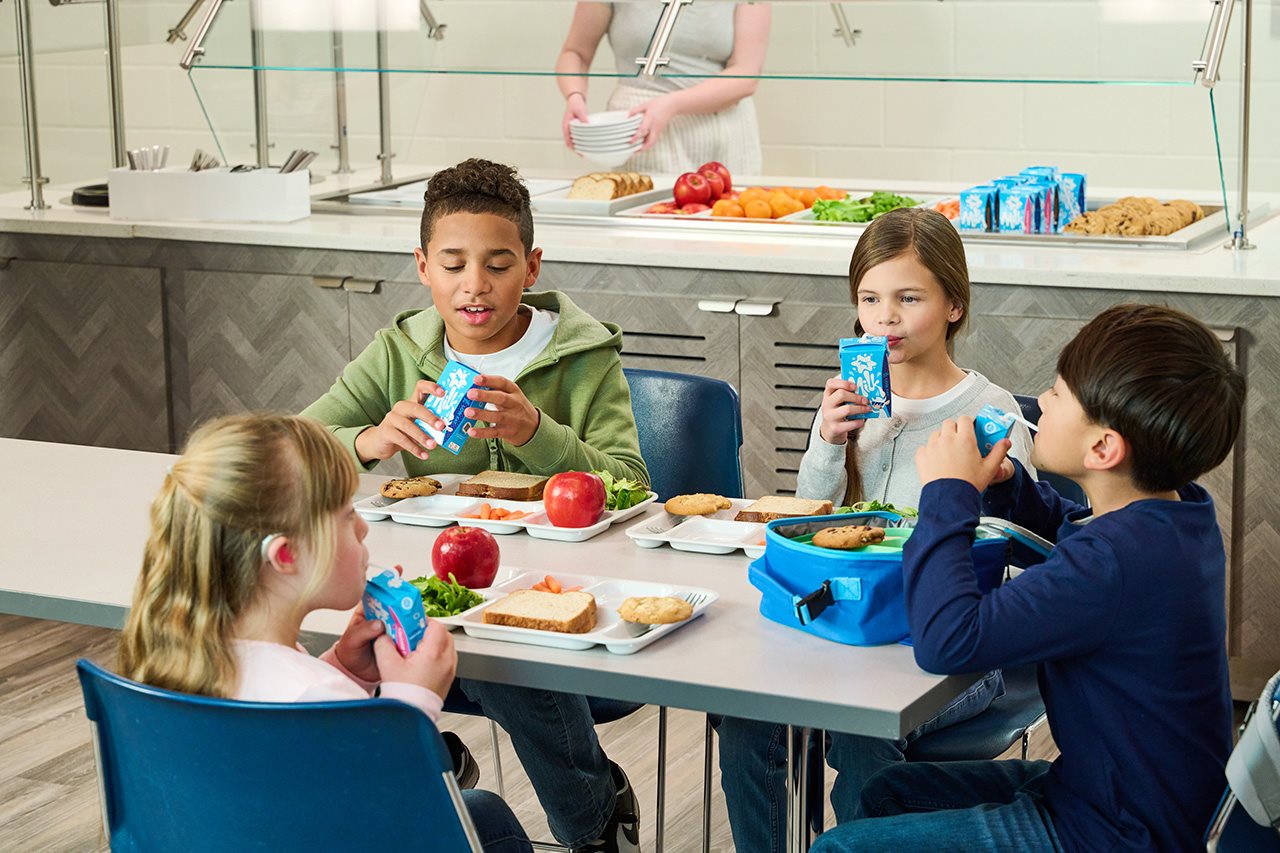
Four children sit at a lunch table, drinking milk with their lunch.


Provides several dietary options

Every child is unique, and so are their dietary needs. Thankfully, shelf-stable milk comes in a variety of formulations, including lactose-free options to suit practically every dietary preference. Now you can rest easy knowing your child can have milk without a tummy ache.

Preserves without preservatives

Because of the UHT method used to create shelf-stable milk, you can make sure your child has consistent access to delicious, nutrient-rich dairy milk without any added preservatives or artificial additives. It’s the same wholesome, nutritious milk you love, just packaged smarter to suit modern families and busy lifestyles.

Get ready for the back-to-school season with these five tips. While you do your weekly grocery shopping, visit the baking or breakfast aisle to find and stock up on shelf-stable milk, so you’ll be ready for the first day of school and the year ahead. Plus, you can use them this summer, no matter where your warm-weather activities take you.

To learn more about the benefits of shelf-stable milk, visit TetraPak.com/EN-US/SchoolMilk.

Why ‘Artemis Fowl’ is the perfect summer read for the whole family

2026-07-31T12:01:01

(BPT) – Artemis Fowl is back! It’s been twenty-five years since the twelve-year-old criminal mastermind captured the imagination of kids. Now, longtime millennial fans and families new to the series can delve into Eoin Colfer’s wild, chaotic and fantastical world.

From villain to antihero

When Artemis Fowl first hit bookshelves in 2001, children’s literature was overrun with earnest, wide-eyed protagonists destined to save the world, no matter the personal cost. But saving the world is the last thing on Artemis’s mind.

Armed with a super-genius intellect, high-tech gadgets, a sharp designer suit and iconic sunglasses, Artemis begins the series as somewhat of a villain. He enjoys tricking humans and fairies alike and is determined to restore his family’s stolen fortune through heists, mind games and advanced technology that walks the line between science and magic.

Throughout the series, readers embark on Artemis’s journey of self-discovery and growth, as he accidentally grows a conscience, strikes up an unlikely friendship with Holly Short, a fairy captain in the elite LEPrecon unit, and resolves conflicts between humans and fairies, with global ramifications.

Even though twenty-five years have passed, Artemis fits right into the modern literary landscape that is rife with complex antiheroes. Ahead of his time in the Y2K era, the cheeky, sly, and light-fingered twelve-year-old with a penchant for organizing Bond-esque heists and holding tech-savvy fairies captive is now more relevant than ever.

Artemis Fowl also asks fans tough questions that are as important now as they were when the book was first published. Is there such a thing as good versus evil? Can humans and fairies coexist? What makes a family? These questions and more will puzzle and delight readers, giving families plenty of compelling topics to explore together.

A new look for fans past and present

To celebrate a quarter century of Colfer’s tech-forward fairy world, fans of all ages can enjoy Artemis’s antics with two new, nostalgic editions of the novel.

Middle-schoolers (and their parents) can pick up a copy of Artemis Fowl 25th Anniversary Edition. This gorgeous paperback features the original iconic gold-and-holographic cover, updated with intricate blue-and-gold sprayed edges. It’s a must-have for any family library, whether readers are meeting Artemis Fowl for the first time or getting reacquainted with their old friend who is far too clever for his own good.

null

Die-hard fans can join in on the fun by adding the Artemis Fowl Deluxe Collector’s Edition to their shelves. This beautiful hardcover book comes complete with a foiled slipcase, ribbon bookmark, and foiled cover showcasing Artemis in his infamous sunglasses. This stunning edition is a delightful reason to revisit the magic, mischief, and wit of the series.

null


A familiar story for parents, an exciting read for a new generation

Whether you grew up deciphering the Gnommish language at the bottom of the book’s pages or you’re just stepping into Haven City for the first time, Artemis Fowl is ready to prove that a villain with a heart of gold (and a pot of fairy gold) can capture imaginations of all ages. Visit Books.Disney.com to preorder and discover (or rediscover) the magic.