How to lighten the back-to-school burden

2025-08-19T11:35:01

(BPT) – Your child’s backpack shouldn’t feel like a punishment. Yet for countless students across America, that daily trudge to school has become a literal pain in the back — and neck, and shoulders. What starts as minor discomfort can quickly escalate into serious musculoskeletal problems that interfere with learning, sports, and daily activities.

The American Academy of Orthopaedic Surgeons is stepping in with guidance to help parents and caregivers transform their child’s backpack from a source of pain into a tool that supports healthy posture and bone and joint development.

“Families everywhere take backpacks for granted as everyday gear needed for school, but they don’t often understand the burden they can place on the body and posture when they’re used incorrectly,” said pediatric orthopaedic surgeon Reid Boyce Nichols, MD, FAAOS. “A few simple steps can give you confidence that your child will be able to get through their school day without the pain or discomfort that incorrect use can cause.”

Here are tips to guide you and your kids when shopping for and using backpacks.

Shop with comfort in mind

The best-designed backpacks are effective at distributing weight so the body’s strongest muscles can carry it safely, without undue stress or strain. While kids may be focused on backpack colors and styles when shopping, parents and caregivers should consider:

  • Size: Is the backpack’s size appropriate for your child? If it looks too big, see if you can find a smaller one. Does it feel light when you pick it up?
  • Support: Well-designed backpacks should have two wide, padded shoulder straps and a padded back.
  • Extra features for heavy loads: This includes a waist strap, as well as wheels — a rolling backpack can make it much easier to handle heavy loads when needed.

Practice injury prevention

Whether it’s your child’s first year of school or their last, it’s never too late to start using best practices for health and safety.

“Teens and older students often resist advice about ‘how to wear a backpack,’ but the reality is they’re dealing with heavier course loads and fewer places to store supplies throughout the day,” said Dr. Nichols. “Once they understand that a few adjustments can prevent the nagging pain that interferes with everything from sitting in class to playing sports, most are willing to make the changes.” To help prevent injury, recommend and demonstrate the following practices:

  • Use both shoulder straps whenever you’re carrying a backpack, rather than carrying it on one shoulder.
  • Tighten the straps to keep the backpack’s load closer to the back.
  • Organize items strategically with heavier items low and toward the center of the backpack.
  • Pack light, removing items if they’re too heavy. Carry items only required for each day, and —
    • Leave unnecessary books at home or school
    • Choose a smaller water bottle
    • Bring sports gear in a separate bag that can be stored in a locker
  • Lift properly by bending at the knees when picking up a backpack.

Especially if a child has had previous discomfort using a backpack, consider using a cross-body bag as an alternative for carrying books and supplies.

Be proactive to prevent injury

When you’re getting ready for back-to-school season, watch your child put on and take off their fully loaded backpack to see if it’s a struggle. If the backpack seems too heavy, see if your child can remove any books and carry them in their arms to ease the load. Work with them to review the distribution of weight in their backpack, placing heavier items low and toward the center of the backpack. Beyond choosing a different backpack and practicing how to pack and wear it correctly, it may also be possible for your child to stop at their locker as time permits throughout the day to drop off or exchange heavier books.

Finally, make sure to pay attention to any signs of back pain in your child or teenager.

“Encourage your child or teen to tell you about back, neck, or shoulder pain they may be feeling during or after carrying their backpack,” added Dr. Nichols. “The presence of symptoms may indicate a poor backpack fit, or too much weight being carried.”

Learn more about backpack safety and back pain in children at OrthoInfo.org.

New study: Common misconception doubles crash risk

2025-08-19T12:17:00

(BPT) – A two-second glance away from the road doubles your crash risk, yet a new study from State Farm® shows that over 65% of drivers believe it’s safe to look away from the road for two seconds or longer. Even more concerning is the fact that reading or sending a quick text takes double that time, at an average of more than 4 seconds. How common are these seconds-long glances away from the road? The study found that 80% of drivers admit to engaging in at least one distracting behavior while driving.

In a recent study of over 1,300 survey participants aged 22-40, State Farm captured drivers’ attitudes and behaviors, revealing that nearly half (45%) have experienced a crash or near-miss while engaging in distracting activities behind the wheel.

The hidden danger of “quick” distractions

When reading or sending a text message while driving — which takes an average of 4.6 seconds — drivers travel the equivalent of a football field at 55 miles per hour with their eyes off the road.

“Many drivers underestimate the risk associated with even brief distractions,” said Brianne Jones, vice president of Operations, P&C Claims, State Farm. “These findings highlight a critical safety issue for every driver, passenger and pedestrian on and or adjacent to our roadways. Our goal is to raise awareness and encourage focused driving practices to lower accidents and create safer roads.”

Most common distracting behaviors

The most common distractions include:

  • Navigation and communication: 45% admitted to manually entering location data while driving
  • Music management: 44% scroll through playlists or manually search for music while driving
  • Texting: 39% read or send text messages while driving
  • Phone calls: 34% manually dial cell phones
  • App interaction: 28% interact with phone apps while driving
  • Email: 21% read or send emails while driving

Stress as a distraction trigger

The survey also identified specific triggers that increase distracted driving behavior. Feeling stressed or busy was linked to overall distraction behind the wheel. When drivers have items on their “to-do” list, 27% become more distracted. Additionally, 17% report that being upset or stressed leads to more dangerous behind-the-wheel behaviors.

Taking action during National Traffic Safety Awareness Month

August marks National Traffic Safety Awareness Month, making this an opportune time for drivers to reassess their habits. State Farm encourages motorists to:

  • Put phones in “Do Not Disturb” mode while driving
  • Set up navigation and music before starting the vehicle
  • Pull over safely if urgent communication is necessary
  • Recognize personal stress triggers that lead to distracted behaviors
Distracted Driving infographic that talks about what most drivers don't realize

State Farm also offers an opportunity for customers to save money with good driving through their Drive Safe & Save® program, with auto insurance discounts up to 30%*. State Farm customers are also eligible for a range of other Auto Insurance Discounts that can reward safe drivers and their families.

Embracing Organic Architecture to Create a More Beautiful Kitchen

2025-08-18T14:31:00

(BPT) – Today, kitchens that incorporate design elements from famed architects go far beyond the latest trends. They draw on key principles of balance, proportion and integrity to create spaces that feel luxurious and enduring. Every detail, from faucet finishes to cabinet silhouettes, plays an important role in shaping the overall space. Homeowners are seeking a mix of beauty and function, turning to the outdoors for inspiration.

Designing with structure in mind

Designers are inspired by architectural philosophies, coupled with cues from nature to create visually unique spaces. Geometric shapes and strategic focal points shape the kitchen’s experience, directing flow and rhythm. The Frank Lloyd Wright® Kitchen Collection by Brizo®, embodies these principles with its rounded and squared arch spouts, asymmetrical designs and clean lines, coupled with a wide choice of natural materials. Wood, glass, black onyx and concrete effortlessly combine to create a statement look.

Embracing unique materials

Emphasizing organic architecture demands quality materials to create cohesive, inviting kitchens that blend indoor and outdoor elegance. These elements serve not only as structural features, but as sources of inspiration that inform design choices around flooring, appliances and fixtures. By introducing expressive, tactile materials, designers are creating unexpected yet harmonious combinations, allowing the materials themselves to act as design features, rather than relying solely on added décor.

Taking the lead from architectural pioneers

Visionaries like Frank Lloyd Wright drew influence from nature, infusing design with simplicity, individuality and integrity. Today’s kitchens can echo this sentiment through the incorporation of finishes and accents in earth tones, warm golds, deep charcoals and soft metallics, creating warmth and authenticity. As kitchen design evolves, spaces designed with an eye for architecture provide a cohesive vision, narrating a story through shape, form and material.

These new spaces transcend mere utility, merging purpose with art and using layout, materials and natural palettes to define their essence. This is not just a passing trend; it’s a cultural shift reshaping kitchen and home design for the future.

44% of Americans say pumpkin spice now costs more — but they’re still buying: New study

2025-08-18T10:39:00

(BPT) – Pumpkin season is here and some are asking for a price check: 44% of Americans say tariffs and inflation are making pumpkin-flavored items cost more and the “pumpkin spice tax” or the premium price on seasonal items is real (39%), according to new Empower research. Still, more than half (54%) say they look forward to purchasing these specialties every season (62% younger generations). Millennials spend the most, averaging around $64 per month on pumpkin spice-flavored products during the fall, more than five times what Boomers spend at $12.

Pumpkin spice prices are on the rise

A third of Americans admit they’re willing to pay more for pumpkin spice-flavored versions of everyday products, and the appetite is even bigger among younger generations: 41% of Millennials and 39% of Gen Z say the seasonal spin is worth the splurge. In fact, nearly half of consumers say pumpkin spice gives products a more premium or exclusive vibe.

While Americans say they spend $32 per month on pumpkin spice-flavored items during the fall, the spending habits vary by generation:

  • Gen Z: $45
  • Millennials: $64
  • Gen X: $29
  • Boomers: $12

Why pumpkin spice is still brewing big

For some, pumpkin spice goes beyond flavor: 54% of Americans say buying these products is something they look forward to every fall. Close to half (47%) actively purchase pumpkin spice goods during the season, and among younger consumers, that jumps to 53%.

The excitement kicks off earlier and earlier, as 1 in 3 Americans (34%) say they start buying as soon as pumpkin spice products hit the shelves, often before the official end of the summer season. For Gen Z and Millennials, that number spikes to 45%. The pumpkin effect can be a differentiator: more than a third (35%) say they’re loyal to certain brands specifically because of their pumpkin spice offerings.

Still, not everyone is paying extra for pumpkin: 56% say they avoid seasonal markups, and 58% stick to a budget to avoid spending extra on seasonal flavors. Yet 48% of Gen Z admit they spend more on food and drinks in the fall because of pumpkin spice promotions (34% overall).

What’s getting the pumpkin treatment?

Americans are purchasing pumpkin products across a wide range of categories:

  • Baked goods – 40%
  • Coffee/beverages – 39%
  • Candies/snacks – 26%
  • Ice cream/dairy products – 24%
  • Accessories/decor – 23%
  • Breakfast foods – 22%
  • Personal care items – 16%

Younger generations in particular can’t get enough of their seasonal coffee: 51% of Gen Z and 47% of Millennials are sipping on pumpkin spice-flavored coffee. When it comes to motivation, 37% of Americans say they simply love the taste. Another 24% say the limited-time nature of pumpkin spice makes them more likely to buy.

Visit The Currency™ to read Empower’s full research report, “The Pumpkin Premium.”

Methodology:

Empower’s “The Pumpkin Premium” study is based on online survey responses from 2,200 Americans ages 18+ from Aug. 9-11, 2025. The survey is weighted to be nationally representative of U.S. adults.

5 simple shifts for a smooth school year

2025-08-18T11:51:00

(BPT) – Back-to-school season brings early mornings, new routines and plenty of moving parts, but a few simple shifts can make daily life feel a lot more manageable. Actress, cookbook author and busy mom Tiffani Thiessen shares her favorite ways to ease into the season with less stress and more intention.

1. Wardrobe hack

Designate Sunday evening as outfit prep time. Lay out five full outfits for each weekday on labeled hangers or in a divided drawer organizer. This removes daily indecision and morning stress, especially during the back-to-school rush.

Bonus: Get kids involved in the process so they can choose what they feel good in, which boosts confidence and independence.

2. Dedicated drop zone

Establish a clear and consistent landing spot near the door for daily essentials like backpacks, shoes, jackets and lunchboxes. Use bins, cubbies or hooks labeled with each family member’s name. Not only does this reduce clutter, but it also helps reinforce routines and build responsibility.

3. Pack ahead

Turn lunch prep into a shared evening activity. Involve kids in choosing and packing their own meals, giving them a few healthy and fun options to select from like fruit, sandwiches and snacks. This builds decision-making skills and ensures they’re more likely to actually eat what’s packed.

Use bento-style containers to keep everything neat and visible, and store lunchboxes in the fridge overnight so they’re ready to grab and go in the morning.

4. Talk it out

Create a simple daily ritual of checking in with the family by asking about the “highs and lows” of their day. This five-minute conversation opens the door for meaningful connection and allows kids to process emotions, celebrate wins, and discuss challenges. Make it part of the after-school routine, either during snack time or while preparing dinner.

5. Make tasty dinners a breeze

When it comes to dinner on busy nights, Thiessen turns to Fresh Express to get something fresh and flavorful on the table in minutes, like her go-to recipe for Farmhouse Ranch Chopped Salad Tostadas.

Fresh Express offers a convenient, restaurant-quality salad experience with chef-crafted blends that are ready to enjoy in minutes. From fresh blends to flavorful kits, the versatile salads from Fresh Express are your blank canvas to express yourself and celebrate individuality and spark creativity in the kitchen.

Farmhouse Ranch Chopped Salad Tostadas
Prep time: 30 minutes; Cook time: 45 minutes; Total time: 1 hour 15 minutes; Servings: 4

This recipe is bursting with flavor: smoky chili-lime chicken, golden crisp tostadas, melty cheese and a zesty corn and black bean medley crowned with a cool, creamy jalapeno ranch-dressed salad. Every bite is a balance of heat and crunch, spice and cream, boldness and comfort.

Ingredients

Chili Spice

  • 2 teaspoons ancho chili powder
  • 2 teaspoons smoked paprika
  • 2 teaspoons kosher salt
  • 1/2 teaspoon granulated garlic
  • 1/2 teaspoon light brown sugar
  • 1/2 teaspoon white pepper
  • 1/2 teaspoon ground cumin

Chili-Lime Chicken

  • 1 pound boneless, skinless chicken breast, at room temperature, pounded to 1/4-inch thick
  • 5 tablespoons extra-virgin olive oil, divided
  • 1 small lime, zested (save lime for juicing)
  • 1 garlic clove, grated
  • 2 tablespoons chili spice (see recipe above), divided

Jalapeno Ranch Dressing

Corn and Black Beans

  • 2 tablespoons extra-virgin olive oil
  • 1 1/2 cups (7 ounces) fresh corn kernels (from about 2 ears of corn)
  • 1 (15-ounce) can black beans, drained and rinsed
  • 1 teaspoon chili spice (see recipe above)
  • 1 small lime, juiced
  • Kosher salt, to taste

Tostadas

  • 4 (6-inch) corn tortillas
  • 1 cup neutral oil, such as vegetable or canola
  • 8 ounces shredded Oaxacan cheese
  • 1 1/2 teaspoons chili spice

Garnish:

  • Shaved radishes
  • Crumbled cotija cheese
  • Cilantro leaves with tender stems
  • Charred lime

Instructions

1. Arrange oven rack in middle position and preheat oven to 400F.

2. To make chili spice: Add all ingredients to small bowl and mix to combine. Set aside.

3. To make chicken: In shallow baking dish, whisk together 3 tablespoons of olive oil, lime zest and grated garlic.

4. Lay chicken breast into baking dish and coat both sides with oil. Season one side of breasts with 1 tablespoon chili spice. Flip and season the opposite side with remaining 1 tablespoon. Set aside to marinate at room temperature 10 minutes.

5. To make jalapeno ranch dressing: Heat medium cast-iron skillet over medium-high heat. Add jalapeno and char 8-10 minutes, turning occasionally to ensure skin is blackened and flesh is softened. Remove from pan and place in bowl. Cover with plastic wrap to steam 5 minutes. Using paper towels or the back of a knife, scrape charred flesh off jalapenos. Discard skin and finely chop flesh. Add jalapeno to packaged ranch dressing and stir to combine. Set aside or refrigerate until ready to use.

6. For corn and black beans: Heat olive oil in same hot cast-iron skillet. Add corn and black beans and season with chili spice. Cook, stirring occasionally, 3-5 minutes until corn is slightly blistered. Remove from pan into a bowl. Squeeze fresh lime over top and toss to combine. Season with salt to taste. Set aside.

7. To cook chicken: Heat same cast-iron skillet over medium-high heat. Add remaining 2 tablespoons olive oil to coat bottom of pan. Add chicken and cook 3 minutes per side until internal temperature reads 165F. Remove from pan onto cutting board and roughly chop into bite-sized pieces. Set aside.

8. To make tostadas: Place cooling rack into baking sheet. In medium high-sided skillet, heat oil over medium heat until shimmering. In batches, fry one tostada 2 minutes per side until crispy. Remove to prepared cooling rack and immediately season with generous sprinkle of chili spice and pinch of salt. Repeat with remaining 3 tortillas. To each fried tortilla, add heaping 1/3 cup Oaxacan cheese and 1/4 cup corn and black beans. Divide chopped chicken among four tostadas and bake in oven on middle rack 4-5 minutes until cheese is melted. Remove from oven and set aside to cool slightly.

9. To assemble salad: Add Fresh Express Farmhouse Ranch salad greens into serving bowl. Drizzle jalapeno ranch dressing over salad and toss to combine. Top with sliced radish, cotija cheese and cilantro.

10. To serve, place tostada onto serving plate. Top with serving of Farmhouse Ranch Chopped Salad and finish with a squeeze of charred lime.

Thanks to these tips and this crowd-pleasing recipe, your family will get off to a great start this school year. Visit FreshExpress.com for more school night meal ideas and recipes.

Discover Michigan’s innovative investments in aerospace and defense

2025-08-18T06:01:00

(BPT) – The U.S. aerospace and defense industries are showing strong growth and staying power. According to a market report by Mordor Intelligence, the aerospace and defense market has a current estimated value of over $525 billion in 2025. It’s expected to continue growing at a compound annual rate of 5.76% through 2030, reaching almost $695 billion.

While many regions in the U.S. are contributing to market growth, one state stands out as an industry leader in the aerospace and defense space: Michigan, driven by its Office of Defense and Aerospace Innovation (ODAI). ODAI supports a defense industry that contributes $30 billion in economic activity for the state, with more than 166,000 jobs and nearly 5,000 Michigan businesses serving the defense, defense aerospace and homeland security industries.

How The Great Lakes State leads the way

Michigan has emerged as a national leader in aerospace and defense, leveraging its industrial legacy and innovation ecosystem. To accelerate this momentum, the state launched the ODAI in 2024, building on the foundation of the Michigan Defense Center. ODAI’s mission is to catalyze growth within the state’s defense and aerospace sectors while advancing innovation and research opportunities that benefit Michigan.

The state is home to over 900 aerospace-related companies and seven Federal Aviation Administration UAS Test Sites. Combined, the aerospace and defense industries contribute a staggering $30 billion to Michigan’s economy and provide more than 166,000 jobs in defense, aerospace and homeland security.

In the early years of World War II, President Franklin D. Roosevelt called on Americans to step up as the “arsenal of democracy” in support of the Allied powers, and Detroit answered the call. Since then, Michigan has built on its WWII legacy and reimagined the Arsenal of Democracy as the Arsenal of Innovation, the place where history is made and records are broken. For example, Selfridge Air National Guard Base will be home to one of the newest aircraft in the U.S. Air Force, the F-15EX. This and other advances in defense make Michigan uniquely positioned to help the U.S. remain at the forefront of innovation and defense.

The state plans to further bolster its economic and technological presence in these industries through the Michigan Advanced Air Mobility (AAM) Initiative. This strategic approach to AAM includes the development of an integrated manufacturing and innovative ecosystem. Thanks to the initiative’s AAM Activation Fund, four new projects will receive over $4.1 million in total funding to scale Michigan’s AAM research and infrastructure.

A robust foundation and state-funded initiatives have helped Michigan draw the attention of several aerospace and defense companies, making key industry investments across the state. For example, AJG Aerospace — a local Michigan startup — is investing over $33 million to produce aerospace Invar bond tools, aluminum vacuum fixtures, carbon fiber bond tools, carbon fiber flight parts, aluminum flight parts and carbon fiber structural parts.

Great Lakes Sound & Vibration, another Michigan-based company, is combining the strengths of both industries. The company announced an $8.5 million expansion at its airpark facility. This key investment aims to support additional growth for projects with the U.S. Army, U.S. Navy, U.S. Marine Corps and U.S. Air Force in addition to contractors that build tanks, trucks, ships and aircraft for the U.S. Department of Defense.

An innovative competition takes to the skies

This year, the inaugural Uncrewed Triple Challenge took place across Michigan’s Alpena Harbor, Thunder Bay and ended at Camp Grayling. This first-of-its-kind competition showcased autonomous innovation across land, air and water and brought together uncrewed ground vehicles (UGVs), aerial drones (UAVs) and maritime systems for a live demonstration of next-gen mobility and defense applications.

Participants — which included Mythos AI, SiFly and DataSpeed — were challenged to transport packages across Michigan using unmanned systems without any human intervention. Not only did this event show promising industry innovations, but one company broke a world record.

SiFly’s electric Q12 drone more than doubled the world record for the longest continuous drone payload flight. The multirotor drone carried a 10-pound payload along the 26-mile flight segment without battery swaps or connection loss, even while navigating wind gusts up to 32 mph.

Become part of the future of Michigan’s aerospace and defense sectors

These are just a few examples of why Michigan is at the forefront of the aerospace and defense industries. To learn more about Michigan’s ecosystem and what it has to offer, visit MichiganBusiness.org/Industries/Defense.

Entering kindergarten with confidence is just as important as knowing the ABCs

2025-08-18T08:01:00

(BPT) – In today’s fast-paced, technology-driven world, it’s more important than ever for children to build durable skills — creativity, social skills and emotional skills, for example — starting from an early age. In fact, new research from the Modern Family Index (MFI), commissioned by Bright Horizons and conducted by The Harris Poll, revealed that 73% of parents feel the rise of AI has made durable skills just as important as traditional academic skills like reading, writing and math.

Similarly, experts are recognizing this trend and increasingly advocating for play-based preschool experiences that focus on supporting the whole child and emphasize social and emotional development alongside academics. This means that the skills children need to be successful in kindergarten look a bit different than they have in the past.

What does school readiness look like today?

“School readiness” isn’t about memorizing facts from worksheets or apps. Among other skills, being prepared for success in school means children…

  • Adapt, learn from mistakes and keep trying after a setback
  • Are curious and creative problem-solvers
  • Recognize many letters, shapes and numbers
  • Engage and have fun with peers and friends
  • Use tools like scissors appropriately
  • With support, understand and manage emotions and behaviors
  • Understand and follow simple directions
  • Have a healthy self-concept and are developing confidence

The MFI also found that 71% of parents worry about properly preparing their children for kindergarten, while 80% wish they had resources and support to better understand how to support their children’s development.

“Parents today are navigating a rapidly changing world and want to do everything they can to set their children up for success,” said Rachel Robertson, Chief Academic Officer at Bright Horizons. “This research makes it clear that parents are looking to preschools not just for academics, but for support in building a variety of both social and emotional skills. High-quality early education that fosters curiosity, builds confidence and nurtures the whole child is what truly lays the foundation for kindergarten and beyond.”

What can parents do at home to foster these skills?

Robertson recommends the following tips for parents to help foster durable skills at home.

  • Provide plenty of opportunities to enjoy books — go to the library, read and invent stories together.
  • Allow time, space and encouragement for creative and imaginative play.
  • Ask ‘thinking’ questions: What do you think? How do you think that works? What are you planning?
  • Apply skills authentically: Look for shapes on a walk, practice counting when setting the table, find letters in the grocery store, label household items and problem-solve real issues like taking turns, sharing or cleaning up.
  • Encourage healthy risk-taking, even if that means making mistakes and trying again.
  • Play simple games that require concentrating, adapting in the moment and using working memory (e.g., Chutes and Ladders™, card and matching games, Simon Says).
  • Model and practice managing emotions, self-calming, taking others’ perspectives and empathy.
  • Allow their inquiries and interests to guide their learning. If they want to talk dinosaurs, help them research what they eat, find items that are the same length as their feet, explore their habitat and build a mini-replica, and provide materials that inspire dinosaur imaginary play.
  • Offer rich, diverse, meaningful and authentic opportunities to explore and discover the world, while recognizing that each child develops at their own pace.

Learn more

Visit www.brighthorizons.com for more information and resources to support healthy early childhood development.

An innovative way to make connections: Create a unique song

2025-08-15T11:29:01

(BPT) – In this era of instant communication and hyperconnected social media, you might think everyone feels connected to everyone else. Unfortunately, that’s not the case. According to a new global study from LG on social connection, 68% of people find it harder to make real friends, and 1/3 reported having one or fewer meaningful connections in the past month — with 8% experiencing none at all. In the survey, 9 in 10 respondents also believe meaningful connections lead to a more optimistic outlook on life.

It would appear that all that posting, scrolling and “liking” has little to do with real human connection. And human connection is vital to everyone’s happiness and well-being.

“One of the most reliable predictors of happiness is having deep and meaningful relationships. Yet today, many people are spending more time online and less time connecting in person,” said Jean M. Twenge, professor of Psychology at San Diego State University. “Social media in particular tends to create shallow relationships rather than the deep connections people need. It’s common for people to have hundreds of followers but no one to talk to in real life if they need support. We need to build more meaningful connections with those around us. That might turn around the pronounced decline in happiness that’s occurred over the last decade.”

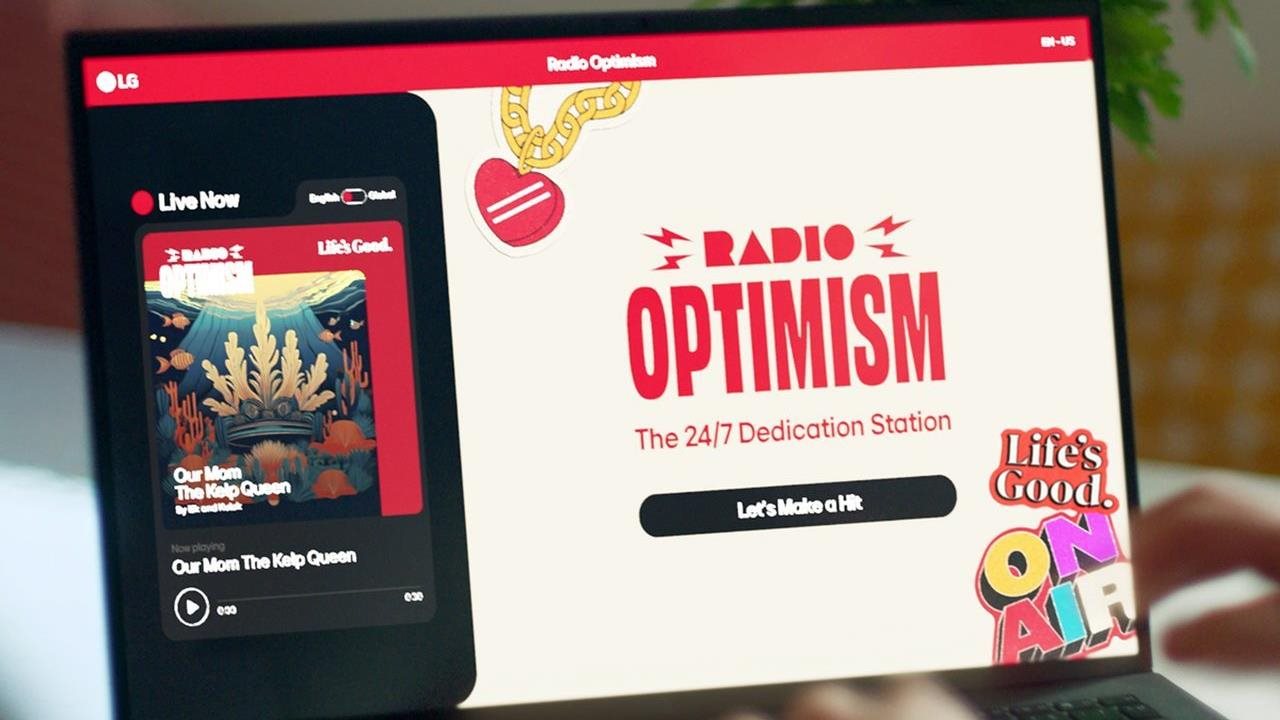
With the goal of building more meaningful connections, LG Electronics is leaning further into its “Life’s Good” philosophy with a new “Radio Optimism” campaign designed to help people everywhere foster deeper connections. Using technology with a creative, playful and positive spin, Radio Optimism uses the universal language of music to help people express friendship and love with the people they care about.

How Radio Optimism works

Inspired by traditional radio’s unique way of connecting people through music and storytelling, the Radio Optimism platform is an interactive platform where anyone can create and send personalized songs to loved ones — no musical background or songwriting experience required!

All it takes is a few taps. You step into Radio Optimism at RadioOptimism.LG.com, then tap “Let’s Make a Song” to join and begin your story. Choose your preferred language, then enter who the song is for and write a brief prompt about what you want to express to them. Next, you select a style for your song, ranging from R&B to punk and everything in between, followed by a “vibe,” be it romantic, moody, melodic or energetic. The Radio Optimism tool does the rest, writing a unique song in just minutes that you can share with your friend or loved one to bring a smile to their face and make a genuine connection with them.

Once generated, your songs can be sent to recipients to deepen your connection — and can even be made available for others to discover worldwide. This way of expressing feelings can help people enrich their lives, while spreading optimism in their own unique style. The website is free and currently available in English, Spanish, German, French, Korean and Portuguese, with plans to support additional languages in coming months to enable broader participation.

“As technology advances, meaningful human connections become increasingly vital to enrich our lives,” said Hyoeun Kim, head of LG’s Brand Management Division. “LG continues its commitment to bringing optimism into customers’ daily lives, staying true to our enduring brand promise of ‘Life’s Good.'”

Start creating your own meaningful songs for friends and family today at RadioOptimism.LG.com, and learn more about the campaign on LG.com/lifesgood.

Planning the ultimate deck party? 4 smart upgrades to create a standout entertaining space

2025-08-14T09:31:00

(BPT) – Backyard gatherings are more popular than ever. Millennials and Gen Z are leading the charge, and the numbers back it up — searches for “dinner parties” have surged by 148%, according to Evite. Translation? Home is the new hot spot, and your backyard is prime real estate.

But creating a standout space takes more than a grill and some string lights. Today’s best outdoor setups combine style, comfort and functionality, including built-in kitchens, smart tech features, efficient layouts and weather-ready details. The trick is to plan ahead. Knowing what you want from the start, whether it’s a place to unwind, entertain or both, makes it easier to bring your vision to life.

These four smart design moves will help you build a deck that’s made to host, no matter the season.

1. Maximize functionality with a multi-level design

Think beyond a single flat surface. A multi-level deck layout adds dimension, functionality and visual interest to your outdoor space — essentially doubling your usable square footage. Imagine dining or hosting guests on the upper level, while a shaded lounge, private spa retreat or media-ready hangout lives below.

Have a second-story deck? Installing a drainage system between the substructure and deck surface creates a watertight barrier that prevents rain from seeping through. This opens up endless possibilities for finished space underneath — whether you want to relax, entertain or stream the big game year-round.

Beautiful custom deck over a stone patio.

2. Design zones for every occasion

The most functional decks are laid out like open-concept interiors, with defined areas for dining, lounging and conversation. These distinct zones help guests move naturally while creating cozy, purposeful spaces. Place your outdoor dining table on the upper level and use the space below for casual seating or a tucked-away bar. Use rugs, sectional seating and ambient lighting to visually define each area, without obstructing views or disrupting flow.

Massive double deck with upstairs outdoor kitchen, dining area under gazebo, and open seating area. Downstairs deck has seating area, pool area, and storage area.

3. Power up entertainment features

Today’s outdoor spaces are tech-enabled with everything from TVs and speakers to heaters, fans and charging stations. However, all that functionality requires safe and dry infrastructure. This is where an “above-the-joist” deck drainage system, like Trex® RainEscape®, really pays off. Unlike other systems that install below the joists of the deck, RainEscape covers the entire substructure, allowing you to safely run electric, gas and data lines to support modern amenities like a media wall, smart kitchen or full sound system. Add Wi-Fi extenders and smart-home integration to keep the space fully connected and guest-ready.

Under desk living space with living room, fire place and TV

4. Build in smart storage

Even the most stylish decks need practical features. Built-in storage keeps essentials — like cushions, serving ware and party supplies — organized and out of sight, yet always close at hand. Use the protected area beneath your deck for cabinets, weatherproof bins or under-bench compartments. You’ll keep clutter at bay, while ensuring your space looks polished and feels ready for anything.

Second floor deck with a main floor storage shed

The best outdoor living spaces start with thoughtful planning. When you design with intention from the beginning, you create a versatile space that looks great, functions seamlessly and fits the way you live and entertain.

Discover how to bring your vision to life at TrexRainEscape.com.

Walk to build community for people with alopecia areata

2025-08-13T07:01:00

(BPT) – When Keira was diagnosed with alopecia areata at just 2 years old, her mother Leslie felt lost and unsure where to turn for support. “It was so isolating and lonely,” said Leslie. “I felt desperate for information and a community.”

As her daughter began attending school, the diagnosis affected Keira’s daily life in heartbreaking ways. One day, Keira told her mom, “Being the only bald kid at school is really hard.” This made Leslie more determined than ever to connect with other families who had children with alopecia.

Leslie’s search for community began with the National Alopecia Areata Foundation™ (NAAF™), which connects people living with alopecia areata, their families, caregivers and medical and scientific professionals. NAAF fosters community that drives research and treatment development, raises awareness to reduce stigma and provides support to improve lives.

Finding this community helped Leslie and Keira feel seen and connected. Leslie signed up for NAAF’s “You Are Not Alone” webinars and found a wealth of resources that helped ease their journey — including tools to help her approach Keira’s teacher, which encouraged the family to be open with the school community about her condition.

When Leslie learned about NAAF’s Walk For Alopecia™ in 2022, she created a “Walk Where You Are Team” in Minneapolis, inviting everyone who supported Keira to participate. The following year, Leslie upped her efforts with an official volunteer-led walk site inviting anyone in the Twin Cities to join.

“One of the most meaningful moments was when a man who lived with alopecia areata for over 50 years told me how healing it was to be there,” Leslie recalled. “I never imagined that by trying to build a community to support my daughter, I could help others, too.”

It’s not just hair

Alopecia areata is a common autoimmune skin disease, in which the body’s immune system mistakes healthy tissues as dangerous and begins attacking them. “Alopecia” means bald and “areata” means patchy. The disease causes hair loss on the scalp, face and sometimes other body areas, like under the arms or on the legs. People with alopecia areata most often lose hair in circular, coin-sized patches on the scalp, but in more severe cases they may lose all their hair.

Hair loss often first appears during childhood, but how and when is different for everyone.

The chronic and unpredictable nature of alopecia areata can cause profound psychological impact, including loss of self-identity, depression, withdrawal and even suicidal ideation. Although it is frequently dismissed as a cosmetic condition, alopecia areata can be a deeply traumatic experience, resulting in emotional and economic pain and social isolation.

About 2% of people worldwide and nearly 7 million Americans will experience alopecia areata at some point in their lifetime. People of all ages, genders and racial and ethnic groups are affected by alopecia areata. New FDA-approved treatments driven by NAAF and the alopecia areata community allow some people living with severe alopecia areata to safely and effectively regrow their hair, but more research is needed, and there are many potential new treatments in the drug development pipeline.

How you can make a difference

Through the Walk For Alopecia Presented by Pfizer, anyone anywhere can have a direct impact on alopecia areata treatment development, as well as helping to fund services and resources for people living with alopecia areata and their families. The Walk For Alopecia is the world’s largest alopecia areata awareness and fundraising campaign, acting as the finale of Alopecia Areata Awareness Month each September. The Walk brings the alopecia areata community together, empowering individuals, families and the public to advance the change they want to see by directly funding programs and research, while shining a light on a disease which often lives in the shadows.

“Participating in the Walk For Alopecia really helped us talk about alopecia to other people. I learned a lot, and it helped us feel less nervous about what Keira might experience in life,” Leslie said. “Now we feel so much more connected to everyone on the alopecia journey, and we know we are not alone!”

Ready to make a difference in a fun, active and meaningful way? Register today for the Third Annual Walk For Alopecia on Saturday, Sept. 27, at over 20 nationwide locations — or if there isn’t a walk near you, you can “Walk Where You Are” as an individual or team in your neighborhood to shine a bright light on alopecia areata. Visit NAAF.org/walk for information and to register.

About 2% of people worldwide and nearly 7 million Americans will experience alopecia areata at some point in their lifetime. [RB1] People of all ages, genders and racial and ethnic groups are affected by alopecia areata. New FDA-approved treatments driven by NAAF and the alopecia areata community allow some people living with severe alopecia areata to safely and effectively regrow their hair, but more research is needed, and there are many potential new treatments in the drug development pipeline.

How you can make a difference

Through the Walk For Alopecia Presented by Pfizer[JS2] , anyone anywhere can have a direct impact on alopecia areata treatment development, as well as helping to fund services and resources for people living with alopecia areata and their families. The Walk For Alopecia is the world’s largest alopecia areata awareness and fundraising campaign, acting as the finale of Alopecia Areata Awareness Month each September. The Walk brings the alopecia areata community together, empowering individuals, families and the public to advance the change they want to see by directly funding programs and research, while shining a light on a disease which often lives in the shadows.


[RB1]we need to adjust this to be consistent with what we say other places “nearly 7 million Americans are impacted” as the 700K number does not align with the 2% world pop stat–but the 7 million does.

another option would be just to remove the US stat and focus on the 2% worldwide

[JS2]@Robbie Baker Do we want to say “Presented by Pfizer” or no because that wasn’t listed as a benefit this year?