How to spot valuable financial information online [Infographic]

2022-07-19T08:01:00

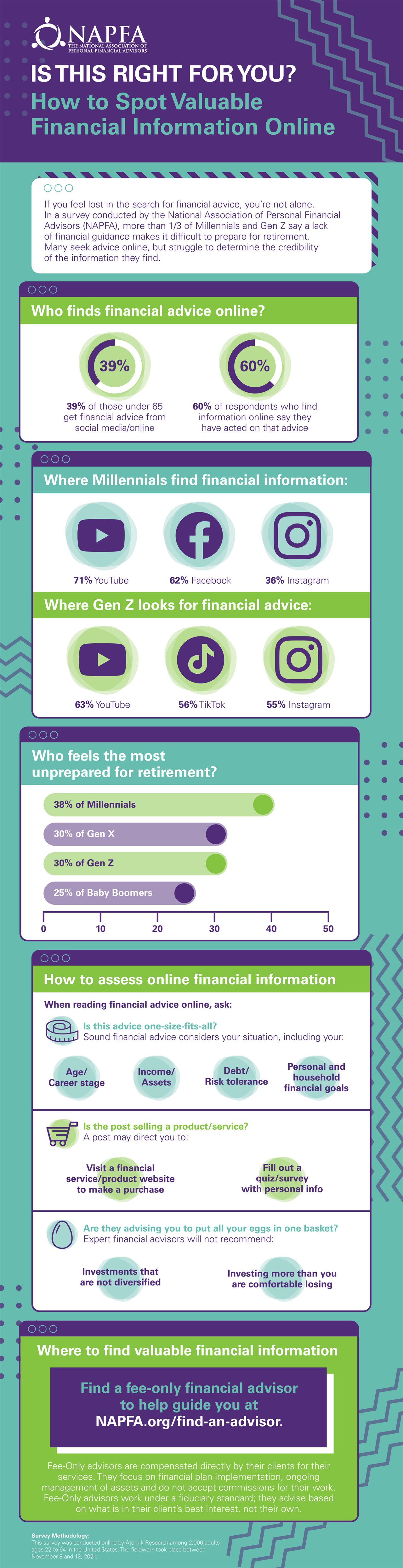
(BPT) – A survey released by NAPFA found that over one-third (34%) of Millennials and Generation Z Americans say that a lack of financial guidance is inhibiting to their ability to prepare for retirement. Millennials reported feeling the most unprepared when it comes to their futures (38%), with about 30% of Gen Z respondents feeling unprepared.

The survey results also show that more than one-third (39%) of Americans under 65 receive their financial advice online or from social media. Further, over one-fourth of Gen Z Americans receive their financial advice from social media. YouTube seems to be the most popular place for Gen Z (63%) and Millennials (71%) to discuss financial planning, while TikTok is gaining popularity with Gen Z (56%). More than 60% of the respondents who receive their information online say they have acted on that advice.

The survey was conducted online by Atomik Research among 2,006 adults ages 22 to 64 in the United States. The fieldwork took place between November 8 and 12, 2021.

Trust-based philanthropy has the power to transform how foundations fund nonprofits

2022-07-12T06:57:00

(BPT) – When nonprofits receive grants from foundations or funders, the application, rules and reporting process are often arduous. Historically, the power dynamic leans heavily toward those providing the money, and because nonprofits need funds to do the good work they do, they have no other choice than to go through each tedious, time-consuming step.

There are numerous problems that emerge from this traditional partnership. One key issue is nonprofits have to take time away from the work they do to manage the grant process, which means less time toward the mission itself. Another is that foundations typically have the ultimate say in what’s best for their community and people impacted because they determine what is funded or not.

“Why are foundations dictating what’s best for their communities when it’s the nonprofits that often have people on the ground and their finger on the pulse of what’s happening in their neighborhoods?” said Samantha Plotino, executive director of The Provident Bank Foundation in New Jersey.

Plotino is a thought leader in a small advisory committee of forward-thinking practitioners formed by the Council of New Jersey Grantmakers and the New Jersey Center for Nonprofits which is spearheading a unique initiative called “Doing Good Better: Amplifying and Deepening Philanthropic and Nonprofit Partnerships in NJ.” The goal is to reimagine how New Jersey nonprofits and philanthropy can work together more efficiently and foster better relationships.

“The purpose of the Doing Good Better initiative is to reimagine relationships among funders, nonprofits and government to create shared power rooted in collaboration, mutual trust and respect,” says Theresa Jacks, acting president and CEO of the Council of New Jersey Grantmakers.

“The Provident Bank Foundation has spent the last two years shifting our culture, structures and grantmaking practices in ways that rely on trust-based values,” Plotino said. “The backbone of this initiative has been the Trust-Based Philanthropy Project, which highlights recognizing the inherent power imbalance between foundations and nonprofits. We believe that philanthropy will be more successful, rewarding and effective if funders approach their grantee relationships from a place of trust, humility and transparency.”

“By listening to what nonprofits and their communities need to be most impactful, foundations can be truly supportive,” said Linda Czipo, president and CEO at the New Jersey Center for Nonprofits. “This is particularly important for smaller nonprofits or partners led by or serving people of color or other historically excluded communities.”

Bold foundations are learning from the actions in New Jersey and making their own changes. Plotino shares some strategies for implanting trust-based philanthropy for any funder interested throughout the U.S.:

Advisory group: Form a group of dedicated, passionate people who can work together to determine areas for improvement. Meet regularly and maintain ongoing communication to determine what works, what doesn’t and what can change. Solicit feedback and act on it.

Update applications: Nonprofits must apply for their grants through an application. This is an important process for funders to learn more about the nonprofit and its intentions for the funds. While an application is necessary, consider what is essential and what isn’t. By streamlining the application process and maintaining communication with applicants, you’ll help nonprofits save time and put their best foot forward.

Rethink reporting: Nonprofits want to share the good work they’ve done thanks to the generosity of funders, but required reporting is often difficult. Consider updating, cutting back or eliminating the reporting requirement. Evaluate the burden of having to track everything, and look for alternative ways to show accountability. Always strive to simplify and streamline paperwork.

Unrestricted funding: Remember the importance in investing in general overhead expenses. For example, it might seem obvious to fund food for a food pantry, but what about the cost of electricity to light and heat the space, cleaning supplies, administration, employee training and more? These overhead expenses are just as essential, but often don’t get the attention and funding they desperately need.

Ongoing support: Don’t stop the relationship with nonprofits once the check is written and the funds are distributed. Explore ways you can engage with nonprofits and provide additional support, such as professional counsel. Even a simple, friendly email to check in shows you care.

Changing the funder-nonprofit dynamic might seem overwhelming, which is why Plotino’s advice to others is: “Start small in adopting trust-based philanthropy. Make adjustments over time. Find a place to start that makes sense and then build on it. We all have the same goal, which is improving quality of life in our communities. Small steps can lead to big impact.”

Learn the basics about your credit score: 5 things to know

2022-07-11T18:09:00

(BPT) – Many people have financial goals – maybe it’s to get an education, buy a car, purchase a home, or start a business – that require access to credit. However, if you are new to credit, trying to build a credit history can be daunting. It helps to know the basics about the FICO® Score.

A FICO Score summarizes your credit report into a three-digit number. Credit reports are maintained by the three nationwide credit bureaus, Experian, Equifax and TransUnion. The score includes measures on how long you’ve had credit, how much credit you have, how much of your available credit is being used and if you’ve paid on time. It helps lenders determine how likely you are to repay a loan. This, in turn, affects how much you can borrow and how much it will cost (e.g., the interest rate).

“Knowing that access to credit is a key building block for economic inclusion and financial independence, FICO has been spearheading efforts to help more consumers gain access to credit, safely and responsibly,” said Sally Taylor, vice president and general manager of FICO Scores. “Before FICO, human bias could play a factor in the decision.”

But what if you are a young adult or immigrant with no credit score at all?

Lenders want to include new borrowers. To help support this, FICO and lenders are using alternative data and innovative credit scoring techniques, while ramping up consumer credit education efforts.

FICO introduced alternative scores such as UltraFICO Score, which enhances credit bureau data with data not typically found in traditional credit bureau files, such as balance information from your consumer permissioned checking account. The recently introduced FICO Score 10T taps into trended data – a deeper look at traditional credit bureau data, the use of trended data considers a historical view such as account balances for the previous 24-plus months, giving lenders more insight into how individuals are managing their credit.

People can also take steps to actively build their credit history. To help, here are five things to know if you are new to credit:

#1. Understand the basics about your score

Ninety percent of the top U.S. lenders use FICO Scores to help them make lending decisions. To get a score, you need at least one credit account opened for six months or more and at least one account that is reporting to the credit bureaus in the last six months (Those criteria can be met with the same account.).

If you have zero credit history, you can consider applying for a credit-builder loan or a secured credit card.

#2. Take advantage of new ways to establish credit

More lenders are using newer scores that tap into alternative data sources, such as telecom, utilities and checking account data. To help establish credit history, consider opportunities with reputable lenders and the credit bureaus to proactively share your personal, responsible financial information (such as on-time rent payments).

#3. Actively monitor your score

Research has shown that consumers who frequently check their credit score are more likely to have a higher overall score. There are several ways you can monitor your score. FICO works with over 200 institutions to provide FICO Scores free to consumers. You can check your monthly credit card statement, your online banking environment or go to myFICO.com to monitor your score.

#4. Demonstrate responsible borrowing and stay the course

Your FICO Score is dynamic; it changes with your credit behavior. Your score today doesn’t have to be your score tomorrow. Plan and stay the course with positive borrower behaviors that will be reflected in your credit file. Stay up to date on your bills, keep balances low and only apply for the credit you need.

#5. Empower yourself with knowledge

Understanding your credit score and how to manage it doesn’t have to be a mystery. There are many educational resources available, including free workshops supported by FICO where you can learn about your credit score directly from the experts. Visit www.scoreabetterfuture.com to learn more.

Whether your goal is purchasing your first home, going to college or financing a new car, it is helpful to envision a target credit score that allows you to achieve it. With that target in mind, and these tips and educational resources, you can start building a sustainable path toward a FICO Score that achieves your financial goal, regardless of your current credit experience.

Trust and community support are two reasons why Americans are shopping family-owned and local

2022-06-27T10:17:00

(BPT) – When you go shopping for a good or service you need, you have a choice. You can shop family-owned and -operated or you can shop franchises and corporations. People are realizing where they put their dollars counts and more are opting to shop local when possible because they trust family-owned and local businesses and they want to help support their communities.

In fact, 64% are likely to trust family-owned and -operated businesses, according to a study conducted by OnePoll on behalf of CG Roxane, a family-owned and -operated business. Among the reasons why respondents prefer family-owned and local businesses, 34% said better quality, 32% said transparency about sources and 31% said fewer middlemen.

Shopping family-owned and local to support communities

Today’s retail landscape often promotes online ordering and two-day delivery, yet people are starting to think about what really matters to them and opting to shop family-owned and local more frequently. The study found 35% of Americans have shopped family-owned in the last six months, and three in five believe that shopping locally helps their town. Respondents take the need of their community to heart, as 49% usually shop local for goods compared to mass retailers and online vendors. With so much going on in the world, supporting family-owned and local businesses and communities is one simple way to make a difference.

People will spend more for locally sourced goods

Shopping local is making a concise effort to support businesses that are close by or utilize nearby resources, with 35% of Americans citing “imported” and “internationally sourced” as red flags when it comes to purchasing goods. Roughly half of people typically shop at locally owned and operated businesses and 57% are even willing to spend more money on goods that are locally sourced. Crystal Geyser Alpine Spring Water is the only major U.S. bottled water that is captured directly at its seven natural springs across the United States. Consumer sentiment follows suit, with 60% of those surveyed being more likely to purchase bottled water if it is sourced from a natural spring source within their region versus trucked in from another part of the country. (Crystal Geyser Alpine Spring Water only bottles its spring water right at the spring source.)

This choice not only supports local communities and resources, but it is more sustainable and reduces carbon output, which is important as recycling initiatives and carbon footprint reduction represent 40% and 33% respectively of the eco-friendly business initiatives that are most important to Americans.

Family-owned and local businesses help communities thrive

With 39% of Americans citing it “helps my community” as a reason to support family-owned and local businesses, it is evident they are helping define towns and support economic growth. They also add to the community culture, with some participating in local events and programs that directly impact residents. When it comes to benefitting by way of scholarship, fundraisers or other events, over half of people in the study have benefited directly from this type of community involvement from local businesses, while 42% also know of someone else who benefitted.

“As a family-owned and -operated business, CG Roxane is proud to play a role in the well-being of our communities, in particular those surrounding its 10 facilities across the country,” said CG Roxane Office & Human Resources Manager Cindy Miller. “The lasting impact we are able to make on the lives of our community members is truly a blessing.”

Family-owned and -operated businesses are the heart of local communities. By showing your support and shopping local when possible, you’re spending your dollars in a manner that makes a difference and embraces your values.

Expert Series: Simple tips for small-business success in an evolving economic landscape

2022-06-27T07:01:00

(BPT) – By Aimee DiCicco, Sr. Vice President Revenue Operations and Business Development

Small businesses are a critical part of the United States’ economy, and their owners are truly living the American dream. Being your own boss is something most people have thought about, but it takes grit, determination and hard work to bring that vision to life and ultimately make it a success.

There are 31.7 million small businesses in America compared to 20,139 large businesses, according to the U.S. Small Business Administration. This equates to small businesses representing 99.9% of all U.S. firms, making them a powerful economic force that supports commerce and job creation. Small businesses are also an important part of our communities, helping make our neighborhoods and world a bit brighter.

At FedEx Office, we work with small-business owners every day and know the impact they make on the community and the drive it takes for them to do well. Often these owners wear multiple hats and work countless hours, and we recognize the hard work that goes into running these businesses.

That’s why we want to share some of the strategies small businesses across the country can use to save time and money, and how FedEx Office can help, serving as a one-stop shop with around-the-corner convenience.

1. Know and engage your customers

According to a Salesforce survey, 84% of customers say being treated like a person, not a number, is very important to winning their business. Target your customer marketing with personalized accounts and outreach that really makes an impact, such as mailers, brochures, electronic newsletters, email marketing and more.

Additionally, a human-to-human touch can deliver a big return for small-business owners looking to deepen relationships with their customers. For example, including a handwritten note in your orders and following up with first-time customers with a postcard are effective retention strategies. Other great occasions to reach out include a customer’s anniversary, birthday or during the holidays.

You can also create a customer loyalty and referral program. Your local FedEx Office team can help you design the perfect brand communication pieces including cards, flyers, postcards and more, and print them quickly so you can focus on what matters — engaging your customers. FedEx Office also offers graphic design services through Canva to allow small businesses to easily design and print the perfect materials for their business.

2. Streamline digital customer communication

Taking a look at the backend of your e-commerce site to see how customers are using your website while ensuring the site is resistant to system glitches helps optimize the customer experience and encourage return visits. If you’re tech savvy, you may be able to look at analytics yourself; otherwise, explore vendors that can help with that process by using visual analytics tools. You can use this information to help you position important elements on your website or print marketing to get more clicks and interest.

Social media platforms are another way to build a loyal customer base and convey your key messages. Make sure you are posting interesting and relevant content regularly to keep people engaged with your business. Posting regularly lets people know about sales, updated inventory and seasonal promotions.

Social media isn’t just for advertising; it’s a great way to interact with customers with polls, raffles and more. You should consider showing yourself and your employees in your posts also so customers can see the people that bring the business to life. It can also serve as a platform to encourage customers to sign up for direct mailers, brochures and other marketing materials. Remember to check comments so you can reply in a timely manner and manage your brand image.

3. Explore traditional marketing

Yes, having an optimized website and active social accounts is key for many small businesses to grow, but never overlook tried-and-true traditional strategies. For example, hanging flyers and handing out brochures is a low-cost way to promote your business (remember to ask permission before doing so in local facilities). FedEx Office helps you create and print professional business flyers, brochures and postcards for your business. Vibrant, attention-grabbing printed materials can help catch your target audience’s eye and promote sales, making them a worthwhile investment.

Banners are another smart investment that can be used over and over again, whether it’s at your physical location or traveling to trade shows, fairs, markets and more. The placement of your banner should help inform your design, color, material and message. When choosing colors, think about if it will clash or blend in with the background. For example, don’t choose a red background if you’ll be hanging your banner against a red brick wall. Additionally, take time to carefully consider your message. What action do you want people to take after seeing your banner? Now, how can you convey that action with a simple yet powerful message?

From printing and shipping to design consultation and much more, FedEx Office wants to help small businesses succeed. Learn more at FedEx.com.

Top 5 ways to secure employee devices while on vacation this summer

2022-06-21T07:01:00

(BPT) – While the rest of your friends are packing sunscreen, cold beverages and beach towels for that ocean getaway, don’t forget to pack some security punch into your summer vacation with best-in-class security tools and the world’s best open directory platform — JumpCloud.

As more employees are bringing work laptops or other devices along with them on summer vacation these days, it’s a good idea to keep security top of mind — along with the sunscreen — for protection while you’re enjoying fun in the sun.

For small to medium-sized enterprises (SMEs) especially, IT admins need all hands on deck when it comes to guarding against security breaches. Without big budgets or a large staff, IT admins at SMEs juggle multiple demands as the sole resource responsible for keeping the company operational — and its data secure.

Here are the top ways SMEs can help employees keep their devices secure, anywhere they go — but remember, these tips don’t prevent damage from sand or ocean waves!

1. Make sure everyone keeps business and personal devices separate

In a recent survey of IT admins conducted by JumpCloud, the majority of respondents (nearly 80%) said at least some employees at their organization use personal devices for work purposes. But personal devices can introduce unnecessary risk to any company, so it’s best to remind everyone how important it is to keep business and personal devices separate. Don’t conduct business or make network connections using personal devices — and don’t order beachside takeout on your company cell.

2. Give everyone a refresh on common threats

Employees on vacation need to know the dangers of using unsecured public Wi-Fi connections while away from home. Offer regular training on your organization’s best security practices and protocols when accessing your company’s network on any device. Provide frequent reminders and alerts about how to avoid common phishing scams, and the importance of promptly reporting lost or stolen devices. The upside? Employees will learn how to keep their personal information more secure, too! And that is a vacation bonus anywhere you travel.

3. Use a directory platform with comprehensive security solutions

To help you stay on track from wherever you’re working — or playing, the JumpCloud Directory Platform enables SMEs to adopt a zero-trust security posture by establishing trusted identities, trusted networks, trusted devices and conditional access control policies to manage how and what resources users can access.

JumpCloud provides an open unified platform for access, identity and device management for easy remote work management. Its entirely zero-touch onboarding process allows IT admins to onboard and offboard users and devices anywhere in the world with automated workflows in a single web console. Simply put, JumpCloud offers an open directory platform for secure, frictionless access from any device to any IT resource, anywhere — even when you’re relaxing on the beach.

4. Update to state-of-the-art security practices

Everyone loves the latest tech — but especially IT admins with security updates at the top of their to-do list. If you’re not using them already, take advantage of the latest technology to implement updated security practices such as multifactor authentication (MFA), biometric authentication and password managers — companywide. Knowing you’re using cutting-edge security will make it easier to sit back and enjoy your time off even more.

5. Use patch management

Patch management is essential for cyber defense, yet many organizations struggle with patching in their hybrid work environment — which is even tougher during summer months when more employees are out of office. Patch management from JumpCloud makes it easier for IT admins to deploy automated patch updates and strengthen overall security. IT admins can use patch management to manage Mac and Windows updates and patches from the JumpCloud console easily and quickly.

“Especially when employees are not only working remote but also on vacation, SMEs need to be able to manage a variety of identity and device environments — without adding friction to the user experience,” says Joel Rennich, head of device identity at JumpCloud. “Using a comprehensive directory solution is an effective way to meet these needs, wherever your employees are located.”

Before you pack your suitcase for your well-earned vacay, learn more about the latest security solutions at JumpCloud.com.

Tips to help small-business owners turn the summer slowdown into future success

2022-06-16T09:01:00

(BPT) – Many small businesses across the country have one thing in common: seasonal highs and lows. While it’s common for revenue to ebb and flow throughout the year, many businesses face a lull in the summer. Unfortunately, this seasonal slowdown may cause cashflow to decline.

This can be challenging for businesses, especially since summer is also the time to plan ahead, purchase inventory and supplies, and upgrade equipment in preparation for the holiday season, which is usually the most active part of their sales cycle — and one that often requires the most amount of capital.

“If you’re a small-business owner, especially in a business that sees seasonal ups and downs, it is critical to be thinking one step ahead. While summer slowdowns and the associated cash crunch can be daunting, it can also be an opportunity to think about what’s next,” said Bernardo Martinez, VP, Global Merchant Lending at PayPal.

From exploring new marketing tactics, to alternative lending solutions that allow you to invest in your success, here are some ideas to help you make the most of your summer downtime.

Idea 1: Understand your customers

As the pandemic shifted consumer behavior, many small businesses were forced to adapt and innovate (or create) their e-commerce platforms. Keep thinking of these types of pivots as part of an ongoing evolution of the business. Use time in the slower summer months to look at customer behaviors and identify trends that could lead to innovations. Have certain products gained or lost popularity? Are customers dropping off at a certain point in the sales funnel? Can you leverage market research and customer data to expand your online presence or target certain customers with marketing?

Understanding how your current customers are behaving may help you shape your future strategies. You might find that it makes more sense to invest in customer engagement by strengthening existing customer relationships, rather than trying to attract new ones. The need to evolve never stops, and you can use the extra time to better understand how your customers are engaging with your business.

Idea 2: Refresh marketing

Summer is also great time to take a second look at your marketing mix and plan ahead. See how strategic you can get with your email, newsletter and direct mail. Use the time to make a long-term marketing plan that helps get your business in front of your existing customers and find new ones. Focusing on gaining new subscribers could lead to more sales down the line, but keeping current customers engaged is just as important.

With more time during the summer, this might be the ideal season to start or post more frequently on your blog and social media channels, start an email newsletter or create holiday content in advance. Another idea: Maybe set up automations for when things get busy again. Summer may also bring opportunities to sponsor or involve yourself in community events to build your local clientele and goodwill.

Idea 3: Leverage small-business loans

Don’t let cashflow gaps keep you from moving your plans forward. Whether it’s kicking off a marketing plan or ordering inventory for the essential holiday season, you may need capital and flexibility to take action and position your business for future success.

“It is normal for small and mid-sized businesses to need access to capital to grow their business, and it is OK to seek financial help,” said Martinez. “Seasonal businesses especially need access to capital with flexible terms to offset their fluctuating cash flow.”

He points to recent PayPal research that found SMBs are seeing small-business loans in a new light. Many SMB owners (70%) surveyed say the pandemic reduced the perception that taking out a business loan was only for struggling business. Furthermore, SMB owners are realizing that accessing loans can help with growing their business (34%) and staying competitive (23%).1

Martinez points to two financing options in particular that may help seasonal small businesses, especially during the summer months:

PayPal Working Capital is a business loan primarily based on your PayPal account history. There’s no credit check when you apply, so there’s no effect on your credit score, and there’s one fixed fee. You can receive the funding in mere minutes if approved, and you pay back the loan automatically with a percentage of your sales that you choose when you apply. That means the higher your sales, the faster you repay. On days without sales, you won’t pay a thing, but you need to repay a minimum of 5% or 10%, depending on the estimated loan term, every 90 days to keep your loan in good standing.

PayPal Business Loans is a competitively priced, fixed-term loan based on an overall assessment of your business’s health. There are no late, early repayment or processing fees,2 and if approved, funds can be transferred into your PayPal Business account as fast as the next business day.3 You choose the loan amount and term that fits your business needs.

Although the summer months can be a struggle for many, the slowdown is normal. By using the downtime as an opportunity to reassess your business needs and plan ahead, you can set your business up for success when things pick up again.

Endnotes:

The lender for PayPal Business Loan and PayPal Working Capital is WebBank, Member FDIC.

1Wakefield research, commissioned by PayPal. August 26-September 7, 2021. An online survey conducted by Wakefield Research of 1,000 U.S. small-business owners (ages 18+), defined as businesses with 500 or fewer employees.

2In addition to the Total Loan Fee, the only other cost is a $20 Returned Item Fee that is only assessed if a payment is returned.

3The lender transfers funds as fast as the next business day for applications approved by 5pm ET on bank business days.

The content of this article is provided for informational purposes only. You should consider obtaining independent business, tax, financial, and/or legal advice before making any business decision.


How to improve cash flow for small businesses

2022-06-14T11:01:00

(BPT) – The last few years have been rocky times for the 32.5 million U.S. small businesses, according to the U.S. Small Business Administration (SBA). They have faced big challenges such as the COVID-19 pandemic, labor shortages and rising inflation. These firms, which account for 43.5% of gross domestic product, are also facing a lending crunch. The Associated Press reported in April that banks have been less generous with loans. In 2019, about 50% of businesses received the full amount of loans they requested. But in 2021, it was 30% — a steep drop.

Minority- and women-owned businesses also feel they have a big hill to climb when it comes to loans. For example, Black-owned businesses feel they are less likely to secure the full amount of financing they request. For women, a Bank of America study stated that 60% of female business owners felt they didn’t have the same access to financing as male entrepreneurs.

In the face of this challenging environment, more business owners are taking a hard look at how to improve cash flow, from traditional sources to emerging alternatives.

Traditional sources of capital

To fund their business ventures, business owners have typically turned to their personal savings or family and friends. Outside of that, bank loans remain a go-to option because of their relatively low rates. But those loans are becoming harder to secure. Another issue is that many banks require multiple years of financial records, which emerging companies may not be able to provide.

Loan financing also comes with strings attached, such as administrative red tape, restrictions, lag time in receiving the actual funds, and shorter coverage periods.

Another “traditional” route is asset-based lending, which requires collateral. This type of capital has its own detractors, including substantially higher overhead to maintain and higher interest rates over time. Also, lenders prefer liquid assets such as securities, which many business owners may not have.

A third option is factoring programs, which involve businesses selling their unpaid invoices in return for immediate working capital. Downsides include lack of control and higher costs compared to regular loans. Another detractor is stigma — factoring may signal to customers possible cash flow problems.

Alternative sources of financing

Many business owners have now turned to alternatives such as online lenders and crowdfunding.

Businesses with a new product have turned to crowdfunding sites like Kickstarter and Indiegogo. But there can be pitfalls. Setting up a campaign that goes viral and attracts supporters isn’t guaranteed.

Online lending platforms are another attractive form of financing, but while the cash flow may be instantaneous compared to traditional banks, these online loans come with higher interest rates and big late penalty fees. A cursory look at online lenders reveals APRs at 10% or higher. Traditional bank loans are 3% to 7%.

New solutions for financing and managing cash flow

For business owners who find the drawbacks of traditional financing overwhelming or are leery of alternative modes, there is another route to consider when managing cash flow. Increasingly, nonbank companies are integrating bank-like services into their tech platforms, a concept known as embedded finance. These bank-like services could include payments and invoice processing and lending. Advantages of embedded financing, like Plaid or Apple Pay, are transparency, ease of transactions, the capture of relevant customer data, and they offer another revenue stream to businesses.

Business owners who are considering this as a solution should consider speed and ease of payments, costs and other benefits when deciding between platforms. For example, C2FO, a fintech software company, offers an integrated and secure platform where businesses can accelerate the payment of invoices while offering a discount to customers who pay early. An advantage of this platform is improved cash flow, giving the businesses the power to determine the best time and terms for getting paid. Business owners who partner with C2FO also sidestep the red tape and costs of traditional and alternative financing routes.

For another solution, C2FO is now offering the C2FO CashFlow+TM Card, a new card that expands on C2FO’s established early payment system. The process is as follows: Business owners choose which invoices to accelerate, and early payments are sent to the CashFlow+ Card. Where this differs from typical early pay is that there is no discount given to secure early payment when the card is used. Businesses get paid early and in full and then can use the card, which also offers 1% cash back on purchases. Business owners get rewarded for getting paid now so they can expand, transform and innovate — a different approach from more traditional and alternative means of getting capital.

Adulting 101: Three financial tips to consider

2022-06-14T08:01:00

(BPT) – Being an adult is a learned behavior that takes practice. A key consideration for “adulting” is becoming financially savvy and it’s never too early to start building your financial knowledge. With this guide, students preparing to graduate into the real world can master the art of adulting one step at a time. In fact, taking control of your finances now will help ensure financial security throughout your life.

Ingredients of financial literacy

“It’s never too early to get started on your own financial journey. One of the easiest ways parents can teach their kids about money is to set them up with their own bank account, like Chase High School Checking or Chase College Checking,” said Matt Gromada, Managing Director, Head of Family, Student and Starter Banking at Chase. “It opens the door for important conversations and real-world scenarios about the basics of finance — from spending and saving to credit scores. By having these regular conversations, you can help set your child up for a strong financial future.”

To help get you started on that financial journey, here are three important things aspiring adults will want to consider:

Saving is safety: Saving is the foundation for financial security and independence. Start by putting money aside regularly, even if a small amount, because it’s never too early to start saving and there’s never too little to start saving. And, by starting to save young, it will become a habit that helps build that emergency fund sooner rather than later. An emergency fund can offer peace of mind for unexpected costs as you get older, such as a car repair or sudden medical bill. The easiest way to make it a habit is by automation. Chase Autosave lets you set up repeating, automatic transfers from a Chase checking to a Chase savings account. This simple transaction can help you build an emergency fund without thinking twice.

Begin budgeting: A budget, or a basic financial plan for your money, can help you understand your expenses and help you live within your means. To create your budget, you need to know your income, expenses and how much you want to save. Chase makes it simple with budget worksheets available to all. Enter your recurring income and expenses to see where your money goes each month.

Credit basics: Adults can establish and build good credit by managing your finances wisely. Having and maintaining a strong credit score and history is crucial. For example, credit score is a key consideration when buying a car or a house. Your credit score is based on how responsibly you manage your credit. The main elements of securing a good credit score are paying your bills on time, the length of time you’ve had a credit history, and the amount and kind of accounts you have. Potential lenders will use this information to determine your credit risk. Learning the basics of credit and how to improve your score early on will set you up for future success when you want to make larger purchases. Chase makes keeping track of your credit easy with the Credit Journey, which offers free credit and identity monitoring, including alerts to let you know if your data is exposed in a data breach or on the dark web.

With an eye on your future, these three elements are a great place to start your financial journey. Master these basics, and you’ll be well on your way to successful “adulting.”

Ideas for women to improve their investment strategies on the path to a better financial future

2022-06-07T07:01:00

(BPT) – Americans in general do not save enough for retirement, and women unfortunately save even less. One reason for this is that women are paid less across the board. According to the Bureau of Labor Statistics, in 2020 women earned 81 cents for every dollar men earned — which is actually the closest women have ever gotten to achieving pay equity in the U.S. Add to that the disproportional effects of the pandemic, which saw record job losses for women, especially women of color. This gender pay gap then has long-term effects, as it also leads to the gender investing gap.

Why women invest less

People who identify as women are investing less not only due to their lower pay overall, but also because of the roles women play in supporting and providing hands-on care for their children, elderly parents and sometimes spouses as well. Especially for women in the “sandwich generation” who take care of both children and parents, that often means putting off investing in their own financial futures — while they use any funds they have to provide for others before ensuring their own economic security.

Another setback for women is more subtle, but equally damaging. From childhood, women often identify themselves as less financially literate and less confident about investing. This can lead to hesitation when it comes to investing for retirement, even when they have the means to do so.

Due to both the pay and investment gaps, women over age 65 live on an income about 17% less than that of men — but also have a longer life expectancy, up to five years longer than men, according to this year’s report from the World Population Review. The result? A much tougher economic future.

What women can do to improve their investment outlook

To help women move further along their financial path, American Century Investments® is teaming up with community partners such as the National Women’s Soccer League (NWSL) team KC Current and a local Kansas City artist to spearhead the “Make Your Investing Move” campaign.

Investing is always a journey, but some best practices can help women (or anyone) be more successful at it. Here are tips for women to help them achieve investment equity, from American Century Investments:

  • Keep time in mind. Knowing your timeline helps you choose the right investments for you. Timing is also important because the longer you invest, the more your money may grow — which is a good reason to start now.
  • Discover your investing identity. Understanding your tendencies and how you make decisions can help you figure out what kind of investments to choose and how you want to manage them, whether on your own or with a professional.
  • Know your comfort with risk. All investing involves risk, so knowing your comfort level with risk — especially when the markets shift — is crucial for making decisions about your investment portfolio and helping you stick with your plan.
  • Set goals. Goals are essential for anything you want to accomplish, especially investing. Knowing what you want can help you figure out how much money you’ll need, and how much to invest to get there.
  • Do the math. A good way to know how much money to invest is knowing how much you have saved now, then estimating what you’ll need to reach your goals. You can use investing calculators to estimate and general rules of thumb to check your progress. This guide can help you understand how much you should be saving, wherever you are on the journey.

Take the pledge

Want to get started? Take the digital pledge at MyInvestingMove.com to commit to your financial self-care. “Signing” your name to a pledge increases your chances of following through on that pledge — which helps you put financial self-care on the top of your to-do list. Once you’ve signed, you’ll receive content that will help take you through the steps of making your investing move, outlining what actions you can take and providing resources for you to learn more.

Women often say that they don’t invest because they “aren’t earning enough yet,” but actively preparing is always the best decision in the long run. You can change your own financial future and this is a great chance to begin.

Investment return and principal value of security investments will fluctuate. The value at the time of redemption may be more or less than the original cost. Past performance is no guarantee of future results.

This material has been prepared for educational purposes only. It is not intended to provide, and should not be relied upon for, investment, accounting, legal or tax advice.