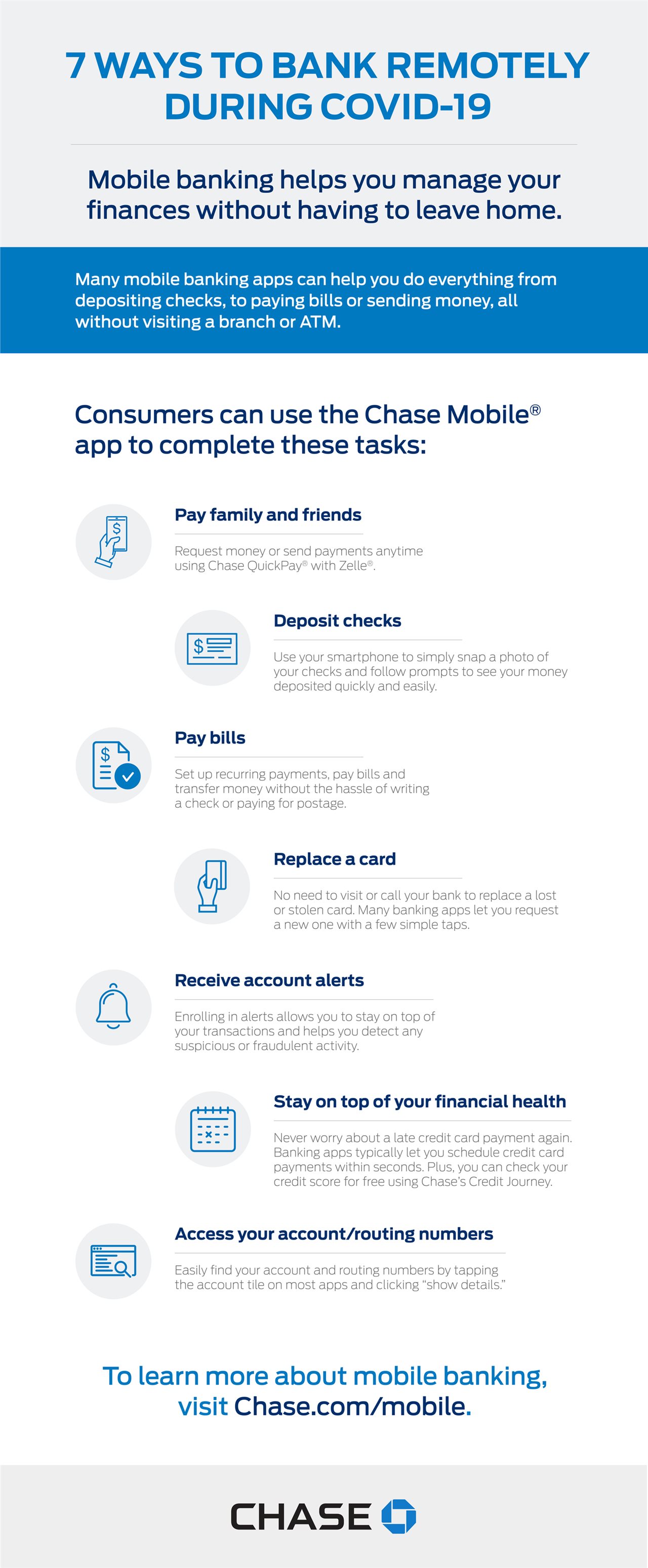
7 ways to bank remotely during COVID-19 [Infographic]

2020-05-12T14:01:00

(BPT) – Mobile banking helps you manage your finances without having to leave home. Many mobile banking apps can help you do everything from depositing checks, to paying bills or sending money, all without visiting a branch or ATM.


Offices of the future: What can we expect from office space post coronavirus?

2020-04-29T02:01:00

(BPT) – Though most office employees are working remotely during this unprecedented time, there will be a time when the world re-emerges from COVID-19. What will office space look like then?

Despite concerns regarding more companies shifting completely to remote working, workspaces play an essential role and impact companies in numerous ways. According to a recent Bloomberg article, people are overworked, stressed and eager to get back to the office. It’s much more than simply an address where people report for their job. An office can help define a company brand, promote safe employee engagement, underscore efficiency and even help boost retention and recruitment efforts, giving an organization an edge over competitors.

Workspaces are also constantly evolving. Just think about where and how your parents worked compared to where and how you work today. What’s interesting is we were in the midst of a dramatic shift in the types of amenities that companies desire for their workplaces, largely driven by the millennial workforce and preparing for Gen Z, which is just now entering the workforce. This shift is now experiencing its own shift as companies work to comply with social-distancing mandates and create safer workplaces that limit the transmission of COVID-19.

KBS, one of the nation’s largest owners of office properties across the U.S., provides key insight into these demands and what the workspaces of the future may look and feel like as tenants go back to work.

Here are five potential ways office spaces of the future may evolve:

Reconfigured Use of Space

We will begin to see interior office designs evolve to incorporate more space between workstations, as well as unique ways to break down density throughout a building.

Office owners will be challenged to deliver environments that are safe, aesthetically pleasing and still provide that collaboration and camaraderie that tenants want. We will likely see significant innovation within office space designs over the next year as office owners reconfigure spaces to inspire collaborative environments, as well as maintain a safe distance.

Smart Tech and Touchless Amenities

Office owners will likely begin implementing touchless amenities into many office properties across the U.S. This includes items such as touchless elevators, automatic doors, faucets and possibly incorporating voice command for frequently used items within a building in order to limit the transmission of illness.

These features will be important in our current environment; however, they will likely become commonplace as we move further into the future. Companies and their employees want environments that put their health top of mind. Smart tech and touchless features are an easy way to do this.

Integration of Health Focused Materials

Beyond touchless features, we will also see office spaces incorporate more antibacterial materials into office designs. Office property owners will be more selective in the materials used in order to further limit the spread of illness in the future. Office spaces may also incorporate antibacterial coatings on surfaces, as well as more sanitation stations throughout a building.

Additionally, electrostatic cleaning is gaining popularity. This method uses an electrostatic machine to spray all surfaces including chairs, keyboards, telephones, carpet, kitchen appliances, counter tops, file cabinets and door handles; covering all surfaces and in a quicker fashion. This method is compliant with CDC guidelines for COVID-19 cleaning.

Increase in Concierge Services

While concierge services and service-based amenities were a growing trend in office space prior to COVID-19, we will likely see an increase in concierge services, especially those that incorporate contactless options such as food delivery, dry cleaning lockers and other services that make everyday life easier.

In fact, for the KBS office property in Chicago, Accenture Tower, we created a customized app that easily connects tenants and their employees with surrounding amenities. The app includes the ability to order food directly through the app, limiting contact and the need for employees to leave the building.

More Customized Space

The shift to remote working for all employees and processes has allowed them to identify what is working and what’s not. This renewed understanding of their business operations will result in more demand for customized office spaces that fit companies’ specific needs, and they will be looking to landlords to provide it.

KBS, as a forward-looking office owner, truly understands how to deliver these customized spaces, even when tenants aren’t able to visualize it themselves. In fact, prior to COVID-19, KBS consistently built spec space without a committed tenant.

At District 237, a KBS client portfolio property in San Jose, California, we repositioned an entire building, 100,000 square feet of spec space. It was an extremely progressive strategy that was successful and something we would definitely consider doing again if it was the right fit for the property. The reason we were able to do this is because we look at every property on an individual basis and what that specific property’s needs are, as well as the surrounding community, demographics, tenants, etc. We would apply these same principles in customized space today, also taking into account shifts in needs based on COVID-19, ultimately delivering an in-demand space that tenants want. For more information and to see other office properties from KBS visit kbs.com.

By Rod Richerson, regional president, Western United States, KBS


How you can help children in poverty during the pandemic without leaving home

2020-04-29T08:01:00

(BPT) – While most of the world has hit pause on daily life, kindness and giving can be considered essential services. Socio-economic consequences of the COVID-19 health pandemic are challenging families across the globe, as schools have closed, after-school meal programs have paused, businesses have shut down, and families are feeling greater strain on finances. Children living in poverty are especially vulnerable, needing the support of nonprofit organizations and community assistance now more than ever. Providing this support has always been the mission of Red Nose Day — the annual fundraising campaign encouraging Americans to aid organizations working to end child poverty through the purchase of Red Noses at Walgreens. This year the campaign is back, but instead of selling the iconic Red Nose in Walgreens stores, the retailer created a way to engage in kindness and giving from the safety of your home to support children in need and those affected by COVID-19.

Due to public health concerns and the need for social distancing because of the COVID-19 outbreak, Walgreens is bringing Red Nose Day digital. The online shift offers a way for everyone to rally around the Red Nose in support of those in need during a critical time, even while remaining physically distant.

Get your digital Red Nose on

Now through May 30, when you donate a minimum of $1 at Walgreens.com/RedNoseDay, your donation will unlock a digital Red Nose filter to share proudly on Facebook, Instagram and Snapchat. Invite your friends and family to join you, sparking a wave of online donations and keeping the Red Nose spirit alive by spreading virtual joy. You can feel good knowing that 100% of funds raised will benefit Red Nose Day partner organizations that help keep kids safe, healthy and educated.

How it helps

The efforts of the Red Nose Day campaign are especially crucial during this year of economic upheaval and health crisis. Your donations provide funds for nutritious meals, essential medicine, clean water, education-based services and other vital aid to help children in America and around the world.

Grantee partner recipients of the Red Nose Day Fund include:

  • Boys & Girls Clubs of America, which provide safe places for children to learn and play after school
  • Children’s Health Fund, which brings essential medical services to underserved children
  • Feeding America, the hunger relief organization
  • Save the Children, which provides critical early childhood programs
  • City Year, which provides the social, emotional and academic skills to young adults in low-income households to succeed in school and life
  • Covenant House, which provides housing and support to youth facing homelessness
  • International Rescue Committee, a global humanitarian aid organization
  • Laureus Sport for Good, which uses the power of sport to end violence, discrimination and disadvantage for young people
  • UnidosUS, which advocates for Latinos in civic engagement, education, health and housing
  • The Global Fund, a partnership to accelerate the end of AIDS, tuberculosis and malaria

Join the cause

You can join the celebration when stars unite for a world of good during the Red Nose Day TV Special, Thursday, May 21, at 8/7c on NBC.

Want to get your own Red Nose on and get involved? Visit walgreens.com/RedNoseDay to learn more.


Working from home? Great gear for solving top telecommuting problems

2020-04-23T07:01:00

(BPT) – The coronavirus pandemic has altered life dramatically across the world. For millions of Americans, their new quarantine routine includes working remotely 100% of the time. Telecommuting makes work possible, but it’s not without challenges. Fortunately, there are some simple solutions you can use to work effectively from home now and in the future.

Problem: Fuzzy conference calls with annoying delays

Solution: Anker PowerConf speaker for clear conference calls

Conference calls are now a daily essential. However, many people are quickly learning the speakerphone on their computer and cell phones are sub-par at best. The Anker PowerConf Bluetooth conference speaker makes those calls amazingly clear, with six microphones for 360 degrees of coverage. With its Smart Voice Enhancement feature, it makes your voice stand out, blocking background noises in the next room or outside (e.g., dogs barking, kids playing or a lawnmower next door). With its 24-hour playtime and charging port for your phone, you’ll feel like a boss at every meeting.

Problem: Limited MacBook ports

Solution: PowerExpand Direct 7-in-2 Hub helps you maximize your MacBook

So much to do, but not enough ports to do it with? Expand your MacBook’s two USB-C ports into one Thunderbolt USB-C port, one USB-C data port, two USB-A ports, one HDMI port, one SD card slot, and one microSD card slot — all from the ultra-compact PowerExpand Direct 7-in-2 Hub. The Thunderbolt 3-enabled USB-C port supports huge charging power up to 100W, data transfer up to an astounding 40 Gb/s, and media display at resolutions up to 5K. Plus, the HDMI port supports a resolution of 4K at 30Hz while the Thunderbolt 3 port supports 5K at 60Hz. Connect to two displays simultaneously, so you can stream content and work at maximum efficiency.

Problem: Annoying earbuds that drop audio

Solution: Soundcore Liberty Air 2 earphones with optimized audio

Earbuds are a work-from-home essential, but not all are created equal. Whether you’re listening to a work presentation or taking a call, you need the crystal-clear sound that you get with the Soundcore Liberty Air 2 earbuds. Each earbud is equipped with two microphones and noise-reduction technology that reduces outside noises by 60% to ensure that everyone on the other side of the call can clearly hear what is being said. The ultra-light, yet rigid driver maintains its structure, even when vibrating at high frequencies, to ensure you can effortlessly hear your colleagues as well. A single charge provides 7 hours of listening, while the charging case extends it to 28 hours of playtime. When the case is in need of a recharge, simply set it down on a wireless charger or use the included USB-C cable.

Problem: A dusty, dirty home office

Solution: The eufy RoboVac 15C MAX smart robot vacuum

You’re spending more time at home, which means there are probably crumbs, dust and more in your workspaces. Technology can help keep things clean so you can focus on your work. Enter the affordable eufy RoboVac 15C MAX smart robot vacuum with a super-slim design and impressive suction power of up to 2000 Pa that quietly cleans for up to 100 minutes. When this RoboVac encounters a mess, it activates BoostIQ Technology that increases suction power for the best clean possible. With Wi-Fi capabilities, use the EufyHome app, Alexa or Google Assistant voice control services to activate your vacuum for a clean floor with zero effort from you. You can keep working and get your floors clean simultaneously, making you a multitasking master.

Problem: Slow charging and not enough ports for devices

Solution: The Anker PowerPort Strip PD 2 mini with USB expansion

Using all your devices at home burns through battery life, so you need a solution with ultra-fast charging capabilities to keep everyone connected. With the compact PowerPort Strip PD 2 mini you get one USB-C port, two PowerIQ-enabled USB charging ports, and two AC outlets to power five devices simultaneously. What’s more, PowerIQ provides charging times that are 2.5 times faster than generic wall chargers. Rest assured, safety is top of mind with this charger thanks to a seven-point safety system, which includes a fire-retardant casing and child-friendly safety shutters. With 5 feet of cable and a worry-free 18-month warranty, it’s a smart choice for the whole family.

For inspiration and more solutions for flawless working from home, visit www.anker.com.


How to decode your college financial aid offers

2020-04-20T06:01:00

(BPT) – This time of year, high school seniors and parents are on the edge of their seats waiting for college acceptance letters — and to learn how much school will cost. Like many families during this unprecedented time, how parents and students approach paying for college may be evolving. One important document that will help with the college decision-making process is the financial aid offer. And now, decoding it is more important than ever.

First, you filled out the Free Application for Federal Student Aid (FAFSA). Each year, you should fill out the FAFSA as early as possible (it’s available for the new academic year on Oct. 1).

What happens after the FAFSA?

After your FAFSA is processed, you can view your Student Aid Report (SAR) — not to be confused with the financial aid offer letters from each school you designated on the FAFSA. The SAR summarizes the information from your FAFSA and should be checked for accuracy. It will state your Expected Family Contribution (EFC), which helps determine eligibility for federal student aid. If you need to correct the SAR, go to studentaid.gov.

After your child starts receiving letters of acceptance from schools, you’ll receive financial aid offer letters from those schools, usually around March or April.

What’s on financial aid offer letters?

You may find your child’s financial aid offers confusing. You’re not alone. In a recent College Ave Student Loans parent survey conducted by Barnes & Noble College Insights, 42% of parents who received a letter found aspects of the aid offer letters confusing, and 68% agreed that the terms and layout of these letters varied from school to school, making it hard to compare them.

One tool you can use to compare offers: Finaid.org/calculators/awardletteradvanced.phtml.

Cost of attending school

Cost of attendance (COA) is an estimate of tuition and fees, room and board, and some other costs. Some letters use the term “net price” or “net cost” to describe the cost of attending for the academic year. It includes tuition, plus on-campus housing and dining. Many costs may or may not be listed, such as books, clubs, athletic and student activity fees, plus travel to and from school.

Scholarships and grants

If your child was awarded a federal grant (such as a Pell grant) or scholarships from the college or university, they will be listed on your offer letter. These do not need to be repaid and are applied directly to the school’s tuition.

Work-study programs

If your child indicated interest in work-study on the FAFSA and qualifies for a work-study program, he or she can work part-time on campus to help cover expenses. This is money that does not need to be repaid.

Federal loans

On the financial aid offers, you’ll likely see loans for the student and/or parent. These loans will need to be repaid. For loans in the student’s name, the payments typically begin after the student leaves school. The amount students can borrow is limited and depends on factors such as the year in school.

The most common type of student loans are Direct Loans, which offer low fixed interest rates, and you may or may not be charged interest while in school depending on your financial need. Parent PLUS loans are an option parents can use to help children pay for college. Repayment on Parent PLUS loans typically starts right away, not after the student leaves school.

What if all costs aren’t covered?

Even families who qualify for aid may find the total cost isn’t covered. In the College Ave Student Loans parent survey conducted by Barnes & Noble College Insights, 68% of parents said paying for 100% of college was an unattainable goal.

You can write a letter to the school appealing your aid package in light of family circumstances. Of the 21% of parents who received an aid offer in the study and appealed it, 61% were successful in getting money from the school.

Additional options:

  • Private loans
    To cover the gap between financial aid and college costs, College Ave Student Loans are customized to fit the individual needs of each student and family. Compare loan options and begin your application at CollegeAveStudentLoans.com.
  • Live at home
    On-campus room and board can be a substantial portion of college expenses.
  • Attend community college
    Many community colleges have transfer agreements with 4-year institutions. Some students can take courses at a lower cost in the first 1 to 2 years, then transfer to their desired school to complete their degree. Have a clear plan and make sure credits will transfer if this sounds like the path for you.

College Ave Student Loans simplifies the student loan experience. Visit CollegeAveStudentLoans.com/tools/calculator to explore the best ways to save money and see estimated monthly loan payments.


4 Tips to Upskill and Get Hired

2020-04-16T15:01:00

(BPT) – Skills are like kitchen knives, over time they can get dull. By continuing to refresh your skills and experiences, you may find your way into a new job or career path. With our day-to-day routines changing and evolving, it’s more important now than ever to invest in your skills to grow both professionally and personally — whether that’s brushing up on what you already know, adapting to the changing job market, or learning something new. According to a recent survey by LinkedIn, almost one-third of professionals in the U.S. are planning on learning new skills.

Here are four ways you can get started with online learning.

1. Set aside time for learning

Oftentimes, online learning is associated with changing roles or brushing up on skills for a job interview. While these are key areas where learning can be useful, you’ll get the most value from learning if you make it part of your everyday routine. LinkedIn Learning courses are “bite-sized,” making it easy and convenient for you to add online learning to your daily schedule. For example, you can watch an hour-long course in 10-minute segments, so consider committing 10 minutes a day to learning over your morning coffee or lunch break.

2. Discover courses for in-demand skills

LinkedIn Learning gives you the flexibility to search for courses, skills, videos and instructors across hundreds of topics and industries. You can “follow” skills that you want to learn more about, discover learning paths to start a new career and receive suggested courses to stay sharp based on your current role. It’s okay if you don’t know where to start — focus on what you need to learn to do a specific job, and for inspiration, LinkedIn will show you trending courses that are popular with other learners. If you’re currently working remotely, which requires a slightly different skill set, LinkedIn released a free learning path to help you adjust to your new environment and tips to be more productive.

3. Boost your job search

Job searching can be stressful, especially in today’s job market, but there are lots of ways to discover new opportunities and stand out. Whether that’s creating a search plan that connects you to jobs based on your skills and experience, leaning on your professional network for referrals, making a lasting impression during your interview or mastering ways to negotiate salary, there are a number of best practices to learn to get your job search on the right track. LinkedIn’s learning path for job seekers is also available to help you get back on your feet when facing challenging times.

4. Make learning fun and collaborative

Learning has become much more social in the online world as people lean on their community to share courses and collaborate. Those who learn together often feel more energized and connected. Also, consider posting about the online courses you found valuable on your LinkedIn feed, or suggesting courses for individuals within your network to help them reach their goals. There are more than 16,000 expert-led courses on LinkedIn Learning, ranging from managing a diverse team, how to develop resilience, incorporating mindfulness into your routine, demonstrating executive leadership and more. Sharing best practices with others helps strengthen relationships, which could lead to opportunities down the road.

You’ll spend approximately 90,000 hours working throughout your career, so it’s important to think about what you’re “in it” for. Many professionals fear they don’t have the right skills for their job, or haven’t simply taken a step back to ask themselves: “Am I in the right job?” Asking yourself these important (sometimes difficult) questions, and committing to learn and enhance your skills, will help set you up for success, no matter where you are in your career.


Tips for managing unexpected expenses

2020-04-14T09:07:01

(BPT) – Even when times are good, it’s tough for most people to handle unexpected expenses. According to Forbes, nearly 78% of U.S. workers live from one paycheck to the next, with little or no money set aside for an emergency. But especially during uncertain times, any unexpected occurrence — from a broken appliance to a punctured car tire — can send a family into a downward spiral of debt that just makes the situation worse.

Tough choices

When a family has no cash set aside and only high-interest credit cards to draw upon, the resulting interest payments can turn a simple set of tires or a cell phone replacement into a major financial setback. And if a payment is missed, that does further harm to your credit rating, making any future borrowing even more difficult.

Other solutions to a cash crunch can be just as problematic. A recent survey by The Harris Poll1 on behalf of Purchasing Power, LLC revealed that 21% of U.S. adults borrowed from their 401(k) over the course of one year. While that may seem like a good solution for a short-term emergency, borrowing from your 401(k) can create problems in the future, such as:

  • You’ll have to repay the loan with after-tax dollars, losing the benefit of that pre-tax investment.
  • You’ll lose out on wealth you could be building by leaving money in the 401(k).
  • If you fail to repay the loan promptly, the amount owed will be considered a withdrawal, so you’ll end up owing both tax and penalties on that amount.

Better options for unexpected expenses

What are the alternatives to using high-interest credit cards or borrowing from retirement savings like a 401(k)? Here are some options to consider before making choices that could hurt your financial future.

  • Sell unused items. If you have unused items in your home, chances are there’s someone out there who would pay cash for it. Check out Craigslist or Ebay and see how much people are willing to pay for what you’re selling.
  • Reassess your household budget. Look for any recurring expenses you can do without to free up more monthly cash. Consider cutting the cord on cable and/or renegotiating with your internet/cell phone provider.
  • Consider a side-hustle. Use your skills to moonlight on a contract basis or sell homemade items online. Even providing services for a fee in your neighborhood such as yard work, minor repairs, childcare support or dog walking could help you set a little money aside.
  • Borrow from family or crowdsource. Friends and family may be willing to help — especially for a short-term, specific expense. Determine exactly how much you need to cover the expense, and just ask for that amount. If it’s a loan, agree on repayment and interest terms. If you’re crowdsourcing, don’t accept money that exceeds your goal.
  • Review your employer’s voluntary benefits options. Take advantage of financial tools that may be available to you. For example, Purchasing Power® allows workers to secure a replacement washing machine or automobile tires without incurring any monthly interest or other fees over the course of a manageable 12-month payment term. The repayments come directly from payroll deductions, so you won’t risk missing a payment and harming your credit score.

“Unfortunately, credit card debt is at an all-time high, which can create even bigger problems for borrowers down the road. When the refrigerator stops working or your kids need a new laptop for school, many Americans — especially younger workers — don’t have the resources to cope with it,” says Trey Loughran, CEO of Purchasing Power. “Paying with cash or using a low-interest credit card are the best ways to cover unexpected expenses, but that’s not always possible. The challenge is finding alternative ways to meet short-term needs without compromising long-term finances.”

Employers interested in offering Purchasing Power for their employees can visit Corp.PurchasingPower.com to learn more.

1 Harris Poll on behalf of Purchasing Power® among 807 U.S. adults who are employed full-time, December 2019.


Sound financial tips during COVID-19 uncertainty

2020-04-14T18:01:00

(BPT) – The current COVID-19 financial landscape is unpredictable, causing anxiety for people of all ages. With layoffs, unexpected medical expenses, and an ever-changing and uncertain economy, it’s easy to worry.

“Now more than ever is the time to take an active approach with your finances to position yourself for success,” says Danielle Seurkamp, CFP. “Knowledge is power during unpredictable times.”

Andy Mardock, CFP, agrees. “Emotions are running high with coronavirus concerns. Being informed helps you resist gut reactions driven by emotion so you don’t make a move you later regret.”

Both Seurkamp and Mardock are members of the National Association of Personal Financial Advisors (NAPFA), an association of fee-only financial advisors who adhere to a fiduciary standard. Together they offer important financial tips to empower you to make wise financial decisions today and in the future:

Budget and be proactive

Create a budget and identify which bills are locked-in and which are discretionary. Then decide what can and can’t be cut. For those who have lost significant income, contact providers as soon as possible to explore options.

“Many companies are waiving late fees, establishing payment plans or deferring payments,” says Mardock. Foreclosures and evictions have been suspended in many cases. Contact your financial institution for relief on mortgages and other loans in the form of payment deferrals or forbearance to ease the pressure. For business owners, review the rules of CARES Act loans as well as the requirements for loan forgiveness to ensure you’re taking care of both your employees and your company.

Manage medical costs

Medical costs including over-the-counter drugs and menstrual care items are now considered a deductible medical expense. Seurkamp says you should consider using money in your flexible spending account on these items to reduce the burden on your monthly income. COBRA insurance premiums can also be paid using money in an HSA.

Get your stimulus check

“If you haven’t filed a tax return for 2018 or 2019, file one as soon as possible to qualify for a stimulus check provided by the federal government as part of the CARES Act,” says Seurkamp. “If your 2019 income was lower than 2018 or you added a child to your family last year, file your 2019 return now to potentially qualify for a higher stimulus check.”

Access emergency funds

If needed, use emergency cash or sell bonds to fund your living expenses. Now is also a good time to use low-interest debt like a home equity line of credit for cash needs if necessary.

“Try to avoid selling stock to create cash right now since values are down,” advises Mardock.

Use retirement savings cautiously

The CARES Act stimulus package makes it easier to dip into retirement savings to fund short-term living expenses. The 10% penalty on early IRA distributions has been suspended for up to $100,000 of COVID-related withdrawals. The amount that can be borrowed from a 401(k) has been doubled from $50,000 to $100,000 and the repayment terms have been relaxed.

“You can use these resources to cover essential expenses but resist the urge to use retirement savings for discretionary spending,” says Seurkamp. “Remember, you will either have to pay back what you borrowed or eventually pay tax on the withdrawals. Furthermore, to create cash in a 401(k) to withdraw, you will almost inevitably have to sell stocks when values are depressed, locking in losses.”

Limit media time

It’s important to be informed, but easy to become fatigued by watching negative financial news over and over. Once you’re informed, turn off the financial news, suggests Mardock. It will always be there when you come back. Moments to recharge and refocus are a necessary component of making smart financial decisions.

Consider virtual guidance

“If you’re feeling overwhelmed or have questions, set up a virtual meeting with a financial advisor,” says Seurkamp. “There are a variety of fee models for financial planning, including hourly, project-based and subscription offerings.” Most advisory fees are based on the complexity of the client’s financial situation, which alleviates issues around affordability.

In addition, as part of the group’s community response, some members of NAPFA are offering pro-bono assistance to those whose incomes are in jeopardy. This includes access to basic information about unemployment, tax waivers, lender moratoriums and more.

Even one hour with a financial advisor can help bring you peace of mind and some tangible next steps.

Visit www.napfa.org for more consumer tips and resources.


In volatile times, understanding your finances is more important than ever

2020-04-08T07:01:00

(BPT) – Wild swings in the U.S. stock market marked the past weeks as the nation reeled from the effects of the global COVID-19 pandemic, oil price wars and trade disputes, causing havoc to Americans’ finances.

In March alone, the Dow Jones Industrial Average had the five biggest daily gains and five biggest falls of its 135-year history as governments around the world responded to the outbreak, according to a March 17, 2020 BBC article.

Amid this market turmoil, it’s understandable to feel uneasy about your current finances as well as your long-term and retirement savings. Prudential research shows most consumers aren’t prepared for an unexpected financial hit. In fact, 54% of respondents in our recent survey on the impact of COVID-19 said they wouldn’t be financially ready for an outbreak that limits their ability to work for a few weeks.

The federal stimulus package that was just signed into law gives a much-needed boost to individuals and the economy. But many people still face the dilemma of meeting immediate needs while trying to figure out what to do about long-term goals.

Should you change asset allocations in your retirement or investment accounts? If faced with a financial hardship, can you take an early withdrawal from your 401(k) or IRA, or tap into life insurance? If you’re close to retirement or you just retired, you may be wondering about alternatives to preserve your savings.

In times like this, staying informed and seeking good counsel on financial matters is invaluable.

“The best solution to calming financial fears and creating a plan is to better understand the nature of the problem and the solutions available,” says Brad Hearn, president of Prudential Advisors. “Crisis or not, improving your financial literacy is crucial to achieving your short- and long-term goals.”

To improve your financial literacy, Hearn suggests the following:

  • Learn the finances of “Me, Inc.” Since many of us are currently forced to spend more time at home, perhaps now is a good time to take a close look at your finances.
    • Get a handle on your budget.
    • Consider how much you’re spending and how much you’re saving.
    • Understand your own personal money flow like you would a business.
  • Recognize that our finances can affect our overall well-being. A 2019 Prudential study found that 59% of workers who use financial wellness programs consider their overall mental health “good.” But that drops to 55% for those who do not use financial wellness programs.
  • Learn more about how financial systems work — that can help you better understand your own finances. As much as possible, try to make financial decisions objectively and remove emotions from the equation.
  • Talk to someone. A variety of resources is available to us all if we just look around. Tax professionals, financial professionals and accountants are certainly sources. Also consider financial wellness programs offered through houses of worship, credit counseling services and others. These can help you navigate common questions such as:
    • How much should you set aside for an emergency fund?
    • How long do periods of market volatility normally last?
    • How can you build a long-term financial plan that prepares you well for the future?

No matter who you rely on for financial advice, your goal should be to create a solid foundation by creating a holistic financial plan able to withstand future disruptions.

Prudential Advisors is a brand name of The Prudential Insurance Company of America and its subsidiaries located in Newark, NJ.


Retirement planning during uncertain times: Lessons for each generation

2020-04-06T08:59:00

(BPT) – By Kelly Greene, TIAA Sr. Director and co-author of The New York Times bestseller The Wall Street Journal Complete Retirement Guidebook

Don’t touch your face, and don’t touch your stocks — that advice went viral in the past few weeks, and it goes for retirement savings, too.

Like so many of you, I am trying to do everything imaginable right now to support the health of medically fragile family and friends.

But the only thing I haven’t woken up thinking about is whether I should be changing the way I’m saving for retirement. Here’s why: We’ve been on this roller-coaster ride before, and we were just as uncertain those times, too. No one knew what would happen in 2000 when the tech bubble burst, or in 2001 after the September 11 terrorist attacks. How we would emerge from the financial crisis in 2008 was a mystery for at least a few years.

I had a front-row seat for those economic calamities as a personal finance journalist covering retirement planning. In those earlier times of uncertainty, I interviewed hundreds of people, at all stages of their career and retirement, along with financial advisors. And many of the people who suffered financially were those who reacted emotionally — taking action right away.

Rushing a decision about retirement savings could lead to regrets and cost you more money unwinding a hasty move down the road. Here are some stories from recent times of turmoil that provide lessons for people at different points in their career:

Early Career Lesson: Resist selling low and buying high

I remember a 20-something-year-old friend, who, when the markets were falling in 2000, confided that he’d just liquidated his 401(k) because he couldn’t stand to lose any more money. “I’m out,” he said, throwing up his hands. The real pain came the next year, when he learned he owed hefty tax penalties for that emotional move.

Other people who kept their savings in a workplace plan, but sold off sinking equity funds, also lost out. It’s easy to forget to re-invest when markets start to improve, leading to a classic error: They sold low and then bought high.

The problem is, there’s no way to know exactly how long, or when, financial markets will hit bottom and start to bounce back. The lesson here is that it’s best to focus on what we can do and let our investments ride.

Mid to Late Career Lesson: Don’t put all your eggs in one basket

After a decade or two of making regular contributions in your retirement accounts, especially with employer contributions, it’s exciting to see savings add up. In the mid-2000s, a heady time for the markets, many mid-career investors moved savings into equities, dreaming of retiring early.

Then real estate lending started showing cracks, leading to 2008’s full-blown financial crisis. Retirement savings tumbled as much as 40% in value. That meant people with $1 million suddenly had $600,000. One retired banking executive I interviewed had invested his life’s savings in financial services stocks, because he felt comfortable investing in what he understood. By early 2009, he was back at work running a bank’s foreclosure unit to make ends meet.

It’s a great illustration of why we shouldn’t put all of our eggs in one basket. Some retirement-plan choices, such as target-date funds, will diversify our investments for us, based on when we plan to retire.

But if you want to choose your own retirement-plan investments, it’s important to keep your asset allocation on track. And if you haven’t thought about it in a few years, or ever, consider asking a financial advisor to help you make sure your current strategy aligns with your goals.

As you get closer to retirement, it’s important to consider additional ways to diversify beyond stocks and bonds. Increasingly, real estate, alternatives, annuities and other types of assets can provide more ways for retirement investors to spread risk.

Nearing Retirement Lesson: Use a three-legged stool

If you are getting ready to retire, should you wait? It depends on how you expect to generate your retirement income and how much cash you’ve set aside.

Retirement planners use models to talk about how to create your income stream. The most classic is the “three-legged stool” of Social Security, investments and a pension (all but extinct) or annuities. There are many variations on “buckets” to hold cash, short-term and long-term investments, with earnings trickling from the longer term holdings to cash.

If your “three-legged stool” includes enough sources of guaranteed lifetime income, or your “buckets” hold enough cash to avoid selling off investments that have lost value, you may be in good shape. If you’re not already working with a financial advisor, it might be worth getting a second opinion.

However, if your investments are still heavily weighted in stocks, you may want to re-evaluate your timing. If you do decide to delay your retirement date by a year or two, consider the approach that some would-be retirees took in 2008: By working a few more years than originally planned, they increased the size of their monthly Social Security checks.

Meanwhile, to reward themselves for staying on the job, they used a small part of their would-be savings to go ahead with a few retirement goals, such as travel or a kitchen renovation.

As you can see, amid so much other uncertainty right now, retirement planning is one part of your life that can be managed — either on your own, or with the help of a financial advisor. No matter where you are on your career path, there are strategies for dealing with market volatility while continuing to save for your financial future.

1126863

As with all mutual funds, the principal value of a target date fund isn’t guaranteed at any time, including at the target date, and will fluctuate with market changes. The target date approximates when investors may plan to start making withdrawals. However, you are not required to withdraw the funds at that target date. After the target date has been reached, some of your money may be merged into a fund with a more stable asset allocation.

Target date funds share the risks associated with the types of securities held by each of the underlying funds in which they invest. In addition to the fees and expenses associated with the target date funds, there is exposure to the fees and expenses associated with the underlying mutual funds.

Any guarantees are backed by the claims-paying ability of the issuing company.