Resolve to improve your health with omega-3s

2018-01-05T13:27:00

(BPT) – Now that the holidays are over, many health-conscious Americans do their best to make healthier choices in the new year. But according to new research, even those who do their best to eat a balanced diet aren’t getting enough omega-3s — essential nutrients that the body requires to function.

Among their numerous benefits, omega-3 fatty acids, such as eicosapentaenoic (EPA) and docosahexaenoic (DHA), have been associated with overall heart health, improving eye, brain and joint performance as we age. But when it comes to health, knowledge is just the first step. People should consider if they are consuming enough omega-3s and take action. A study recently published in Nutrients compared consumers’ knowledge and perception about omega-3s in their diet with the actual levels in their blood. Interestingly, participants were familiar with omega-3s, their health benefits and appropriate food sources, yet they simply weren’t getting enough. In fact, 98 percent of adults who were not using dietary supplements had low omega-3 levels.

Many experts recommend 1,000mg of EPA and DHA per day. Since omega-3s are not produced naturally within the body, you can increase your intake by eating two fatty fish meals per week, such as salmon, mackerel, herring or tuna, or by taking a supplement. But if you are like many others who do not consume significant amounts of fish on a regular basis due to dietary preferences, or if you simply don’t have access to fresh fish, consider adding a supplement to your self-care routine. Look for omega-3 supplements high in EPA and DHA, such as MegaRed 4-in-1 900mg, which contains a special combination of high-concentration fish oil and high-absorption krill oil and delivers one of the highest amounts of omega-3s per dose.

Omega-3 supplements are a great start to supporting heart, brain, eye and joint health in the new year.


New year, new you. Be your best, most productive self in 2018

2018-01-10T11:01:00

(BPT) – It’s a new year, the time people traditionally take a look at what’s working in their lives and what could be kicked up a notch. If you could use more productivity and efficiency in your life, you’re not alone. Sometimes, it’s all anyone can do to make it through the day unscathed, let alone slay every item on their to-do list.

The good news? There’s help out there. Here are some tips, tactics and technology to help you wrangle productivity and efficiency back into your life at work and at home this year.

Eat that frog

If procrastination bedevils you, take a page from Mark Twain. He famously said if you eat a live frog first thing in the morning, you can go about the rest of your day knowing the worst is behind you. Author Brian Tracy brings that philosophy into the workplace, coaching people to “eat that frog,” or, get your most unpleasant or challenging task — the thing you’re most likely to put off — done first. It’s a powerful way to cut down on procrastination, accomplish more and slay your to-do list every day.

Get smart at home

Artificial intelligence is going to be big in 2018, with everything from chatbots helping you with your banking questions to devices designed to make your home smarter and life easier. LG Electronics has just released its AI device, the LG ThinQ Speaker, which comes with Google Assistant built in and features improved vocal clarity thanks to technology from Meridian Audio, the maker of high-performance audio solutions. With a voice-activated interface it serves as a smart home hub for your entertainment needs and for LG’s smart home appliances. Another LG device that plays well with the Google Assistant is the TONE Platinum SE, a Bluetooth headset that has a button for accessing the Google Assistant in a snap. It allows you to have a more natural conversation with it instead of always having to prompt everything with “Hey Google.”

YNAB

Struggling with your finances? Check out You Need A Budget. It’s an online program that helps users take control of their spending and save money with the goal of getting out of the living-paycheck-to-paycheck snare. On average, YNAB helps users save $600 by the second month and $6,000 the first year.

A dry cleaner in your closet

If you have ever scowled into your closet realizing you have nothing clean or wrinkle-free to wear to the office, the LG Styler from LG Electronics is for you. It looks like a closet of the future, but it’s a steam cleaner and wrinkle reducer that uses just water to get the job done. Hang your clothes inside, close the door and boom, they come out clean, fresh and lovely.

Keep your resolutions

Setting goals for 2018? There’s an app for that. It’s called Strides, and it tracks any goal or habit you’d like to incorporate into your life. Weight loss, exercise, getting up early, you name it, Strides can track your progress and let you know how you’re doing.

Wrestle laundry into submission

If your family’s mountain of laundry eats up your weekends, check out the LG TWINWash. It takes the pain out of laundry day. It features the LG SideKick, a pedestal washer (an industry-first innovation) that can tackle smaller loads, delicates and intimates. You can run both the SideKick and the main washer at the same time, and it’s also Wi-Fi enabled so you can check the status of your laundry from anywhere using your smartphone.

Using tips, tactics and technology, you can be your best, most productive, efficient self in 2018, giving you more time to enjoy everything the new year has to offer.


The Changing Landscape of Lung Cancer Treatment

2018-01-25T09:03:01

(BPT) – At age 64, Bob Carlson was diagnosed with non-small cell lung cancer, and he felt the diagnosis was like “an expiration date being stamped on his life, like a milk carton,” and the time he had left “wasn’t nearly enough.” Bob, his wife, Julia, and doctors chose chemotherapy to combat his illness—but according to Bob, his quality of life after taking the treatments was non-existent.

Bob became so sick from the chemotherapy that he felt the treatments were almost worse than the disease itself. He talked to his doctor, who said there was nothing else they could do. Bob was on the verge of giving up hope when his physician sent him to a different research center. There, Bob met with another physician who presented him with a new option and renewed his fight.

Understanding the changing lung cancer treatment landscape

Lung cancer is the most common cancer worldwide, representing approximately 13 percent of all cancer diagnoses. While a cure for lung cancer does not currently exist, cancer immunotherapy is changing the treatment landscape and improving the prognosis for many people with lung cancer. Several immunotherapy treatments are approved for lung cancer by the U.S. Food and Drug Administration (FDA), including some as a first-line treatment for advanced lung cancer patients.

Immunotherapy is widely considered to be the most promising new cancer treatment approach since the development of the first chemotherapies in the 1940s. Cancer immunotherapy treatments harness and enhance the innate powers of the immune system to fight cancer.

According to a report published in the Annals of Oncology by the Cancer Research Institute, a nonprofit organization dedicated to the advancement of cancer immunotherapy research, there are over 2,004 immunotherapy agents in development with over sixty clinical trials evaluating immunotherapy combinations in lung cancer. There are 26 immunotherapies approved by the FDA, including six immunotherapy agents for the treatment of lung cancer.

“Today, the lung cancer space has the largest number of combination clinical trials underway, evaluating how two or more medications can work better when taken together. These trials hold much promise for patients, but there are still a lot of misperceptions surrounding clinical trials, with many people thinking that these studies are only an option after other treatments have failed,” said Dr. Jill O’Donnell-Tormey, chief executive officer and director of scientific affairs at the Cancer Research Institute. “However, many of the clinical trials currently underway are evaluating immunotherapy treatments for front-line use.”

The Cancer Research Institute offers the Cancer Immunotherapy Clinical Trial Finder as a free resource to help patients match themselves with appropriate trials based on their specific cancer diagnosis, stage, and treatment history.

“We hope that the Clinical Trial Finder will help more people learn about potential clinical trial options earlier in their patient journey so that they might have better outcomes,” said Dr. O’Donnell-Tormey.

How a clinical trial made all the difference

In August 2013, Bob became the very last patient to enroll in a particular clinical trial for non-small cell lung cancer, evaluating a checkpoint inhibitor—a promising immunotherapy approach that works by “taking the brakes off” the immune system to allow it to mount a stronger and more effective attack against cancer.

Once he started the immunotherapy treatment in the clinical trial, Bob and his doctors realized in short order that the treatment was working. “We saw tumor reduction rather quickly—which was amazing. And to top it off, unlike chemotherapy, which involved lengthy infusions that took many hours and left me ill due to the side effects, the experience of having the immunotherapy treatment in this case only took about 30 minutes, and has very little impact on my quality of life. You take your medicine, and you go on with your life. I have had to make zero lifestyle changes,” said Bob.

Now, almost five years later, Bob and Julia are back pursuing their hobby of wildlife photography and travel. He is hopeful that more patients will benefit from emerging immunotherapy treatments—through new FDA-approved therapies and through clinical trial participation.

“My only wish is that I had known about the immunotherapy clinical trial sooner,” he continued. “And I hope that through continued research more immunotherapy treatments are discovered that work for all patients with all cancer types.”

There are many other cancer patients and survivors, like Bob, who have been given new hope thanks to cancer immunotherapy research and clinical trials. For more information on cancer immunotherapy and how to match with an open clinical trial, visit the Cancer Research Institute Cancer Immunotherapy Clinical Trial Finder at https://www.cancerresearch.org/patients/clinical-trials.


More than 39,000 veterans are homeless each night: How you can help

2018-01-26T10:29:00

(BPT) – There are 18.8 million veterans in the U.S., according to the most recent U.S. Census. More than 9 million are seeking treatment at their local U.S. Department of Veteran Affairs medical center, and more than 39,000 are homeless on any given night, according to the U.S. Department of Housing and Urban Development.

There are many ways to help a veteran in need. Below are a few suggestions on how you can make a difference in a veteran’s life this year.

Tie your passion to your action.

We all have passions that bring us joy. There are many ways that suit your interests to give back while helping veterans in need. For example, do you like to spend time outdoors? Many organizations host volunteer activities like cleaning a veterans memorial in the community. Are you more of a people person? Give your time to a local veterans facility to connect with a resident in need of company.

Reach out to a veteran service organization to learn more.

The American Legion Auxiliary (ALA), The American Legion and Sons of The American Legion are actively involved in veteran causes with local units across the U.S. They offer community through memberships, organize and hold volunteer events throughout the year. As a first step, visit the websites of each organization and look for a unit close to you. Meeting with these organizations or others can kick-start your efforts to get involved with the veteran community.

Donate a day of service.

Everyday life can get messy with full-time jobs and commitments. One way to identify free time for charitable activities is to use a day off engaging in community service. “Donate” your Memorial Day to help the ALA distribute handmade poppies that support veterans in local hospitals, visit a veterans facility or deliver a meal or care package.

Give a gift.

Extend your thankfulness to the veteran community by making a gift. Mark your calendar for Nov. 27, 2018, when you can participate in #GivingTuesday, a global giving movement, by making a monetary donation to an organization that dedicates its efforts to helping veterans. Whether you come together as a family, a company, a community or by yourself, a donation can make a real difference.

Helping a veteran can be a year-long commitment or a one-day activity. To learn more about how to take the first step, visit www.ALAforVeterans.org.


Healthy half-time snacking tips from a pro

2018-01-17T14:33:00

(BPT) – Healthy snacking and making good food choices can be difficult any time of the year, but it can be especially tough during the big game. Business Insider reports that only 80 percent of people who start a New Year’s resolution keep that resolution through February. This happens to correspond with the biggest football game of the year and the common food temptations that go along with it — chicken wings, chips and salsa, pizza, not to mention beer.

Bryan Snyder, registered dietitian and nutrition director for the Denver Broncos, who is responsible for keeping the year-round nutrition strategies for the team’s players on track, also knows the pitfalls for the fans. “I advise people trying to eat healthier to follow a sustainable meal plan.”

Snyder describes a sustainable meal plan as one that allows some flexibility to have a meal here and there that might have a higher calorie intake.

“I often see people go from eating a poor diet and choosing unhealthy snacks, in combination with not exercising, to all of a sudden deciding to work out every day and eat perfectly every meal. The issue that can arise from that behavior is that it isn’t a sustainable plan, and it doesn’t allow any room for those big game snacks.”

Snyder’s recommendation is to find a nice middle ground. Allow yourself to sneak in some of those not-so-healthy calories on game day, but also give yourself some healthier options that you can have while keeping a guilt-free conscience.

Snyder’s snack of choice? Pistachios. “Pistachios are loaded with antioxidants and fiber, which will help you feel full and prevent you from overeating during the big game, and give you an immune system boost as well.”

Other healthy options are pita chips with hummus, vegetables with vegetable dip, bison or turkey burger sliders, popcorn, baked sweet potato fries, or a cup of turkey chili. For those who can’t imagine game day without wings, Snyder suggests baking the wings instead of deep-frying to replace some of the unwanted and unnecessary fats.

“Oftentimes we want to eat healthier, but we simply don’t know what to eat,” says Snyder. “All of these options are healthy swaps for satisfying game day enjoyment.”

Snyder recommends, too, having a backup plan if you’re going over to someone else’s house to watch the game, as this can be one of the biggest pitfalls to straying from a diet. “Don’t give yourself an excuse to eat poorly. Take along some portable healthy snacks — such as healthy bars, trail mix or pistachios — to be sure you have options and don’t indulge in hours of unhealthy snacking.”

While it is certainly understandable and sometimes difficult to eat healthy during the big game, it is something that can be done with the right planning and preparation, according to Snyder.

“One other common misconception about healthy snacking is that you have to sacrifice great taste,” warns Snyder. “Follow this game plan, and I guarantee you won’t.”


Do you know all of your psoriasis treatment options?

2018-01-25T08:01:00

(BPT) – Dru Riddle of Fort Worth, Texas, is one of the estimated 7.5 million people afflicted with psoriasis across the United States. A nurse anesthetist and university professor, Riddle understands first-hand the importance of receiving the proper treatment as quickly as possible and treating the condition with safe, effective medicine. Diagnosed with psoriasis in 2003 and psoriatic arthritis (PA) in 2010, Riddle underwent the treatment trials and errors common to many sufferers of PA before he was connected with a health care provider who prescribed a more aggressive plan that included biologics. Before doctors put him to a biologic therapy, Riddle suffered for several years with skin lesions and joint pain. “Finally I was switched to an injectable biologic medication,” Riddle says. “Those medications have really helped control my disease and the symptoms.”

A condition that is more than skin deep

Psoriasis often presents as patches of itchy, flaky skin, while PA — which affects about a third of psoriasis patients — results in joint swelling and pain, which may cause permanent damage. Both conditions are a product of the body’s immune system attacking itself instead of the foreign invader that should be its target.

PA can usually be identified by psoriasis-like skin inflammations. However, sometimes the joint pain and swelling appear first. This can make it difficult for doctors to properly diagnose the condition.

Initially, Riddle’s condition was treated topically with little to no effect. The relief he found with the right medicines was life-changing and he has vowed to help others with PA find the right care.

“I recommend anyone with PA be extremely aggressive with their treatment,” Riddle says. “The risks of not treating your PA are so much greater than treating it.”

Understanding biosimilars

In his quest for the right treatment regime, Riddle was diligent about his self-care and joined a number of clinical trials for the types of biologics that have been so integral to his treatment plan. It was thanks to his proactive approach to treating his condition that he started learning more about biosimilars.

Biosimilars are safe, effective and affordable alternatives to conventional biologic medicines, similar to generic offerings in other medicinal categories. Widely used in Europe, biosimilars have faced a biologics-dominated market in the United States that has so far been successful in limiting their availability. Expanding the biosimilars market in the United States will require manufacturers, the government and regulatory groups to work together to craft new policies, making access to these potentially life-changing treatments their top priority.

Riddle applauds the option of safe, effective and affordable biosimilars for patients.

“The expense of the biologic medication can be prohibitive — they’re very costly,” Riddle says. “So some people may benefit from a more affordable biosimilar medication. That medication has the same efficacy, meaning it works just as well as the biologic.”

Learning more about your options

“There’s no need to be afraid of the medicine,” says Christine Simmon, Executive Director of The Biosimilars Council, a group working to support the broad components of the biosimilar industry and enabling increased access to safe, effective and affordable biosimilar medicines. “Learn more about your options, talk to your doctor and make sure you’re receiving the medication that is the most effective treatment for your condition.”

If you have psoriasis and/or PA, you deserve to know all of your options, including biosimilars. Your doctor can provide you the information you need on these treatment options. To prepare for your next doctor’s visit and have your initial questions answered, visit http://biosimilarscouncil.org/ today.


Why probiotics should be part of your routine in 2018

2018-02-01T09:01:00

(BPT) – At the turn of the calendar, many people begin taking action on what they plan to accomplish in the new year. Some have resolved to take up a new hobby, to save more money, to travel and, of course, to improve their health.

New eating plans and gym memberships are common steps people take toward their health goals, but there are other effective ways to improve your health — like adding probiotics to your daily regimen. You’ve likely heard of probiotics before, but do you know how they benefit your health and how to select the right one for you? This article can help.*

What is a probiotic?

Before delving into how probiotics can help your body, let’s first explain what they actually are. In the simplest terms, probiotics are the good bacteria (live microorganisms) that live inside your digestive tract and help your body to function properly. There are many different types of probiotics, and each one performs a different function in your digestive system.*

The billions of bacteria that live inside your digestive tract are often called “microflora,” or more correctly, “microbiota,” and the environment that they work together to create inside the body is called the microbiome. Maintaining proper balance within your microbiome is crucial for overall health.*

How do probiotics help?

The beneficial bacteria in the digestive tract are influenced by a variety of factors such as stress, medication use, traveling and poor diet. Therefore, it is important to prioritize diet and lifestyle to maintain proper gut ecology. Probiotics are also effective for maintaining healthy populations of beneficial bacteria. Numerous clinical studies have shown probiotics have positive effects on health, including assisting in the digestion of food and the absorption of nutrients and contributing to immune system health. Some studies have suggested that certain beneficial strains may also support brain function.*

Probiotics in your diet

Probiotics are found in many foods you may enjoy every day including yogurt, kefir and sauerkraut. However, due to food processing and packaging, maintaining the stability and potency of the live beneficial bacteria in these foods can be a challenge. Including probiotic supplements in your routine ensures a consistent dose to help you and your family maintain optimal health.*

Finding the right probiotic supplement for you

Probiotic supplements can help support health at any age — from infancy to adulthood. When it comes to selecting the probiotics for you and your family, the best options are those that are formulated based on clinical research. Genestra Brands offers a comprehensive line of clinically studied, effective probiotic strains that have been recommended by doctors for more than 20 years. With more than 25 gluten-free, non-GMO formulas, Genestra Brands’ probiotics offer personalized support to help make your New Year’s resolution of becoming a healthier you that much easier.*

Before you begin taking any type of probiotic, speak with your doctor and/or pharmacist about whether they are safe and right for you.

To learn more about probiotics designed with you in mind, visit genestrahmf.com.

* These statements have not been evaluated by the Food and Drug Administration. This product is not intended to diagnose, treat, cure or prevent any disease.


Giving a Voice to Caregivers & Patients Fighting Liver Cancer

2018-01-12T15:51:00

(BPT) – Like many people, you are likely aware of the term “liver cancer” and may have some perceptions of this disease, but you may have less information than you think. Chances are, though, you have never heard of hepatocellular carcinoma (HCC), even though it’s the most common type of liver cancer and the fastest-growing cause of cancer death in the United States.1,2,3

Andrea Wilson was in a similar situation when her younger sister Adrienne was diagnosed with HCC. Once Andrea understood more about this devastating disease, she made it her mission to tell Adrienne’s story and to help others who suffer from this cancer.

More than sisters

Andrea and Adrienne shared an inseparable bond. As Adrienne’s legal guardian, Andrea was both Adrienne’s parent and sister.

“Adrienne was simply the best—my everything,” said Andrea, president and founder of Blue Faery: The Adrienne Wilson Liver Cancer Association, a leading liver cancer advocacy group. “She taught me the true meaning of unconditional love.”

One day, Adrienne felt severe pain in her right side. Six hours later, an ER doctor told Andrea and Adrienne she had tumors in her liver and lungs. Within two days, Adrienne was diagnosed with stage IV HCC.

“Our lives changed forever when we heard those eight words, ‘She has tumors in her liver and lungs,’” Andrea said. From the time she felt the pain in her side to the moment she died, Adrienne lived 147 days.

Raising awareness

According to a survey fielded by Bristol-Myers Squibb Company, in collaboration with Blue Faery, nearly half (47%) of people who care for someone with advanced stage liver cancer said they were aware of liver cancer but not very knowledgeable.4 In fact, Andrea never would have expected that Adrienne could have been at risk of developing the disease. Before that day, she believed heavy alcohol use was the only cause of this cancer.

She isn’t alone.

Many caregivers (43%) of patients with advanced stage disease did not think their loved one was at risk. One of the reasons may be that many of these people (72%), like Andrea, believed that heavy alcohol use was the most common risk factor for liver cancer.4 In reality, chronic infection with Hepatitis B virus (HBV) or Hepatitis C virus (HCV) is the most common risk factor for liver cancer.3,5

Caregivers may also face the challenge of making critical treatment decisions with their loved one. However, more than half of caregivers of people with advanced stage liver cancer surveyed (58%) admit it’s hard to understand what treatment options are available for their loved one. Nearly all of these caregivers (95%) believe more information needs to be available about different types of liver cancer treatment options and/or areas of research, and eight in 10(82%) wish they knew where to go to find this information.4

Making this type of information available became Andrea’s mission when she founded Blue Faery to support people affected by primary liver cancer, specifically HCC.

Additionally, according to the caregivers surveyed, 90% wish there were more public awareness of the seriousness of a liver cancer diagnosis, and 77% think liver cancer doesn’t get as much attention as other cancers.4

To address the needs these caregivers identified in the survey, Bristol-Myers Squibb and Blue Faery have launched LiverCancerOutlook.com, a website offering information about liver cancer and providing links to additional resources for patients and caregivers.

“Before Adrienne passed away, she said that cancer added to the story of her life. She believed it contributed to her character and sense of humor,” Andrea said. “I could not save Adrienne from liver cancer, but I have made it my mission to tell her story and to help others suffering from this devastating disease.”

For more information, or to share with a loved one, visit LiverCancerOutlook.com.

Blue Faery was compensated by Bristol-Myers Squibb for its time spent as an advisor on the Liver Cancer Outlook Survey and related content. Bristol-Myers Squibb does not endorse and is not responsible for information provided by third-party organizations.

References

1. American Cancer Society. Cancer Facts & Figures. 2017. Atlanta: American Cancer Society; 2017.

2. Islami F, Miller K, Siegel R, et al. Disparities in Liver Cancer Occurrence in the United States by Race/Ethnicity and State. Ca Cancer J Clin 2017 Jul 8;67(4):273–289.

3. Mittal S and El-Serag HB. Epidemiology of hepatocellular carcinoma: consider the population. J Clin Gastroenterol. 2013 Jul; 47 Suppl:S2-6.

4. Bristol-Myers Squibb. Bryter. U.S. Survey of Liver Cancer Caregivers. July 24, 2017 – August 31, 2017.

5. American Cancer Society. Liver Cancer Risk Factors. https://www.cancer.org/cancer/liver-cancer/causes-risks-prevention/risk-factors.html. Accessed December 18, 2017.



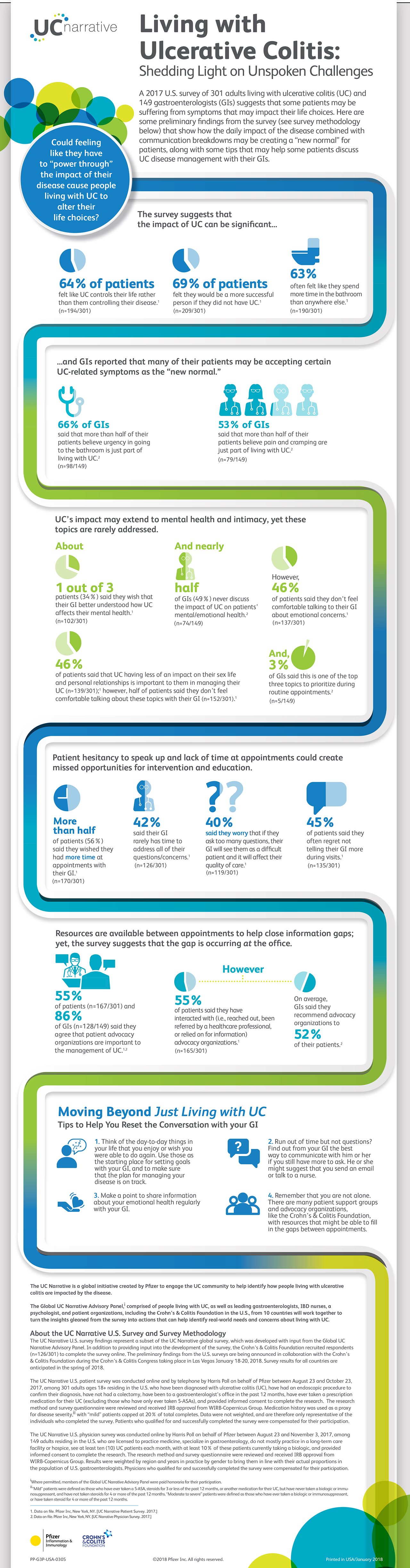
Living with Ulcerative Colitis: Shedding Light on Unspoken Challenges [Infographic]

2018-01-22T08:01:00

(BPT) – A 2017 U.S. survey of 301 adults living with ulcerative colitis (UC) and 149 gastroenterologists (GIs) suggests that some patients may be suffering from symptoms that may impact their life choices. Here are some preliminary findings from the survey (see survey methodology below) that show how the daily impact of the disease combined with communication breakdowns may be creating a “new normal” for patients, along with some tips that may help some patients discuss UC disease management with their GIs.