How to experience 12 iconic destinations in the Mexican Caribbean

2025-09-18T16:11:00

(BPT) – Renowned for its crystal-clear waters, white sand beaches, lush jungles and rich cultural heritage, the Mexican Caribbean is home to ancient archaeological sites, mystical cenotes, vibrant islands and serene lagoons. With over 100 miles of breathtaking scenery, travelers worldwide flock to the Mexican Caribbean to indulge in its dynamic culinary scene, world-class entertainment and award-winning accommodations.

Here are 12 unforgettable ways to experience the Mexican Caribbean’s captivating destinations.

1. From day to night, experience the allure of Cancún

Cancún is the ultimate day-to-night destination, offering a blend of adventure, leisure and vibrant nightlife. Visitors can spend their days enjoying world-class golf courses, luxury shopping, snorkeling or simply relaxing on the region’s iconic beaches. As the sun sets, Cancún transforms into a nightlife haven. Its legendary bars and clubs host themed parties and immersive entertainment experiences, making it a top choice for weddings, group celebrations and unforgettable nights out. Whether you’re seeking daytime thrills or exciting evenings, Cancún delivers the perfect balance of relaxation and fun.

2. Discover a shoppers’ paradise in Playa del Carmen

Love to shop? In Playa del Carmen, you can go treasure hunting along its famous Fifth Avenue. Parallel to the beach, Fifth Avenue is the soul of the city, offering a variety of restaurants, boutiques, shops and entertainment. On this street you’ll find everything from locally made souvenirs and handicrafts to one-of-a-kind art, luxury brand clothing and fashion accessories. Mexican silver is renowned worldwide, and you’ll discover an array of quality handmade pieces in Playa del Carmen.

3. Explore a mystical underwater world in Puerto Morelos

Outdoor adventurers will love the Cenotes Route of Puerto Morelos, offering the chance to discover a subterranean world of natural pools filled with beauty and mysticism. Just a few minutes from downtown Puerto Morelos, visitors can dive into crystalline cenotes surrounded by lush jungle, where activities like swimming, snorkeling, zip-lining and cave exploration await.

4. Unwind and recharge amongst the beauty of Costa Mujeres

Costa Mujeres invites travelers to unwind in style, where world-class golf and spa experiences are seamlessly woven into the region’s tranquil coastal charm. A variety of golf courses offer a challenge as captivating as the views. For those seeking rejuvenation, luxury resorts deliver indulgent wellness escapes with services ranging from holistic treatments, hydrotherapy circuits, and beachfront massages, to bespoke sessions practicing yoga, meditation and mindful nutrition. Whether you’re looking to unplug on the golf course or recharge with a spa day, Costa Mujeres is an ideal getaway.

5. Immerse in the natural wonders of Holbox

Holbox is a serene sanctuary that offers a rare blend of tranquility and natural wonder. With transportation available only via golf carts and bicycles, this barefoot paradise invites visitors to disconnect and immerse themselves in its laid-back rhythm. From swimming alongside majestic whale sharks and witnessing the magical glow of bioluminescence to exploring flamingo-filled islets and the Yalahau cenote, Holbox is a haven for nature lovers and adventure seekers alike.

6. Step into serenity in Tulum

Tulum is a serene blend of ancient Mayan heritage and boho-chic charm. Travelers can embrace mindful wellness in a boutique beachside escape, or indulge in award-winning cuisine inspired by international fusion. Whether spending the day lounging in an oceanfront hammock or shopping through bohemian inspired shops, stylish adventures await in Tulum.

7. Unwind in the tranquil paradise of Isla Mujeres

Just a short ferry ride from the buzz of Cancún, Isla Mujeres is an island gem where travelers can snorkel through vibrant coral reefs at Garrafon Park, swim with whale sharks, or relax on world-renowned beaches like Playa Norte and Punta Sur. Golf carts are the main mode of transportation, boutique hotels and luxury resorts line the coast, and nearby Isla Contoy beckons with its protected bird species and marine life.

8. Dive into land and water adventures in Cozumel

One of the largest islands in Mexico, Cozumel offers a rich marine landscape and deep cultural roots. Travelers can explore a transcendent underwater world by diving or snorkeling at Palancar Reef, part of the Mesoamerican Barrier Reef System, the second-largest reef system in the world. On land, visitors can discover the island’s Mayan heritage through immersive experiences, spend relaxing afternoons at a beach club, or get a sweat in while running or cycling on beachfront paths.

9. Learn from ancestral traditions in Maya Ka’an

Maya Ka’an offers a captivating blend of nature, heritage and community in the heart of the Mexican Caribbean. From the cultural hub of Felipe Carrillo Puerto to the Sian Ka’an Biosphere Reserve, a UNESCO World Heritage Site, Maya Ka’an delivers immersive adventures that honor both the land and its people. Whether floating down a natural lazy river or learning traditional crafts and techniques, visitors leave with a deeper connection to the Mayan spirit and the natural world.

10. Float along the turquoise waters of Bacalar

In Bacalar’s “Lagoon of Seven Colors,” ideal days are spent kayaking, snorkeling, paddle boarding or floating along the region’s multi-hued blue waters. Beyond the lagoon, Bacalar offers rich biodiversity and eco-adventures, from birdwatching to snorkeling in Cenote Azul. With nearby Mayan archaeological sites adding cultural depth, Bacalar is a soulful escape that blends nature, history and sustainability in one unforgettable experience.

11. Uncover a cultural gateway in Chetumal

In the coastal city of Chetumal, culture, art and history merge. At the Museum of Maya Culture, travelers can discover a comprehensive exploration of the traditions and achievements of the ancient Maya people. Situated on Chetumal Bay, the region provides the perfect setting for enjoying water activities amid relaxing Caribbean atmosphere. Make sure to include explorations of fascinating archaeological sites in the area, such as Oxtankah and Kohunlich, which offer a glimpse into the region’s history.

12. Take a stroll through Mahahual

Mahahual offers the perfect balance of laid-back charm and natural exploration. Casual afternoons can be spent perusing its relaxed beachfront boardwalk, lined with shops, cafés and diving centers, or dive into the crystal-clear waters that make this picturesque fishing village a favorite among nature lovers. Known for its gentle waves and close connection to the sea, Mahahual is near the Banco Chinchorro, the largest coral atoll in Mexico, making it a prime spot for snorkeling, scuba diving and marine discovery.

No matter what kind of vacation you’re dreaming of, the Mexican Caribbean has a destination to match. Visit MexicanCaribbean.travel to plan your perfect trip.

How students can get the internet connectivity they need

2025-09-18T11:01:00

(BPT) – Coral Almazan was in high school during the pandemic. Like millions of other kids in school at that time, she suddenly found herself adrift, sent home to continue classwork online, but without reliable internet access at home.

She recalls how challenging it was to stay connected to the internet — and to her school, teachers and classmates — as she worked hard to earn her high school diploma.

“Those are supposed to be the best times of your life, yet we were stuck behind computer screens,” Almazan recalled. “There were times the electricity bill still needed to be paid, and I was left wondering, ‘How will I connect to my classes? How will I complete my homework?’ I remember struggling.”

The digital divide

The pandemic brought into clearer focus the wider problem that still persists: the digital divide, or gap between students who have regular access to reliable internet and those who do not. That’s why her story still resonates. Despite the clear ongoing need for connectivity in today’s increasingly digital-first learning environment, reliable home internet still remains out of reach for too many.

Too many families still need to access internet connectivity at their local library, or even sitting outside neighborhood businesses where they can tap into free Wi-Fi to get homework done, communicate with teachers or apply to college.

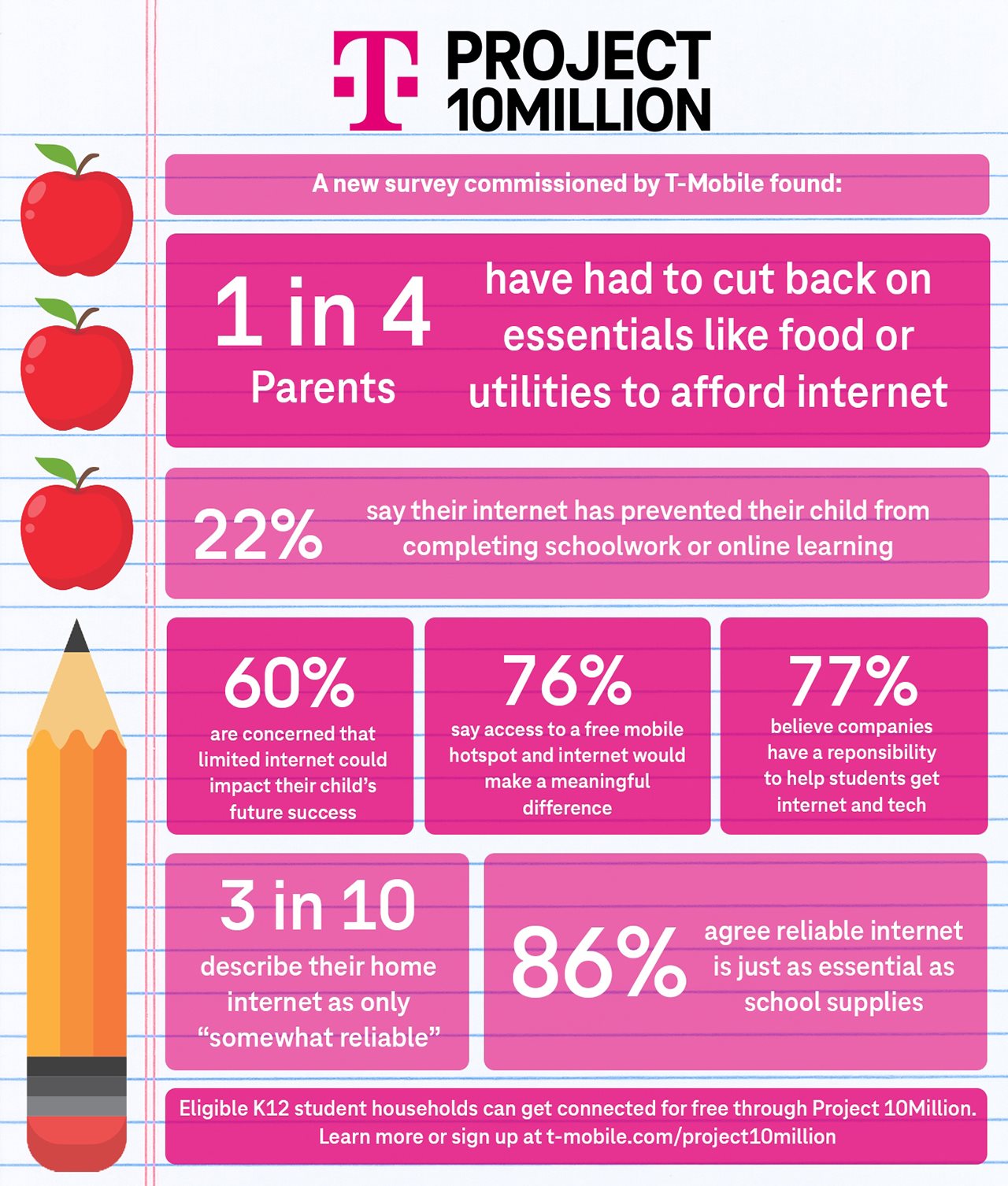
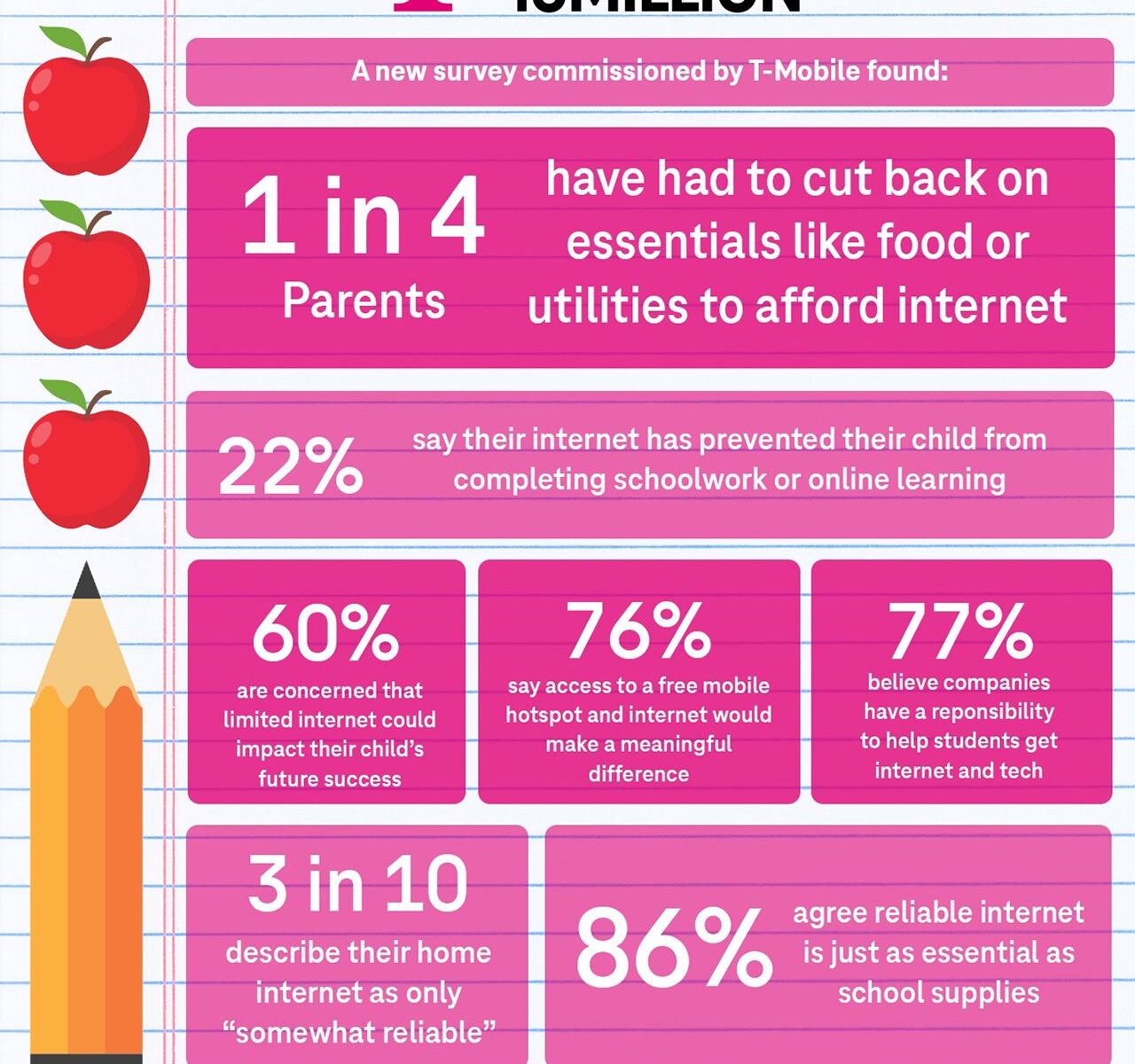
In a new survey* commissioned by T-Mobile, 3 in 10 parents describe their home internet as only somewhat reliable. For many families, staying connected comes at a steep cost. In fact, nearly one-fourth (24%) have had to cut back on essentials like food or utilities just to afford their internet. Most parents (85%) agree that families shouldn’t have to make that kind of trade-off to keep their students learning.

How T-Mobile is making a difference

To help families nationwide get connected, T-Mobile’s nationwide initiative, Project 10Million, has been working to help close the digital divide by offering free mobile hotspots, free high-speed data and access to low-cost devices to eligible K–12 student households. Since 2020, the program has connected over 6.3 million students, delivering over $7.3 billion in products and services that enable learning from home.

Project 10Million offers free internet access to eligible K-12 student households including:

  • A free mobile hotspot
  • 200GB of high-speed data per year for students who sign up directly with T-Mobile through the T-Mobile website, not their school district (increased from 100GB in 2024)
  • Access to low-cost laptops and tablets

Project 10Million is available to any student household participating in the National School Lunch Program (NSLP) or other government assistance programs. Families can sign up at T-Mobile.com/project10million or through participating school districts.

Families who sign up directly receive a hotspot, powered by T-Mobile’s network — America’s Best Network. If families reach their data cap, they can purchase a 10GB data pass for just $10, keeping the service accessible and affordable.

Connectivity leads to success

Looking back, Almazan credits her free T-Mobile hotspot with helping her succeed in high school as well as getting into college.

“It changed everything for my whole family,” Almazan said. “It wasn’t just my schoolwork. My siblings were able to do theirs too, with no lag, even when we were online together. The graphics on my class Zooms got so much clearer. It made a huge difference.”

Today, Almazan is pursuing a criminal justice degree at Houston Christian University and is already taking graduate-level courses. She’s also using her experience to inspire other students and advocate for more equitable access to digital resources. She credits T-Mobile’s Project 10Million as a pivotal part of her aspirations.

“Project 10Million definitely influenced me to go into policy work,” Almazan shared. “Helping each other out should be everybody’s motivation.”

To learn more about the program or to sign up, visit T-Mobile.com/project10million.

This is an infographic called

*The Project 10Million Survey was conducted via a PN View survey fielded by Big Village among a sample of 1,005 U.S. adults 18 years of age and older who are parents with children 17 years of age and under living at home. This survey was live on July 24-29, 2025.

Understanding how type 1 diabetes can impact an entire family

2025-09-18T08:01:01

(BPT) – Sponsored by Sanofi

When it comes to understanding your risk of type 1 diabetes (T1D), family history is a significant risk factor for developing the autoimmune condition. If even one family member has T1D, the risk increases up to 15 times.

Despite having relatives who live with T1D, Sheila King didn’t think she was at risk of developing the disease. “I was living life as a young adult in New York City,” Sheila explained. “So, when I started experiencing fatigue and extreme thirst, I just assumed it was a byproduct of my busy life.” The reality, however, was much more serious: These symptoms were signs of T1D.

At the time, Sheila’s mom, who herself lives with T1D, noticed something wasn’t quite right and decided to test Sheila’s blood sugar. Concerned about the results, they went straight to urgent care and, ultimately, the emergency room as Sheila was already in diabetic ketoacidosis (DKA), a dangerous complication of autoimmune T1D.

As Sheila described it, “Even though I’ve been surrounded by T1D my entire life, the diagnosis still came as a shock. At the time, I had no idea T1D screening was available, which could have given me more time to prepare for the realities of my diagnosis.”

Navigating Sheila’s “new normal”

Back in New York City, Sheila grappled with a life that required constant T1D management, including on her first date with her now-husband and professional baseball player Mike King. “We were having dinner at a restaurant shortly after she was diagnosed, and she was manually pricking herself and injecting herself with insulin,” Mike shared.

The impact of a Stage 3 T1D diagnosis is immediate and requires an individual’s ongoing attention. As Sheila explained, “I had to consider how to manage my T1D everywhere I went, and it was taxing, both physically and emotionally. It would have been helpful to have more time to prepare for how T1D would impact every aspect of my life.”

But while T1D was (and continues to be) an all-encompassing reality for the couple, it didn’t stop Mike and Sheila from falling in love. In fact, the experience of navigating Sheila’s disease only inspired them to pursue a new passion project: a foundation created with the goal of improving T1D screening awareness and education.

“I’m consistently in awe of how Sheila faces T1D head-on, but it certainly isn’t easy,” Mike added. “Her experience has inspired both of us to want to improve awareness about T1D screening and risk factors for the disease, so that people don’t have to find out about their diagnosis the same way Sheila did.”

Mike and Sheila walking across the street


The benefits of T1D screening

Early T1D detection can help you be better prepared to spot the signs of T1D and reduce the risk of serious complications like DKA, which Sheila experienced firsthand. What’s more, an early-stage diagnosis can give you or your loved ones more time to plan. So, talk to your doctor about T1D screening. You can also find helpful information about T1D risk factors (such as family history) and your screening options at ScreenForType1.com.

Sanofi does not provide medical advice, diagnosis, or treatment – information is provided for educational purposes only. Your doctor is the best source of health information. Talk to your doctor if you have any questions about your health or treatment.

Sheila and Mike King are paid spokespeople for Sanofi.

Conscious consumption for better living: The case of Chilean salmon

2025-09-17T09:01:01

(BPT) – Americans are more mindful than ever about the food that ends up on their plates, shopping beyond just convenience or cost. While budget plays a key role, factors like nutrition, sustainability and long-term well-being are now part of the conversation. Despite growing awareness, many Americans still fall short of the Dietary Guidelines’ recommendation to eat at least 8 ounces of seafood per week. That’s where Chilean salmon specifically shines in offering a flavorful, feel-good food that checks all the boxes for health-conscious eaters.

What makes Chilean salmon a nutritious choice?

Chilean salmon delivers many powerful health benefits, thanks to its rich nutrient profile. It’s packed with high-quality, lean protein and is particularly high in essential omega-3 fatty acids. All of these nutrients are known to support heart, brain and immune health at every stage of life. Chilean salmon is also low in mercury, making it a great choice for the entire family, including pregnant women and children.

The U.S. Food and Drug Administration (FDA) includes salmon on its list of foods that meet the new criteria for its updated definition of “healthy,” which focuses on nutrient-dense foods that promote long-term health. The combination of hard-to-find nutrients that support health throughout the lifespan make salmon an important food to include in your diet.

Close-up of a fork taking a piece of pasta, broccoli and salmon from a bowl.


What makes Chilean salmon an easy, sustainable choice?

Farmed salmon, including salmon from Chile, has the highest edible yield and lowest feed conversion ratio (FCR) of animal proteins, meaning it’s the most efficient animal to farm. Chilean salmon farmers have formed impactful third-party partnerships that ensure accountability and hold each farm to high environmental standards. This commitment to protecting the ocean is ongoing; salmon farmers are constantly refining and improving their practices based on the latest science and technological advances. Moreover, fish farming, known as aquaculture, plays an important role in protecting natural fisheries while ensuring there is enough food to sustain the growing global population.

The pristine and consistently cold waters of Patagonia allow Chilean salmon to thrive year-round, making fresh and frozen salmon available at your local grocer no matter the season.

A Centro Magallanes salmon farm.


How to eat salmon from Chile to reap the benefits

It’s the perfect season to add more Chilean salmon to the weekly menu rotation. Whether it’s grilled on the BBQ, tossed into a salad or baked with fresh herbs and citrus, this versatile protein is perfect for family meals. Quick to prepare and easy to love, it’s the kind of “conscious” choice that tastes as good as it feels.

Chilean salmon is a convenient, healthy protein source to buy fresh or keep on hand in the freezer. It is flash frozen to preserve quality and defrosts in just 15 minutes. Ask for Chilean salmon at the seafood counter or find it in the frozen aisle during your next grocery trip.

3 steps you can take now to help get your brand into AI overviews

2025-09-17T00:01:00

(BPT) – From the most experienced marketing and PR pros to the do-it-all-yourself small-business owners, the goal is often the same: get people to a website to learn more and ultimately become a customer.

Until recently, search engine optimization (SEO) was a winning strategy to get on the first page of a potential customer’s online search. But the game has changed now that AI is rewriting the rules, leaving many businesses feeling invisible, according to a recent webinar, “Branded Content in the Era of AI & GEO: Myths, Truths & Trends.”

Entering a visibility economy

People are discovering and trusting content using new tools and features like Google’s AI Overviews, ChatGPT and Perplexity. For example, type in a search and milliseconds later receive a handy AI summary with answers.

“This leads to a visibility economy,” said Lisa Jilek, CEO at Brandpoint, a branded content company with a long history of paid media solutions. “In the current AI-driven landscape, being seen is more important, yet challenging, than ever. Now a key goal for businesses of all sizes is to get cited by AI.”

AI Search is on track to surpass traditional SEO traffic by 2028, according to Semrush. And the average AI search visitor is 4.4 times as valuable, based on conversion rate, as the average visit from traditional organic search.

AI-enhanced search and AI overviews often contain link symbols and website citations. These are what the AI crawlers have deemed credible and pulled from to write the answer for the search query.

“People are no longer scrolling,” said Jilek. “It’s all about the AI summary and positioning your brand’s information to be selected as credible and cited by the bots. This is what people are now seeing and interacting with online.”

How to get into AI overviews

There is no one strategy that guarantees you show up in AI overviews. But you can do things to position your brand for success and make your content more appealing.

“AI is looking for credible content on high-quality websites to crawl in order to create its summaries,” said Adam McBroom, Chief Technology Officer at Brandpoint. “You need to regularly put out content that is clear, topical, credible and readable by people and AI.”

Woman online retail business owner creating content to direct traffic to her site.

How can you get started? Here are three steps to help you get into AI overviews:

Step 1: Create great content

No matter the type of digital content — press release, blog, sponsored content article, social media post — Jilek and McBroom said that in order to craft AI-friendly content, you should use:

  • Structured formats: Q&As, listicles and bylines with credible sources have the potential to get cited by AI engines more reliably.
  • Intent-rich angles: Create content that answers the questions people may ask online and solves the pain points of your customers.
  • Strong visuals: Infographics, listicles and videos engage audiences and send signals to AI algorithms.
  • Authentic voices: AI tools are getting better at identifying sources that are authentic and authoritative, plus people trust brands that are genuine.
  • Parsable snippets: Short, clear and well-formatted content is more likely to be surfaced and cited, especially when placed on multiple high-quality media sites.

Step 2: Publish on quality websites

Credibility is the quality of content as well as where that content appears. High-quality websites matter.

“For instance, an article on USA Today is more credible to AI crawlers because it’s a long-standing news publication that many people use,” McBroom explained. “Another example could be an established blog that has authority in a specific industry space.”

“Credibility and consistency are important for AI search,” added Jilek. “You can’t go wrong with good content on credible websites. Do this regularly and you’re not only appealing to AI, but you’re building brand visibility and reputation for your target audiences as well.”

Step 3: Use consistent messaging

Getting a reporter to cover a story that features your brand is challenging. Many communicators are now using a converged media strategy that balances earned placements (when a reporter covers your brand as part of a story) and paid placements (coverage with a cost) to help ensure a consistent stream of messaging.

Paid placements are unique because you can completely control the message, plus you get guarantees on where it will appear. Branded content refers to paid placements that are distributed on media sites, such as a sponsored article on a newspaper website or an infographic on a media page.

Does AI use branded content?

McBroom has observed that AI citations are referencing branded content, offering an opportunity for businesses.

“Brandpoint distributes branded content for clients on our network of high-quality publishing partners,” McBroom said. “We’re seeing client content appearing in AI summaries. AI crawlers are looking for credible content on credible websites. The value of those placements and frequency will reinforce a brand’s message and goals.”

Group of IT people writing computer code

Plus, many publishers now have partnerships and licensing agreements with AI companies, such as Perplexity AI with Gannett, which owns USA Today and more than 200 local publications.

AI overviews offer opportunity

While AI presents new challenges to businesses big and small, it also provides new opportunities.

“AI enhanced search and AI overviews provide a gigantic opportunity for brands, as consumers are learning online,” said McBroom. “Later, when they do visit your website, they are further down the conversion funnel than traditional organic search. They come in more qualified and are closer to taking action.”

To learn more about branded content and how it can be a part of your media planning strategy, visit Brandpoint.com.

5 essential tasks to make your car road trip ready

2025-09-16T08:01:00

(BPT) – Are you planning to hit the open road? Fall is a popular time for a road trip, and it’s not hard to see why. The cooler climate, changing leaves and fun seasonal activities make traveling by car this time of year a fun adventure, whether you go solo, with friends or take the whole family.

As you consider your travel to-dos, make sure to add car maintenance tasks to your list. Performing basic car care tasks is an easy way to avoid breakdowns during your autumnal getaway, so the only detours are the ones you choose. To help ensure you have an enjoyable, worry-free journey, NAPA offers its top five car maintenance tasks to do before your road trip.

Check tire pressure

Your tires are the only contact your car has with the road, so it’s critical they’re in tip-top shape before you leave your driveway for your vacation.

First, check your tire pressure. The cool autumn weather can cause tire pressure to drop. Low tire pressure may not seem like a big deal, but it can lead to poor handling, reduced fuel efficiency, uneven tire wear and blowouts. Before filling up your tires, check your owner’s manual or the label on the driver’s door jamb to find the ideal pressure for your tires.

Pro tip: While you’re checking your tire pressure, take a moment to inspect the tread. If the tread depth is less than 4/32 inches, you should consider changing your tires.

A technician pours NAPA High Mileage SW-30 motor oil into a vehicle


Change oil

Changing your vehicle’s oil before you leave on your big fall road trip is one of the most important things you can check off your preparation task list. An oil change can boost your fuel efficiency and ensure your engine is clean and well-lubricated so that you can avoid costly repairs down the road.

For your oil change, pick a product that offers superior protection and performance, such as NAPA Full Synthetic High Mileage Motor Oil. This advanced synthetic blend ensures optimal lubrication in extreme temperatures, reduces emissions and keeps engines cleaner.

Thanks to high-mileage additives like seal conditioners, NAPA’s high-mileage motor oil helps minimize leaks and oil consumption while enhancing fuel economy through reduced engine drag. The oil also contains friction-reducing agents and detergents that protect against wear, prevent sludge buildup and maintain engine efficiency. Compatible with both gasoline and diesel engines, including turbocharged systems, it’s a reliable choice for long-lasting engine health.

A NAPA Gold oil filter and bottle of NAPA SW-30 motor oil sit on a table under an elevated vehicle.


Replace the oil filter

Don’t forget to replace your oil filter! A clean oil filter traps debris, keeps your oil clean and removes contaminants that can cause damage to your car. When you change your oil but keep the old filter, you’re contaminating the new, clean oil with old, dirty oil, essentially defeating the purpose of an oil change.

When replacing your oil filter, use a filter built for real-world driving. For example, NAPA Gold Filters are designed for any driving condition, offering up to 10,000 miles of filtration with premium components that trap up to 99% of contaminants and hold up to twice as much debris as conventional filters. Their durable construction, optimal oil flow and reliable cold-start protection make them a trusted choice for both professionals and DIYers. So, whether you’re commuting, road-tripping or facing stop-and-go traffic, you can drive with peace of mind.

A technician checks the fluid level in a vehicle using a dipstick.


Inspect and replace lights

Fall ushers in shorter days and earlier nights. To keep yourself and other cars on the road safe, check that all your vehicle lights are functional. That includes the headlights, taillights, brake lights, hazards, turn signals and fog lights.

Pro tip: Headlights should be replaced in pairs, so if a light on one side is out, it’s a good idea to get ahead of any issues and change the matching light on the other side. NAPA Lamps has a full selection from which to choose.

Swap wipers

When’s the last time you replaced your wiper blades? If you can’t remember, it’s time to install a new pair. Worn wiper blades can’t clean the windshield properly, leaving streaks and limiting your view of the road.

Check your owner’s manual to find the right length wiper blades for your make and model. Don’t forget the rear wipers! They’re just as important to keeping you safe while you drive.

This fall, show your car a little love. By completing these five important car maintenance tasks, you can drive with confidence no matter where the road takes you.

For more information on fall road trip tips, chat with a knowledgeable expert at your local NAPA Auto Parts store. Don’t forget to check out all the auto parts available on NAPAOnline and find a NAPA Auto Care location for routine maintenance and repairs.

4 ways to protect your HVAC system from natural disasters

2025-09-15T09:17:00

(BPT) – When severe weather strikes, one’s home is often the first line of defense. While many homeowners are focused on protecting the roof, windows or basement, it’s easy to forget about one of the home’s most important systems: heating and cooling. An HVAC system keeps a family comfortable year-round, but it’s also vulnerable to damage during storms, floods, wildfires and other natural disasters.

Taking a few precautions can help avoid costly repairs and ensure the system is safe to use after the storm passes. The following are four steps homeowners can take to protect their HVAC systems.

Power down before the storm

When a natural disaster approaches, turn off power to the HVAC system at the circuit breaker. This reduces the risk of electrical damage from power surges and helps protect the equipment in the event of flooding.

A great way to go one step further is to install surge suppression for both your indoor and outdoor units. These devices work by squelching surges and spikes that might damage the electronics within your system. They help prevent problems during lightning storms or when the electrical grid is under stress from severe weather. Some models can also provide protection during electrical brownouts. The best part? They’re relatively inexpensive and easy to install, but they offer excellent protection for your HVAC investment.

Secure outdoor units from high winds

Strong winds can cause serious damage, either by shifting the unit off its base or by hurling debris into the equipment. Before the storm, bolt outdoor units securely in place. Remove lawn furniture, planters or tools that could become airborne hazards. In hurricane-prone areas, homeowners often use hurricane straps to provide their equipment with added stability.

Guard against flooding

Rising water poses major risks to indoor and outdoor HVAC equipment. If a home is in a flood-prone area, consider elevating your outdoor unit on a concrete or composite platform. After flooding, never attempt to restart the HVAC system without first having it inspected. Moisture exposure can cause hidden damage, electrical hazards or mold growth if not addressed by a professional.

Keep up with regular maintenance

Routine HVAC maintenance is always a smart move, but it’s especially important in areas prone to extreme weather conditions. Having a system inspected both before and after severe storms can help catch any damage early. A qualified technician, such as a Rheem Pro Partner®, ensures the equipment is safe, efficient and ready for the season ahead.

Regardless of one’s location, preparation is essential. Natural disasters can happen with little warning, and these steps can help protect a home’s comfort systems and save users from unexpected expenses. For additional resources and expert help, companies such as Rheem, a well-known 100-year-old HVAC manufacturer, and its network of contractors, offer guidance to homeowners navigating these challenges.

How contracting public transit makes a difference for communities

2025-09-15T06:01:00

(BPT) – At 7:32 a.m., Amanda pulls into the coffee shop near her office like she does every morning. She waves at the barista, snags her regular latte and hops back into the car, never thinking twice about the train rumbling by two blocks away. Amanda hasn’t used public transit in years — not since college. But public transit has already shaped her entire morning, even if she’s not aware of it.

The barista who made her coffee? He took the early bus from a neighborhood 45 minutes away. The mechanic who tuned up her car last week? She got to the shop on a light rail line that saved her nearly $200 a month in gas. The assistant in Amanda’s office who makes her job easier? He takes a commuter van pool into town every day — no car, no problem.

Amanda may not realize it, but public transit is part of her everyday life. It connects many of the people she depends on — quietly, reliably and often invisibly.

Public transportation doesn’t just move people. It moves economies, classrooms, hospitals and households. According to the American Public Transportation Association, nearly 87% of transit trips support local economic activity — getting people to work, school, medical appointments or essential services.

Even if you never board a bus or train yourself, transit touches your life through the many people who depend on it every day: The teacher who greets your child in the morning, the nurse in your hospital room, the server who refills your water and the electrician who wired your home. They all rely on public transit systems to show up, contribute and keep your world running.

Public transit is an invisible infrastructure of opportunity — especially for those without reliable access to a car. It’s a lifeline for seniors, people with disabilities, students and working-class families. For every person like Amanda who’s behind the wheel, there are dozens more whose journeys quietly intersect with hers through a bus route or subway line.

A couple walks and converses as people behind them wait to board a bus.

Partnerships that keep people moving

What helps public transportation agencies meet today’s challenges to keep serving the needs of people in communities around the country? Partnerships between public transit agencies and organizations belonging to the North American Transit Alliance (NATA), which provides the experience and expertise to operate and staff innovative transportation solutions.

NATA’s member organizations make up 15% of the U.S. public transportation workforce, encompassing over 71,000 employees in 46 states. NATA member organizations help public transportation improve service even in communities with massive transit demands, remaining flexible enough to respond to each region’s unique needs and conditions.

Across the country, partnerships with private transit operators have resulted in better passenger service, a more efficient service with better value for taxpayers, and new innovations that directly benefit passengers, including:

  • Restructuring bus routes for increased transit service frequency
  • Launching smaller microtransit services to complement traditional transit service, resulting in faster, critical connections for residents.
  • Introducing new technology such as contactless fare payment system and passenger mobile applications.

Partnerships inspire solutions

The many people who use and are touched by public transportation services nationwide (even if they’re unaware of it) benefit from these partnerships with NATA member organizations. The increased efficiency and innovation achieved through public-private partnerships better serves the passengers who rely on them every day. Partnerships help transit companies get the most value for their budget dollars — while hiring trained local contractors for good-paying transit jobs that benefit entire communities.

The bus you didn’t see

At 5:45 p.m., Amanda heads home. She hits some traffic, grumbles and turns up the radio. Meanwhile, just down the block, a man in a faded polo shirt waits at the bus stop. He just cleaned the office where Amanda works. She’s never met him, but she notices the polished floors and tidy lobby every morning. Tomorrow, he’ll be back — thanks to a bus that shows up right on time.

Whether we see it or not, public transit is always there — moving people, sustaining communities and quietly making our daily lives possible.

Learn more about public-private transportation solutions that help connect and strengthen communities at NATransitAlliance.org/contracting.

From Italy’s Heartland to Your Kitchen: Explore Authentic Italian Flavor with This Parmigiano Reggiano

2025-09-11T09:01:00

(BPT) – For centuries, Parmigiano Reggiano has been at the heart of Italian cooking — transforming everyday ingredients into memorable meals. With its rich, nutty flavor, unmistakable aroma and unique crystalline texture, this Italian classic elevates even the simplest of recipes.

Galbani®, Italy’s #1 cheese brand, offers a certified PDO (Protected Designation of Origin) Parmigiano Reggiano that is produced, prepared and imported directly from Italy’s heartland. Made with only three ingredients — milk, salt and rennet — and aged to perfection, Galbani delivers the unmistakable taste of true Italian craftsmanship to the table.

Elevate Classics

Parmigiano Reggiano has long been a cornerstone of Italian cooking, valued for the way it enhances and elevates any dish. Its magic lies in its versatility. Toss it freshly grated over hot pasta or risotto, adding layers of nutty, savory flavor to every bite. Add a rind to a pot of soup, stew or sauce to deepen the taste as it simmers. Finish roasted broccoli, grilled zucchini or sautéed spinach with a generous sprinkle just before serving for a warm, flavorful touch.

Creative Twists for Special Moments

Parmigiano Reggiano’s appeal also goes beyond traditional dishes. Toss warm popcorn with butter, rosemary and finely grated Parmigiano Reggiano for an elevated movie-night snack. Shave over a classic Caesar salad. Or make entertaining effortless with a cheese board built around Parmigiano Reggiano wedges, figs, honey and cured meats — no cooking required.

Galbani Parmigiano Reggiano grated cheese in a cutting board next to a small dish of olive oil

From Italy’s Heart to Your Table

Each wheel of Galbani Parmigiano Reggiano begins in a protected area that includes the provinces of Parma, Reggio Emilia, Modena, Bologna to the left of the Reno River, and Mantua to the right of the Po River in the heart of northern Italy. Here, centuries-old methods and careful aging create a cheese that’s as versatile as it is flavorful. Galbani Parmigiano Reggiano contains no anti-caking agents, stabilizers or preservatives. It’s available in 14- and 24-month 7 oz wedges and 18-month, 2.82 oz cups of grated, shredded and shaved Parmigiano Reggiano — each tightly sealed to preserve peak freshness.

Galbani Parmigiano Reggiano is produced in Italy and made available by Lactalis USA, the world’s largest dairy company. Find Galbani Parmigiano Reggiano at major retailers nationwide. For more product details and recipe inspiration, visit www.galbanicheese.com.

5 ways to achieve peak performance with superior nutrition

2025-09-12T09:03:00

(BPT) – Whether you’re chasing fitness goals, managing busy workdays or simply aiming to feel your best, peak performance starts with the right foundation. Without proper nutrition, your energy levels, focus and recovery can all take a hit, making it harder to show up at your best day after day.

To help you stay sharp, Registered Dietitian and Nutritionist Dawn Jackson Blatner shares her top strategies for achieving peak performance. These simple and effective tips are designed to aid you in building healthy habits, sustaining energy and recovering well, whatever your wellness goals might be.

1. Set yourself up for success

When you’re working toward any health and fitness results, Blatner recommends setting small, achievable goals rather than tackling everything at once. If you have larger goals in mind, break them down into smaller, more manageable chunks that you can realistically envision yourself achieving. This approach helps you to stay motivated and build momentum toward lasting results.

2. Make healthy snacking easier

When your energy dips, it’s tempting to grab whatever’s closest, but quick fixes like chips or candy won’t keep you going for long. Instead, think of snacks as fuel to power your body and mind through busy days. Stock up on options that balance protein, fiber and healthy fats, like cheese or meat sticks, Greek yogurt or hard-boiled eggs. Keep them handy in your kitchen, office or bag so the best choices are also the easiest ones, helping you stay sharp, energized and on track with your wellness goals.

3. Take hydration seriously

Drinking water is essential to stay hydrated throughout the day, especially while working out, but it’s also vital to include beverages containing electrolytes to help keep your energy levels steady. Options like milk, coconut water, watermelon water or low-sugar sports drinks can help replenish fluids and support performance. Keeping these close by throughout the day makes it easier to stay hydrated.

4. Focus on whole foods

Minimally processed foods provide long-lasting fuel for your body and your mind, helping you perform at your best. Whole foods are close to their natural form, so they retain their natural nutrients and fiber. Think of fruits and vegetables, nuts and seeds, plus grains in the form of whole wheat bread, brown rice, quinoa and oats. You can also include dairy, meat and fish products that are minimally processed, with little or no added sugars, salt or artificial ingredients. Planning meals in advance can help ensure you always have nourishing choices ready.

5. Keep breakfast hearty

Breakfast plays a key role in setting the tone for your day, providing the energy and focus you need to support your workouts and movement throughout the day. For a flavorful start, you can have fun making delicious recipes such as this Turkey Sausage, Veggie and Cheddar Breakfast Casserole from Eggland’s Best.

Eggland’s Best eggs contain more than double the Vitamin B12 compared to ordinary eggs, providing a natural energy boost and keeping you energized and satisfied all day long. Eggland’s Best eggs also contain more than double the omega-3’s than ordinary eggs, which helps to maintain stronger bones and promote a healthy heart.

Turkey Sausage, Veggie and Cheddar Breakfast Casserole

Prep Time: 15 minutes | Cook time: 40-45 minutes | Yield: 8 servings

This easy, make-ahead Turkey Sausage, Veggie and Cheddar Breakfast Casserole is great for meal prep! It’s freezer-friendly, super easy to customize to your tastes, and you can use all kinds of veggies. It also makes for amazing leftovers!

Ingredients

  • 12 Eggland’s Best eggs, large
  • 1 tablespoon extra virgin olive oil
  • 1/2 red onion, diced
  • 2 garlic cloves, minced
  • 1/2 cup red bell pepper, diced
  • 1/2 cup green bell pepper, diced
  • 1 pound ground turkey sausage
  • 1 cup low-fat sour cream
  • 1 1/2 cups grated cheddar cheese
  • Salt and pepper, to taste

Preparation

1. Heat oven to 350 degrees. Spray a 9×13-inch casserole dish or large deep pie dish with non-stick cooking spray.
2. Heat oil in a skillet. Cook onions and garlic until onions start to get translucent. Season with salt and pepper. Add bell peppers and cook an additional 1-2 minutes.
3. Remove from heat and set aside in a separate dish.
4. Cook ground turkey sausage in the skillet you used for the vegetables. Season with salt and pepper, if desired. Once cooked all the way through, remove from heat and drain. Set aside.
5. In a large bowl, mix eggs, sour cream and 1 cup of the cheddar cheese. Use a whisk to make sure everything is mixed really well. Season with salt and pepper.
6. Add the vegetables and turkey sausage to the bowl and mix until everything is coated with the eggs and well mixed.
7. Transfer to casserole dish.
8. Cook 40-50 minutes, until center is set. Remove from the oven, sprinkle with remaining cheese and return to oven for 1-2 minutes to melt cheese.
9. Let cool, then serve. You can make this ahead and store for easy meal planning.

Find more nutritious recipe inspiration to help you achieve peak performance at EgglandsBest.com.