Bridging the Gap: New Bootcamps Help Underrepresented Founders Break Into Tech

2025-08-04T10:01:00

(BPT) – In the business world, talent and tenacity are often described as the ultimate equalizers. But for many startup founders — especially those from underrepresented backgrounds — the reality is more complicated. Access to capital remains uneven. Networks that open doors to advisors, investors and early customers are often closed circles. These structural challenges can stall progress before it even begins.

Despite these headwinds, founders from these communities are launching some of the most resilient, creative ventures in technology today. What’s needed isn’t just grit — it’s access, context-specific support and a clear path to scale.

Now underrepresented founders have a new opportunity that can help supercharge their success.

Amazon Web Services (AWS), in partnership with Techstars, a pre-seed investor backing startups building a better future for everyone, recognizes the importance of helping founders create transformative solutions, and as part of this commitment, they’ve recently launched a global initiative designed to support underrepresented founders around the globe.

Enter the AWS Impact Bootcamps

Group of co-workers working out systems with sticky notes on a glass wall.

If you’re an underrepresented founder building something bold, AWS Impact Bootcamps are for you. Over two days, you’ll get deep technical training with real tools, expert business advice from people who’ve done it before and direct access to mentors, investors and support that actually matters.

AWS Impact Bootcamps builds on AWS’s $30 million commitment to Black, Women, Latino, and LGBTQIA+ founders launched in 2022 and scales AWS’s global footprint in supporting hundreds more diverse founders beyond the U.S. to reach other countries around the world.

For many early-stage founders, the distance between a great idea and a fundable startup isn’t talent — it’s translation. Turning a product into a business means understanding how to pitch, how to price and how to map a go-to-market strategy. But, for founders who don’t have access to seasoned advisors, this translation gap can stall momentum.

This is where initiatives like the AWS Impact Bootcamps come in. By designing a curriculum specifically around the most acute challenges underrepresented founders face, the bootcamps aim to equip participants with tools that often take years to acquire.

Scaling access, one city at a time

Each bootcamp accommodates up to 50 founders per city, delivering focused training on critical business themes like sales, GTM (go-to-market) or fundraising. The AWS Impact Bootcamps program will launch in six cities across North America, Latin America, Europe and Asia-Pacific:

  • Atlanta, Georgia, United States (Sept. 8-9)
  • New York, New York, United States (Sept. 15-16)
  • Mexico City, Mexico (Oct. 1-2, 2025)
  • London, United Kingdom (Oct. 16-17, 2025)
  • Tokyo, Japan (TBD early 2026)
  • Berlin, Germany (TBD early 2026)

Each bootcamp will deliver an intensive two-day experience, equipping early-stage, underrepresented founders with deep technical training with real tools, expert business advice and access to mentors, investors and community, in addition to $5,000 in AWS promotional credits to get building on the world’s leading cloud. Workshops will be managed locally by the program partner, Techstars.

Join the next generation of founders

To apply, founding teams must identify as a member of an underrepresented community (Black, Women, Latino, Indigenous, LGBTQIA+, and founders with disabilities), or demonstrate work, activities or engagement that otherwise supports such communities. Applicants must also demonstrate clear cloud technology needs and have secured pre-seed or angel funding up to $2 million. Additionally, they should be operating with a publicly launched product, be under 5 years old and commit to the full two-day program.

Founders can learn more about the AWS Impact Bootcamps here: https://aws.amazon.com/startups/lp/aws-impact-bootcamps.

Electric Vehicles Have Unique Needs. Here’s How Tires Can Help

2025-08-04T09:01:00

(BPT) – Electric vehicles have put a charge into the U.S. automotive market, but there’s a burning question many drivers still have: How can tires help them get the most out of their EVs?

From October 2024 to January 2025, hybrid and electric vehicles accounted for 25% of new vehicle sales in the United States — a 32% year-over-year increase, according to S&P Global.

The American EV segment may be showing electrifying growth these days, but global tiremaker Nokian Tyres has developed tires with EVs in mind for many years. Way back in 2012, the inventor of the winter and all-weather passenger tires set a world record for the fastest electric vehicle on ice. Every tire the company makes comes with an Electric Fit marking that certifies it’s a seamless fit for EVs.

What does Nokian Tyres have to say about EV tires? And how are tiremakers working hard to meet the needs of this emerging market?

It starts by recognizing the unique demands electric vehicles place on tires.

Weight

Electric vehicles are generally 10 to 15% heavier than internal combustion engine vehicles. That places extra wear and tear on traditional tires. Rubber that isn’t durable enough to withstand the added bulk will wear out more quickly, and sometimes irregularly.

That makes blowouts more likely and driving less efficient. The added weight can also increase braking time and cause handling issues on challenging surfaces, such as rain or wintry precipitation.

Tiremakers seek to account for the heavier load by constructing tires with heavier-duty materials and formulating rubber compounds to be more responsive to the road. Nokian Tyres reinforces its EV-compatible products with robust internal structures and advanced materials that maintain stability and durability under heavier loads. The result is a tire that delivers confident handling and long-lasting performance, even under the increased demands of electric mobility.

Noise

Without the hum of an engine, EVs make road noise more noticeable. The main sound drivers notice in the cabin is the noise of tires touching the road. Tire manufacturers seek to mitigate noise frequencies by using tread patterns, rubber compounds and materials that dampen sound waves.

Nokian Tyres addresses this with innovative noise-reduction technologies, including silent sidewall designs and optimized tread patterns that absorb sound and reduce vibration. Nokian Tyres inserts acoustic foam into its dedicated EV winter products, the Nokian Tyres Hakkapeliitta 10 EV and R5 EV. The result is a smoother, quieter ride that complements the serene driving experience EV owners expect.

Close up of the tread on the tire on the back passenger side of a car in the snow.

Torque

Electric vehicles are powerful. They often deliver two to three times more torque than comparable ICE vehicles, especially in the mainstream and luxury segments. And because that torque is available instantly, EVs feel quicker and more responsive in everyday driving.

That extra acceleration power presents a challenge to tires, since rapid changes in speed can cause them to wear more quickly. Drivers should pursue tires that can withstand high torque and deliver grip that maximizes their vehicles’ acceleration power. The key: tread patterns and rubber compounds that balance durability and responsiveness.

Nokian Tyres engineers its EV tires with advanced tread compounds and reinforced structures that resist abrasion and maintain grip under sudden acceleration. This helps drivers enjoy the full performance of their EVs without compromising safety or longevity.

Range

Tire design plays a critical role in EV range. High rolling resistance can drain battery life, while optimized tires can help extend it.

How do tiremakers lower the rolling resistance of their tires, helping to optimize EV range? Design plays a big role. According to Nokian Tyres, a tire’s sidewall construction, tread pattern and rubber compound play a role in reducing rolling resistance.

Nokian Tyres’ EV-compatible products feature low-rolling-resistance compounds that reduce energy loss and improve efficiency; in fact, more than 90% of Nokian Tyres products rank in the lowest categories of rolling resistance. This means drivers can go farther on a single charge — an essential benefit for those looking to maximize their vehicle’s potential.

For the right driver, electric vehicles can offer big advantages over rides powered by internal combustion engines. But that’s only true if the tires are up to the challenge.

For more recommendations about EV tires, visit NokianTires.com/EVs.

How to sweeten your summer with delectable chocolate treats

2025-08-04T11:01:00

(BPT) – Summer is about fun, relaxation — and savoring every moment. To make the most of your summer days, premium chocolate maker Chocolove has irresistible new flavors, a smattering of s’mores options and a decadently refreshing milkshake recipe to help you indulge.

Get nutty with 3 new flavors

Whether you go crazy for pistachios, pecans or walnuts — or all three — Chocolove has you covered with new perfectly balanced nut flavors that are both delicious and rich in texture.

  • Milk Chocolate with Pistachios & Sea Salt: rich, creamy milk chocolate paired with the delicate crunch of roasted pistachios and a hint of sea salt for satisfying flavor in every bite, complete with antioxidants, healthy fats and fiber.
  • Milk Chocolate with Pecans, Cookies & Sea Salt: a comforting blend of velvety milk chocolate, decadent crumbles of cookies and crunchy rich pecans to evoke memories of nostalgic dessert flavors.
  • Dark Chocolate with Walnuts & Sea Salt: bold, sophisticated dark chocolate harmonizing perfectly with the earthy crunch of walnuts and a savory touch of sea salt, delivering elevated taste plus omega-3 fatty acids and antioxidants.

Want to try them all? Enjoy these new flavors at Chocolove.com and for a limited time in a special 6-pack assortment box with two of each variety, ideal for sampling and gifting. Also, look for the nut bars in retail stores including Natural Grocers, Harris Teeter, Raley’s, New Seasons, and Fresh Thyme.

Savor the richness of Dubai Style Milk Chocolate

For a chocolate experience that satisfies all of your senses, the new Dubai Style Milk Chocolate Pistachio & Kadayif Bites Gift Box combines luxurious flavor and irresistible texture in every bite.

Wrapped in velvety milk chocolate, each handcrafted, bite-sized piece is filled with a creamy pistachio center blended with crisp strands of Kadayif pastry, a finely shredded phyllo adding delightful crunch. It’s a delicious way to celebrate life’s little luxuries — and the perfect gift for foodies who appreciate unique and elevated desserts.

Level up your s’mores

Whether you make these summertime treats at the fireside or in your toaster oven, s’mores season calls for something special. Keep it classic with smooth milk or bold dark chocolate, or add a decadent twist with filled or flavored bars. Try these tasty options for crave-worthy s’mores that transform a childhood favorite into a gourmet experience.

  • Hawaiian Sea Salt in Strong Dark Chocolate: strong, bittersweet dark chocolate complemented by Hawaiian Alaea red sea salt for a perfect sweet-salty balance.
  • Raspberries in Dark Chocolate: smooth semi-sweet dark chocolate with crispy bits of tart freeze-dried raspberry pieces bursting with flavor for a harmonious combination that will transform your s’mores into a celebration of summer.
  • Milk Chocolate: a classic s’mores must-have — creamy milk chocolate offering caramel-like flavors blending into a light cocoa finish.
  • Salted Caramel in Dark Chocolate: salted caramel filling is enveloped in classic premium dark chocolate.

Shake things up with this sweet summer recipe

Experience the refreshing bliss of a cool, creamy Chocolove Double Chocolate Milkshake, perfect for a hot summer day. Combining the rich, velvety taste of Chocolove Milk Chocolate with the smoothness of vanilla ice cream, this milkshake is a quick and easy delight your whole family will love. To elevate the decadence, add a luxurious drizzle of Chocolove Strong Dark Chocolate.

For a delightful dessert or sweet afternoon pick-me-up, this milkshake is sure to satisfy your chocolate cravings. Ready in 15 minutes, it’s an effortless way to enjoy a touch of chocolate heaven anytime. Follow the directions below.

null

Double Chocolate Bliss Milkshake
Prep time: 15 minutes; Serves 2

Ingredients
1 cup vanilla ice cream
1/2 cup whole milk
1 bar Chocolove Milk Chocolate (3.2 ounces), melted
1/2 teaspoon vanilla extract
1/2 bar Chocolove Strong Dark Chocolate (1.6 ounces), melted (for drizzle)
Whipped cream (for topping)
Chocolate shavings for sprinkles (optional, for garnish)

Recipe
Melt chocolate: Break Milk and Dark Chocolate bars into pieces. Melt separately in microwave or double boiler, stirring until smooth. Let cool slightly.

Drizzle glasses: Using a spoon or squeeze bottle, drizzle melted Dark Chocolate, coating the inside and outside rim of the serving glasses.

Blend shake: In a blender, combine vanilla ice cream, milk, melted Milk Chocolate and vanilla extract. Blend until smooth.

Serve: Pour milkshake into glasses. Top with whipped cream and garnish. Serve immediately and enjoy!

With these special treats and recipes, your summer just got a whole lot sweeter. You can also feel good knowing Chocolove is ethically sourced and made from traceable, Non-GMO Project Verified ingredients, and most flavors are Rainforest Alliance Certified, meaning Chocolove’s sourcing practices support a better future for cocoa farmers and their families. Chocolove is also free of artificial preservatives for a decadent, world-class flavor experience.

Find everything you need to savor the summer at Chocolove.com, Amazon, Whole Foods Market, Publix, Walgreens, Safeway, Albertsons, Kroger, Walmart, Target, Sprouts and a variety of independent and natural retailers.

Inflation biting into dental care? Keeping teeth healthy on a budget

2025-08-04T10:01:00

(BPT) – If you’ve been avoiding the dentist due to budget concerns, you’re not alone. Economic pressures are forcing millions of Americans to delay health care, and dental visits are often the first to go.

The ripple effect is especially pronounced in lower-income households. About half (46%) of Americans have skipped or delayed dental care due to cost, according to the ADA Health Policy Institute. This trend, though it may seem cost-effective in the short term, often leads to worsening conditions needing more complex, expensive treatment down the road. These economic realities are concerning not just for oral health, but for your overall well-being. Skipping routine dental care can have far-reaching consequences, leading to more severe oral health issues like tooth decay and gum disease, as well as missed opportunities to detect conditions such as oral cancers. Ignoring dental problems often results in greater financial, physical and emotional costs later.

Aspen Dental, a national leader in affordable tooth replacement options including implants and dentures, is stepping up to bridge the gap and address these challenges head-on.

Dr White and a patient looking in the mirror at her new tooth implants

Innovative, accessible solutions for every patient

Aspen Dental’s patient-first approach is designed to alleviate the financial burdens that prevent so many from seeking care. For those without insurance, Aspen offers a savings plan with exclusive member discounts on most dental services to make essential treatments accessible and affordable. The Aspen Dental Savings Plan, combined with transparent pricing and flexible financing options, ensure patients can get the care they need without compromising on quality.

Leading the way in comprehensive tooth replacement solutions

As a recognized leader in tooth replacement, Aspen Dental provides solutions tailored to meet a wide range of needs and budgets. In addition to traditional dentures, patients at many offices have access to digital dentures, which use cutting-edge technology to ensure precise fit and quick turnaround. For those seeking permanent solutions, Aspen Dental provides dental implants that can last 25 years or longer with proper care. Also available are implant dentures, which combine the stability of implants with the affordability of traditional dentures.

Aspen Dental’s network of clinicians lead the industry in incorporating the most advanced tools and technologies into their practices, from on-site labs and digital scanning to a doctor-led, state-of-the-art options for straightening teeth.

A box containing a dental retainer

These comprehensive services demonstrate affordability and innovation can coexist, providing patients with care that is high-quality and accessible.

Addressing the dental care crisis in underserved areas

Nearly 60 million Americans currently live in areas with insufficient access to dental services, according to the Health Resources and Services Administration. This means fewer than one dentist for every 5,000 people. In many rural areas, there are none.

Limited access to dental care disproportionately affects rural regions, where nearly 34% of counties in the U.S. do not have a single dental practitioner, increasing both oral and general health disparities.

With over 1,100 locations in 46 states and 3,000 trusted dental clinicians, Aspen Dental uses its expansive reach to bring much-needed services to underserved populations. Following a mission to expand access to dental care for all, Aspen Dental’s presence is felt in communities across the country that have a limited number of providers or clinics offering affordable care options.

“For many communities, Aspen Dental is the first meaningful access point to quality oral healthcare,” said dentist and managing clinical director, Dr. Pamela Ellis. “Doctors across the Aspen network believe every person deserves a healthy smile, no matter their zip code, income or insurance status.”

By establishing offices in rural areas and underserved urban neighborhoods and equipping them with advanced technology and state-of-the-art treatment options, Aspen Dental is breaking down barriers to care.

Why delaying dental care costs more in the long run

Economic uncertainty directly impacts people’s ability to maintain their health and quality of life. Recent research from the National Association of Dental Plans shows that while preventive dental visits have remained relatively stable, many patients are avoiding non-urgent and cosmetic treatments, leading to a cascade of untreated issues over time. Research from the Centers for Disease Control and Prevention also highlights how limited preventive care results in higher rates of untreated tooth decay among adults, with 1 in 4 adults aged 20-64 living with untreated dental issues.

“It’s heartbreaking to see patients delay critical care due to financial pressures, especially when untreated dental issues can quickly escalate,” said practice owner Dr. Whitney White. “We’re here to provide solutions that fit every patient’s need, so they never have to choose between their health and financial well-being.”

A lifeline for affordable dental care

As many Americans face economic uncertainty, Aspen Dental provides a lifeline for millions seeking affordable and reliable oral health care. With a focus on underserved communities, innovative treatments and patient-first solutions, Aspen is bridging the gap for those who might otherwise fall through the cracks.

“The cost of care should never be a barrier to maintaining your health,” White continued. “Aspen Dental is proud to be a trusted partner for patients across the country, providing care where it’s needed most and helping Americans maintain their smiles even during times of economic uncertainty.”

An Aspen dental building

For more information about Aspen Dental’s comprehensive tooth replacement solutions or to find a dentist near you, visit AspenDental.com.

5 ways to support your gut health for the fall season

2025-07-31T08:17:01

(BPT) – As fall routines ramp up and calendars fill, it’s natural to feel a little off-kilter. Transitioning from the relaxed pace of summer to the structure of a new school and work schedule can take a toll — not just on your time but also on your digestive system, too. In fact, studies show that stress can affect health through its impact on gut bacteria.

To help you stay energized, focused and feeling your best this season, Registered Dietitian and Nutritionist Dawn Jackson Blatner is sharing her go-to gut health tips. These simple, effective strategies will help keep your digestion on track so you can ease into autumn with confidence and comfort.

1. Boost digestion before breakfast

Blatner suggests starting your morning with a warm glass of lemon water before eating anything. This easy habit helps rehydrate your body after a night’s rest and gently wakes up your digestive system. According to Cleveland Clinic, the natural acidity of lemon can help break down food in your stomach and set the tone for smoother digestion all day long.

2. Get moving early

Incorporating a little light movement to your morning routine can do wonders for your gut. Whether it’s a quick walk, a gentle yoga flow or a few minutes of stretching, getting your body moving can promote regularity. This small step not only supports gut health but also boosts energy levels throughout the day.

3. Take time to destress daily

Chronic stress can affect your mood and therefore disrupt your gut microbiome. Set aside a few minutes each day to unwind with a calming ritual, like deep breathing, journaling or sipping a cup of herbal tea. These simple stress-reducing habits can help lower cortisol levels, which in turn supports a more balanced and resilient digestive system.

4. Be consistent with mealtime

Your digestive system thrives on routine. Another way to promote regularity is by sticking to consistent mealtimes, even on the weekends. Eating at roughly the same times each day helps “train” your gut to expect and process food more efficiently, reducing uncomfortable symptoms like bloating and sluggishness.

5. Give your body time to digest

Blatner also advises that staying upright after meals is key to avoiding indigestion, especially if you’re prone to issues like acid reflux. Lying down too soon after having a meal can interfere with your body’s natural digestive flow. Try to allow for a few hours between your last meal and bedtime to support better digestion and sleep.

6. Make smart, balanced meal choices

What you eat plays a major role in how your gut feels. Blatner recommends focusing on balanced meals that are rich in protein, fiber and a variety of nutrients to keep energy levels stable and digestion running smoothly. Recipes like this Superfood Egg Sandwich from Eggland’s Best is packed with gut-friendly ingredients like Greek yogurt, spinach and seeds, and can be enjoyed at any time of day.

Eggland’s Best eggs contain more than double the Omega-3s compared to ordinary eggs, which can be beneficial for reducing inflammation in the gut and promoting a balanced gut environment. Eggland’s Best eggs also contain six times more Vitamin D compared to ordinary eggs, which helps boost your body’s immunity and helps fight off harmful bacteria.

Superfood Egg Sandwich
Prep time 15 minutes
Cook time 10 minutes
Yield 2 servings

Ingredients

  • 4 Eggland’s Best organic eggs, large
  • 2 tablespoons mayonnaise substitute (1/4 cup Greek yogurt, 1 teaspoon Dijon mustard, pinch of salt, pepper to taste)
  • 4 slices grain bread (for example, wheat, spelt and rye bread)
  • 1 packed cup raw baby spinach leaves, arugula, cucumbers and microgreens
  • 2 teaspoons mixed seeds (for example, a mixture of chia, pumpkin, sunflower and sesame seeds)
  • 1 small avocado, sliced

Preparation

  1. Bring eggs to a boil and simmer for 10 minutes.
  2. Drain and cool, then peel and chop.
  3. Add Greek yogurt, Dijon mustard, salt and pepper and mix.
  4. Add sliced cucumbers, avocado, spinach and arugula. *Disclaimer: greens to be thoroughly washed before consuming.
  5. Top with egg mixture and add seeds. Then add avocado and microgreens.
  6. Build sandwich and repeat! Slice and serve.

With these tips and this tasty recipe, you can help to start off your autumn routine feeling more energetic and ready to face each day.

To find Eggland’s Best eggs near you, plus more recipe inspiration, visit EgglandsBest.com.

It’s Never Too Late to Pool Safely This Summer with These Simple, Life-Saving Tips

2025-07-31T07:01:00

(BPT) – Summertime means making memories by the pool and enjoying time with family and friends. While having fun in the sun, it’s never too late to take precautions, especially for children in and around the water. The Consumer Product Safety Commission (CPSC) encourages families to incorporate simple safety tips into their pool routines to keep their families safer this summer.

Drowning remains the leading cause of death for children ages one to four, and, according to a recent report from CPSC, an average of 357 children under the age of 15 fatally drowned in pool- or spa-related incidents each year from 2020 to 2022. Fatal drownings are consistently highest during the summer months, emphasizing the importance of ensuring children’s safety throughout the peak of swim season.

By following these simple safety tips, you can help to keep children safer and prevent childhood drownings:

1. Install barriers around residential pools and spas

Swimming pool with protective fencing.

Barriers are often the first line of defense to prevent unsupervised children from accessing the pool, one of the most likely drowning scenarios. Common barriers include pool fences, door and pool alarms, and pool covers. Pool fences should be at least 4 feet tall and impossible for children to climb. It’s important to have self-closing, self-latching devices on fence gates and doors that access pools.

2. Teach children to swim

Group of middle schoolers in a swimming pool with kick boards and an instructor.

Swimming lessons are often available from organizations that operate in local communities, such as local Departments of Recreation. These lessons are not only fun but are a lifesaving skill.

3. Identify an adult Water Watcher

Mother, teaching little girl how to swim in a pool.

A designated Water Watcher — typically a parent, guardian, or trusted friend — monitors and supervises children in and around pools and spas. A Water Watcher should not be distracted and avoid reading, texting, and using a phone while performing this duty. To give everyone a chance to relax, create a schedule that allows for swapping every 15 minutes.

4. Learn how to perform CPR

A group of parents learning CPR

This summer, sign up to become CPR certified for both children and adults. The American Red Cross offers classes, which are often available in-person and online.

5. Ensure drain covers meet federal safety standards

Swimming pool drain

Teach your children to stay away from pool and spa covers, pipes, and other openings to prevent entrapment. Further, inspect your pool and spa drain covers to ensure they comply with the Virginia Graeme Baker Act and haven’t been recalled. Check CPSC.gov/recalls and sign up for recall email alerts.

By following these simple safety tips, we can all do our part to help prevent childhood drowning. To learn more about pool and spa safety, visit poolsafely.gov.

Back to School Food Allergy Guide: What Parents Need to Know

2025-07-31T09:01:00

(BPT) – Children spend anywhere from 800 to 1,100 hours at school each year. For those with food allergies, that time comes with added risks. From cafeteria meals to classroom snacks, the risk of a food allergy exposure is an everyday concern.

And with good reason: The U.S. Centers for Disease Control and Prevention (CDC) estimates that 1 in 13 children — roughly two per classroom — are affected by food allergies. Of those, 42% have experienced at least one severe allergic reaction, known as anaphylaxis. For children at risk, even a small exposure can be life-threatening.

The good news? With the right preparation, you can help your child manage food allergies with care and consistency. Discover how to educate, plan and confidently communicate with school staff and other parents to support your child throughout the school year.

Awareness and education are key

What is a food allergy? Simply put, it’s an allergic reaction that occurs after eating a food allergen. Your body’s immune system mistakenly responds to a certain food as if it were a harmful germ, causing an allergic reaction.

In children, the most common food allergies are to peanuts, tree nuts, milk, eggs, fin fish and shellfish.

A serious allergic reaction involves two or more body organs — the skin, lungs, stomach and/or heart. Symptoms may include:

  • Hives on the skin, sometimes on several parts of the body
  • Shortness of breath, wheezing, repetitive cough
  • Tightness in the throat, hoarse, trouble swallowing
  • Swelling of the tongue, lips or throat
  • Stomach discomfort such as abdominal cramps, diarrhea or vomiting
  • Blood pressure changes
  • Pale, faint, dizzy, confused

Epinephrine is the only medication that can stop anaphylaxis. Administer it as soon as possible. Remember the rule: “Epinephrine First, Epinephrine Fast.”

10 tips for a safe school year

Here are 10 essential tasks to help ensure your child with food allergies is safe, supported and included at school.

  1. Schedule a back-to-school health checkup. Obtain updated medication forms, epinephrine prescriptions and an emergency care plan. Discuss whether new food allergy therapies — such as biologics — might offer added protection in case of accidental exposure.
  2. Meet with school staff. Discuss food allergy accommodations in the cafeteria and classroom. Review the emergency plan. This is especially important if your child starts a new school.
  3. Teach your child how to stay safe. Help your child recognize signs of an allergic reaction and understand when and how to ask for help. Make sure your child knows who to turn to and what steps to take in an emergency.
  4. Be ready for the first day of school. Submit all required school health forms, drop off your child’s epinephrine and share a copy of the emergency care plan.
  5. Pack allergy-safe meals and snacks. Make sure your child only eats what is safe based on his or her dietary restrictions.
  6. Plan for snacks and special events. Confirm school policies for snack times and meals during field trips. Encourage no sharing of food.
  7. Ensure epinephrine is easy to access. Find out if the school stocks epinephrine, where it’s stored, and if the staff is trained to administer it in an emergency. Remember, your child is permitted by law to self-carry an epinephrine device.
  8. Address bullying and exclusion. Talk with your child about speaking up if they are being excluded, teased or bullied due to food allergies. Encourage talking with a trusted adult.
  9. Check in with your child. Make it a habit to ask your child how things are going at school, including if there’s any difficulty managing food allergies.
  10. Keep the conversation going. Communication between home and school is key. Keep teachers, school nurses and staff informed of any changes in your child’s health or needs.

Food allergies don’t have to get in the way of a safe, fun school year. With a little planning and teamwork, you can help your child thrive in and out of the classroom. For more information, tools and resources, visit AllergyAsthmaNetwork.org.

5 essential ground rules for your child’s first phone

2025-07-30T16:25:00

(BPT) – Do you have a middle schooler begging for their first phone? It’s not surprising given that 70% of kids get their first phone by age 12.

If you’re anxious about the idea of giving your child their first phone and the freedom that comes with it, you’re not alone. In many ways, it may feel like you’re letting them out into the digital unknown without a driver’s license. However, no matter when you decide to take the plunge, you have the power to make the experience a positive one.

“A child’s first phone is an important milestone for families,” said Dr. Jacqueline Nesi, a psychologist who specializes in the impact of digital technology on kids’ well-being. “This milestone moment calls for ‘straight talk’ — that is, honest, direct conversations between parents and children about technology use. It’s the perfect opportunity to lay the groundwork for healthy digital habits in the future.”

As you get ready for the fall school year, add establishing smartphone ground rules with your children to the list. To help you start this conversation, check out Dr. Nesi’s five essential first phone rules.

Rule 1: Create phone-free zones

There’s a time and place for phones. Before you give your child their first phone, establish phone-free zones and times. For example, you may decide that bedrooms and the dinner table are phone-free zones. You can also designate times of day, like homework time or an hour before bed, as phone-free time. Establishing these expectations can help your child focus on being present and lay the groundwork for lifelong digital well-being.

Rule 2: Set clear screen time boundaries

Establish daily and/or weekly screen time limits, including a bedtime cutoff for tech use. Once you’ve established these times and limits, remember to stick to these boundaries.

How much screentime to give your child will depend on a few factors like their age, schoolwork load, extracurricular activities and family responsibilities. Keep in mind that these limits shouldn’t be set in stone. As they get older, you can revisit screen time limits and adjust accordingly.

Rule 3: Establish app approval process

Respecting your child’s privacy while monitoring their phone activity can be challenging. However, parental controls can help you make sure your child is using their phone safely and accessing age-appropriate content.

For example, using parental controls, you can set up an app approval process. Some apps may allow you to restrict in-app purchases and content, giving you peace of mind.

Rule 4: Define consequences before problems arise

Don’t wait until phone use issues crop up. Get ahead by having a frank conversation with your children about the consequences for ignoring the rules. Work with your child to establish “logical consequences,” or ones that make sense based on the behavior in question. For example, if your child is ignoring screen time rules for a certain app, you might consider temporarily limiting access to that app.

And don’t forget to notice when they’re following the rules, too! Make it a habit to notice and praise responsible, respectful phone use.

Rule 5: Pay attention to your own digital habits

We know that parents’ digital habits play an important role in shaping their children’s phone behavior. So, pay close attention to what you’re modeling, and ensure you’re allowing plenty of time for phone-free time together with your child.

Start the conversation today

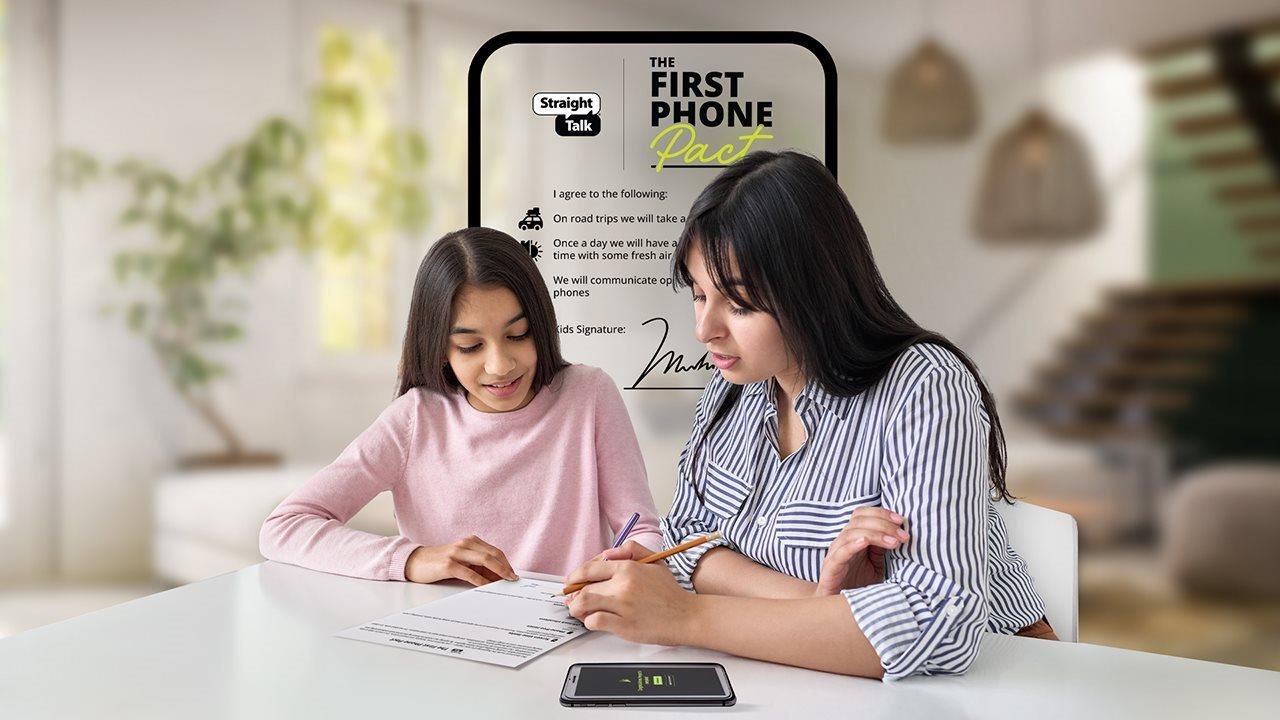
Use these five rules as a starting place for establishing your family’s phone agreement. Consider using the “First Phone Pact” made by Dr. Nesi in collaboration with Straight Talk Wireless — a leading prepaid brand covered by Verizon’s 5G network — as a roadmap for this discussion. The simple fill-in-the-blank prompts and multiple-choice answers help you build a phone pact together, establishing boundaries that work for your family.

Add a phone to your back-to-school supplies list

If you’re ready to buy your child their first phone, take advantage of the following Straight Talk Wireless deals before Oct. 19, 2025.

  • Samsung A26: $99 (save $100) with $55+ monthly plan
  • iPhone Options: $50 off iPhone 14, 15, 15+, 15 Pro and 16e with $55+ plan activation
  • Moto G 5G (128GB): FREE with $55+ plan activation (new lines or upgrades)
  • Plan details: $55 monthly plans include unlimited talk, text and data

The downloadable First Phone Pact template is available in English and Spanish. For more information, visit thefirstphonepact.com.

Americans spend nearly 4 hours a day thinking about money: new study

2025-07-30T09:01:01

(BPT) – Money is on the mind: Americans are spending nearly 4 hours a day thinking about money, according to new research from Empower, a financial services company. That’s the equivalent of a part-time job, but nearly half (45%) say it motivates them to take action to reach their long-term goals.

Time spent thinking about money by generation

  • Gen Z: 4.82 hours/day
  • Millennials: 4.73 hours/day
  • Gen X: 3.74 hours/day
  • Boomers: 2.4 hours/day

More than half (54%) say they’re thinking about money more often than they did last year.

What are people thinking about? For most, it’s quality of life considerations: bills (57%), inflation and rising prices (51%), housing costs (34%), debt (30%), tariffs (28%), and retirement savings (24%).

In fact, a majority (55%) of Americans say they think about their retirement weekly, or daily (27%). One in 4 (22%) high-income earners have retirement on the mind multiple times a day.

Checking in – and in

People are not just thinking about finances — they’re checking in, and in. Nearly one-fifth of the population (17%) checks their financial accounts, including credit cards and investments, multiple times per day, and a quarter (24%) checks their bank account daily. Keeping a close eye is more common among younger adults: 24% of Gen Z and 21% of Millennials monitor accounts several times a day, compared to just 10% of Boomers.

“In an era of 24/7 economic headlines, it’s no surprise that money is dominating our daily thoughts,” said Rebecca Rickert, head of communications and consumer insights at Empower. “But here’s the silver lining: We’re seeing a real shift from passive worry to proactive behavior. People are motivated. They’re looking for tools, information, and advice to turn that energy into progress.”

The time of day matters, too. Gen Z is most likely to think about money in the late afternoon, between 2 p.m. and 5 p.m., whereas Millennials and Gen X report an uptick in financial thoughts between 8 p.m. and 11 p.m., when the day slows down.

When money keeps Americans up at night

Over a third of Americans (36%) say they lose sleep over financial worries, and for Millennials, that number jumps to 44%. Boomers report sleeping better: Just 24% say money keeps them up at night.

Even during the day, 38% say money-related thoughts interfere with their ability to focus, and close to 2 in 5 say it strains relationships with friends and family (38%). In fact, over half (53%) say they’re feeling financial stress more acutely than ever (62% Gen X, 41% Baby Boomers).

But there’s a flip side: Motivation

One third (33%) are thinking about how to grow their money, and how to achieve long-term security (30%). Some 35% say they actively work to improve their financial situation when these thoughts arise, with Millennials among the most proactive (40%).

These actions are paying off. One in 5 (20%) respondents report significantly improving their credit score. Another 20% have paid off meaningful debt, created a successful budget (19%) or spending plan (19%).

Seeking information and advice

With money top of mind, Americans are searching for insights they can trust. About 1 in 5 people seek out financial news multiple times a week, and nearly half say that trusted financial information helps them make smarter decisions (41%). High-income earners report they are seeking out financial news and insights at least once per day (31%). A third of respondents say that talking with a financial advisor helps clarify their thinking around money and financial goals (33%).

Notably, younger adults are leading the way in financial curiosity. Millennials, in particular, value financial education — 52% say they place a high importance on financial insights and news (46% overall). More than half say they follow financial news to stay informed. Inflation and cost of living (49%) are the top topics people are researching, followed closely by budgeting (35%), saving (35%), and broader economic forecasts (27%).

What would help ease the pressure?

When asked what would reduce their financial stress, nearly half said a higher income (47%) would ease their worries, while 45% pointed to lower living expenses. Broader economic improvements (29%), debt elimination (28%), and a larger emergency fund (24%) were also top responses. Notably, almost 1 in 5 (18%) people said a detailed financial plan would go a long way toward helping them feel better about their finances (25% Gen Z, 23% Millennials).

To keep up with rising costs and financial anxiety, Americans are cutting back: 53% have reduced dining out; 46% are buying fewer non-essentials; 40% are scaling back entertainment; 39% are postponing travel or vacations; 33% are canceling subscription services; 29% are passing on social activities with friends.

Nearly 1 in 4 adjust their spending habits every month due to financial concerns, and 17% recalibrate weekly.

Money mindset: Focus on the future

Americans can’t stop thinking about their finances, but for many, it’s because they are dreaming of a bright future. Nearly half of Americans (47%) say they feel confident they will reach their financial goals.

Methodology

Empower’s “Money on the Mind” study is based on online survey responses from 2,206 Americans ages 18+ fielded by a third-party panel provider from June 10-12, 2025. The survey is weighted to be nationally representative of U.S. adults.

RO4674848-0725

OFF!Cast Mosquito Forecast Predicts Which National Parks Could Be Buzzing with Mosquitoes

2025-07-30T15:15:00

(BPT) – Spending Great American Outdoors Day at a National Park? OFF!® Mosquito & Tick Repellent uncovers top national parks with high and low mosquito activity ahead of free admission day in August.

Aug. 4 marks Great American Outdoors Day, and with all national parks offering free admission for the holiday, adventurers are gearing up for a day of exploration. But alongside visitors enjoying the expanded opportunities to visit their national parks, another group is expected to show up in full force: mosquitoes. With 37.8 million visitors to the national parks during the month of August last year, OFF!® and the National Park Foundation are teaming up to share insider tips for avoiding the buzz and enjoying the day.

To help travelers plan smarter, OFF!® — the #1 most trusted insect repellent brand* — created OFF!Cast Mosquito Forecast™, which predicts mosquito behavior and populations. Whether you’re a meticulous planner or a mosquito magnet, this guide informs parkgoers on where to expect higher mosquito activity — so they can come prepared with the data backed from OFF!Cast Mosquito Forecast™. With the right protection from OFF!® repellents, every parkgoer can enjoy a comfortable outdoor experience at the parks, regardless of how many bugs might be present.

What is the OFF!Cast Mosquito Forecast™?: Developed by OFF!® and enhanced by the brand’s partnership with The Weather Channel® app, the flagship consumer brand from The Weather Company, OFF!Cast Mosquito Forecast™ uses entomological research on mosquitoes from SC Johnson’s Center for Insect Science and Family Health™, along with real-time weather data — like temperature, humidity and precipitation — to predict daily mosquito activity down to the ZIP code.

National Parks with High Mosquito Visitation

While all parks offer a chance to connect with nature, some may see more mosquito activity than others on Great American Outdoors Day, making protection essential for an adventurous escape. The following parks are expected to feature higher mosquito activity, so take extra caution (and bring your OFF!® insect repellent when visiting to help stay protected).

Shenandoah National Park

1. Shenandoah National Park | Luray, VA: Just 75 miles from the bustle of Washington, D.C., Shenandoah National Park is a land bursting with cascading waterfalls, spectacular vistas, fields of wildflowers and quiet wooded hollows. Summer brings higher humidity and warmer temperatures to the park, which can make its moist forested terrain and abundant standing water sources a seasonal haven for mosquitoes.

Badlands National Park

2. Badlands National Park | Interior, SD: The striking geologic deposits at Badlands National Park contain one of the world’s richest fossil beds. The park’s 244,000 acres protect an expanse of mixed-grass prairie where bison, bighorn sheep, prairie dogs and black-footed ferrets live today. While the Badlands seem dry at a glance, episodic rainfall and warmer summer temperatures can create ideal — but often short-lived — conditions for mosquitoes. Visitors may see higher mosquito activity after rains, particularly near campgrounds, low areas or wetlands in and around the park.

Everglades National Park

3. Everglades National Park | Homestead, FL: Established in 1947 as the first national park created for its biodiversity, Everglades National Park protects 1.5 million acres of wetland, forest, marine habitats, as well as the native plants and animals that call it home. The subtropical climate of the Everglades tends to be hot and humid with nearly stagnant water systems of swamps, marshes and sloughs that create an environment that is ripe for mosquito breeding and activity.

Rocky Mountain National Park

4. Rocky Mountain National Park | Estes Park, CO: Rocky Mountain National Park’s 415 square miles (265,807 acres) encompasses a spectacular range of mountain environments. From meadows found in the montane life zone to glistening alpine lakes and up to the towering mountain peaks, there is something for everyone to discover. Seasonal snowmelt, wetlands, warm summer temperatures, and calm low-elevation valleys create an ideal habitat for mosquitoes especially in June and July when wet areas are more abundant.

White Sands National Park

5. White Sands National Park | Alamogordo, NM: Rising from the heart of the Tularosa Basin is one of the world’s great natural wonders — the glistening white sands of New Mexico. Great wave-like dunes of gypsum sand have engulfed 275 square miles of desert, creating the world’s largest gypsum dunefield. While White Sands National Park may not seem like an obvious mosquito hotspot due to its arid desert setting, seasonal monsoon rains between July-September can create temporary bodies of stagnant water. Couple that with warm, humid microclimates and this dunefield can create an increase in mosquito breeding and activity.

National Parks with Low-Medium Mosquito Visitation

Not all parks are expected to be buzzing with mosquitoes on Great American Outdoors Day. Here are locations OFF!Cast expects to feature lower mosquito activity — making them perfect for a scenic and less buggy adventure. Prevention still remains the best form of protection, so even when mosquito forecasts are low, make sure to make mosquito protection a part of your routine for uninterrupted time outdoors.

Joshua Tree National Park

1. Joshua Tree National Park | Twentynine Palms, CA: Two distinct desert ecosystems, the Mojave and the Colorado, come together in Joshua Tree National Park. A fascinating variety of plants and animals make their homes in a land sculpted by strong winds and occasional torrents of rain. With a hotter and drier climate, mosquitoes are less commonly found at the park, but be mindful of their activity around scarce water sources.

Utah

2. Utah’s “Mighty Five” National Parks — Arches (Moab, UT), Bryce Canyon (Bryce Canyon City, UT), Canyonlands (Moab, UT) Capitol Reef (Torrey, UT) and Zion (Springdale, UT): Known for their strikingly colorful desert landscapes, these parks feature dramatic landforms like towering cliffs, natural stone arches, deep canyons and unique rock formations shaped over millions of years. With their dry desert climate, mosquito activity is generally lower, though visitors should remain mindful during dawn and dusk when activity may increase.

Mount Rainier National Park

3. Mount Rainier National Park | Ashford, WA: Ascending to 14,410 feet above sea level, this park stands as an icon in the Washington landscape. An active volcano, Mount Rainier is the most glaciated peak in the contiguous U.S.A., spawning five major rivers. Mosquitoes can be present, especially in lower elevation areas and those with marshy, wet conditions or shallow lakes and ponds. Stay clear of puddles, wet meadows and snowmelt streams.

Yosemite National Park

4. Yosemite National Park | Yosemite, CA: First protected in 1864, Yosemite National Park is best known for its waterfalls, but within its nearly 1,200 square miles, you can find deep valleys, grand meadows, ancient giant sequoias, a vast wilderness area and much more. Mosquito activity at the park varies — with areas of lower elevation, streams and other water sources like puddles and melting snow being where you will see them the most.

Acadia National Park

5. Acadia National Park | Bar Harbor, ME: Considered the crown jewel of the North Atlantic Coast, Acadia National Park protects the natural beauty of the highest rocky headlands along the Atlantic coastline of the United States, an abundance of habitats and a rich cultural heritage. With relatively cool summers and constant sea breezes, Acadia’s rocky coastal environment and limited and scattered wetlands create a less hospitable environment for mosquitoes compared to inland and marshy regions of New England.

Want to check all the national parks off your bucket list? Find out how you can get an all-access pass to all the national parks by entering the OFF! to Adventure Sweepstakes.

*Voted most trusted Insect Repellent (for use on body) brand by American shoppers based on the 2024 BrandSpark® American Trust Study”