Want to save money and reduce your home’s carbon footprint? Explore hybrid heating

2023-10-23T07:21:00

(BPT) – As temperatures dip across the country, homeowners are shifting their attention to keeping their indoor spaces comfortable during the cooler months. However, many conventional heating and cooling systems can be very inefficient to operate, causing your utility bill to soar — especially in the winter.

What’s the solution to creating a comfortable home that’s also energy-efficient and supports a healthy environment? One option that homeowners in colder climates may want to consider is a hybrid system that pairs an electric heat pump with a furnace as a back-up heat source.

What is hybrid heating?

A hybrid HVAC system uses a heat pump as the primary heat source paired with a furnace for supplemental heat only in the coldest months. Heat pumps “move” heat from one source to another, as opposed to “creating” heat, making them highly efficient systems that reduce energy use by as much as two-thirds when compared to conventional heating. However, at very cold outdoor temperatures, many air source heat pumps need to rely on backup heating, which is either electric resistance strip heating or fuel combustion heating from a furnace.

Because electric resistance uses a significant amount of electricity, it is very inefficient and can place a large strain on the electric grid. This can create more harmful carbon emissions than utilizing a gas furnace for the limited periods that backup heating is needed — making hybrid systems a very sustainable solution.

“A dual fuel heat pump system is a proven, sustainable way for homeowners to heat and cool their home year-round while reducing their emissions and cutting energy costs,” said Manuel de la Fuente, vice president and general manager of Johnson Controls-Hitachi North America.

Reliable comfort in extreme cold

Hybrid heating systems work similar to how a hybrid car uses gas or electric automatically based on whatever is most efficient. In very cold weather, a hybrid heat pump with a gas furnace for backup heat will not only ensure consistent and dependable indoor temperatures, it’ll also have lower carbon emissions and operating costs than a heat pump utilizing electric resistance for backup heat.

For example, the Hitachi air365 Hybrid dual fuel system combines two heat sources: an external Hitachi Mini VRF heat pump and either your existing gas furnace with an attached dual fuel module, or a new model, such as the YORK® YP9C Modulating Gas Furnace. When the air365 Hybrid system is in heating mode, a smart sensor monitors the outdoor temperature. If it reaches a temperature where the heat pump cannot efficiently meet the indoor heating demand, it automatically switches from the heat pump to the furnace.

Rebates and tax credits

There are many federal, state and local incentives available now that encourage heat pump adoption and significantly reduce the upfront costs of new equipment. For example, the Inflation Reduction Act (IRA) expanded incentives for high-efficiency HVAC equipment, including the 25C tax credit. Many electric utilities also offer incentives for customers to install high-efficiency heat pumps, and these incentives can usually be combined with federal and state programs. Climate policies and incentive programs differ from state to state and even city to city, so rebate amounts and qualifications may change depending on homeowner location.

To find a Johnson Controls-Hitachi Air Conditioning contractor, visit HitachiAirCon.com, and to learn more about Hitachi air365 Hybrid dual fuel system, visit HitachiAirCon.com/air365hybrid.

4 ways to prevent home fires and keep your family safe

2023-10-23T12:23:00

(BPT) – Hundreds of thousands of residential building fires happen each year in America, according to the U.S. Fire Administration — yet only 26% of families have a home fire escape plan developed and practiced[1]. Kids practice up to 156 fire drills during their K-12 experience[2], but they are often less knowledgeable about what to do when a smoke alarm goes off at home.

Learning the basics of fire safety is the first and most important step in fighting the dangers of fire. Understanding the best ways to protect your home and family should always be at the top of your to-do list. To help you prepare, the fire safety experts at Kidde, a trusted leader in fire safety for more than 100 years, provide the following tips and advice:

1. Make sure you have working smoke alarms throughout the home

A working smoke alarm can double your family’s chances of safely escaping from a house fire[3]. In fact, three out of five home fire deaths happen in homes without properly working smoke alarms[4]. Like any home appliance, a smoke alarm should be carefully maintained. To do this:

  • Place a working smoke alarm or detector on every level of your home, in hallways, and both inside and outside every sleeping area.
  • Use interconnected alarms to make sure you hear an alarm from any room in your home.
  • Test alarms weekly by simply pressing the test button on its face.
  • Replace your smoke alarms every ten years.

2. Have fire extinguishers within reach

Place extinguishers on every level of your home, but especially near rooms where fires are more likely to start, including the kitchen, living room and laundry room. Choose multipurpose extinguishers that are large enough to put out a small fire, but not too heavy to handle, and ensure everyone in your family knows how to use it properly. Remember the P.A.S.S. method: PULL the pin, AIM at the base of the fire, SQUEEZE the handle, and SWEEP side to side.

3. Discuss fire safety with your family

Kidde is on a mission to help families everywhere make fire safety a priority and keep children safe at home. To do this, it’s imperative children know that the most important thing to do when they hear a smoke alarm is to leave the house or building immediately. Kidde created the Cause for Alarm jingle – Beeps that Last, Get Out Fast – to help kids remember what to do in the event of a fire. Fire safety should not be out of sight, out of mind, but rather an integral part of your daily family routine. Listen to the educational sing-a-long song online.

There are other fire safety resources that can help your family better prepare in the event of a home fire. Visit causeforalarm.org for a fire safety checklist to ensure your home is as safe as possible when it comes to kitchen appliances, electronics, heating, candles and other factors that can lead to fires.

4. Create a home fire escape plan

Once a house fire starts, you only have two minutes or less to act and escape safely. When escape planning, remember:

  • Draw a map of your home, mark two ways out of every room and pick a safe meeting spot away from your home.
  • Practice two times per year and at two different times of the day — daytime and nighttime.
  • Designate who will assist children and those with mobility or health issues.
  • Have escape ladders in upstairs rooms.
  • Get outside fast and once you are outside, stay outside. Make sure everyone in your home knows how to dial 911 or your local emergency number.

For additional resources, visit causeforalarm.org.

4 Reasons Why Your Office Should Go to the Dogs

2023-10-23T08:21:00

(BPT) – Enticing workers to return to the office after months, or even years, of working from home or in a hybrid model is proving to be tricky for some businesses. Incentives to return to the office have been met with mixed reviews, but there’s one perk that may prove to be very worthwhile — allowing employees to bring their pets to the office.

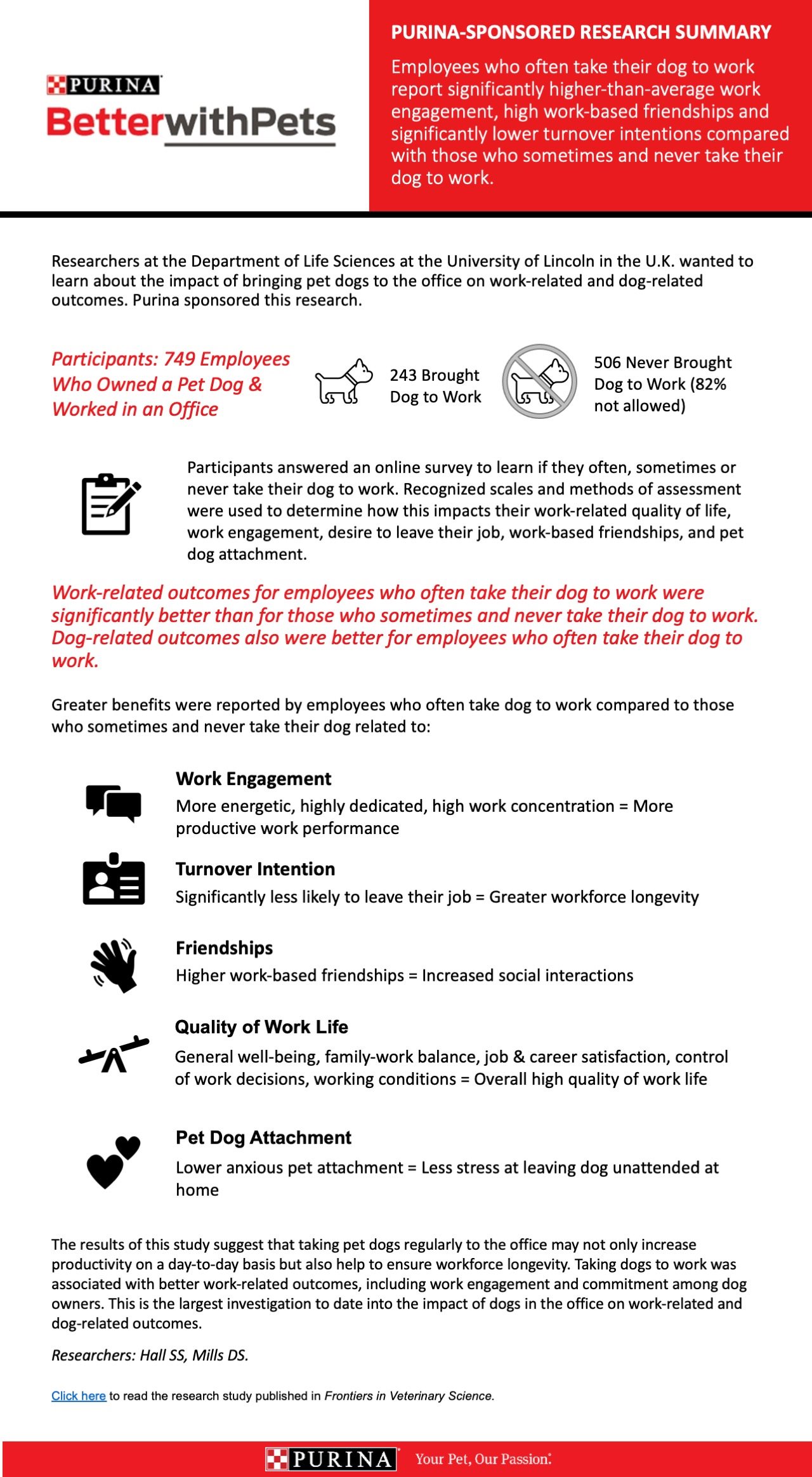
Research sponsored by Purina has shed light on the many benefits that dogs can bring to the workplace. The University of Lincoln study, which surveyed nearly 750 employees, found that bringing dogs to work can have positive impacts on employee well-being, job satisfaction, and workplace culture. The study reported that employees who often take their dog to work report 22% higher satisfaction with their working conditions, revealing four key reasons to include Fido (or Fluffy) in the office culture:

Better Work Engagement

Contrary to the belief that taking dogs to the office could be distracting, the study found that individuals who often or sometimes brought their dogs to work were more engaged with their work than those who never did. Specifically, those who often brought their dogs to work showed higher levels of dedication, absorption, and total work engagement.

Reduced Turnover

The study found that individuals who often brought their dogs to work had significantly lower intentions to leave than those who sometimes or never brought their dog to the office. This suggests that having dogs at work could increase employees’ loyalty to their organization and reduce the risk of turnover.

Stronger Relationships

The study also found that bringing dogs to work could increase employees’ friendship acuity. Individuals who often brought their dogs to work reported significantly higher friendship acuity than those who never did. This means that having dogs at work could help employees build stronger relationships with their colleagues.

Higher Quality of Work Life

Finally, the study found that bringing dogs to work could significantly improve employees’ work-related quality of life. Individuals who often brought their dogs to work reported higher levels of general well-being and a better home-work interface than those who sometimes or never did.

While the research provides solid evidence that bringing dogs to work can have significant benefits for both employees and organizations, there are also benefits to the dogs. Dogs left alone for long periods of time can suffer from separation anxiety and lack physical and mental stimulation. By having the dogs in the office, it can release stress for both the owner and the pet, strengthening their bond.

It is important to note that the benefits of having dogs at work may vary depending on the organizational culture, the type of work, and the specific needs of employees. Therefore, organizations should carefully consider the pros and cons of having dogs at work and implement policies that are in the best interest of their employees and the organization.

The pet experts at Purina, which has welcomed dogs and cats to its St. Louis headquarters for more than two decades, has put together a free toolkit to help create pet-friendly workplaces.

How to Become a Holiday Smart Shopper: Unmissable Steps to Maximize your Budget

2023-10-22T23:01:00

(BPT) – With the holiday season approaching, the days get shorter, the air feels crisper, and our focus shifts to joyful gift-giving and get-togethers. Whether it’s hosting a festive feast for friends and family, finding that perfect gift for a coworker, or decking the halls, the season features plenty of special memory-making moments.

But with economic uncertainty and steep costs of living impacting the average American, prioritizing these moments can be easier said than done. According to a September 2023 CNBC survey, more than half (55%) of households earning $50,000 or less said they’re feeling the impact of the economy on their personal finances. That number jumped to 61% for households earning between $50,000 and $100,000, according to the survey, but one thing is clear – Americans are looking for ways to make their money go further.

This holiday season, you don’t have to miss out on shopping for the moments that matter most. These tips will help you become the ultimate holiday smart shopper and stretch your budget further:

Make your list and check it twice.

With major retailers rolling out deals earlier each year, having a ready list and checking it twice means you’re able to jump on some of the best prices of the season.

Once you decide who you want to give a gift to this year, set a firm limit for how much you’d like to spend on holiday gifts, décor, and experiences. The earlier this is in place, the more time you give yourself to shop sales, compare prices, find coupons, and eliminate costly last-minute impulse buys or paying a dreaded rush-shipping fee in late December.

To make sure you’re getting the best bang for your holiday buck, start price watching the items on your list to determine the best time to buy. PayPal Honey’s Droplist feature allows you to add items you’re interested in to a watchlist and get automatically notified if their price drops, so you can buy at a lower price.

Regardless of when you check out, you can almost always find ways to save. PayPal Honey’s desktop and mobile browser extensions automatically search for and apply available coupon codes and cash back1 offers at checkout, helping you find some of the best deals on your holiday purchases.

Spread out your budget with flexible payments.

Managing your holiday shopping budget requires a well-executed plan, which not only includes who’s on your list, but also how you’re paying for everything. Flexible payment solutions like PayPal Pay Later offer a smart, simple, and secure way to spread payments out over time so you can make space and budget for the moments and memories that will endure well beyond the season.

When checking out with PayPal, shoppers can choose to break up the cost of the purchases – either dividing the cost into four interest-free payments with Pay in 42 or for larger purchases ($199 to $10,000), selecting Pay Monthly3 and breaking the total cost into monthly payments over a longer period of time.

Earn rewards, maximize cashback, and level up your shopping.

One of the best ways to become a savvy holiday shopper is by earning (and maximizing) your rewards and not leaving any cashback on the table. A great starting point? Simply opening the PayPal app.

With PayPal Rewards1, you can discover cashback and rewards in the PayPal app that can help you stretch your budget for all your holiday purchases. Even better, you can also stack credit card points on top of existing deals you find in the PayPal app. For example, if you shop with the PayPal Cashback Mastercard®, you’ll earn 3% cashback4 when checking out with PayPal in addition to any other rewards you earn while shopping in the PayPal app.

Reward stacking indicates you’ve leveled up, so welcome to holiday shopping expert status! But there’s one more tip that can help you save big this holiday season.

Find fellow gift-givers to go big!

Have a friend or family member eyeing an expensive gift? You don’t have to blow your budget to make their holiday wishes come true. For gifts that cost a little more, consider coming together with other gift givers to purchase. For example, you can divide the cost of higher priced electronics with your parents for your sibling’s gift or ask your friends to chip in on elegant new holiday tableware that can rotate with each year’s Friendsgiving dinner host.

You can use PayPal or Venmo to go in on larger gifts with friends and loved ones. It’s easy and free to set up an account on PayPal or Venmo, and they both offer a simple, secure way to send or receive money.

Don’t let budgeting woes or long shopping lists dampen your cheer this holiday season. These tips will transform you into a holiday power shopper, enabling you to stretch your budget and find the perfect gifts. With careful planning and strategic decision-making, you can focus on what matters most: spending time with loved ones, sharing gifts, and creating one-of-a-kind holiday memories.

1. Eligible items only. Redeem points for cash and other rewards. Terms and exclusions apply.

2. Pay in 4 is subject to approval. Eligibility varies by state. CA: Loans made or arranged pursuant to a CA Financing Law License. GA: Installment Lender Licensee, NMLS #910457. RI: Small Loan Lender Licensee. NM residents: Find more disclosures related to Pay in 4. Learn more at paypal.com/payin4.

3. Pay Monthly is subject to credit approval. Fixed APR is 9.99-35.99% based on your credit. Rates as low as 4.99% from time to time. Terms may vary based on the purchase amount. Offer availability varies by state, merchant, and purchase amount. The lender for Pay Monthly is WebBank. PayPal, Inc. (NMLS #910457): CT Small Loan Licensee. RI Loan Broker Licensee. VT Loan Solicitation Licensee. Learn more at paypal.com/buynowpaylater.

4. Applications are subject to credit approval. The PayPal Cashback Mastercard is issued by Synchrony Bank pursuant to a license by Mastercard International Incorporated. Purchases are subject to credit approval, and the PayPal Cashback Mastercard must be used for payment. See Rewards Program Terms for details and restrictions.

Take control of your finances: 3 tips for improving your financial journey

2023-10-23T10:01:01

(BPT) – If you’re just beginning your financial journey, it might feel overwhelming. Finances are one topic many are unwilling to talk about, leaving you on your own to figure out basics like budgeting, building your credit score or negotiating your first salary.

To help young women develop skills so they won’t have to sweat the stress, Secret Deodorant has gathered resources and partnered with financial experts to provide young women the tools they need not just to survive, but thrive. Through their “No More Financial Secrets” initiative, Secret Deodorant is offering free resources, and tips from a diverse group of financial experts at Secret.com/MoneyMoves.

One of these experts is Carmen Perez, creator of the MUCH budgeting app, which helps individuals manage their money and paychecks.

“While finances may seem intimidating when you’re just starting out, remind yourself how far you’ve come,” said Perez. “Don’t be afraid to face finances head on, talk to trusted people and use resources available to you.”

Here are some tips to help empower you on your journey to financial wellness.

Get a clear picture of your finances

While the word “budget” can sound scary, it just means making a plan for how to best use your money. You need to understand your financial picture before planning where you want to go. It begins with two steps: know how much money is coming in (what you earn) and how much is going out (tracking all your spending). Budgeting apps can help you get started.

“Always make sure your needs are being met before spending on wants,” Perez recommended. “If you spend more than you earn, you’ll need to make some changes, or you could end up in debt.” If you find yourself in a situation where you have more bills than income, your first focus should be on increasing your income. Increasing your income could look like taking on a side hustle temporarily, learning a new in-demand skill, asking for a raise, or changing jobs to get a bump in pay.

After tracking your spending for a few weeks, you’ll see areas where you could cut back. Some costs are essential (like rent and utilities, food and debt repayment), but other areas may be possible to trim, like going out to eat and non-essential purchases.

How to build your credit score

Having a good credit score makes it possible to open new credit cards or get loans, to buy a car or home — and can even impact your ability to rent an apartment. From a lender’s point of view, a good credit score means you’ll be reliable when paying your bills.

To build a good credit history, you need to use credit (make occasional purchases on a credit card), then pay your bills on time every month (preferably in full). You shouldn’t use over 30% of your available credit, so if a card is maxed out, it’s time to pay down debt more aggressively.

“Building a good credit score takes time,” advised Perez. “But the habits you need to get a good credit score, like paying bills on time and not over-using credit, are financial habits that will benefit you throughout your lifetime.”

Use your digital calendar or a bill payment app to help you monitor due dates so you don’t miss payments, because even one late payment on a credit card can negatively impact your credit score for years.

Negotiating your first salary

Negotiating your first salary can be nerve-wracking, but it’s a crucial part of the job process. Start by researching the typical salary range for your position in your area. Understanding your own value is key; think about what skills and experiences you bring to the table.

Be prepared to describe the skills, knowledge and experience that make you a valuable employee and do your research! Understanding the salary range for the role and what types of salary packages are common for someone with your level of experience will help you during the negotiation period. If the offer seems low, ask about other benefits, which can be part of your overall compensation package. If your skills meet or exceed the requirements of the position, it’s reasonable to ask for 10-20% more than the initial offer.

Remember, they are expecting you to negotiate and you don’t have to accept the job offer immediately. Tell them you’d like to take a day or two to consider it, then take time to weigh the pros and cons, and consult trusted friends or family members.

“Talking about salaries and money can seem uncomfortable, even with good friends or relatives,” added Perez. “But discussing your offer with others who’ve been through similar situations is very helpful. Don’t be afraid to ask questions when you’re dealing with new circumstances.”

Developing the ability to achieve your financial goals is within your reach. Visit Secret.com/MoneyMoves to access free educational resources and tips to help you on your financial journey.

Game changer: The woman-led company driving the future of competitive mobile gaming

2023-10-23T07:31:00

(BPT) – You might not realize it, but just about everyone you meet is a gamer, no matter their age. According to the Entertainment Software Association (ESA), 65% of Americans play video games regularly, and the number of people over 45 who play them is about the same as those under 18.

Mobile games of skill that bring the fun anytime, anywhere are a large factor in that growth. While you may not have heard of skill games, chances are you’ve played a few; games like Chess, Solitaire, Atari Breakout and others that rely on the player’s skills as opposed to chance, all fall into the category. The genre’s popularity is only expected to continue: according to Forbes Business Insights, the skill-based gaming market is expected to grow from $35.61 billion in 2023 to $85.34 billion by 2030.

A major player in the category is WorldWinner. A pioneer in the category with over two decades of experience with skill gaming, WorldWinner is a recognizable and trusted brand in the space. The platform’s parent company, Game Taco, recently announced they are taking on WorldWinner as their consumer brand name. Recently recognized as one of the top players in the skill gaming category by Fortune Business Insights, the company is likely to keep dominating the competition under the WorldWinner name and the leadership of newly appointed CEO Nancy MacIntyre.

Proven results from a driven entrepreneur

Named to the position of CEO in May, MacIntyre has been with the company since 2021. During her time as General Manager, MacIntyre changed the way the company went to market to drive user engagement. Improvements driven by MacIntyre include a major revamp to WorldWinner’s tournament programming, the creation of innovative new games and a new “Rookie Rewards” program for new players. These efforts, among others, helped double WorldWinner’s userbase and triple its amount of entry fees.

MacIntyre was also part of the team who helped execute a partnership with FanDuel, a first-of-its-kind industry collaboration between a skill-gaming and sportsbook/daily fantasy sports company. Together, the companies developed and launched FanDuel Faceoff. The mobile-based skill gaming platform allows players to use their existing FanDuel accounts and wallets to jump right into the action with a whole new portfolio of skill-based games.

“FanDuel partnered with Game Taco (now WorldWinner) over two years ago to extend FanDuel’s offerings to include skill gaming and give our customers an entirely new experience,” said Aaron Champagne, General Manager and Vice President of DFS, Faceoff and Free to Play at FanDuel. “We appreciate our partners at Game Taco’s deep experience in delivering meaningful, innovative game experiences to all segments of consumers; it has been essential to making FanDuel Faceoff a success. The WorldWinner team understands the skill gaming customer and has helped us grow engagement and give our customers even more to enjoy.”

A creative leader for a creative company

MacIntyre is no stranger to innovation or the spotlight, having worked as an executive at globally recognized companies including Hasbro Interactive, Lucasfilm and LeapFrog. She also founded and led Fingerprint, an entertainment company for kids that was eventually acquired by Sandbox Kids. During her tenure, MacIntyre grew the company through inventive, new practices that have since become mainstream.

MacIntyre faced and solved many challenges at Fingerprint, which was initially launched into a crowded app marketplace. To stand out, she created a product experience for children that would deliver games, books and music all in one application that was sold direct-to-consumer through mobile carriers like Verizon and T-Mobile and hardware leaders like Samsung and Gateway. Fingerprint was designed as a completely safe, walled-garden experience that parents could trust and kids would love.

Much like MacIntyre, WorldWinner has always been committed to understanding and growing with its userbase. Founded in 1999, the company pioneered cross-platform skill-gaming and now boasts a loyal user base that has spanned 20-plus years. Since its inception, WorldWinner has had over 34 million users who have played over 4 billion games and competed in more than 1.6 billion cash tournaments, with an average of 5 million tournaments played monthly. To date, WorldWinner has awarded users over $2 billion in cash prizes.

The rise and future of mobile-based skill games

MacIntyre credits her ongoing success to understanding the customer and what motivates players, especially on mobile. Much like the skill gaming market, the mobile app market is set to grow significantly through 2025 and is projected to reach $270 billion. According to YouGov, 42% of American adults play at least one hour of mobile games per week.

Mobile games also attract a more diverse user base. Mobile game users don’t necessarily identify as gamers in the traditional sense but enjoy “killing time” with mobile games. These casual players will be key in growing the mobile game market.

“Mobile is an integral part of our lives and what we do for entertainment; everyone has a device putting everything right at their fingertips all the time,” said MacIntyre. “In the mobile space, we’re competing not just with other games but also music, videos, social media, you name it. As a result, you can no longer succeed just by creating a great app — the mobile experience also must give consumers what they want and that’s connection.”

Eat more to live longer: 5 tips from a preventive medicine doctor

2023-10-22T23:01:00

(BPT) – When it comes to diet, there seems to be a constant stream of extreme, contradictory advice out there. A news report may say one kind of food is “deadly,” while superfoods are promoted by social media influencers. The result: If you’re concerned about health, you may be sacrificing flavor and cutting back on foods you love—without reaping any rewards.

But what if instead of eating less, you could live a long, healthy life by eating more?

That’s exactly what Dr. Michael Crupain says everyone should be doing. As a board-certified preventive medicine physician with a personal mission to make the world a healthier, more delicious place, Crupain has spent decades studying biology, nutrition, and health in the halls of academia while also honing his culinary skills in top restaurant kitchens and alongside home cooks around the world.

Now, he’s combined knowledge from both worlds into a new cookbook, The Power Five: Essential Foods for Optimum Health, published by National Geographic. Filled with over 75 recipes, The Power Five will help you eat more delicious foods and improve your health at the same time.

What are the Power Five foods?

1. Fruits and vegetables for life

According to the U.S. Department of Agriculture, most people eat only about half the recommended amounts of fruits and vegetables. That’s why Crupain turned his kitchen into a lab, studying techniques from grandmothers and master chefs to develop recipes with flavor and texture combinations to help home cooks turn vegetables into mouthwatering meals.

“Increasing fruits and vegetables in your life starts with finding the best in-season ingredients and learning simple techniques to transform them into dishes even the pickiest eater will enjoy,” says Crupain. “These recipes let you tap into the science of longevity and include more powerful, nutrient-dense foods in your life. Fruits and vegetables are loaded with fiber, antioxidants, vitamins, and minerals to power your cells and lower the risk of heart disease, stroke, diabetes, other inflammatory diseases, and even some cancers.”

2. The magic of beans

This member of the Power Five is often associated with magic, and while they may not be supernatural, they are a powerful protein source. Beans are rich in antioxidants and healthy fiber, and they also feed the good bacteria in your gut that transform them into other nutrients important for health. Impressively, beans power the diets of the people who tend to live the longest around the world.

Beans are also versatile because there are so many kinds—over 400, actually. With all this diversity, Crupain says it’s easy to find something to love.

“Whether you choose canned beans or the amazing varieties you can find dried, beans can be added to almost any dish,” says Crupain. In The Power Five you can find them in recipes substituting for chicken, in a creamy sauce, or as a complement to pastas.

3. Whole grains you can love

With so much anti-carb sentiment in the media, you may be surprised—and excited—to learn that a nutrition expert wants you to eat more bread and pasta. According to Dr. Crupain, our bodies quickly turn the refined grains we usually eat into sugar, which promotes inflammation and easily becomes excess calories.

But whole grains are different. Whole grains contain layers called the bran and germ, which provide fiber, fats, and other important nutrients. Eating whole grains is associated with a lower risk of high blood pressure, heart disease, and diabetes. In The Power Five Crupain shows readers how to make whole grain pasta, breads, and even desserts that taste more like their refined counterparts than bland health foods. See below for a Whole Wheat Sourdough Lasagna Bread recipe to try.

4. The unique benefits of fish

In general, people eat enough animal products, but that’s not true for fish. Unfortunately, says Crupain, many people just don’t want to eat fish, so he spent months developing tasty fish recipes, creating techniques to help readers access this amazing source of healthy omega-3 fatty acids by maximizing flavor and minimizing effort.

If you eat just one or two servings of fatty fish (think salmon or trout) a week, studies suggest you can decrease the risk of death from heart disease dramatically. Omega-3 fatty acids are also a powerful nutrient for brain development in babies and support the nervous system. Eating fish seems to reduce the risk of stroke and dementia as well.

“Sustainability becomes a big issue when we think about people eating more fish,” says Crupain, “but more sustainable fish farms are helping meet the demand. In The Power Five I teach people recipes for steelhead trout, a fatty fish loaded with omega-3s that’s found in both elite kitchens and at your local grocer. It has a mild flavor, and when you follow the techniques in the book, I guarantee even people who don’t love fish will change their minds.”

5. Big nutrition in little packages: Nuts and seeds

While everyone searches for the next superfood, it turns out some of the most powerful foods come in the smallest packages. Tiny but mighty nuts and seeds are supersized by mounting evidence showing they can lower your risk of heart disease and diabetes. While you might avoid these Power Five foods because they’re relatively high in fat, Crupain says you should be doing just the opposite.

“Nuts and seeds are nutrient-dense foods loaded with good healthy fats,” Crupain notes. “Eating more healthy fats, instead of saturated fats, is associated with lower lousy cholesterol levels and lower risk of heart disease.” Nuts are also a great snack, like one of Crupain’s favorites, California walnuts, which are an excellent source of omega-3s. In The Power Five you’ll discover how to use nuts and seeds to add texture to a dish or even replace cream.

Check out one of Dr. Crupain’s recipes featuring whole grains, from The Power Five:

Whole Wheat Sourdough Lasagna Bread
Serves 6 to 8. Prep time: 14 hours. Cook time: 1 hour.

Lasagna is comfort food at its best and is one of life’s great pleasures. This recipe is a bit of a showboater if you want to take your sourdough making to the next level. It gets a bit messy when you’re hiding thin layers of cherry tomato sauce and cheese between bread—but it’s worth it.

Ingredients:

40 grams whole wheat flour
1 tablespoon sourdough starter
50 grams extra-virgin olive oil, plus more for pan
6 grams salt
200 grams whole wheat durum flour
100 grams whole wheat bread flour
2 1/2 cups cherry tomato sauce (see recipe, page 32, or use your own thin tomato sauce)
1 cup grated Parmigiano-Reggiano cheese

Method:

1. Prepare dough: Combine 40 grams of water, the whole wheat flour, and the starter. Let rise until at least doubled (somewhere between 6 and 10 hours, depending on room temperature and your starter. If you do this before bed, it can be ready when you wake up).

2. Combine the fed starter with 150 grams of water. Stir to combine. Add olive oil and salt, and combine. Stir in durum and bread flours, and mix with hands until well combined. Let rest in covered bowl for 30 minutes.

3. Turn dough out onto lightly damp work surface. Knead using slap-and-fold technique by lifting the dough and smacking the end onto the work surface and folding the opposite side of the dough over top. Rotate the dough 90 degrees and repeat the slapping and folding for 8 minutes (check out Breadtopia’s video of this method). Return dough to bowl, cover, and let rest for about the same time that was required to let your starter double in size in step 1 to allow dough to ferment (6 to 10 hours). This dough is stiff, and you may not notice it grow much.

4. Prepare bread: Preheat oven to 375°F. Rub loaf pan with oil and line with parchment paper on all sides. You can use two pieces, one cut to fit the long way and one the short way.

5. Roll dough to 1/8-inch thickness on work surface, aiming for an approximately 24-inch square. Don’t worry if you end up with something irregularly shaped; you can fix it as you fold it up. Rub dough with olive oil, and top with a thin layer of tomato sauce; sprinkle with cheese. Then fold dough in half, creating a rectangle. Repeat layering with oil, sauce, and cheese, and fold in half again so you again have a square. Repeat layering and folding two more times, until dough is approximately the length of the loaf pan. (It’s OK if it’s a little bigger.) Transfer dough to prepared pan (the loaf will be delicate at this point, with so many layers of sauce, so transfer with the aid of a large spatula or bench scraper). Top with light layer of remaining sauce (there shouldn’t be too much left) and cheese.

6. Place loaf pan on parchment paper–lined sheet pan, and place in oven. Bake for 1 hour, rotating pan halfway through. If top darkens too quickly, you can cover with foil. It’s hard to tell when it’s done from looking at it, so use an instant-read thermometer. It should read 212°F when inserted into center. Let cool on wire rack until cool enough to handle. Use the parchment paper to lift bread out of loaf pan or turn over to unmold. Cut into slices, and serve warm or at room temperature.

Sound delicious? You can get started on your own journey to better health through eating more by reading Dr. Crupain’s book and trying some of the many recipes in The Power Five: Essential Foods for Optimum Health, available wherever books are sold.


5 Steps for a Successful New Flooring Installation

2023-10-20T08:41:00

(BPT) – When it comes to giving your home a fresh, new look, few projects are as transformative as a flooring installation. Whether you’re tired of that old carpet or seeking to enhance your living spaces, the journey to a new floor can be both exciting and daunting. To ensure your floor remodeling project meets your expectations, follow these five essential steps:

1. Select the Best Flooring Type

What’s the best flooring? The perfect flooring type suits your lifestyle and aesthetic preferences. With a wide array of flooring materials available, the decision can be overwhelming. From the warmth of hardwood to the practicality of laminate, each type has its unique advantages and drawbacks.

In a recent survey by Modernize Home Services, most homeowners — 16% of total respondents — planning a flooring remodel project in the next 12 months intend to choose laminate. It’s a top choice for many due to laminate floor durability and affordability. Hardwood and tile floors were tied closely behind with 15% each.

To make an informed choice, explore Modernize’s comprehensive guide to flooring types. This resource, available at no cost, offers a clear summary of various flooring types and includes a helpful quiz to assist homeowners in making the perfect selection.

2. Research the Cost of Flooring Installation

One of the most crucial aspects of planning a flooring project is understanding the cost involved. The expenses can vary based on factors like your location and the specific flooring materials you choose. So, it’s essential to research local flooring installation costs to set a realistic budget for your project.

To gain a better understanding of the cost of flooring installation, read Modernize’s guide to flooring costs.

3. Identify Skilled Contractors for Flooring

Selecting the right contractor for your flooring project is as vital as choosing the flooring material. A skilled and experienced professional can make a big difference in the quality of the installation. Look for contractors who specialize in flooring projects and have a solid track record of successful installations.

Ask family and friends for recommendations and use an online contractor matching service, such as Modernize.com, to connect with experienced professionals in your area. Review floor remodeling professionals’ business profiles, such as this overview of Empire Today, to understand a flooring contractor’s experience and expertise before requesting a quote for your project.

4. Order Flooring Materials

Once you’ve chosen the best flooring type and identified a reliable contractor, it’s time to order the necessary materials. Depending on the flooring type you’ve selected, the required materials can vary. Work closely with your floor remodeling contractor to ensure all materials are ordered before your planned installation so that your project stays on schedule and is completed in a timely manner.

5. Prepare the Space for Installation

As you prepare for a new flooring installation, get your space ready. This involves clearing the area of any obstructions that might hinder the process.

While contractors typically handle moving large furniture, it’s the homeowner’s responsibility to pick up toys, shoes and small items from the floors. Additionally, items like standing lamps, decor and other smaller items should be moved to allow for a seamless installation process.

Flooring Renovation Return on Investment (ROI)

All flooring projects can potentially increase your home’s value, particularly when installing hardwood, tile or good-quality carpet. Modernize explains how to approach calculating the return on your flooring project and advises homeowners to maximize flooring renovation ROI by upgrading strategically, choosing materials that best balance aesthetics and value, and selecting neutral flooring colors that complement any decor style.

Enhancing the beauty and value of your home has never been more accessible. Learn more about how new floors can be a valuable investment on Modernize.com: Calculating the Return on your Flooring Project.

Paxton Embraces Childhood With A First-in-Class Treatment for Hemophilia A

2023-10-20T07:01:00

(BPT) – Article is sponsored and developed by Sanofi. Jenny and Paxton were compensated by Sanofi and received free product through Sanofi’s Patient Support Program.

As a parent, there is no formula for raising a happy and healthy child. For Jenny and her son Paxton, it’s been a balancing act; struggling to find treatment for his hemophilia A while giving him a typical childhood full of happy memories. Yet, the duo navigated his condition as a team so Paxton could live his young life as smoothly as possible.

Their journey started shortly after his birth, when Paxton showed the telltale signs of hemophilia A, a rare, lifelong condition in which the ability of a person’s blood to clot properly is impaired.1,2 This can lead to excessive bleeds or spontaneous bleeds into joints that can result in joint damage, chronic pain, and potentially impact quality of life.1 His first few months were smooth sailing and Jenny was hopeful that life with hemophilia A would be manageable for her and Paxton.

However, once Paxton turned seven months old, Jenny noticed a large purple sore under his tongue that would mark the beginning of the next few years of his life in and out of the hospital. His visits ranged from three to four times a month, receiving infusions for his bleeds that could take up to five hours in the hospital.2 As he endured the pokes and pain from his treatments, Jenny struggled to cope at first but strived to embody the strength Paxton needed not only from a mother to son, but also as teammates in managing a chronic condition together. And Paxton was the MVP.

“I made it my goal to set a positive example for Paxton and be his fiercest advocate,” Jenny said. “To follow through with my promise to ensure he had a strong, beautiful childhood full of happy memories, hemophilia or no hemophilia.”

Jenny was initially reluctant to switch from on-demand treatment to prophylaxis with recombinant factor VIII due to the number of injections. But after learning how prophylaxis could potentially decrease the number of bleeds and help protect Paxton’s joints, Jenny’s mindset shifted. Now putting prevention first, this team made the switch when Paxton was five years old and he responded well to treatment, seeing a reduction in his bleeds and allowing him to participate in the activities he enjoys.

“Shifting to prophylaxis treatment fit our schedules, but our needs changed again as Paxton got older and more active. With that increased activity, we knew his body could potentially have an issue as his factor levels decreased and reached his trough level,” Jenny said. Trough levels measure factor VIII in the blood, which is essential for evaluating the risk of bleeding.2 When trough levels or factor activity levels are low, there is a higher risk of bleeding, so it’s important to maintain factor levels.2

Jenny became interested in learning more about ALTUVIIIO® [antihemophilic factor (recombinant), Fc-VWF-XTEN fusion protein-ehtl], a first-in-class factor VIII treatment for adults and children with hemophilia A that offers once-weekly dosing.3 With ALTUVIIIO proven to maintain factor activity levels in the normal to near-normal range (over 40%) for most of the week in adults and two to three days in children,3 Jenny considered this a potential option for her son and their team.

Their consultation with Paxton’s other teammate, his hematologist, helped them to learn more about ALTUVIIIO and its most common side effects, including headache, joint pain and back pain, and the possibility to develop inhibitors while taking the treatment. After switching to ALTUVIIIO, Jenny and Paxton both expressed a sense of freedom brought by its once-weekly dosing.3

“ALTUVIIIO gives us peace of mind knowing that Paxton’s factor levels stay higher throughout the week, so he can keep his head in the game and enjoy being a kid,” she said. Paxton’s new dosing schedule allows him to infuse once a week, giving him more time to do the activities he loves.

Now in the 8th grade, Paxton and his mother encourage others affected by hemophilia to build a supportive team that helps them focus on their life goals. “As a parent, there is no greater reward than watching my son chase life with so much passion,” Jenny said.

Patient experiences on ALTUVIIIO may vary so please talk to your doctor when making treatment decisions. To learn more, visit ALTUVIIIO.com.

INDICATION

ALTUVIIIO® [antihemophilic factor (recombinant), Fc-VWF-XTEN fusion protein-ehtl] is an injectable medicine that is used to control and reduce the number of bleeding episodes in people with hemophilia A (congenital Factor VIII deficiency).

Your healthcare provider may give you ALTUVIIIO when you have surgery.

IMPORTANT SAFETY INFORMATION

What is the most important information I need to know about ALTUVIIIO?

Do not attempt to give yourself an injection unless you have been taught how by your healthcare provider or hemophilia center. You must carefully follow your healthcare provider’s instructions regarding the dose and schedule for injecting ALTUVIIIO so that your treatment will work best for you.

Who should not use ALTUVIIIO?

You should not use ALTUVIIIO if you have had an allergic reaction to it in the past.

What should I tell my healthcare provider before using ALTUVIIIO?

Tell your healthcare provider if you have had any medical problems, take any medications, including prescription and non-prescription medicines, supplements, or herbal medicines, are breastfeeding, or are pregnant or planning to become pregnant.

What are the possible side effects of ALTUVIIIO?

You can have an allergic reaction to ALTUVIIIO. Call your healthcare provider or emergency department right away if you have any of the following symptoms: difficulty breathing, chest tightness, swelling of the face, rash, or hives.

Your body can also make antibodies called “inhibitors” against ALTUVIIIO. This can stop ALTUVIIIO from working properly. Your healthcare provider may give you blood tests to check for inhibitors.

The common side effects of ALTUVIIIO are headache, joint pain, and back pain.

These are not the only possible side effects of ALTUVIIIO. Tell your healthcare provider about any side effect that bothers you or does not go away.

Please see full Prescribing Information.

References

  1. What is hemophilia? Centers for Disease Control. July 17, 2020. https://www.cdc.gov/ncbddd/hemophilia/facts.html. Accessed September 26, 2023.
  2. Srivastava A, et al. WHF Guidelines for the Management of Hemophilia Third Edition. Haemophilia. 2020; 26 (Suppl. 6): 1-158. doi: 10.1111/hae.14046.
  3. ALTUVIIIO [antihemophilic factor (recombinant), Fc-VWF-XTEN fusion protein-ehtl] prescribing information. Bioverativ Therapeutics, Inc. March 2023.

MAT-US-2308462-v1.0-10/2023

© 2023 Genzyme Corporation. All rights reserved.

ALTUVIIIO and Sanofi are registered trademarks of Sanofi or an affiliate.

Seniors: When you exercise your body, you can boost brain health, too

2023-10-20T16:33:00

(BPT) – Physical fitness is important as you age, improving strength, flexibility and balance. Research shows that your morning stretch, daily walk or weekly fitness class is doing more than just helping your body feel its best; it’s supporting your brain health, too.

Staying physically active can help older adults maintain — and even improve — mental function, while lowering the risk of developing chronic illness. According to the Alzheimer’s Society, regular exercise can reduce a person’s risk of developing dementia by approximately 30%, and for Alzheimer’s specifically, that risk can be reduced by 45%.

In addition to risk reduction, exercise can be beneficial for seniors who are currently experiencing cognitive issues. Physical activity is a common part of treatment plans for people with dementia or Alzheimer’s disease and can help dementia patients manage and potentially reduce symptoms.

One exercise program with something for every ability is SilverSneakers, a fitness program available at no cost to Medicare Advantage members in participating health plans to stay physically active, socially engaged and mentally sharp. The program has been serving people aged 65 and older for more than 30 years.

It is never too late to start exercising

Even if you start a workout routine later in life, the benefits to your brain and body are abundant. Talk with your doctor about beginning physical fitness and consider options of interest that are available to you. Exercising with friends or joining a fitness class designed for older adults can help you feel comfortable while trying something new.

Sims Corbett is a SilverSneakers instructor who is passionate about senior fitness. One of her favorite things about her job is helping older adults discover a passion for exercise and physical activity, even if they’ve never set foot in a gym before.

“Members have access to thousands of gyms, in-person and virtual classes, and platforms designed to foster social interaction and mental well-being, which becomes even more important with age. As an instructor, I see how regular exercise can benefit everyone, at every age,” said Corbett.

SilverSneakers offers our members access to more than 22,000 participating locations with 100+ weekly live virtual classes and 45,000 virtual programs focusing on balance, fall prevention, strength, flexibility, cardiovascular health and much more.

Medicare Annual Enrollment Period is underway through Dec. 7 so now is a perfect time for seniors to choose a plan that offers benefits like fitness. For more information and to check eligibility, visit getsilversneakers.com.

Senior workout inspiration

If you want to start exercising, Corbett recommends choosing activities you will enjoy. “Fitness should be fun. I encourage seniors to take a moment to think about what they have enjoyed doing in the past and what has piqued their interest over the years. Did you take dance classes growing up? Love to swim? Have you always been curious about yoga? We’re all more likely to continue doing something that we enjoy.”

Some SilverSneakers classes that are good for the body and mind include aerobic classes like Cardio Interval, Walk Strong and Line Dancing. These classes can help patients manage and reduce symptoms related to cognitive functioning.

When you start, you might decide to exercise with a partner or in a group, which can add a fun social element while keeping each other accountable. However, this is not essential, and even if you exercise alone at home as your schedule allows, you’ll reap many benefits.

While fitness classes are great for guided exercise and making new friends, remember that activities like walking, biking or even household chores like gardening, vacuuming or playing with the dog are all good options for moving the body. All movement — even standing more — can be beneficial for physical and mental wellness.