Finding relief for severe eczema: new advanced treatments

2024-09-20T10:01:00

(BPT) – Do you have intensely itchy, flaky skin that flares up during certain times of the year or in certain conditions? Does the itching get so bad it interrupts your sleep? Does your incessant scratching cause skin to crack, ooze or become infected?

If these symptoms sound familiar, you may have moderate to severe eczema. And you’re not alone. Among the 31.6 million people living with eczema in the United States, 40% of adults and 33% of children have moderate to severe eczema.

What is eczema?

Eczema, also called atopic dermatitis, is a chronic, inflammatory skin condition. It causes itchy, painful rashes.

While the cause of eczema is unknown, doctors believe it’s related to:

  • genetics or family history of the condition;
  • an overactive immune system that causes skin inflammation when exposed to allergens and irritants;
  • a defective skin barrier that allows moisture to escape the body, and allergens and bacteria to enter.

Eczema can appear on the face, neck, hands, wrists, elbows, knees, ankles and feet. Common symptoms include:

  • Red bumps, blisters or patches on light skin
  • Brown, purple or ashen gray bumps, blisters or patches on dark skin
  • Itchiness
  • Dry skin
  • Swelling
  • Flaky, scaly or cracking skin
  • Open, oozing skin
  • Thickened skin
  • Raw or sensitive skin due to scratching

When eczema is moderate to severe, symptoms are often widespread across the body. The inflammation causes intense, constant itching. This leads to the natural response of scratching. And unfortunately, too much scratching can then cause an infection if the surface of the skin is broken. Signs of an infection include crusty skin (often on top of the eczema), swollen bumps and pus-filled blisters.

Moderate to severe eczema can significantly impact your quality of life. It may affect your ability to do daily tasks and disrupt sleep at night.

How to manage and treat eczema

While there’s no cure for eczema, treatments are available that can help reduce symptoms and break the itch-scratch cycle.

You can also take steps to avoid what triggers your symptoms. Because each person has specific triggers that may cause or worsen eczema, it’s helpful to track and identify when and where your symptoms are at their worst. Typical eczema triggers include:

  • Contact allergies to jewelry, cosmetics, cleaning or skin products
  • Dry skin
  • Dust mites that live in mattresses, carpets, pillows and furniture
  • Environmental allergies like pollen or mold
  • Food allergies to foods like tree nuts, shellfish or wheat
  • Pet dander
  • Hormonal changes around menstruation, pregnancy or menopause
  • Outdoor temperatures including excessive heat or severe cold
  • Skin irritants like heavy or tight clothing, certain fabrics or detergents
  • Stress
  • Cigarette smoke

It’s common to have more than one trigger. Some may be easier to avoid than others.

If you’re unable to identify your triggers, see a board-certified allergist or dermatologist for testing. These specialists can accurately pinpoint your triggers and recommend treatments.

The first line of treatment for mild to moderate eczema typically involves moisturizers and topical medications like corticosteroids, calcineurin inhibitors and PDE4 inhibitors. These medications help reduce skin inflammation, irritation and itch.

Advanced treatments for moderate to severe eczema

What can you do when eczema is moderate to severe and topical medications do not provide enough relief?

Ask your doctor about more advanced treatments. Biologic medications and Janus Kinase (JAK) inhibitors are two options. They target the source of eczema symptoms rather than the symptoms themselves, stopping skin inflammation at the cell level before it can start.

JAK inhibitors are approved to treat mild, moderate and severe atopic dermatitis in adults and children ages 12 and older whose symptoms are not adequately controlled with topical medications. Three JAK inhibitors are available for atopic dermatitis. Two are taken daily as a tablet or liquid. A third is a topical applied to affected skin twice a day — but on no more than 20% of the body.

Biologic medications dupilumab (Dupixent®) and tralokinumab (Adbry®) are approved to treat moderate to severe atopic dermatitis in people whose symptoms are not adequately controlled with all other medications. Dupilumab and tralokinumab prevent certain cells in the body from activating and causing skin inflammation.

Dupilumab is prescribed to adults and children ages 6 months and older. Tralokinumab is for adults and children 12 years of age and older. Both are given as injections every 1-4 weeks, either in the doctor’s office or at home with an auto-injector pen. You can learn more about biologics for severe eczema at BiologicMeds.org.

Don’t just put up with constant eczema symptoms when you can take action to start finding relief. See a board-certified allergist or dermatologist and ask about the latest treatments.


Expert tips to help you overcome chronic pain

2024-09-20T07:01:00

(BPT) – Chronic pain is defined as pain that persists for three months or longer. According to the Centers for Disease Control and Prevention (CDC), approximately 100 million Americans live with chronic pain, highlighting the widespread nature of this condition.

“We see many kinds of chronic pain in our offices,” said Dr. Steven Knauf, Vice President of Chiropractic and Compliance at The Joint Chiropractic. “Chronic pain is often an indication of an underlying condition that doctors of chiropractic may help identify and treat. In addition, a doctor of chiropractic may help patients understand how to prevent pain in the future and keep their bodies strong.”

In honor of Pain Awareness Month this September, learn more about how to best cope with and reduce the chronic pain you may be living with.

Some of the most common causes of chronic pain include:

  • Injuries: Various injuries often lead to chronic pain, which can include everything from sports injuries and accidents to overuse injuries that can occur due to repetitive motions.
  • Osteoarthritis: This condition causes inflammation and pain in the joints that worsens over time, and may occur in older adults and those with a family history of osteoarthritis.
  • Headaches: While they may have many causes depending on the type of headache (such as migraines versus tension headaches), headaches are a type of chronic pain that can impede your everyday functioning.
  • Spinal stenosis: Mechanical issues in the spine can cause narrowing of the spinal canal where the spinal cord passes through, leading to ongoing pain.

Tips to help manage and prevent pain

Whatever type of chronic pain you’re experiencing, it’s a good idea to see a healthcare provider to help determine the underlying causes and practices that can help eliminate your pain. For example, chiropractors often recommend that exercise can help stave off back pain. As your body sits sedentary, tension can build, causing great pain over time. Chiropractors insist that exercise is the most beneficial way to improve your ability to manage pain throughout your body.

“In many cases, being active is one of the most effective ways to manage and prevent chronic pain, but pain itself can keep people from moving,” said Knauf. “Unfortunately, this can lead to a downward spiral of inactivity and more pain.”

The good news is, as little as 30 minutes of exercise each day can help release tension in your body to help manage chronic pain, as well as other regular practices.

Here are tips to help you prevent and better cope with many types of chronic pain:

  • Deep breathing: Taking deliberate, deep breaths can relax tension and release muscles, which also promotes better rest and sleep so your body can recover from and relieve pain. You may want to try a breathing or relaxation app for exercises to get you started.
  • Stretching: Prevent muscles from becoming too tense and sore by trying some gentle stretching in your daily routine. It’s recommended to warm up muscles a little first to avoid injury. Consult a healthcare professional or experienced trainer for the best ways to stretch safely, given your current condition.

Handling pain relief on the job:

  • For physically demanding jobs it’s important to stretch periodically, and equally important to find time to get off your feet when possible. Allowing yourself little breaks from standing is a good way to help eliminate stress and tension from the joints at the spine. Even if your job is demanding, there’s always time for a 10- to 15-minute break. Chiropractors suggest taking a break every couple of hours to best benefit your back. Take advantage of your breaks to put your feet up and rest.
  • Desk jobs can create the opposite problem from too much sitting. Try to take frequent breaks to get up and stretch or walk around your desk. Move your legs and arms to reduce stiffness, or leave your desk for a little while so your muscles and joints have a chance to exercise and move. Pay attention to your posture while you’re sitting throughout the day, as well. Ensure your back is straight so you’re not leaning forward or straining your neck. Arrange your keyboard and computer at a comfortable distance that does not create back problems.

Commit to routine chiropractic care

Getting regular chiropractic care is another great tip to try that may help you find relief from your chronic pain. Chiropractors work with the vertebrae of the spine and surrounding joints to improve quality of life by restoring the ability to move and improve the body’s ability to handle physical stress.

To find a chiropractor near you, visit TheJoint.com.

Using these tips, you can help to better manage and prevent your chronic pain so you can feel your best whether you’re at work, at rest or at play.

Taking steps to prevent falls

2024-09-19T20:01:00

(BPT) – When you’re young, an injury from a fall may sideline you for a few days or weeks, but a full recovery is usually quick. As you get older, the consequences of falls are more serious, setting up a sequence of events that can have longstanding implications on independence and health.

Although falls become more common and can be more serious as you age, they are not a natural part of getting older. In fact, most falls are preventable. Knowing the risk factors and steps to prevent falls is important.

Risk factors for falls include overall health (e.g., physical fitness), environment (e.g., hazards at home), and behaviors (e.g., rushing around).

Simple steps to help prevent falls

Stay active. Exercise helps increase or maintain coordination and muscle tone that can keep you steady on your feet and sharpen your reactions. Walking, gardening or taking an exercise class are just a few ways to keep your heart healthy and your muscles toned.

Manage underlying chronic conditions. The better your overall health, the lower your risk of falling. Chronic conditions like diabetes, depression, osteoarthritis, obesity and high blood pressure can increase your risk. Managing conditions by seeing your health care provider regularly, taking medication as prescribed, eating a healthy diet and choosing appropriate exercise can help prevent falls.

Review medications. Some medications’ side effects and interactions can cause dizziness, which can increase the risk of falling. Types of medicines associated with an increased risk include sedatives and diuretics, as well as those used to treat high blood pressure and anxiety. Talk to your health care provider about all prescriptions and over-the-counter medicines you take.

Get your eyes checked. Vision changes as you age, so it is important to get your eyes checked once a year to make sure your prescription is up to date and to be screened for any eye-related diseases like cataracts and glaucoma, which are usually treatable when caught at an early stage.

Assess your home. Look around your home for potential hazards. Consider enlisting the help of a family member or friend who may be more likely to notice things you don’t. Make small changes like installing grab bars in your bathrooms, getting rid of slippery throw rugs (or adding a rubber backing), and keeping passageways inside and outside your home well-lit and free from clutter and debris.

For more tips and information, visit acl.gov/fallsprevention.

4 simple hacks to keep a tidy home this school year

2024-09-19T07:01:00

(BPT) – The beginning of the school year can be a challenging time for families. The transition from the carefree summer days to a structured school routine is rough on students and parents alike. For busy parents juggling work, school schedules and extracurricular activities, it can be challenging to keep your home tidy and organized.

A clean and tidy home is important to maintain all year-round, but especially during the academic year. By maintaining a peaceful and clutter-free environment, your kids can feel more relaxed when they get home from school and after-school activities and focus on homework and projects.

To make the transition from summer to school easier for your family, follow these few simple hacks to maintain a tidy home even during the busiest times.

1. Designate homework and play zones

Your home has different spaces for different uses, and maintaining these divisions is one of the best ways to keep your home organized during the school week. If you haven’t already, designate homework and play zones for your children.

By creating specific areas for specific tasks and activities, your kids will have an easier time concentrating on their work. More importantly, it can help contain clutter and keep toys and school supplies from taking over the entire house.

Within these designated zones, you can set up organizational storage so everything has its place. Having a place for specific items makes it easier for your family to quickly tidy up an area.

2. Involve your kids in housekeeping

You can teach your kids the importance of cleanliness and organization by involving them in household chores. Not only does this take some chores off your plate, but it helps children develop skills they’ll use for the rest of their lives.

Start by assigning age-appropriate chores and responsibilities. For example, younger children may only be responsible for tidying their bedroom and playroom, while older children may take on additional tasks like taking out the trash and cleaning the bathroom. Consider using a chore wheel and rewards system to make cleaning fun and fulfilling.

3. Establish a morning and evening cleanup routine

A morning and evening cleanup routine can help your family stay ahead of household mess during the school year. Encourage your kids to spend a few minutes each morning and evening tidying up common areas and putting away their belongings.

In the morning, this may involve making beds and taking breakfast dishes to the sink. An evening routine can include preparing their backpacks for the next day, cleaning designated areas and tidying their rooms.

Consistency is key. While these cleanup sessions are only a few minutes, getting your family into the habit can go a long way in maintaining a clean and tidy home.

4. Choose the right tools for the job

Having the right tools for cleaning can make a world of difference. Make sure to have cleaning supplies and household appliances that are efficient and easy to use. One indispensable tool that can help you quickly clean any area in your home is a cordless vacuum. They’re easy to use and carry, so even your kids can use them.

When choosing a cordless vacuum, opt for a convenient and powerful model like the LG CordZero™ All in One Cordless Stick Vacuum (A949KTMS). LG — America’s most reliable line of home appliances and now the #1 appliance brand in the U.S. — designed the CordZero to help parents combat the everyday mess that comes with the back-to-school season.

Key features like the Dual Floor Max Nozzle incorporate both a soft roller and a carpet agitator to powerfully clean carpets and hard floors with ease. The vacuum also has a Power Mop Pro attachment so you can spray mop hard floors without having to use (or store) two different appliances.

The CordZero vacuum is LG’s most powerful stick vacuum and provides excellent performance. Enjoy up to 200 minutes of uninterrupted use thanks to two rechargeable, quick-release batteries.

Start this school year with less stress and mess.

Embrace the back-to-school season with open arms and a clean house. Using these four simple hacks, an organized and stress-free home during the academic year won’t be a dream but a reality.

Seniors: 4 proactive health steps that can save you money

2024-09-19T08:01:00

(BPT) – As you age, it’s normal to seek ways to stay healthy so you can continue enjoying your life to the fullest. But did you know many approaches that help you feel healthier can also save you money?

It’s all too easy to skip screenings or delay doctor visits for issues you hope are minor. You may think you’re saving money on co-pays, but preventive care is the best medicine to help you safeguard your health and your bank account. In other words, there’s truth behind the adage “an ounce of prevention is worth a pound of cure.”

Here are ways taking action now can make a big impact down the road.

1. Take Advantage of Covered Screenings

Whether you’re on Medicare or other insurance, you’re leaving money on the table if you don’t get screenings and other services covered by your plan.

Find your coverage confusing? Call Medicare or your insurer to learn what’s free of cost. This may include annual flu shots, mammograms, prostate cancer screenings and colonoscopies, diabetes screenings and more.

Once you know which services are fully covered, schedule your appointments immediately. Many conditions and diseases are far easier to prevent or successfully manage if caught early, which means they’ll cost you far less in terms of medical bills — and your health.

2. Schedule a Comprehensive Yearly Eye Exam

Many people who are conscientious about yearly wellness exams may neglect including an eye exam. However, there are good reasons to ensure your vision and eye health stays atop your list, especially as you age.

Recent studies have found uncorrected vision can impact your quality of life and your income. Research from Prevent Blindness America found that not only does visual impairment and blindness have a significant impact on the U.S. economy, but among those 40 and older results in significantly higher medical expenses and reduced quality of life.

Do you find squinting at a computer all day is taking its toll on your vision, or certain work tasks are becoming more challenging? If you miss important details or make errors on the job, it’s possible your vision could be standing in the way of better work performance. You’ll also be saving money if corrected vision prevents costly events like traffic accidents.

As you age, it’s more important than ever to ensure that your vision is corrected for key health and safety reasons, and that you’re screened for glaucoma, cataracts and other conditions that are more easily treatable or managed if discovered in early stages.

If you’ve put off getting a comprehensive eye exam out of concern for the cost, you can save on your next eye exam with a vision insurance plan from VSP® Individual Vision Plans that start at as little as $13/month. VSP has a large doctor network with private-practice and retail locations, and you can choose to use your benefits online. Plus, plans offer up to 30% savings on lens enhancements with 20% savings on additional glasses or sunglasses, from a VSP network doctor within 12 months of your last exam. Best yet, you can purchase a vision insurance plan at any time, with no need to wait for open enrollment or waiting periods.

Start here to find the best vision plan for you, and compare plans to find one that meets your needs at VSPDirect.com.

3. Don’t Forget Your Hearing!

Similar to eye care, hearing is often overlooked, but can have a profound impact on your health, safety and well-being. Recent studies have found hearing loss to be associated with mental health concerns like depression, plus cognitive issues including dementia. In addition, wearing hearing aids if you’ve experienced hearing loss can prevent costly falls, according to the Journal of the American Geriatrics Association.

Because hearing loss can occur gradually over time, it’s crucial to get tested to find out if you could benefit from hearing aids or other interventions. Many of today’s options are less costly than in previous years, so they’re well worth exploring if you discover your hearing has decreased.

4. One Simple Step

For a cost-effective way to improve your overall health, you can’t do much better than simple walking. According to the American Heart Association, 150 minutes of brisk walking per week (just over 20 minutes per day) can help reduce your risk of heart disease and other serious health conditions that can add up to big medical bills. Walking also helps lower stress, improve sleep and boost your mental health. That’s a pretty good return on your investment (and only requires a good pair of walking shoes).

For beginners, check with your doctor before starting an exercise program. Then, take it slowly at first: Walk at a leisurely pace around the block. Each day, try adding a little more distance to your walk or pick up your speed. Bad weather? Choose mall walking, a community center indoor walking area or just around your house.

Following these simple, proactive steps, you can help ensure your overall health, as well as the health of your wallet, at any age.

How above-ground plumbing is a reliable solution for multigenerational homes

2024-09-18T09:01:00

(BPT) – Multigenerational households are on the rise. According to the Pew Research Center, the number of Americans living in a multigenerational family household is four times larger than in the 1970s. For some, multigenerational living has become necessary to care for aging parents. However, the center found that almost a quarter of younger adults ages 25-34 now live in multigenerational homes due to financial issues.

Whether born of an economic necessity or a desire to keep parents close in their golden years, multigenerational housing is here to stay, and creative solutions are needed for these households.

Inflation, mortgage rates and a lack of housing are causing headaches for many would-be homeowners. For those with multiple generations living in one home, finding an affordable option to comfortably and affordably house several loved ones can be difficult. Luckily, the housing industry is adapting to multigenerational housing with a trend of its own: Accessory dwelling units (ADUs).

What is an ADU?

You may not have heard of ADUs, but you’re likely familiar with the concept. Think of granny flats, in-law apartments and mother-in-law suites and you’ve pictured an ADU. This innovative housing solution is growing in popularity because it can more easily house multiple generations and provides a lower-cost housing alternative.

Broadly speaking, there are two types of ADUs: Attached and detached. Attached ADUs are connected to the primary house in some way, whether as an addition to the existing building or as a converted garage or basement. Detached ADUs are stand-alone, independent structures like a converted detached garage or a tiny home on the property.

Whether attached or detached, ADUs are usually smaller than your typical home, ranging from 600-1,200 square feet, so floor space is at a premium. Also, depending on the type of ADU and what fixtures will be installed, plumbing can become challenging for homeowners.

Most ADUs will feature a full bathroom (shower, toilet, sink) and kitchen. With so many fixtures and tight quarters, it’s essential to choose products that maximize space and offer reliability and cost-effectiveness. You could use traditional (below-ground) plumbing systems, but they’re often complex and costly. However, there is another solution that is less costly, messy and time-consuming than below-ground plumbing.

Above-floor plumbing: A cost-effective and simple solution for ADUs

While not as popular in the U.S., above-floor plumbing has been a common drainage solution in Europe. For homeowners considering adding an ADU to their property, this plumbing solution can overcome potential plumbing issues.

There are many different types of above-floor plumbing solutions, and which ADU you choose to build will determine which solution you’ll need.

For example, if you need to build a complete bathroom in an attached ADU, you’ll need a macerating pump system like Saniflo’s Saniaccess 3 for light-traffic areas or Sanibest Pro for high-traffic areas. While these products are incredibly effective at safely discharging toilet waste, they can also handle gray water from a sink, bathtub or shower.

The Saniaccess 3 was perfect for Joe O’Neill’s project: Converting a detached two-car garage into a one-bedroom apartment. The garage sits next to O’Neill’s Cape May, New Jersey, vacation home which he rents out. Converting the garage will allow him to continue to visit the beach at his leisure.

Because of the home’s proximity to the ocean, conventional plumbing would have been unadvisable. However, the Saniaccess 3 macerating system allowed O’Neill to hook up three bathroom fixtures and a washing machine!

If you need a complete apartment solution for an attached or detached ADU, you’ll need a more powerful above-floor plumbing and drainage system like the Sanicubic 1. The pre-assembled simplex grinder system can discharge wastewater from three or more fixtures. This means you can connect a complete bathroom, kitchen and laundry to one product that handles high volumes of waste and water.

If you need a heavy-duty solution for your ADU, you should opt for the Sanicubic 1 VX, which handles 2-inch solids, including rigid solids like sanitary products. It’s also the most useful solution for ADUs that have multiple bathrooms.

Above-floor plumbing may seem foreign, and you may feel that installation will be complex. However, above-floor plumbing allows homeowners to avoid the cost of floor excavation and below-ground drainage installation. Also, above-floor models are generally quicker to set up than their traditional counterparts.

Build the ADU for your family with minimal cost, mess and headaches

By embracing above-floor plumbing technology, you can create functional and cost-effective living spaces for your family. From the youngest to the oldest, everyone can have enough space and plumbing to live comfortably. To learn more about above-floor plumbing solutions, visit Saniflo.com/US.

Prostate Cancer Awareness Month: Myths vs. Facts about a Leading Cancer

2024-09-17T23:01:00

(BPT) – Sponsored by Boston Scientific

Prostate cancer is the second most common cancer found in men in the U.S., with about 1 in 8 men getting diagnosed in their lifetime. The risk of prostate cancer increases as men age, with the majority of cases found in men older than 65. Since September is Prostate Cancer Awareness Month, now is a great time to take a few minutes to learn the facts behind some common myths about prostate cancer. Read on to understand the risks, treatment options and when to take action.

Myth 1: Those without symptoms or a family connection to the disease are unlikely to have prostate cancer.

For many men, prostate cancer often has no signs or symptoms in its early stages, making it difficult to self-detect. While a family connection does increase one’s risk for prostate cancer, there are several other factors that can make a man more prone to the disease, including age. Prostate cancer can also occur more often in Black men than in people of other races and ethnicities.

Myth 2: Prostate cancer grows slowly, so it’s fine to skip annual screenings.

Prostate cancer is treatable when detected early, with a five-year survival rate of nearly 100 percent, so regular screenings are imperative. Men with an average risk of prostate cancer should begin regular screenings at age 50, while men at a higher risk, including Black men, men with a family history of prostate cancer or those with certain genetic mutations, are recommended to start as early as age 40.

Myth 3: Surgery is the only treatment option following a prostate cancer diagnosis.

There are several approaches to treat prostate cancer depending on its stage and patient preferences for treatment. Options for prostate cancer treatment can include active surveillance — or “watch and wait” — for low-grade cancers. In other instances, doctors may recommend surgery, chemotherapy, hormone therapy, targeted drug therapy or radiation therapy. Radiation therapy is a common treatment approach, with over 60,000 U.S. men opting for this option to treat their prostate cancer every year as an alternative to surgery.

Myth 4: Radiation therapy will cause side effects like rectal bleeding.

Like any option to treat prostate cancer, radiation therapy can cause unwanted side effects, which vary for each patient. Some common side effects are urinary or bowel leakage, diminished erectile function or damage to the rectum and surrounding organs due to their proximity to the prostate. For some patients, there are options available that may help minimize the side effects of radiation therapy, such as SpaceOAR™ Hydrogel.

SpaceOAR Hydrogel is a polyethylene glycol (PEG) based hydrogel that temporarily creates a small amount of space between the prostate and the rectum, which helps reduce radiation side effects, including minimizing radiation damage to the rectum. A health care professional can place SpaceOAR Hydrogel during a minimally invasive outpatient procedure in an office, hospital, clinic or surgery center.

As with any medical treatment, there are some risks involved with the use of SpaceOAR Hydrogel. Talk to your doctor about what screening and treatment options are best for you. Learn more about the benefits and risks of SpaceOAR Hydrogel and find a doctor here.

Caution: U.S. Federal law restricts this device to sale by or on the order of a physician. This material is for informational purposes only and not meant for medical diagnosis. This information does not constitute medical or legal advice, and Boston Scientific makes no representation regarding the medical benefits included in this information. Boston Scientific strongly recommends that you consult with your physician on all matters pertaining to your health.

Michelin North America, Inc. Celebrates 50-Year Anniversary in South Carolina

2024-09-17T11:01:00

(BPT) – Today, Michelin North America, Inc. marks its 50-year anniversary of operations in South Carolina with its Michelin Legacy event. Since opening its first facility in Anderson in 1974, Michelin has expanded its footprint exponentially to include nearly 10,000 employees across 15 facilities statewide. The company proudly reports $8.2 billion total annual economic impact in South Carolina alone and looks forward to continued investment at both the state and national levels.

This infographic is called

The only FDA-approved nasal spray medication proven to reduce symptoms in people living with treatment-resistant depression

2024-09-17T13:01:00

(BPT) – Clinical depression or major depressive disorder (MDD) is one of the most common mental health disorders, with almost 21 million adults in the United States having experienced at least one major depressive episode in 2020.1 Even though it is one of the leading causes of disability in the US, an estimated one-third of US adults living with MDD do not respond adequately to two different antidepressants during the same depressive episode, often defined as treatment-resistant depression (TRD).2

For these patients, there are treatments available that are backed by safety and efficacy data, like SPRAVATO® (esketamine) CIII nasal spray, which received FDA approval to treat adults with TRD and to treat depressive symptoms in adults with MDD with acute suicidal thoughts or actions, in combination with an oral antidepressant.3

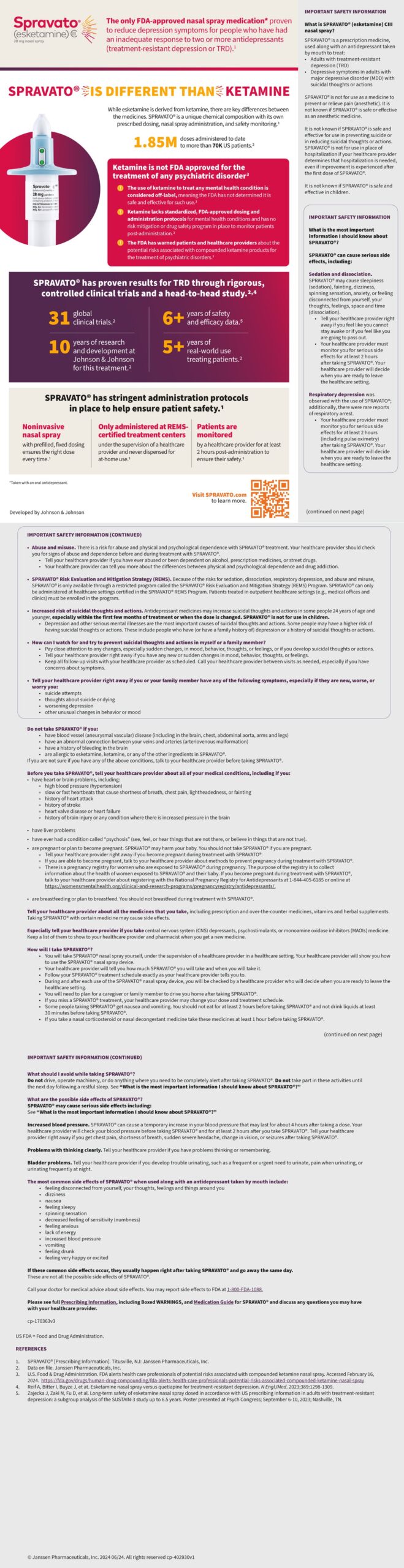
Patient safety is a top priority for Johnson & Johnson. This is why Johnson & Johnson collaborated with the U.S. FDA to establish a Risk Evaluation and Mitigation Strategy (REMS) program for SPRAVATO®, implementing stringent safety and post-administration protocols.3

SPRAVATO® is derived from ketamine3; however, it’s important to note that it is distinctly different from ketamine. Learn more about the proven safety and efficacy of SPRAVATO® and how it is different than ketamine in the infographic below.

Infographic is called

References:

  1. National Institute of Mental Health. Major depression. Accessed July 15, 2024. https://www.nimh.nih.gov/health/statistics/major-depression
  2. Agency for Healthcare Research and Quality. Definition of treatment-resistant depression in the Medicare population. Accessed July 15, 2024. https://www.ncbi.nlm.nih.gov/books/NBK526366/pdf/Bookshelf_NBK526366.pdf
  3. SPRAVATO® [Prescribing Information]. Titusville, NJ: Janssen Pharmaceuticals, Inc.

cp-466323v1

Back-to-school tech essentials: 5 laptops for student success

2024-09-17T11:01:00

(BPT) – As a parent or educator, you know how technology has changed the educational landscape. It would be nearly impossible for students to complete assignments and, in some cases, even attend classes without the right tech tools. So, as back-to-school season approaches, it’s a smart idea to think about the laptops you would buy or recommend to students.

A laptop isn’t just another electronic device. A student’s laptop should empower students to learn, create and relax throughout the school year. To ensure your student can do it all, look for a laptop powered by Snapdragon to enable groundbreaking AI experiences. For example, laptops built with the Snapdragon X Elite Platform allow students to navigate demanding multi-tasking workloads, without sacrificing efficient battery life.

Each Snapdragon X Elite-powered laptop brings something different to the table, just like each student. If you need help finding the perfect laptop for different learners with diverse needs, check out this roundup of five laptops with AI infused.

1. Lenovo Yoga Slim 7x

For the artists in your life, help them unlock their creativity with the Lenovo Yoga Slim 7x. This powerful creative sidekick knows what your student needs before they do! Thanks to its built-in AI, your student can streamline their creative tasks. The 14-inch laptop weighs just under 3 pounds, so your artist can create on the fly anywhere they go!

The Snapdragon X Elite processor allows the Yoga Slim to give top-tier performance while cutting power consumption by 68%. A single charge keeps the battery powered for 27 hours, so students will never have to worry about plugging in their laptop during class. Instead, they can focus on finishing their notes so they can let their creative juices flow after class for multiple days without a break.

2. HP OmniBook X

Does your student find it difficult to focus on everyday tasks? Steer them toward the HP OmniBook X. As they use their laptop, the AI assistants can help reduce churn by surfacing relevant files, summarizing class notes, and creating imaginative thought starters for a truly personalized experience. This personalization cuts down on distractions to increase focus and productivity in and outside of class.

The OmniBook X, powered by Snapdragon X Elite processor is also perfect for distance learning and digital collaboration. Windows Studio Effects and Copilot+ collaboration tools facilitate crisp and clear conversations. Auto-adjust lighting, creative filters, eye contact enhancement, voice focus and a 5MP (16:10) camera ensure students can showcase their ideas to the classroom, collaborators and the world.

After class, when your student is ready to relax with a movie or game, Qualcomm Adreno GPU allows them to enjoy high-performance graphics and rich user experiences.

3. Samsung Galaxy Book4 Edge 16

For students who switch between phone and laptop, have them check out the Samsung Galaxy Book4 Edge 16. It offers students the ultimate connected experience, backed with Wi-Fi 72 readiness for quick and seamless cross-device connectivity.

Thanks to its hybrid approach, students can control their Galaxy AI phone from the convenience of their PC. They can call, text, set reminders and more, so they can stay in contact with family and friends and stay organized while they work.

Does your student need to watch an international webinar or chat with others overseas? With Automatic Life Captions, language barriers will be a thing of the past. The laptop offers accurate real-time English subtitles translated from 44 languages.

4. Dell XPS 13

For well-rounded students who want to use one tech product for school, work, art and play, they need the Dell XPS 13. This all-terrain vehicle of laptops makes it easier to shop for books, clothing and dorm decorations online, plan their spring break and kick-start research for a class project in a matter of minutes. Paired with 4K streaming & lossless audio your student can watch, share and create from anywhere.

The Snapdragon X Elite processor provides cutting-edge responsiveness and unmatched speed so students can easily navigate a demanding multitasking workload. Snapdragon’s processing power allows for effortless switching between tasks, whether using browsers, video conferencing collaboration or multimedia.

5. MSFT Surface Pro 11

Students who want the best of both worlds should opt for the MSFT Surface Pro 11. This flexible and powerful 2-in-1 laptop/tablet features a detachable keyboard that can be used when attached or detached. Whether they’re taking notes in class, typing up a term paper or taking a break with a digital sketchbook, the Surface Pro adapts to their life, however and wherever they use it.

Like the other Snapdragon X Elite powered laptops in this lineup, students can enjoy AI-accelerated power and lightning-fast speed that keeps up with them all day long.

Help your student level up next semester with the right laptop that meets their unique needs. You can purchase any of these laptops direct from the manufacturer or online and in person at your local Best Buy.

Battery life varies significantly based on device, settings, usage, and other factors.