Leaves are falling, but your risk for pneumococcal disease may still be high—get vaccinated to help protect yourself

2024-09-17T07:01:00

(BPT) – The flavors of fall are often what make the season so special — they bring us together and remind us to slow down and smell the spices. That’s why it’s the perfect time to try out new recipes and share your creations with friends. Apple pie, cider donuts, pumpkin bread — the possibilities are endless. Especially while there are so many fresh ingredients in season, like apples, pumpkins, sweet potatoes and even butternut squash. This fall, be sure to take advantage of all the deliciousness that this season brings.

And while you cook up some tasty treats in the kitchen, don’t forget an important recipe for a healthy fall season — getting vaccinated against pneumococcal pneumonia and invasive pneumococcal disease (IPD). Vaccination can help protect you against these diseases, so you can try some new fall recipes without disruption.

Pneumococcal pneumonia is a potentially serious bacterial lung disease that can put you in the hospital and even be life-threatening. The same bacteria that cause pneumococcal pneumonia are responsible for IPD, which includes blood infection and meningitis. There’s a misconception that you can only get pneumococcal pneumonia during flu season or in the winter, but you can get it any time of year.

If you’re 19-64 with certain underlying medical conditions like asthma, diabetes, chronic heart disease and COPD, you’re at increased risk. Adults 65 or older are also at increased risk. In fact, if you’re 65 or older, you’re at over 10x greater risk of being hospitalized with pneumococcal pneumonia compared with adults 18-49.

If you fit in any of these groups, getting vaccinated is one of the best ways to help protect yourself — and your fall plans.

Vaccination is available all year round, so now is a great time to assess if pneumococcal vaccination is right for you. Even if you’ve already been vaccinated against pneumococcal pneumonia previously, your healthcare provider may recommend another vaccination for additional protection.

Getting pneumococcal pneumonia or IPD shouldn’t be on your fall checklist, so don’t let it get in your way of enjoying all the delicious things this season has to offer.

Talk to your doctor or pharmacist about pneumococcal vaccination and visit VaxAssist.com to schedule a vaccination today.

Brought to you by Pfizer.

Cook up kitchen safety

2024-09-17T09:47:00

(BPT) – Frying bacon, broiling marinated chicken, straining boiling pasta — what do they have in common? In the past, these activities could cause steam or smoke to set off the smoke alarm unnecessarily, causing stress and disruption when trying to get through family dinner prep in peace. To help limit nuisance alarms and protect what matters most, follow these safety tips.

  • Ensure your home is properly equipped with updated technology. Having functioning alarms installed throughout your home is the first line of defense for fire prevention. First Alert recently introduced Precision Detection advanced sensing technology smoke alarms, which are designed and tested to provide early warning in the event of a home fire emergency, while also reducing nuisance alarms as the technology better differentiates non-threatening from threatening smoke.
  • Never leave the stove or oven unattended. Always stay in the kitchen when cooking to keep an eye on the meal. If you must leave the room, assign watching duties to another member of the household.
  • Keep children away from stove-tops and open flames. Create a boundary of 3 feet around all ovens or stoves being used. Avoid any accidents or fires by letting children know the stove is hot and that it is important to be alert. Also, make sure to keep any lighters and matches locked in a high cabinet to avoid starting a fire.
  • Be mindful of cluttering cords. Electric mixers, coffee makers, and plate warmers can be an electrical fire hazard due to the amount of electricity running through the outlets. Also ensure cords are not dangling off the counter within arm’s reach of children.
  • Test your smoke alarms. Having working smoke alarms is the first line of defense. Roughly three out of five fire deaths happen in homes with either no smoke alarms or no working smoke alarms. Fire spreads fast and working smoke alarms give you early warning so you can get outside quickly. Test your smoke alarms regularly to ensure they’re in functioning condition and replace the batteries at least every 6 months. Smoke alarms don’t last forever and need to be replaced at least every 10 years.
  • Have a fire extinguisher on hand. If a fire does happen, make sure to have a fire extinguisher easily accessible in the kitchen — and know how to use it. Remember the acronym P.A.S.S. when operating. Pull the pin, aim at the base of the fire, squeeze the trigger and sweep from side to side.

To learn more about First Alert’s Precision Detection alarms, or for additional fire safety tips, visit FirstAlert.com.

How one company is protecting a national holiday tradition

2024-09-17T10:01:00

(BPT) – Every year since 1970, a tree from one of the 154 national forests travels from its woodland home to the West Lawn of the U.S. Capitol and serves as the “People’s Tree.” As it makes its journey to Washington, D.C., the tree makes several stops along the way, providing opportunities for community engagement and kicking off the spirit of the season.

Transporting the U.S. Capitol Christmas Tree is no easy feat, and this year’s trip will be one of the most challenging to date. The People’s Tree will be harvested from the Tongass National Forest in Wrangell, Alaska, and travel 4,293 miles to its final destination.

For the past 10 years, The People’s Tree has made its journey on a specially made trailer to protect it from the weather elements, so it arrives safe and sound at the Capitol for the lighting ceremony in early December. The steel flatbed trailer extends 60-80 feet to accommodate multiple tree sizes and features a custom wood panel enclosure that is used only for the U.S. Capitol Christmas Tree.

After a decade of use, the trailer’s all-wood panels and assembly pieces needed to be replaced. Since the trailer would be traveling through many harsh conditions, including riding on a barge through the Alaskan waters, it was important that the trailer’s wood construction could withstand the elements.

Preserving the spirit of the season one coat at a time

SEAL-ONCE®, a division of U-C Coatings, saw an opportunity not only to sponsor the rebuild of the trailer but also to protect it and stabilize it on its journey this year and for many years to come. In partnership with the U.S. Forest Service, the SEAL-ONCE team traveled to Wrangell, Alaska, to help rebuild and coat the new trailer.

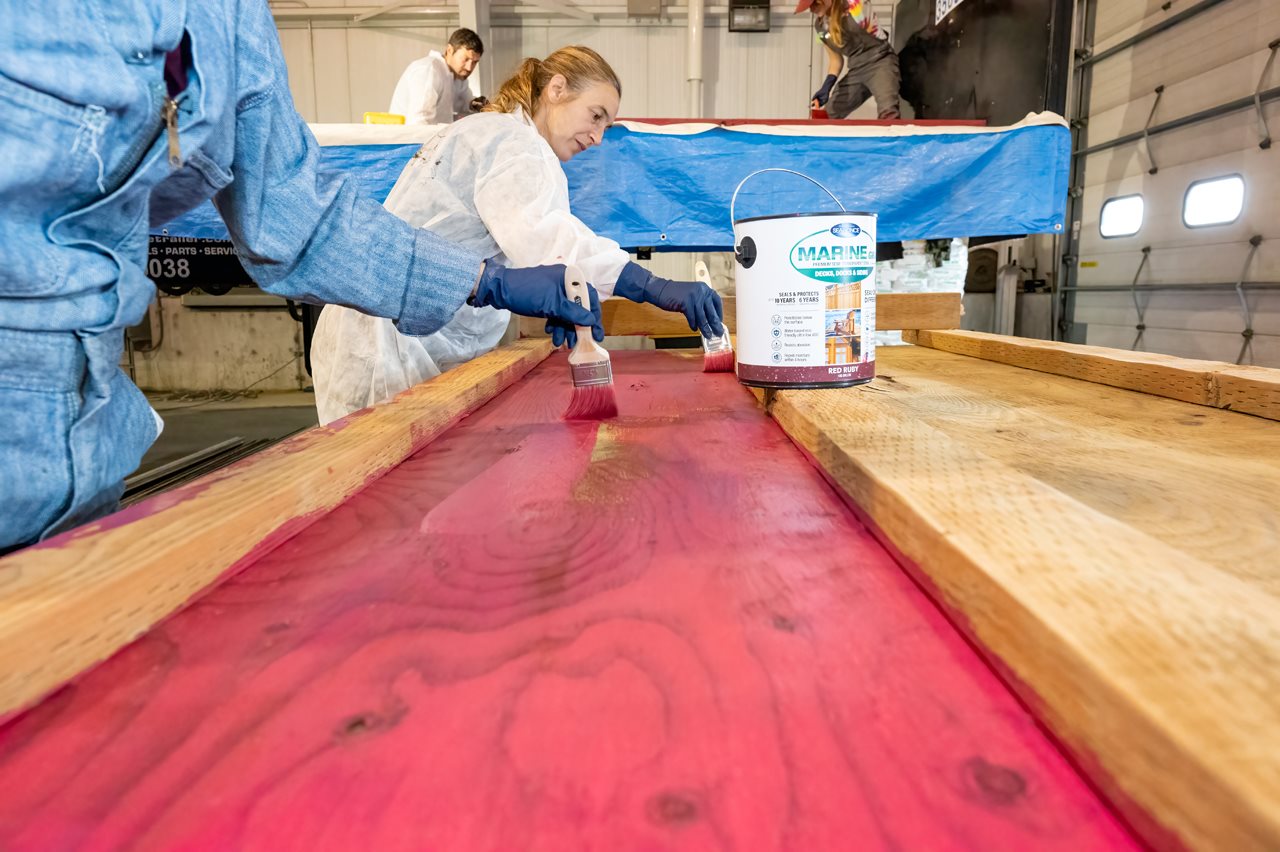
People painting the wood sides of a truck with Marine Grade paint.

SEAL-ONCE is known for its water-based, eco-friendly coatings and sealers for exterior decks, docks, fences, siding and other outdoor projects. The products’ low and ultra-low VOC makes them safe for people, pets and plants, all while providing superior protection and stability.

Close up of a can of red Marine grade paint with a paint brush layed accross the top.

The company supplied the wood and 25 gallons of its SEAL-ONCE Marine Grade Premium Semi-Transparent Stain. The product creates a flexible and breathable barrier that allows the wood to expand and contract as it encounters different weather elements. The product is also abrasion resistant, protects against UV fading and water damage, and is formulated for the harshest of environments.

As a bonus, SEAL-ONCE developed a unique Christmas Red stain, exclusively designed for the U.S. Capitol Christmas Tree trailer, that enhances the natural grain and beauty of the new wood.

A group of people dressed in kaikae loading the Christmas tree on to the truck.

Thanks to this premium exterior wood stain, the trailer will be able to stand up to rain, sleet, snow and even sun exposure along its cross-country road trip.

Protect your home with a pro-level coating

Want to protect your home deck, dock, fence and other wood structures? You can use the same protective coating used on the U.S. Capitol Christmas tree trailer. Right now, you can even save with a 10% discount! To learn more, visit UCCoatings.com.

People along the road side wavying as the Christmas tree truck rolls by them on its journey to Washington D C.

A college admissions checklist for parents

2024-09-17T08:01:00

(BPT) – College admissions season is here. Parents of high school seniors, are you and your student ready? There are a lot of to-dos and deadlines to keep track of during this important and exciting time like application deadlines, essays, and letters of recommendation. It’s about making sure your senior has what he or she needs in place to make the college application process go smoothly, with the goal of attending the school of their choice next year.

Don’t stress! Here’s a college checklist for parents and students to stay on track this fall, from the experts at College Ave.

Mom and daughter making a list of possible expenses and things needed for college.

Create a budget, and don’t forget pre-college expenses. When planning to pay for college, parents typically look at tuition, books, housing and other expenses their child will incur during each school year. It’s vital to know those numbers and understand what your own family budget can handle. But many parents forget about pre-college expenses like application fees, cost of exams, college visits and more. According to a recent College Ave survey, pre-college spend averages $2,891. Building that into your budget now helps prevent unexpected costs later.

Dad and son narrowing down the list of potencial colleges.

Narrow down a list of colleges. On average, students apply to five schools. But, almost 40% apply to more than that, according to the same survey. Work with your senior to create a list of schools they’re interested in attending. That means researching specialties and offerings, campus life, size, cost, GPA and test score requirements and other factors. Be practical about the list, but include a couple of wishes, too.

Young woman writing a college essay on a laptop at a coffee shop.

Write essays. Sometimes called “personal statements,” college essays are a way for students to show admissions officers who they are and why they’re a perfect fit for the school. Have your child research successful college essays to get the style and tone they should use, and then write a personal, heartfelt essay about themselves, their goals and dreams, their circumstances and what they hope to achieve.

100 dollars bills laying on a table.

Enter the College Ave Monthly Scholarship Sweepstakes. At College Ave, they understand how important scholarships are to help pay for college. That’s why they award a $1,000 scholarship award each month. Simply fill out the College Ave scholarship form (it’s just a quick name, address, and phone) and you’re entered. A new winner is selected every month, so come back and enter each month. Bonus: both the student and parent can enter.

Close up of a FASFA form next to a calculator

Get up close and personal with the FAFSA. You must submit the Free Application for Federal Student Aid to qualify for most forms of federal financial aid. The U.S. Department of Education, states, and many schools will use the FAFSA to determine your student’s eligibility for grants, scholarships, and federal student loans. Get ready for when it launches in December for the 2025-2026 school year. Gather information and documentation, including your tax filing status, income, IRA distributions, assets and other figures from your tax return. Remember, it’s not a one-and-done. You’ll need to submit this form every year your child attends college.

Person holding a magnifing glass over a graduation hat that says

Investigate state and local grants and scholarships. The FAFSA is your bedrock starting point, but it isn’t the only way you can get help paying for your child’s education. States also offer grants, scholarships and tuition assistance programs. To find out about yours, start by searching: “State of (your state name) college financial aid support.”

Mother and daughter both working on calculators and referencing laptop information regarding college expenses.

Research unique scholarships. You’d be surprised by the sheer number of scholarships that exist out there. Many are specific to the school you’re applying to, but many are general scholarships. Are you or your spouse a firefighter? There’s a scholarship for kids of firefighters. Is your student left-handed? Yes, there’s one for that, too. Does your child play the bagpipes? You guessed it, there’s a scholarship for that. Have your child brainstorm and research available scholarships. And about that …

Young woman writing on a laptop at a desk in her room.

Get organized about deadlines. This couldn’t be more important. If applying to multiple schools, you’ll have multiple application deadlines to juggle. But those aren’t the only ones. You’ll need to be on top of deadlines for scholarships, grants, loans and much more. Make a deadline calendar on a whiteboard and put it in the kitchen, front and center.

College Ave offers flexible private student loan options tailored to your budget and goals. For more information on everything you need to know when your child is ready to start the college application process, and options to pay for your child’s education, visit College Ave.

Free technology program offers a communication lifeline for the deafblind

2024-09-17T05:01:00

(BPT) – The ability to communicate and connect with other human beings is central to life. For those who are deafblind, even simple communication can be a major hurdle, especially from a distance. People living with both significant hearing and vision loss — due to conditions including Usher Syndrome, CHARGE Syndrome, aging and many other factors — face isolation that may seem impossible to overcome.

Fortunately, today’s technology offers solutions to help people with vision and hearing impairment communicate and feel connected to friends, family and the world at large. Technology opens up possibilities for the deafblind — but people first need the equipment and training to be able to access these opportunities. This is where the iCanConnect program comes in.

A free program that reduces isolation

Ernest using a device that allows him to communicate with others using a phone and laptop.

The iCanConnect program, also known as the National Deaf-Blind Equipment Distribution Program, is run by the Federal Communications Commission (FCC) to provide free distance communication equipment and training to individuals with significant combined hearing and vision loss, and who meet federal eligibility requirements for income and disability.

“Since its inception, iCanConnect has provided nearly 9,500 individuals with free equipment and training,” said Jackie Ellington, FCC administrator for iCanConnect. “If you or a loved one are eligible for this amazing program, don’t miss the opportunity to participate. If you’re unsure if you meet the criteria, go to iCanConnect.org, find your state contact, and reach out.”

Ernest Gallman, a South Carolina resident in his 70s, met his grandbaby virtually, thanks to the equipment and training through iCanConnect. Gallman began losing his eyesight at age 10, then experienced progressive hearing loss over the years, leaving him feeling isolated. After being assessed by his local iCanConnect representative, Gallman received a smartphone, wireless headset and desktop computer. Using this equipment, he was able to meet his new grandson virtually via video chat with his daughter soon after the birth.

“The equipment and training I received through iCanConnect really changed my life. It made me more independent and more connected to my family,” said Gallman. “I hope anyone struggling with independence and isolation won’t be afraid to reach out and get information about the program.”

The beauty of communication

Happy Jan using a special device that makes communication over the phone easier so she can keep in touch with her son.

Jan Attridge, an artist in her 80s from northern Minnesota, began losing her hearing and vision a few years ago resulting from chemotherapy. This made it increasingly difficult to keep in touch with friends and family, including her son Mark.

“I was having trouble hearing on my landline phone, and I was having difficulty understanding messages left on my answering system,” she said. “I was also having more difficulty just understanding what was said during a conversation.”

Attridge was referred to iCanConnect through the Minnesota Department of Human Services. An iCanConnect representative visited her and conducted an assessment of her distance communication needs and goals. Once she was accepted into the program, Attridge received a Clarity desk phone, CapTel phone and an iPhone. An iCanConnect trainer met with her to teach her how to use the new equipment.

Now, Attridge can keep in touch with her son Mark, plus other family and friends with the equipment she received through the program. “iCanConnect has been a godsend,” she said.

For more stories of participants being helped by the program, visit iCanConnect.org/news.

How to find connection

After a person qualifies for the program, a local iCanConnect representative meets with them to determine their distance communication needs and goals. The participant then receives free equipment that best meets their needs, plus free training on how to use it. This equipment helps participants do things like send and receive emails and text messages, make phone calls, participate in social media and manage life activities and services that are increasingly conducted online. The equipment iCanConnect provides includes smartphones and home phones, laptop and desktop computers, braille devices, signalers, screen reading software like JAWS and more.

Since it began, iCanConnect has been helping participants across the U.S. and its territories increase their independence and keep in touch with family, friends and communities. Whether reconnecting with old school friends, playing music and games with family over video chat or participating in telehealth and virtual therapy appointments, iCanConnect helps meet each participant’s goals to stay connected.

To learn more and to apply, visit iCanConnect.org.

Introducing the minimalist mix, Carter’s newest capsule collection

2024-09-16T08:01:00

(BPT) – A minimalist edit made to maximize their options; their new basics BFF.

School is officially back in session. Temps are starting to drop. And that can only mean one thing. Fall — and fall clothing — is here!

This season, Carter’s, the leading children’s apparel brand trusted by parents*, launched the new minimalist mix™ collection. The 48-piece solids collection comes in sizes 2T to 14 and features both separates and sets for easy toddler and kid dressing. It’s the perfect (and easy!) everyday capsule, whether it be for school, playdates or fall adventures to come. Picture joggers, hoodies, zip-ups, crewnecks, dresses, leggings and more in elevated fabrications and fall hues — think trending colors like caramels, berries, olives, lavender and navy.

“We chose easy core colors but also some fun ‘fashion’ colors that all match back to other fall Carter’s styles,” said Allison Robinson, Design Director for Carter’s. The result? Elevated, solid basics that can easily pair with prints but also look great as a solid head-to-toe look! “We were also super excited about getting textured solids into the mix here as well,” she added, speaking to the capsule’s cozy fleeces and wide-ribbed fabrics, which make for effortless transitional pieces.

Not only was the collection designed to stand alone, as well as mix and match within the capsule, but it was also created to match back to Carter’s new fall styles — making getting your kids dressed that much easier. “We loved the fleece hoodies that are trending for fall. Not only are they a great standalone piece, but you can also style with a pair of your favorite jeans or cargos, or pair an easy rib top with a skirt for an easy, put-together fall school look!” shared Robinson.

As for what’s next, be on the lookout for even more refined styles from the minimalist mix™ collection. “We are working towards an in-store stock up destination that mixes in solid items with our current essentials assortment,” said Robinson. Featuring great modern prints, toddler-engaging graphics and easy layering, this selection is meant to make shopping for those extra school outfits easy for parents — so they know their little one will come home in a presentable second (or third or fourth) outfit of the day!

Pastle and brightly colored sweat sets hanging on a wardrobe pole with a cute peace symbol, jean baseball cap and pretty pink purse
Like it? Grab it in every color!

*Based on preferences selected in Carter’s Q3’23-Q2’24 survey of 4009 children’s clothing buyers in the U.S.

Pursuing next-generation solutions targeting non-small cell lung cancer

2024-09-16T08:01:00

(BPT) – Do you or a loved one have non-small cell lung cancer (NSCLC) with epidermal growth factor receptor (EGFR) mutations? We get it, that’s a mouthful. But if you know, you know.

What you might not know is there’s a new clinical trial for this specific diagnosis, part of a next-generation solution being developed to target NSCLC. To understand the significance of this trial, it’s important to grasp the underlying biology involved.

NSCLC is the most common type of lung cancer accounting for approximately 85% of lung cancer diagnoses worldwide (Source: Yale Medicine). According to WebMD, EGFR is a protein on your cells that helps them grow. When changes, commonly referred to as mutations, develop within the EGFR molecule, its normal function is altered which may allow cancer cells to grow and spread more rapidly. About 32% of NSCLC cases worldwide involve an EGFR mutation. These changes in the EGFR protein are referred to as classical, non-classical (or atypical/uncommon), or acquired mutations.

People at the highest risk of having EGFR-positive lung cancer include:

  • Those who have never smoked or were a light smoker
  • Those with lung adenocarcinoma
  • Women
  • Young adults with lung cancer
  • People of Asian or East Asian heritage

Scientists are now beginning to grasp the landscape of EGFR mutations that fuel tumor growth. However, current targeted therapies may only act against a limited subset of these cancer-causing changes. Black Diamond Therapeutics (BDTX), a clinical-stage oncology company dedicated to providing people living with cancer the opportunity to live longer, healthier lives, is developing a treatment to target these mutations. The idea is to target a broad spectrum of EGFR mutations that can drive NSCLC with the goal of reaching a larger patient population.

What about its clinical trial?

BDTX-1535-101 is a Phase 2 clinical trial to evaluate one of the potential therapies Black Diamond has developed. Investigational therapy* BDTX-1535 is designed to address more than 50 EGFR mutations and is taken in pill form by mouth once a day. The trial is now enrolling patients with EGFR non-classical mutations who have not been previously treated, as well as patients who have had prior treatment with an EGFR inhibitor.

If you’re interested in learning more about the BDTX-1535-101 clinical trial (NCT05256290) including participation criteria, visit https://www.blackdiamondtherapeutics.com/patients/clinical-trials.

Before you join a study, learn about the possible risks and benefits and discuss all options with your health care professional.

*Investigational therapies have not been approved by the FDA or any other Regulatory Agency

4 easy home modifications for aging safely in place

2024-09-13T08:01:00

(BPT) – According to the Pew Research Center, 84 million adults ages 65 and older will make up 23% of the population by 2054, a 35% increase from the current 18%. This rise in numbers could be a concern for you or a loved one and encourage you to start making the necessary changes needed to ensure everyone’s safety with aging in place.

“The concept of aging in place is being able to live in your home and community safely, independently and comfortably, regardless of your age, income and physical ability,” said Florence C. Macauley, Certified Aging In Place Specialist and Waterpik™ Showers partner. “Choosing to age at home requires careful planning, thoughtful consideration, and open conversations with your family to ensure your living environment is equipped to handle any cognitive and functional changes you may experience.”

Unfortunately, a study out of the University of Michigan found that not enough people are making those considerations. The study revealed 88% of Americans hope to age in place, but only 15% have thought about the types of changes they’ll need to make at home to do so safely. A fall or other accident at home can significantly disrupt your or your loved ones’ living situation.

It’s important to do all you can to prevent that by making adjustments and modifications in your home for aging safely in place before you (or your aging parents) need them. This way, you’ll be prepared to enjoy your golden years in the comfort of the home you’ve worked hard to create throughout your career.

Macauley, a Certified Aging in Place Specialist (CAPS), Certified Dementia Practitioner (CDP) and Executive Home Modification Specialist, shares her top tips for aging safely in place.

1. Install grab bars in the bathroom. They should go next to the toilet, the sink, and on the walls of the tub or shower to add stability. Grab bars make it easier to get up and down and provide firm support to prevent falls. Additionally, built-in support arms on a raised toilet seat can make it easier for seniors to get up and down. You can also look for a seat with bidet functionality, which adds not only a little bit of luxury but is also a big help with hygiene for people with limited mobility.

Caretaked helping man taking shower using privoting shower head.

2. Add an adjustable shower head. Florence Macauley recommends the Waterpik™ ShowerCare Pivoting Hand-Held Shower Head. “The shower head has a 180-degree pivoting head, which makes it easy to bathe yourself or someone else,” said Macauley. “With two docking stations that allow standing or seated showers and a conveniently placed shut-off valve on the handle, it allows for quick action in case of an emergency while showering. The five spray settings offer a wide range of comfort options suitable for everyone, and the extended hose length increases range of motion to reach all necessary areas during bathing.” It also features intensity control on the handle, including PowerPulse Therapeutic Strength Massage, which is clinically shown to help soothe muscle tension, increase flexibility and promote restful sleep. The ShowerCare shower head is universally designed to seamlessly integrate into any modern bathroom, available in chrome and white finishes, functioning as a modern shower head for all members of the household.

Close up of waterpik shower head

3. Rearrange furniture with clear walkways in mind. Make sure you have a clear path from the living room to the kitchen, or the bedroom to the bathroom and all exits of the home. Do you use a walker, cane or wheelchair? The path should be cleared enough for any assistive device to move freely. Anything in the way? Rearrange or move it out. While you’re at it, install motion-activated lights in hallways for late-night trips to the bathroom.

4. Retire the throw rugs. It’s very easy for people to trip or walkers to get hung up on the edges of throw rugs, causing seniors to have to push and maneuver to get where they’re going. This can cause people to stumble. If you are set on keeping your area rugs, make sure to tape down the edges with two-sided tape.

By making these home modifications now, before they’re needed, you can remove the urgency from the situation and enjoy peace of mind knowing that you and your loved ones can age safely and comfortably at home.

Shop Kids Clothes as Low as $3 During Gerber Childrenswear’s Semi-Annual Sale

2024-09-13T15:01:00

(BPT) – It might not feel like it now, but we know cooler temperatures are right around the corner which means now is the time to think about next season’s wardrobe. Luckily, Gerber Childrenswear’s biggest sale of the year is back — and bigger than ever. The fall Semi-Annual Sale has some of the year’s lowest prices on the things baby and toddlers need for a cozy and comfortable winter.

Whether you’re stocking up on favorites (hello footed pajamas!), bigger sizes for the entire crew or want to find a few new faves, there is a deal for every little one in your life. Get the most bang for your buck with these five picks:

Sweet baby girl in orange onesis.

The Original Onesies® Brand Bodysuits

During Gerber’s Semi-Annual Sale, shoppers can score the original Onesies® brand bodysuits for just $3 each — their lowest price of the year! Designed to make it easy for parents and super comfortable for babies, there’s a reason why Gerber Onesies have been the go-to outfit choice for more than four decades. With long-sleeve options available in solids and trendy prints, it’s the perfect time to stock up on bodysuits to take you through the seasons ahead.

Cute baby boy in teal striped pajamas

Pajamas They’ll Want to Wear All Day

Ask any parent what their go-to outfit is for little ones and we’re willing to bet Sleep ‘N Plays top the list. They’re the ultimate leisure wear, specifically designed to keep babies comfy all day (and night) while they do the things they love. Scoop up multipacks in a variety of colors and prints during the sale as low as $5 each.

Soft embroidery baby blankets in a variety of colors.

Personalized Towels and Blankets

Looking for a gift for a new baby in your life? Or getting a head start on holiday shopping? Whatever the reason, Gerber’s embroidered plush blankets and hooded towel sets are going for less than $25 — with personalization included! Grab both (and the matching security blanket!) and humbly accept your award as the family or friend group’s best gift giver.

Cute baby suggled up in a cream color wearable blanket.

Wearable Blankets for All Night Comfort

Launched earlier this year, wearable blankets from Gerber Childrenswear are the softest, coziest accessory to a baby’s bedtime routine. The ultra-plush microfleece options come in fun prints like florals and polar bears that will have your baby begging to go to bed (well, we can hope!). Most importantly, wearable blankets from the brand are the safest on the market, adhering to all industry safety standards so mom and dad can sleep well at night, too.

Baby sitting up in soft pink pants and fuzzy slippers.

Daycare Basics Designed to Last

With the big kids back in school, now is the time to make sure your littlest learners’ closets are stocked with basics built for hands-on activities. From multi-packs of pants and dresses as low as $10, you won’t be able to go wrong when stocking up. Pro tip: grab a few multi-packs in a variety of sizes for easy transition between growth spurts.

Gerber Childrenswear is your one-stop-shop for baby and toddler essentials that won’t break the bank. Stock up on your favorite styles now through September 23.