5 easy ways to nourish your brain

2024-08-20T07:01:00

(BPT) – What are you doing to nourish your brain on a daily basis? Many people eat a balanced diet and work out to nourish and support their bodies and their overall health, but it’s just as important to support the brain. It can lead to greater mental focus, a longer attention span, sharper memory, greater mental energy, and can even enhance your mood and mental health. And it couldn’t be more important.

Why? It’s because the brain is the epicenter of, well, everything. It’s about experiences, memories, attention span and so much more. Nurturing the brain isn’t just about delaying cognitive decline or aging — it’s about embracing life to the fullest. A healthy brain means meaningful activities, deep relationships, engrossing passion. There is a profound impact of brain health in every aspect of the human journey. Cognitive vitality and unlocking the potential of each moment resonates with everyone. When the brain thrives, so does daily life.

Whether you’re a young professional looking to optimize your cognitive performance, an older adult focused on maintaining mental clarity and memory, or a kid just trying to get through final exams, it’s wise to boost your brain. The good news? It’s easy to do. Here are some ways to give your brain some love.

Eat right. There are many reasons to eat a balanced diet of fruits, veggies, whole grains and lean meats, and brain health is high on that list. Eating foods packed with antioxidants and other nutrients is great for your brain. Omega-3 fatty acids also play a crucial role, and can be found in fatty fish, nuts and seeds.

Get your Cognizin Citicoline on. What’s that? Citicoline is a naturally occurring brain chemical that has neuroprotective properties. In other words, it helps protect and repair brain cells and supports focus and memory. Cognizin® Citicoline is one of the most comprehensive brain ingredients on the market. An innovative form of Citicoline, which has been clinically researched for its role in cognitive function, Cognizin® is a clinically studied nootropic to support mental energy, memory, focus and attention. Many other cognitive health ingredients only enhance brain performance, but Cognizin® provides brain performance as well as brain health support over time. This brain health nutrient has demonstrated through multiple clinical trials that it provides essential brain health benefits to people of all ages.

Exercise. When you exercise, you’re not just burning calories. You’re increasing blood flow to the brain, which can improve cognitive function. How much exercise does the trick? Thirty minutes of moderate exercise on most days is a good guideline. And hey, all of that good food and exercise will help your body, too.

Focus on sleep. A recent study by Johns Hopkins Medicine revealed what many of us already knew — sleep is vital to brain health. If you’ve ever slogged through the day after a bad night’s sleep, you know how groggy and “off” you feel. But this study showed that sleep is an integral part of “brain plasticity,” or the brain’s ability to adapt to input. After a bad night’s sleep, we actually have trouble processing anything we learned the next day and have trouble remembering it in the future. Can’t remember what you had for lunch yesterday? A bad night’s sleep could be the culprit.

Challenge your brain daily. Love Wordle? How about a crossword puzzle or other type of brain teaser? Doing them is like a workout for your brain, and helps keep you sharp.

It’s easy to check off a good diet, sleep, exercise and puzzles each day. What about Cognizin? It’s actually in more products than you might realize, from beverages you see regularly at the grocery store to supplements to protein bars, even lollipops! There are currently 200+ products out there right now that contain Cognizin. Visit Cognizin.com/en/buy-cognizin to get started.

A few easy lifestyle changes can show the love to your brain every day. It’ll love you back, guaranteed.


From bladder cancer to running half marathons: One patient’s journey

2024-08-20T11:01:00

(BPT) – Julio, a 49-year-old engineer and avid runner, discovered an alarming sign of trouble right after completing a half-marathon: blood in his urine. He promptly consulted a doctor, which led to a bladder cancer diagnosis. Specifically, Julio had low-grade intermediate-risk non-muscle invasive bladder cancer (LG-IR-NMIBC), a type known for its tendency to recur.

Although his diagnosis in March 2020 was complicated by the pandemic, Julio was still able to get started on treatment right away, which involved a surgery called transurethral resection of bladder tumor (TURBT) to remove a tumor of around three centimeters from his bladder, followed by a round of chemotherapy to try and prevent further tumors from developing.

“People with LG-IR-NMIBC usually undergo repeated surgical procedures called TURBTs, due to the highly recurrent nature of the disease. This can have a significant impact on a patient’s physical health and quality of life,” explained Sandip Prasad, M.D., MPhil, Director of Genitourinary Surgical Oncology, Morristown Medical Center/Atlantic Health System, New Jersey. “These patients need more options to help them better manage their disease.”

“Surgery was difficult for me,” said Julio. “It took me a long time to recover. It was very painful. It took two to three weeks to start walking and moving like my normal self, then two to three months to start running again.”

Within a year of having surgery, Julio faced the recurrence of small tumors, a common issue with LG-IR-NMIBC. Up to 50% of LG-IR-NMIBC cases recur within one year.[1]

What is bladder cancer?

Bladder cancer can develop when cells in the urinary lining begin growing out of control, and as more cancer cells develop, they can form a tumor that might spread to other parts of the body over time.[2] Bladder cancer can be categorized as either low-grade, which grows slower but has a tendency to recur, or high-grade, which tends to spread more aggressively.[3] About 730,000 people in the U.S. live with bladder cancer, with an estimated 83,190 new cases expected in 2024.[4]

Although bladder cancer is the second most common urologic cancer among men in the U.S., with men around three times more likely than women to be diagnosed with bladder cancer, the treatments have remained the same for decades.[2],[5]

The burden of recurring tumors

While Julio understood that his LG-IR-NMIBC diagnosis meant he had a lower risk of losing his bladder, he also learned that it meant potentially facing recurring tumors and undergoing multiple surgeries. This prospect weighed heavily on him, knowing the surgeries would increasingly disrupt his life and bring more pain. Statistics show that nearly 70% of recurrent patients undergo two or more TURBT surgeries.[1],[6]

Having to face surgery again and again to remove recurring tumors was not something Julio looked forward to. With a wife, three kids, and a career to manage, Julio needs to stay on top of his game. “Life is hectic, and I want to avoid anything that slows me down and keeps me from doing the things that bring me joy,” said Julio.

Investigational approaches in development

Fortunately, Julio’s doctor informed him that there were chemoablative, investigational treatment approaches in development for patients like him, so he enrolled in a clinical trial.

“Offering patients more options is always beneficial,” said Prasad, “and the potential for alternative bladder cancer therapies may provide significant advantages, particularly in cases with frequent recurrence.”

Looking ahead

Today, Julio is physically active and still enjoys running.

“I think it’s important to know that this cancer can happen to anyone, just as it happened to me,” Julio said. “If it happens to you, it’s important to get educated and ask your doctors about all your treatment options, including any investigational treatments in clinical development.”

To learn more about LG-IR-NMIBC, visit UroGen.com.


[1] Babjuk M, Burger M, Comperat EM, et al. European Association of Urology Guidelines on Non-muscle-invasive Bladder Cancer (TaT1 and Carcinoma In Situ) – 2019 Update. Eur Urol. 2019 Nov;76(5):639-657.

[2] About Bladder Cancer. American Cancer Society. https://www.cancer.org/cancer/types/bladder-cancer/about/what-is-bladder-cancer.html. Accessed June 19, 2024.

[3] Bladder Cancer Stages. American Cancer Society. National Cancer Institute. Bethesda, MD, https://www.cancer.gov/types/bladder/stages. Accessed June 19, 2024.

[4] SEER Cancer Stat Facts: Bladder Cancer. National Cancer Institute. Bethesda, MD, https://seer.cancer.gov/statfacts/html/urinb.html. Accessed June 19, 2024.

[5] Centers for Disease Control and Prevention. Male Urologic Cancers. USCS Data Brief, no 21. Atlanta, GA: Centers for Disease Control and Prevention, U.S. Department of Health and Human Services; 2020.

[6] Simon M, Bosset PO, Rouanne M, et al. Multiple recurrences and risk of disease progression in patients with primary low-grade (TaG1) non-muscle-invasive bladder cancer and with low and intermediate EORTC-risk score. PLoS One. 2019 Feb 27;14(2):e0211721.

US-UGN-00298 07/24

Lance Sandwich Crackers Honors Everyday Heroes with 2024 Little League Coach of the Year Award

2024-08-20T08:01:00

(BPT) – For 110 years, Lance has fueled hardworking people — from kids on the field to parents in the stands. The official snack of Little League® is honoring dedicated coaches with the Lance Coach of the Year Award.

The Coach of the Year award honors leaders in their community who emulate the spirit of the Lance brand, powering hardworking heroes on and off the field. These inspirational coaches create an environment of belonging, teach life skills through sports, focus on positive reinforcement, and promote sportsmanship and respectful behavior, encouraging kids to be their best selves through their coaching and mentorship.

After a record-breaking number of submissions, a panel of judges from Lance, Positive Coaching Alliance, and Little League has identified three remarkable individuals as the 2024 Little League Coaches of the Year. These coaches selflessly volunteer their time to make a difference in the lives of their players and communities and embody what Lance stands for.

“Lance has been fueling families across America for over 100 years. Whether on-the-go or at the game, Lance Sandwich Crackers help keep you going. Little League coaches demonstrate the very best of what it means to be a hard worker,” said Victoria Strang, Lance Marketing Director. “We’re honored to recognize these coaches through our annual Coach of the Year award. This year’s honorees demonstrate exceptional passion for encouraging sportsmanship and fostering a sense of community.”

It’s time to meet our 2024 Little League Coaches of the Year:

Inforgraphic about 2024 Little League coaches of the year

Wellness facts about Epsom salt beyond the soaking tub

2024-08-19T08:01:00

(BPT) – If you’re like many people, you’ve more than likely soaked in a bath infused with Epsom salt to calm your sore muscles and relax your mind and nerves. But what is Epsom salt exactly? How should you use it and is it always safe? Here are some of the facts you may not have known about this remarkable natural substance. You will find it may be better enjoying the benefits of Epsom salt without making the time and effort for soaking in a tub!

You can visit a place named Epsom

Epsom salt is actually magnesium sulfate, a natural mineral compound made up of magnesium, sulfur, and oxygen. So why don’t we call it by its chemical name? It goes back 400 years to a town in England called — you guessed it — Epsom. Not knowing yet what it was the citizens of Epsom, England named the substance for the site of its discovery in a rural stream. Epsom became England’s first spa town as people started arriving from long distances to absorb the healthful benefits from the magnesium sulfate infused water. Epsom-It topical lotion takes this experience to the next level by virtue of its portability.

It is a salt good for your body but not your food

Epsom salt isn’t the same as table salt, despite their names and similar appearances. Table salt is sodium chloride, a naturally occurring compound just like magnesium sulfate. And while we all need magnesium in our diet, no one recommends sprinkling magnesium sulfate on your food. Though safe to ingest, it actually has a bitter taste and is only medically indicated for ingestion to relieve constipation.

Magnesium is a key element for your health

Your body can’t exist without magnesium, which is the second-most plentiful mineral in your body, calcium being most abundant. It’s a key factor in over 300 biochemical reactions that help your heart and nervous systems like synthesizing protein, controlling blood glucose, regulating blood pressure, maintaining bone structure and more. It’s a good idea to make sure you’re getting enough in your diet. The Recommended Dietary Allowance or RDA varies from about 310 milligrams (mg) to 410 mg depending on several factors. Topical application, however, has no limits for safe use. Topical application of Epsom salt absorbs slowly into the subdermal skin area, where Epsom-It delivers its best results.

Wellness benefits may be had without the bath

Epsom salt can help provide relief from muscle and nerve aches in as little as 10 minutes. That’s why people soak in warm baths having dissolved Epsom salt. But you don’t need to take a bath to get the same benefits. About 10 years ago, a 90-year-old exercise enthusiast named Paul Greenfield needed to apply Epsom salt to his sore muscles but didn’t have time for soaking. He approached a team of veteran chemists to find a solution and they then created a “bath in a bottle” called Epsom-It: an elegant, novel lotion application of Epsom salt for achieving similar outcomes of human wellness.

“We developed Epsom-It to deliver a magnesium sulfate concentration higher than 20%,” said Epsom-IT chief scientist Matthew Zoeller. “That’s more than 30 times greater than a typical Epsom salt bath would have, plus it can be directly targeted to areas experiencing acute discomfort.”

Epsom salt is not a drug, it offers only natural relief

Other products are indicated to soothe aches and pains, but virtually all other topical pain relief products contain active drugs, some of which may be harmful in high doses. Epsom-It applies magnesium sulfate safely with no side effects. The product has been tested and approved for safety by certified laboratories using approved methods. You can easily massage Epsom-It into your skin directly from the bottle, or you can use our roll-on package to keep your hands dry. And for extra convenience, we also offer it in a small tube.

Last but not least, while to date there have been no major clinical studies to document the effectiveness of Epsom salt, magnesium sulfate continues to be recommended by physicians and wellness professionals.

“Several theories have been raised over the years regarding the physiological mechanism by which magnesium sulfate exerts its calming, soothing effects; and which remain inconclusive from a clinical study standpoint. However, the benefits of magnesium and magnesium sulfate are well known and universally recognized,” said Zoeller. “Four centuries of experience with topical application of magnesium sulfate has proven to be safe and amazingly effective for hundreds of millions of people around the world. Epsom-It enhances that tradition in an elegant manner for the 21st century.”

Learn more about Epsom-It products by visiting www.epsomit.com and look to purchase them at designated retail outlets, such as Walgreens, Walmart, GIANT, Stop & Shop, Weis, Raley’s, and Meijers.

Building a team of experts can help you save time and money

2024-08-19T11:01:00

(BPT) – Many of us have a group of professionals we depend on, including our doctor, plumber or our insurance agent. These experts can quickly become an integral part of our lives, saving us time and money, teaching us about complex purchase decisions, and being available in times of crisis.

Establishing a team of trusted experts in our lives can help guide us through some of life’s most important decisions. Establishing trust in an expert’s knowledge can create a bond, but also a sense of confidence and reliance on someone’s counsel. This is especially true when it comes to choosing an insurance agent.

“Many consumers tend to start their insurance journey by shopping online, however, most will eventually go through an agent when it comes time to buy,” said Brandt Minnich, Mercury Insurance VP & Chief Sales Development Officer. “It is beneficial to turn to a professional, such as an insurance agent, to ensure you have adequate protection without overpaying.”

According to the Bureau of Labor Statistics (BLS), 50% of the current insurance workforce will retire in the next 15 years, leaving more than 400,000 open positions unfilled. This will make having a seasoned professional insurance agent working for you even more valuable.

Here are just a few insurance stats from world financial experts Forbes and credit rating and research company Fitch:

  • Car insurance costs are on the rise. The cost of auto insurance increased by 63.8% between 2014 and 2023 and now averages $2,150 annually for full coverage.
  • Fitch reports that insurers continue to face loss cost uncertainty specific to home insurance because of cost volatility and lack of availability of key building materials, components and skilled labor, as well as higher reinsurance costs.
  • Nationally, insured catastrophe losses for 2023 remained substantial despite a reduction in major hurricane losses, according to leading global reinsurance broker Gallagher Re’s recent Natural Catastrophe and Climate Report: 2023. Instead, industry losses were largely attributable to severe convective storms (generally referred to as thunderstorms) losses totaling $59.7 billion, including 24 events that generated $1 billion or higher in combined loss.

“An independent insurance agent is a licensed professional who represents multiple insurance companies, and they offer a variety of insurance products to their clients,” said Weili Lu, Director of the School of Risk Management and Insurance at California State University, Fullerton. “Their services deliver tailored risk solutions, ensuring that every client’s unique needs are met with expertise and care.”

Here are some best practices for building a strong relationship with your insurance agent:

Communicate: Regular communication with your insurance agent helps to ensure that you stay up to date on your insurance needs and receive ongoing support and guidance.

Provide feedback: If you have feedback or concerns about your policy or service, share them with your insurance agent to keep the lines of communication open.

More personalized customer service: Most agents are easily accessible and offer personalized service as opposed to “online chats” from an app.

Make sure you get regular insurance reviews: Regularly reviewing your insurance coverage and deductibles will help make sure you are adequately covered and avoid surprises.

Going directly to the carrier or agent speeds up the process and lets you determine the price you are willing to pay.

“Going through a trusted insurance agent can be very beneficial,” added Minnich. “An agent can help make sure you are never underinsured, and you are getting all of the discounts to which you are entitled, such as good driver and multi-policy or bundling discounts.”

If you think of your insurance agent as part of your “team of experts,” like your mechanic or your electrician, you can establish a long-term relationship that can save you time and more importantly, money in the long run.

Jump on the Travel Trend Bandwagon: Make Memories, Not Debt, On Your Next Trip

2024-08-19T13:01:00

(BPT) – From international bucket list trips to road trips to vacations with multi-generations to solo travel, there are so many travel trends worth exploring. If you’re eager to plan a trip that indulges in these popular travel trends, it’s important to plan early and research the best travel deals.

“Traveling can be costly, but there are ways to save while still having a fun on-trend trip with family, friends, or all by yourself,” said Steven Guilday, Director of Travel at AARP Services, Inc. “Whether you’re itching for an overseas adventure or a long vacation closer to home, AARP member benefits give you access to products and services that will help you spend your time, not your money, planning your exciting getaway.”

Guilday says that AARP members have access to a wide range of travel discounts and benefits that can help make their long-awaited travel plans a reality while staying on a budget. “Don’t let the stress of travel costs deter you from making lasting memories, especially when there are plenty of cost-saving opportunities to help you enjoy your bucket list vacation without having to pay bucket list prices.”

Here are just a few ways you can make the most of your trip planning while also being budget conscious.

Going the Distance

More and more consumers aren’t holding back when it comes to their vacations and are finally planning that once-in-a-lifetime trip. According to a 2024 AARP travel trends report, a quarter of international travelers are planning bucket list trips, choosing Europe, the Caribbean and Latin America as their top destinations. Big trips equal big planning, and whether it’s a fun-in-the-sun beach vacation or European getaway that’s on the itinerary, using the AARP Travel Center Powered by Expedia is a one-stop shop with savings where AARP members can find exclusive deals, handpicked curated trips, seasonal offers, and special savings on hotels, car rentals, cruises, and more. For a limited time, AARP members can take advantage of handpicked wellness vacations and get a $50 gift card when booking any flight package.

Exploring the Open Seas

Another popular way to maximize your travels is on a cruise vacation. Value-driven and with a wide range of activities and amenities, you’re sure to find something that everyone in your travel party can enjoy. Holland America Line’s fleet of 11 ships offers more than 500 sailings each year across all seven continents, including cruises in Alaska, the Caribbean, Mexico, and Europe. AARP members receive up to $200 in onboard credit per stateroom, based on the length of the cruise and the stateroom chosen. If Antarctica, Greenland and the Galapagos Islands are on your wander list, AARP members (and non-AARP member companions) who book and travel with HX: Hurtigruten Expeditions will receive a 5% discount on all cruise fares plus a €100 per person onboard credit. This offer is stackable with all in-market HX offers. Terms and conditions apply.

Road Rules

It’s not always about the destination or how far you travel but the relief of breaking your everyday routine, exploring new landscapes and enjoying the freedom of driving, windows down, blasting your favorite tunes. As domestic road trips are becoming a go-to way to embark on an adventure and with nearly 7,500 Choice Hotels® properties around the world, like Comfort Inn & Suites and Cambria, travelers can count on Choice for a safe and clean place to stay along their road trip holiday route. AARP members save 10% on bookings with Choice Hotels. Through September 2nd, AARP members receive 15% off stays at participating hotels. That’s an extra 5% off!

Get Travel Ready

Well ahead of your trip, check in on your physical health to ensure you’ll be ready come departure day. Your physical health is directly correlated with your mobility. From running your daily errands to maneuvering around the airport, much of your quality of life depends on your levels of mobility but it can decrease as you age. Exercise, diet, preventive care, and lifestyle choices can keep you stronger and steadier for a more enjoyable vacation. AARP® Physical Therapy at Home™ by Luna provides access to highly experienced physical therapists who come directly to you. Luna employs physical therapists who specialize in preventing falls and treating balance disorders as well as a multitude of other conditions. Both AARP members and non-members can receive at-home physical therapy from Luna. Most insurances and Medicare are accepted by Luna.

As you create your packing list, make sure you have enough prescription medications for your travels. It’s a good idea to have a full supply, plus extra, just in case you experience unexpected delays. AARP members and non-members alike can get a free prescription discount card from AARP® Prescription Discounts Provided by Optum Rx®, which can be used at over 66,000 pharmacies nationwide for savings on FDA-approved medications. AARP members also receive additional benefits, like deeper discounts on medications, home delivery, coverage for dependents, and more.

Taking a vacation is the perfect excuse to pick up a new pair of prescription glasses — whether you’re hoping for a new look or simply want a back-up pair before you jet off, when you’re making your packing list don’t forget to check this off your to-do. By using AARP® Vision Discounts provided by EyeMed, AARP members can save 50% on prescription lenses with the purchase of a frame at LensCrafters, 30% on a complete pair of glasses (frames and lenses) at Glasses.com, and an additional $10 on a complete pair at Target Optical.

Whether planning a trip for this year, over the holidays or into 2025, making memories that can last a lifetime will always be the ultimate travel trend. Use your AARP member benefits to stay on trend — and on budget — when planning your upcoming trips.

To learn more about the benefits and discounts for AARP members to help you plan and save for your bucket-list vacation, please visit aarp.org/save.

AARP member benefits are provided by third parties. AARP receives a royalty fee for the use of its intellectual property. These fees are used for the general purposes of AARP. Provider offers are subject to change and may have restrictions.

New study: Over 1 in 4 Americans hit their limit on the prices of household staples

2024-08-19T08:31:00

(BPT) – “The Big Shrink” is here: Pricing pressures have caused Americans to pull back, with over 6 in 10 (62%) saying their ‘purchasing power’ and income in relation to prices is decreasing — and their money doesn’t go as far as it used to (82%). A majority (79%) note household goods like cereal and chips dwindling in serving sizes, according to new research from Empower, a leader in financial planning, investing, and advice.

Some 78% are using more of their budget on essential items, and 27% have hit a pricing limit, and aren’t willing to pay anything more for many grocery staples, or will cut the items from their shopping lists. Prices are 20% more expensive than February 2020 according to CPI data1 — so consumers would need to pay $1,218 now for their dollars to have the same purchasing power as $1,000 in 2020.2 Consumers say they’ll quit buying goods including:

  • Coffee: Over a third of people aren’t willing to pay even $1 more for a cup of joe.
  • Bread: 1 in 5 Gen X will stop buying loaves of bread if the price increases by more than a buck.
  • Fresh produce: 1 in 5 Gen Z will chop fresh fruits and vegetables from their shopping lists if the price increases by $1.
  • Snacks: 20% of Millennials are not willing to pay one dollar more for snack foods like bags of chips or chocolate bars.

Quality and quantity

Almost half (45%) of people notice a change in quality of items they’ve been buying for years — 79% say there are less chips in the bag, and 54% say that chocolate costs more, but doesn’t taste as good. Price increases can influence loyalty, too: around 75% of Americans say it turns them off from a brand, and many are switching over to generic/store-owned brands (77%). Three in four believe the higher prices go, the less they’re getting in return.

Price check

Sizes aren’t the only thing getting smaller: Americans believe Time is Money, and 29% say their amount of free time is shrinking, feeling priced out of enjoying it (58%) as costs have risen. Nearly half of Americans feel priced out of retiring at the age they want (49%), along with financial goals like home ownership (48%), leaving an inheritance (50%) and paying for a college degree (41%). The sentiment extends to starting a business (38%) or buying a piece of one, through investing in the stock market (40%).

Still, optimism remains: 28% of Americans think prices will keep dropping before the end of this year. A third feel they have the opportunity to grow financially by paying down debt (33%) and investing (17%).

More findings:

  • Inflation generation: 87% say they’re “fed up” with rising prices. Baby Boomers are the least willing to pay more than products’ current prices.
  • The long and short on goals: 47% of Americans say they have less disposable income. But inflation is taking a slice out of larger money goals, too: 35% have less in emergency savings, 24% say their net worth is shrinking and 17% worry they’ll have to work longer to retire.
  • Tipflation and fees: 45% say they are being asked to tip more in places where they didn’t tip 10 years ago. Nearly three-quarters (73%) say extra fees are being added where they haven’t had to pay in the past.
  • Stocking up: In the last year to save money, 53% switched to a generic brand, 34% downloaded a store’s app for rewards/coupons and 21% purchased a store membership to get benefits like free shipping.
  • Getting smaller: 68% say new houses are getting smaller, but not cheaper. More than half (57%) say streaming services have increased prices, but there is less content.
  • Dreaming it: Close to a third (30%) would sacrifice their vacation time in order to achieve their financial goals; 1 in 5 would give up their dream home (22%).
  • Up and down: 37% like the concept of dynamic pricing, even at a grocery store. Two in 5 plan to split more prices with family and friends to make ends meet.

Visit The Currency™ to read Empower’s full research report, The Big Shrink.

Methodology: The Empower “The Big Shrink” study is based on online survey responses from 2,203 Americans ages 18+ fielded by Morning Consult between March 22nd–24th, 2024. The survey is weighted to be nationally representative of U.S. adults (aged 18+).

1 U.S. Bureau of Labor Statistics. The Consumer Price Index, June 2024 compared to February 2020.

2 U.S. Bureau of Labor Statistics. CPI Inflation Calculator. June 2024 price change of $1,000, as compared to June 2020.

RO3765386-0824

Practical tips for families planning a fall off-road weekend

2024-08-19T07:07:00

(BPT) – Summer’s setting and fall’s around the corner, meaning colder weather, rain and snow are on the way. For families across the land, fall’s still a great time to go off-roading on the weekends. From California to Connecticut — and everywhere in between — there are scenic off-road trails of all varieties to explore, featuring rocks, sand, dirt, water, mud and yes, even snow!

Preparing for Fall Off-Roading

For folks heading out on a fun, off-road fall weekend, this is the ideal time to stop scrolling on the phone, grab some supplies, engage the 4×4 system and see where the adventure takes you. Off-roading is not only an extremely enjoyable way to appreciate the great outdoors, but it also offers a chance to strengthen family bonds and make memories that will last a lifetime. Best of all, off-roading is ageless — it’s a great time for all ages, old and young.

Supplies Checklist

Depending on the terrain, you can go off-roading in your daily driver — almost any four-wheel-drive or all-wheel-drive SUV, crossover or light truck can handle it. You’ll be out in the wilderness for several hours, so here are 5 basic tips:

  1. Bring plenty of food and water.
  2. Pack extra clothes as temperatures get extra chilly as the sun goes down.
  3. Take along a flashlight (with new batteries) and a basic safety kit with Band-Aids, sunscreen, gloves, etc.
  4. Research the area/trails you’ll be off-roading at. You’ll most likely be out of cell phone/GPS range, so it’s always good to know where you’ll be driving and what the road will be like.
  5. Make sure your vehicle is in tip-top shape, especially the all-terrain tires or off-road tires.
Large gray truck driving on a rock road in the woods.

“Off- or on-road, tires are super important,” says Kevin Nguyen, manager of product planning for Yokohama Tire Corporation, manufacturer of a variety of on-road or off-road tires for SUVs, pick-up trucks and passenger cars. “They play a vital role in braking, steering, comfort and handling. Doesn’t matter if you’re in a Jeep, electric SUV or family wagon, the wrong tires can result in a disappointment with the handling, ride and treadwear.”

Choosing the Right Tires for Fall Off-Roading

For off-roading in the fall and winter months, Nguyen says you’ll need something extremely durable with great traction. “It all depends on what you drive and what you plan to do, but a good choice is top-notch all-terrain (A/T) tire, which is very versatile and can be used for off-roading as well as daily driving. A great example is our new, rugged GEOLANDAR A/T4. Because of its outstanding off-road resilience and dependable all-weather traction, the ultra-versatile A/T4 is specifically designed to handle any surface — on- or off-road — and in any weather condition — snow included. It’s a ‘go anywhere’ tire.”

To learn more about off-road tires, Nguyen says to check tire company websites like https://www.yokohamatire.com/geolandar-tires or your tire retailer’s website for more help.

Maintaining your daily driver tires for everyday use is essential, too, says Nguyen. This includes taking 5 minutes a month to check your tire pressure. “A tire that’s underinflated will affect your drive and the vehicle’s fuel efficiency. Keeping them properly inflated will give you a better ride and save you some at the gas pump,” he says.

The U.S. Tire Manufacturers Association (USTMA) recommends checking the tires when they are cold — at least four hours since the vehicle was last driven. Nguyen says to always use an accurate tire gauge and make sure the valve is free of debris and water. The correct tire pressure is specified by the manufacturer of the vehicle, not the tire manufacturer. The proper inflation levels can be found on a placard on the inside of the car door and/or in the owner’s manual.

Nguyen offers more tire tips that will help you throughout the year:

  1. Check your tread depth by placing a penny upside down into a tread groove. If you can see all of Lincoln’s head, your tire’s tread has worn down to the legal limit and you need to buy new tires.
  2. Tires must be replaced when the tread is worn down to 2/32 of an inch (the lowest legal limit). It’s best to replace them before they reach 2/32 depending on your drive (geographically and based on the type of streets).
  3. Rotating your tires regularly promotes even wear of the tread. Tires should be rotated every 5,000 to 8,000 miles.
  4. Check your alignment at least once a year or sooner, especially if the vehicle is pulling to one side. This will help avoid uneven wear on tire tread. Tire balance should also be monitored.

For more tire care and safety tips, visit www.yokohamatire.com/tires-101 or www.USTires.org.

Ultimate guide to back-to-school lunches and snacks for busy parents

2024-08-19T08:01:00

(BPT) – As summer winds down, parents everywhere are prepping for the return to school routines by seeking ways to make shopping quicker, more convenient — and easier on the wallet. To help navigate the busy season and give families time back in their day to enjoy the last bit of summer vacation, Shipt, the trusted shopping solution that offers same-day delivery, is providing parents and caregivers valuable deals, helpful tips to make school lunch and snack time planning a breeze — even for those with picky eaters — and delicious data on what grocery items are favorites for packing.

Savings 101 is in session

According to a recent Deloitte survey, back-to-school shopping is the second-largest expenditure of the year for families, falling right behind the holidays. To lighten the load for parents, Shipt is offering a series of deals available on Shipt.com or the Shipt app, including, but not limited to:

  • 8/1-8/31: $10 off orders with promo code BACKTOSCHOOL for all Shipt customers
  • 8/4-8/17: $10 off orders of $35 or more at select at Target, Meijer and other retailers in the Southeast, Southwest, Florida & Georgia, Indianapolis regions***
  • 8/11-8/17: $10 off orders of $75 or more at select retailers for Target Circle 360 members***
  • 8/18-8/31: $10 off orders of $35 or more at select at Target, Meijer and other retailers in the Charlotte, Midwest, West, Mountain, South Atlantic regions***

Helpful tips for back-to-school grocery shopping from the trusted shopping solution

To help tackle school grocery shopping, the trusted shopping solution, Shipt, provides time-saving tips, lunch and snack recommendations and deals throughout the month and beyond.

Tasty tips include:

  • Plan ahead and use your resources: To get ahead of building your Shipt shopping cart, you can create a weekly menu for lunches. That way, when it comes time to check out you know what’s on the menu and in the cart! Shipt’s Auto-Add to Cart can help busy parents seamlessly restock essentials that are regularly on weekly lunch menus by choosing the items and frequency of their choosing so they automatically appear in their carts.
  • Opt for pre-packaged healthy options: Look for healthier pre-packaged options like individual servings of yogurt, cheese sticks, baby carrots and whole grain crackers. Shipt offers grocery delivery from a wide array of retailers, which means there’s no shortage of options to find the best variety of healthy snacks (at the best price) to shop for same-day delivery!
  • Go with what you know: If it isn’t broken, don’t fix it! Parents of picky eaters know what snacks their kids like, so keep a Shipt List handy at all times to make ordering family favorites a little easier. Lists allow customers to create a personalized collection of must-have items to add to their carts with a single click.
  • Get your kids involved: Have your kids browse the Shipt app with you to pick out their favorite fruits, veggies and snacks, then allow them to get creative while packing their lunches in the morning.

Delicious data on what Americans love for school lunches and snacks

Data on what purchases are being made through Shipt reveal some regional favorites, a couple of surprises, plus a number of tried-and-true classics that are sure to belong on your household’s shopping list.

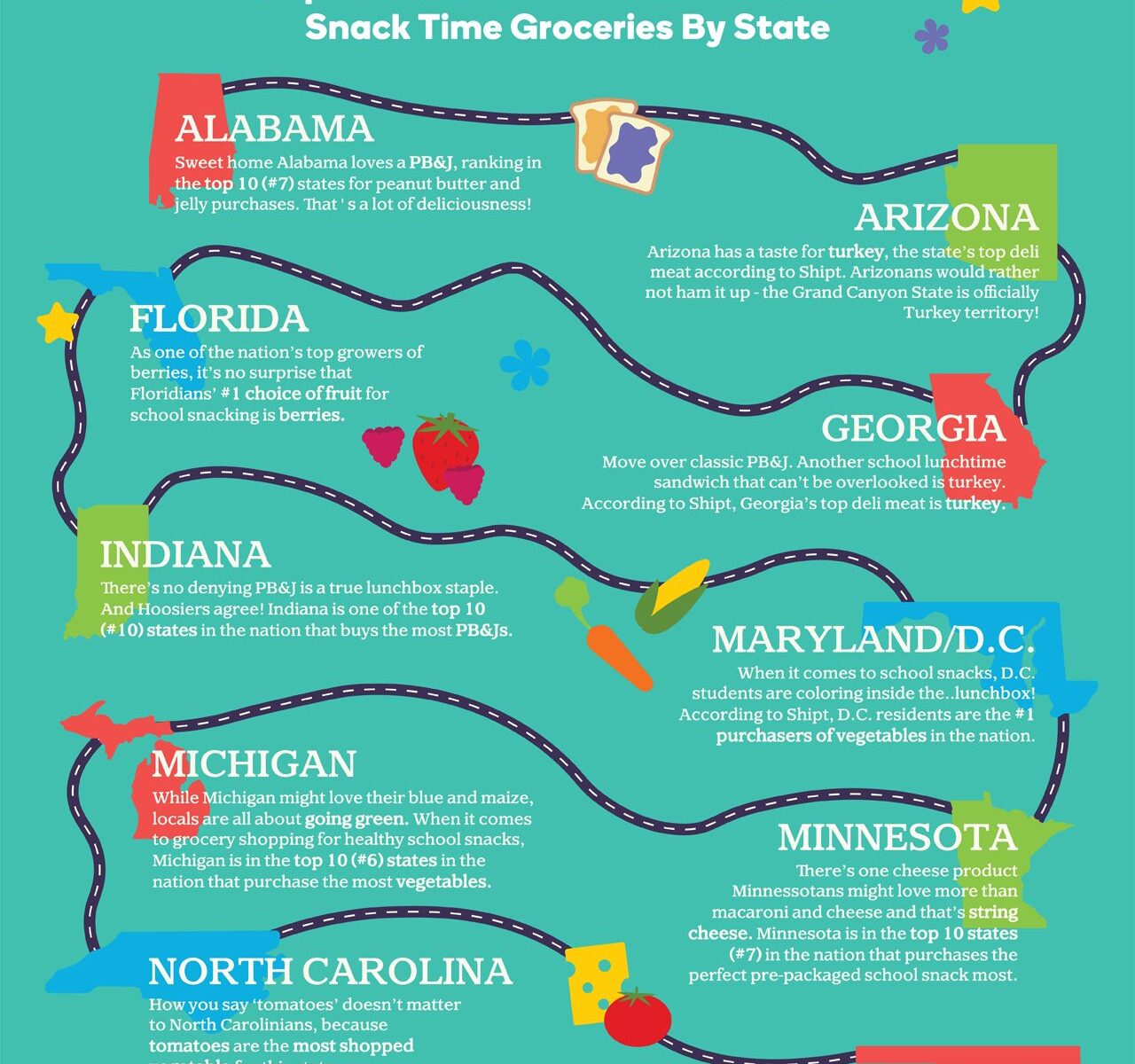
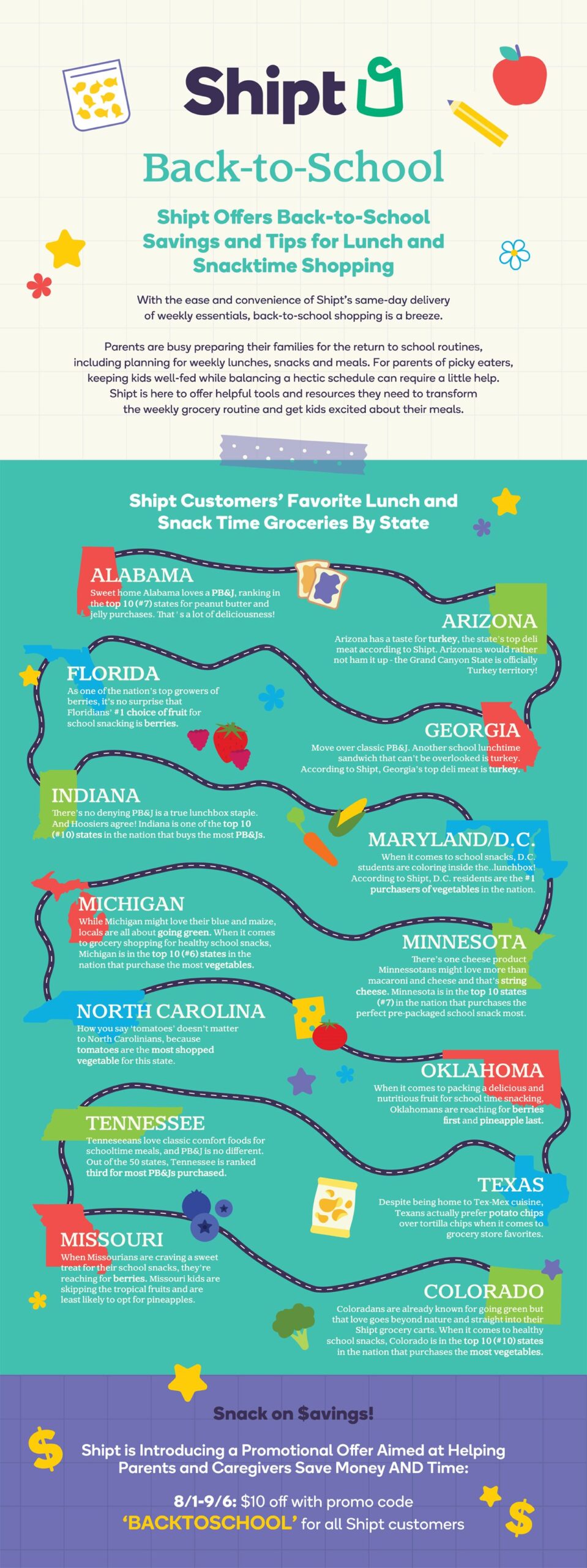
  • PB&J remains a favorite: This all-American favorite was a top choice in many states, including Alabama, Indiana and Oklahoma.
  • Turkey is tops: If you’re looking for the best sandwich fillings, turkey showed up as the number one deli meat selection in Arizona and Georgia.
  • Veggify your lunch boxes: Looking to include more veggies in those lunchboxes? The Washington, D.C., area is your role model, being the leading purchasers of vegetables in the nation. Michigan also shows up as a veggie lover, and North Carolina reveals its love for tomatoes — the most-shopped vegetable (or is it a fruit?) in the state.
  • A berry easy lunchtime choice: While you might expect Floridians to prefer tropical fruits, here’s the surprise: Berries are the leading fruit pick in the Sunshine State.
  • Say cheese: While Minnesotans opt for string cheese, Tennessee residents choose mac and cheese as their lunchtime favorite.
  • Enjoy the crunch: In another surprise, Texans prefer potato chips over tortilla chips for a satisfying snack.
Inforgraphic that says

Providing reliable same-day delivery of a wide selection of fresh groceries straight to your doorstep, Shipt is here to support your family with the tools and resources you need to transform the weekly grocery routine and get kids excited about their meals.

Learn more about how you can streamline your family’s back-to-school lunch and snack shopping at Shipt.com/lp/back-to-school-2024.

**Member must place order of $10 or more by 8/31/24 at 11:59 p.m. HT to qualify for $10 off, which will automatically apply to qualifying order at checkout. Limit 1 credit per member. These terms do not apply to store-level promotions. Offer is subject to Shipt Promotional Terms and Conditions.

***Meijer, Publix, H-E-B, Kroger, Winn-Dixie, Dierbergs, Harris Teeter, Hy-Vee, Cub, Bashas, Stop and Shop, Weis, SaveMart, Lucky California, or FoodMaxx order of $100 or more must be placed by 8/31/24 at 11:59 p.m. HT to qualify for $15 off, which will automatically apply to qualifying order at checkout. Limit 1 per member. Offer is subject to Shipt Promotional Terms and Conditions.

How to cut down on your family’s back-to-school tech costs

2024-08-19T07:05:00

(BPT) – Back-to-school season is upon us, and let’s face it, getting your kids geared up and equipped with the necessary tools for success can get expensive. The cost of school supplies, new clothing, and especially technology can add up fast. However, by adopting smarter shopping strategies, you can reduce these costs and help keep expenses more manageable.

Here are some tips to help slash your family’s back-to-school tech expenses without compromising on quality or functionality.

Research your state’s tax holidays

Many items are given a “tax holiday” — certain days or weeks when sales taxes aren’t charged — which can boost your savings. Tax holidays vary by state and can include a wide range of products such as school supplies, clothing and even electronics. To find out when your state offers these tax-free periods and which items are included, visit TaxAdmin.org/2024-sales-tax-holidays. Keeping these dates in mind can help save money while ensuring your kids have what they need for the school year.

Comparison shop to find the best deals

AI is a quick and efficient new way to comparison shop for your kids’ back-to-school needs, whether it’s a new phone, graphing calculator, tablet or laptop. Many AI-powered tools can automatically compare prices and models of different gadgets saving you time and money. Additionally, browser extensions can help you find and apply coupons or offer cashback for online purchases, alert you about sales and price drops and more, ensuring you get the best value for your money.

Choose a lower-cost phone service provider

Have you checked your monthly phone bill lately? This is one cost you can definitely cut down. Consider switching to a more affordable provider like Straight Talk Wireless, which is now offering their best deal all year: one line for $25 per month when you bring your own phone. This means real unlimited data, talk and text for only $25/month for one line running on Verizon’s award-winning 5G network.

Straight Talk Family Plans can save you even more money, because the more lines you add, the more you save, making it a great option for the whole family. Straight Talk Wireless is available exclusively at Walmart, Walmart.com and Straighttalk.com. Visit StraightTalk.com/straightsavings to learn more.

Consider refurbished, secondhand and trade-ins

Opting for refurbished or secondhand electronic devices is another savvy way to cut tech expenses. Major retailers often accept your old gadgets as trade-ins, offering you store credit or discounts on new purchases. Straight Talk Wireless, for example, provides a $200 phone credit toward a new device after just 12 months of service as part of their StraightSAVINGS! deal.

It’s also a good idea to ask friends and family members if they have tech items they can pass down when they’re ready to upgrade before you spend a ton on new items.

Look into student discounts

Take advantage of student discounts offered by many major retailers to significantly cut down on your tech expenses. It’s worth exploring their websites and memberships or asking in-store about these discounts, as they can lead to substantial savings, especially on big-ticket items. Don’t forget to verify your student status with a valid .edu email or proof of enrollment through services like SheerID or UNiDAYS to unlock these offers.

Making sure your children have all the tech items they need doesn’t have to break your household budget. Using at least a few of these tips, you should be able to help cut down your family’s technology costs this year.