
This Year’s Design Trend Report

2024-04-12T09:01:01

(BPT) – “Style and design surround us — impacting how we feel, the personality of a room or the energy of a space,” said Laura Grilli, director of product design for Daltile. “As a fashion-driven tile brand, Daltile has recently produced its Trend Report 2024 to help homeowners, designers and architects create fresh, breathtaking spaces.”

Coastal Retreat

Coastal Retreat is the design trend of deeply breathing in life — making our souls feel invigorated yet calm. Creating a sense of relaxation, typical of a vacation destination, is many times achieved in this trend by replicating a Mediterranean vibe. Sunbaked colors bring the Mediterranean sun, waves and reinvigorating seaside air into a room’s aesthetics. Mix in a touch of free-spirited style to further breathe life into a space, complete with macrame, woven banana bark, handmade crafts and indigenous patterns to keep things real! The soothing sense of cocooning is also part of Coastal Retreat, finding balance, peace, calm and harmony through rounded shapes, sculptural lines and curves that are welcoming and reassuring. Helped by the dry touch aesthetic of raw stone, natural surfaces and organic shapes, Coastal Retreat can also create contemporary spathrooms that offer the tranquility of a relaxing spa in Bali.

Quiet Luxury

Serene and tasteful, Quiet Luxury provides an elegant escape from the daily grind through settings that meld understated luxury with traditional touches. Starting with a foundation of Soft Minimalism, Quiet Luxury then exquisitely layers on neutral colors, fabric touches and unique metal accents to maintain a quiet sophistication that is the hallmark of this trend. Refined and elegant, yet comforting, the clean lines of the furniture, wall décor and well-placed hero details carry forward years of order, social graciousness and reliable protocol while infusing the space with a contemporary freshness that lifts our spirits, calms our nerves and makes it effortless to truly live in the moment with family, guests or even just our own thoughts. All design elements within a Quiet Luxury space are gentle and refined, radiating a luxury that is comfortably elegant.

Modern Rurality

Unplugging from the frantic pace of today’s overly digitized and chaotic world is totally possible when a space is enveloped by the warmth, purity and rusticity of Modern Rurality’s design components. A wooden backdrop is key as are roughhewn, simple, outdoorsy elements that wrap the space in a relaxed, country atmosphere. There is a rustic charm as well as a heritage-inspired authenticity to Modern Rurality. Infused with a color palette reflective of a rural winter’s day, a space following this trend’s lead will be filled with gorgeous moody colors such as deep navy, saturated moss green, a solemn maroon and various natural shades of brown. Although entrenched in a log cabin feel, the aesthetics of Modern Rurality can also take on a contemporary twist by incorporating some industrial elements such as glass, metal, brick and concrete — achieving a sleekness while staying true to the simplicity that is at the heart of this design.

Retro Revisited

While vibrantly drawing from the past, today’s design trend of Retro Revisited is all about expressing individuality. Everyone has a brand and Retro Revisited allows for a mixing and matching of the best design from the 50s, 60s, 70s and 80s to add life, color and individual expression to contemporary spaces. Cluttercore and hand-crafts are noted hallmarks of this trend as are thrifting and upcycling. Retro Revisited designs can be quirky, exuberant, creative. Disco Elemental, Mid-Century Modern, Maximalism and a touch of rebellion all make their mark in Retro Revisited spaces, sometimes as stand-alone features, other times as mixed epochs. Shiny lacquered wood furniture, striking geometries, psychedelic patterns and bold colors as well as muted crafts or make-and-mend elements all find their niche in this trend that expresses personal freedom.

Biophilic Essence

Nature can be grounding, relaxing, cocooning, but it can also be magnificent and exuberant, full of unexpected surprises! Like a William Turner painting, nature’s elements can powerfully express themselves in ethereal majesty. The trend of Biophilic Essence is many times comprised of materials that have sprung forth from centuries of natural pressure such as marbles, crystals and precious gemstones. The color palette of this trend ranges from earthy browns, greens and grays to the majesty of jewel tones such as royal blue, brilliant yellow and fiery red — because nature gives us all of these colors. Silver, gold and other precious metals add natural artistry to a Biophilic Essence space. Additional signature effects of Biophilic Essence such as light, shadow and the juxtaposition of both in a space create a luminescent presence that heightens the artistry of this design trend. The wonder of nature and the majesty of natural elements can create a feast for our eyes and an uplifting undercurrent for our emotions.

Visit daltile.com/Trend-Report to download the full trend brochure.

Arkansas State Parks and Monument Trails: Unveiling Awe-Inspiring Adventures in the Natural State

2024-04-12T16:25:00

(BPT) – Arkansas stands ready to welcome summer adventurers with open arms. Offering a mosaic of natural wonders, captivating landscapes and unparalleled recreational opportunities, Arkansas State Parks and Monument Trails beckon travelers to discover the extraordinary.

Nestled within the heart of the Ozarks and the splendor of the Mississippi Delta, Arkansas boasts a diverse tapestry of environments, from lush forests to cascading waterfalls, rugged mountains and serene lakeshores. These natural treasures serve as the backdrop for an array of outdoor pursuits, captivating visitors of all ages and interests.

At the forefront of Arkansas’ outdoor renaissance are the Monument Trails, winner of the “Biking” category in Outside magazine’s 2023 Travel Awards. Carefully crafted to blend seamlessly with the state’s pristine wilderness, these world-class mountain-biking trails offer a thrilling fusion of adrenaline and natural beauty. With routes that wind through picturesque landscapes, traverse challenging terrain and unveil breathtaking vistas, the Monument Trails promise an unforgettable journey for cyclists of every skill level.

But the adventure doesn’t end there. Arkansas State Parks boast a wealth of activities for outdoor enthusiasts of all stripes. From hiking and camping to fishing, birdwatching and beyond, there is no shortage of ways to connect with nature and create lasting memories with loved ones.

“Arkansas is a playground for outdoor enthusiasts, offering an unparalleled blend of natural beauty and recreational opportunities,” said Shea Lewis, Secretary of the Arkansas Department of Parks, Heritage and Tourism. “Whether you are seeking pulse-pounding adventure on the Monument Trails or a tranquil escape in one of our state parks, Arkansas invites you to explore, discover and reconnect with the great outdoors.”

The Cossatot River State Park-Natural Area is a 12-mile stretch that features Class IV rapids for experienced kayakers and canoeists, especially adventuresome after a good rain.

Cane Creek State Park offers floaters a relaxing ride through south Arkansas’s cypress trees and water lilies.

Camping takes center stage at Devil’s Den State Park and Hobbs State Park. Through the story of each respective park, the camping options immerse visitors into wholly unique and adventurous experiences. Through the award-winning high architecture of Hobbs State Park or the classic civilian conservation stonework at Devil’s Den State Park, visitors can explore parks as unique as their interests.

For the best flyfishing in the world, try Bull Shoals-White River State Park. You can rent or buy all the equipment you will need on-site at the riverside marina and store. After you catch your limit of trout, park staff are available to teach you how to cook up your mess of fish over an open campfire. What’s more, there are 113 campsites at the park, so you never have to leave.

Discover the allure of Arkansas State Parks and Monument Trails and embark on an adventure like no other. Plan your escape today and experience the premier outdoor adventures of The Natural State.

For more information about Arkansas State Parks, visit arkansasstateparks.com. For more information on the Monument Trails, visit arkansasstateparks.com/trails/monument-trails.

Still haven’t filed your taxes? You’ve got this! 7 tips to help you get it done

2024-04-12T13:43:00

(BPT) – Haven’t filed your taxes yet? It’s coming down to the wire, but there’s still time. You’ve got this! File instantly, even on April 15, when you do it online, and get your refund quickly, too with e-file and direct deposit. All it takes is some upfront organization of your documents and the right resources to help you get the job done.

Here’s your strategy for last-minute tax filing.

Gather your tax documents. Start the e-filing process by getting all your documents in one place so you have information at hand when you need it. This means your W2s and 1099s. Double-check and write down vital information like Social Security numbers for yourself, your spouse and your children, and everyone’s birthdays. Also gather any receipts and forms that show things like childcare expenses, donations and student loan or mortgage interest since you may be able to claim these expenses and increase your refund or lower your taxes. If you’re self-employed think about your medical insurance premiums, mileage, home office expenses, and more.

About those deductions and credits… Not sure about what sorts of deductions or credits you might qualify for? Some areas to keep in mind are benefits for your kids like the Child Tax Credit or the Child and Dependent Care Credit if your kids are under the age of 13 (no age requirement if they are disabled) and you took them to a before- or after-school care program, daycare or day camp so you can work. If you have been hearing about the possible expansion of the Child Tax Credit and were holding off on filing, the IRS Commissioner encourages people to file and has stated that the IRS will adjust impacted returns if an expansion happens. Plus, according to the latest TurboTax Tax Trends Report, as of March 21, 2024, more people have already claimed the credit this year (31.7%) compared to 30.9% in tax year 2022.

File even if you make under the IRS income filing requirement.

The IRS reports over $1 billion in unclaimed refunds every year, much of which belongs to people who make under the IRS income filing threshold and don’t file their taxes. You could be leaving money on the table if you had federal taxes withheld or are eligible for refundable credits like the Earned Income Tax Credit.

E-file with direct deposit is the fastest way to get your refund! This one is a no-brainer, especially if you’re filing at the last minute. The IRS states that most tax filers will receive their tax refunds within 21 days or less of acceptance if they e-file with direct deposit. If you file a paper return and mail it, it can take six to eight weeks to receive your refund.

Have a virtual or local tax expert file for you. If you prefer to have your taxes prepared by an experienced tax expert, you can have your taxes prepared from start to finish in as little as a day, if you work with a TurboTax Full Service expert. You can also still meet with a neighborhood tax pro you trust to handle this process. Visit the TurboTax Verified Tax Pro site to find pros in your area.

What to do if you owe but can’t pay. You owe Uncle Sam some money. What if you don’t have it? First, don’t panic. The IRS is very good at working with people to set up an installment agreement that allows you to pay what you owe over six years.

Remember an extension is an extension to file and not pay. Can’t get it together on time? You can file an extension. Simply request an extension by filling out Form 4868. One important thing to know: An extension is an extension to file and not to pay. If you know what you might owe, or at least an estimate, you can pay 90% of what you owe by April 15 to avoid penalties.

Even though the clock is ticking, you can get this done by April 15. Just get organized before you sit down to file online, and get help if you need it. For more information, visit TurboTax at https://turbotax.intuit.com/.

We’re the Culprits: How Our Actions Spread Invasive Pests

2024-04-11T15:29:00

(BPT) – When you think about online shopping or international travel do you ever think about the invasive pests that could be on fruits, vegetables, and plants? Some invasive pests, like citrus canker disease or Oriental fruit fly, could be in healthy-looking citrus fruit you pack in your luggage. Just one smuggled fruit could wipe out this year’s harvests in your area and then continue to spread across the U.S.

There are many invasive pests that have already arrived on our soils. The spotted lanternfly can lay egg masses on most outdoor surfaces and hitchhike on those items when we transport or ship them. Their egg masses are inconspicuous and look like a smear of mud. Spotted lanternflies have spread to 17 states in just the last 10 years. They are not strong flyers and could not have done that without our help. People can unintentionally spread invasive pests faster and farther than they can move on their own. Pests can hitch rides in international luggage and in items bought online from international sellers. They often enter the U.S. in illegally imported agricultural goods that haven’t been inspected to ensure they’re pest-free.

Once here, invasive pests spread farther on the items people move and ship, endangering America’s crops, forests, ecosystems, and gardens. These pests threaten the American food supply and cost the U.S. an estimated $40 billion each year in damages to trees, plants, and crops.

Fortunately, we can reduce their impact. The United States Department of Agriculture’s (USDA) Animal and Plant Health Inspection Service has tips that online shoppers and international travelers should follow to protect our crops and ecosystems from the threat:

  1. Declare agricultural goods to customs officials when returning from international travel.
  2. Handicraft souvenirs that contain wood, palm fronds, or other plant parts may present a pest risk. Learn about guidelines for importing handicrafts.
  3. Don’t collect foreign soil as a keepsake while overseas. Soil is prohibited from entering the U.S. from most countries without a permit. Learn more.
  4. When ordering online, don’t assume agricultural items are legal to purchase and have shipped into the United States. As the buyer, you are responsible for the import paperwork when you buy the item online from overseas.
  5. Before you buy, contact the seller to find out where the item ships from.
  6. If the item ships from overseas, check with your local USDA representative about what is required to import the agricultural item you want to buy.

Visit Don’t Pack a Pest to learn more about how to travel pest free. For questions about importing and exporting requirements, call APHIS at (877) 770-5990 or email plantproducts.permits@usda.gov.

We each play an important role in protecting our food supply, gardens, and trees. If you are shopping online or traveling overseas, take the appropriate steps to ensure you are following U.S. import laws. Learn more about the invasive plant pests and diseases that may already be in your area, and how to avoid spreading them domestically or from overseas at www.HungryPests.com.

Top 5 Reasons to Call the Great Lakes State Home

2024-04-11T12:03:00

(BPT) – Thinking about moving? Consider Michigan, which offers great jobs, an even better cost of living, economic opportunity and welcoming communities. Its stunning natural landscapes and vibrant urban environments also inspire the quintessential work-life balance. Singles and young professionals looking to boost their careers, families looking to put down roots or individuals looking to find community can find it in Michigan — all with proximity to 3,000 miles of freshwater coastline.

Learn more about these top five reasons to live, work and play in Michigan.

1. Access to great jobs

Ascent Aerospace Engineer.

Whether you’ve just embarked on your career or are a seasoned professional ready to advance in your field, Michigan offers plenty of job opportunities. The state’s cutting-edge, high-tech industries like EV/mobility, clean energy, life sciences, medical devices and engineering, design and development, are all looking to hire.

Michigan is also home to 18 Fortune 500 company headquarters, and more companies are relocating to the state. Join the state’s momentum to help fuel innovation and pave the way for a brighter tomorrow.

2. Cost of living

A coffee date with friends and family.

Affording basic living essentials has become harder in recent years. Even with a great job, it can be hard to pay all your bills and have money left over for relaxation and entertainment. In Michigan, your paycheck can go further. Unlike other tech hubs, Michigan remains one of the most affordable places to live. With a cost of living approximately 10% below the national average, you can spend more of your hard-earned cash on hobbies and experiences.

Michigan is especially attractive for those looking to buy a home, with housing costs 10% lower than the national average. Consider a cozy lakefront cottage, a downtown loft or a family-friendly suburb. Or choose two with the great cost of living.

3. Abundant natural resources

Canoeing Tobin Harbor at Isle Royale National Park on a Michigan summer day.

Outdoor lovers rejoice! You can enjoy outdoor adventures every season in Michigan. Four Great Lakes surround the state’s two peninsulas, offering endless opportunities for water recreation like fishing, swimming, canoeing, kayaking, paddle boarding, boating and more. No matter where you are in Michigan, you’re never farther than 6 miles from a lake, river or stream.

When you need a break from beach life, Michigan offers pristine skiing, snowmobiling, climbing, biking, hunting, camping and hiking terrains. Quench your thirst for wine from the vineyards in Traverse City and take in awe-inspiring viewslike the Northern Lights in Michigan’s Upper Peninsula.

No matter what kind of outdoor recreation you prefer, Michigan’s abundant natural resources have a little something for everyone year-round.

4. Vibrant nightlife

Downtown Detroit’s vibrant winter nights.

Nightlife entertainment abounds in Michigan! At night, the party is just getting started in Ann Arbor, Grand Rapids, Lansing and Detroit.

Music lovers, from Motown fans to EDM devotees, can find a concert or festival across the state. Catch the dancing bug? Many Michigan downtowns offer live music and dance clubs playing electronica, 90s hip-hop beats and soul-stirring jazz melodies.

Foodies will have a veritable feast of choices. Gourmands can whet their appetites with Michigan classics like Detroit-style pizza, coney dogs, Mackinac Island fudge, pasties, breakfast cereal, tart cherries and crisp apples. Plus, many cities offer craft breweries and distilleries where you can talk with friends late into the night while enjoying delightful, innovative drinks. Grand Rapids, Michigan (AKA “Beer City USA”), is known as the craft beverage capital of the U.S.

5. Welcoming communities

The annual Bayview to Mackinac sailing race and festival, Port Huron.

Inclusivity isn’t just a buzzword in Michigan. The state’s leaders have enacted laws to protect the state’s most vulnerable communities. In Michigan, you can belong, no matter who you are or where you come from.

The state is home to people from all walks of life, especially in cities like Grand Rapids and Detroit. Michigan welcomes people from all backgrounds, races, ethnicities, genders and sexual orientations. The state also celebrates its local Indigenous tribes and embraces growing immigrant communities.

Want to learn more about Michigan? Visit TheMichiganLife.org. There, you can find job opportunities and see how affordable it is to live in this beautiful state of opportunity.

How to transform your backyard into a PGA TOUR-level lawn

2024-04-11T12:53:00

(BPT) – Throughout the year, golf tournaments captivate audiences excited to watch the pros do what they do best: play golf! As viewers tune in to see their favorite athletes compete on pristine golf courses, they may dream of replicating this championship-level fairway quality in their backyard.

Are you ready to turn your backyard into a golfer’s dream? TruGreen, the official lawn care treatment provider of the PGA TOUR, has you covered with these five expert tips to make your lawn as beautiful as a world-class golf course.

1. The foundation is underfoot

The key to a healthy, green lawn is rooted in nutrient-rich soil. Premium soil fosters a healthy lawn that can withstand drought, ward off disease and pests, and develop a deep, sturdy root system.

Although the perfect soil composition varies based on grass type, a well-rounded mix of water, air, minerals, and essential nutrients is crucial.

2. Maintain a meticulous mowing schedule

Lawn care is not a one-size-fits-all solution, and the same goes for mowing schedules. The growth of your grass is influenced by various elements, such as prevailing weather and the local climate conditions. As such, you should plan to keep an eye on your lawn and mow it as necessary instead of following a specific schedule. For the most effective mow, adjust your mower to its maximum height setting, mow your lawn with sharp blades, and avoid mowing when the grass is damp.

Another great rule of thumb? Follow the “one-third” rule: aim to mow often enough so that you’re only cutting one-third of the grass blade during any single mowing.

3. Water is welcome

When you water your grass, you’re helping transport necessary nutrients around the roots to the grass blades, ensuring they stay alive and healthy. Watering also improves your lawn’s tolerance against normal wear and tear and foot traffic by boosting firmness and supporting seed germination.

Most turf grasses require about 1 inch of water per week via rainfall or intentional watering. A great watering guideline is to prioritize quality over quantity. Essentially, when you water your lawn, focus on the amount of water applied versus the frequency at which you water.

4. Don’t wait to remove the weeds!

Can you think of anything more annoying than weeds on your lawn? Well, get this: they are likely already disrupting the health of your lawn before you can even spot them.

When approaching weed removal, it’s important to first identify the type of weeds on your lawn. You can avoid the guesswork by consulting a professional to treat weeds early and prevent them from becoming an even bigger problem. Once you know what you’re dealing with, you can determine the best action for removal such as digging by hand or pouring boiling water on them.

To keep stubborn weeds at bay, ensure you are maintaining a healthy, dense lawn that doesn’t allow room for weeds to flourish.

5. Don’t want to do it yourself? Leave it to the pros

“While your pursuit of the perfect swing might leave little room for taking care of your lawn, you don’t have to give up on your dream outdoor space just yet,” says Brian Feldman, TruGreen’s senior director of technical operations. “TruGreen provides tailored plans to meet your yard’s specific needs year-round so you can spend more time playing on your PGA TOUR-level lawn instead of maintaining it.”

These basic lawn care tips are sure to help get things off the ground, but they are just the beginning of your journey to a PGA TOUR-worthy backyard. For more advanced lawn care tasks such as aeration or pest control, learn more about TruGreen’s lawn care service offerings at TruGreen.com.

Why young adults need to be empowered to advocate for their own healthcare choices

2024-04-11T07:01:00

(BPT) – Sponsored by Sanofi

For many people, young adulthood is a time filled with newfound independence and responsibility. Reality begins to set in, with “adulting” tasks becoming part of everyday life, like laundry, cooking, and, perhaps most importantly, starting to take ownership of your health. These changes can set a solid foundation for the future and promote a healthy adult life, especially with the encouragement of parental figures.

Fifth-grade teacher and young adult Mary Anderson is no stranger to having to manage her own health. “I was in my fall semester of my senior year in college when I first started experiencing symptoms of a chronic autoimmune disease, such as sudden and rapid weight loss, immense fatigue, and more,” Anderson explains. “I admittedly didn’t pay close attention to what was happening at first and just chalked my symptoms up to stress. That was a mistake.”

As her symptoms persisted, Anderson decided it was time to visit her primary care physician. During that appointment, her symptoms along with a blood test revealed that she had type 1 diabetes, a condition that causes the immune system to attack healthy cells. What’s more, Anderson’s doctor shared that she was likely mere days away from diabetic ketoacidosis (DKA) — a serious complication of type 1 diabetes that can be life-threatening.

For young adults today, stories like these should underscore the importance of preparing for future wellness, just as you would a test in school. Here’s a comprehensive guide to help young adults embark on their lifelong health journey. There are also many tools available online, including educational resources when you visit The1Pledge.com.

Tip 1: Take ownership of your health:

It can be challenging at first to understand when (and how) to take ownership of your health. Just consider Anderson’s story: “Before my diagnosis, I didn’t pay a lot of attention to my health; once I was diagnosed with type 1 diabetes, however, I understood the importance of taking charge of my healthcare, which for me meant scheduling regular doctors’ appointments and monitoring my own wellness.” As a young adult, you should be empowered to become your own best health advocate, which includes the understanding of why you should not delay proactive or necessary care.

Research shows that children start becoming competent in their decision-making skills to at least contribute to their healthcare decisions as early as age 12. Early involvement in healthcare decisions — something that parental figures can empower young people to be included in — may positively impact a young person’s future health approach.

Tip 2: Schedule regular doctor visits and come prepared:

The CDC recommends regular medical checkups focused on preventative care, which can include screening tests, counseling to help you make informed health decisions, and more. When visiting the doctor, it’s critical for young adults to come to these visits armed with information about their health and family medical history. For example, if just one person in your family has type 1 diabetes, you’re up to 15x more likely to develop it too. Moreover, a history of autoimmune conditions, such as celiac disease or Hashimoto’s disease, can put you at a higher risk for type 1 diabetes. “I had no idea that my family history of type 1 diabetes increased my risk,” Anderson explains. “I’m a firm believer that knowledge is power; it would’ve been incredibly helpful to know more about my background so I could understand my risk sooner.” Knowing your risk is the first step to getting prepared for the future. To better understand your risk factors for type 1 diabetes, take Sanofi’s type 1 diabetes risk quiz at The1Pledge.com.

Tip 3: Get screened:

While type 1 diabetes can’t be prevented, it can be detected early through a diabetes-related autoantibody screening — which may give you more time to prepare and plan for the future. As Anderson noted, “I was fortunate that I caught it soon enough that it didn’t become a serious health emergency — but it was a close call. I hope that my story can encourage at least one person to go get screened because you never know what could be happening inside your body.” It’s important to talk to your doctor about screening, and determine together what options are best for you.

Sanofi does not provide medical advice, diagnosis, or treatment — information is provided for educational purposes only. Your doctor is the best source of health information. Talk to your doctor about type 1 diabetes screening or if you have any questions about your health or treatment.

Mary Anderson is a paid spokesperson for Sanofi.

How tech advances inspire one company to upskill entire communities

2024-04-10T23:01:00

(BPT) – How can you assess the impact of a technological advancement like AI, which has raced at lightning speed across every sector of the globe? While the opportunity of AI is still evolving, some companies see its importance as going beyond the business impact — focusing on how it affects people as well.

Leading global IT services provider Cognizant is one such company. To showcase how Cognizant aims to train and upskill employees and communities around the world during the era of AI, Tobi Young, Senior Vice President and Chief Corporate Affairs Officer at Cognizant, answers questions about how her company strives to make a difference in today’s fast-moving tech landscape.

What does Cognizant do?

Cognizant modernizes and manages the IT systems that keep the world running. As a Fortune 250 company employing approximately 350,000 people worldwide, we help enterprises across industries digitally transform their businesses to stay on the cutting edge. We work shoulder to shoulder with our clients to ensure the infrastructure supporting their mission critical enterprise systems is future-ready.

How does Cognizant’s global reach affect its relationship with employees?

While Cognizant is a global company, we aim to serve people locally. It feels like a hometown company because of the way we treat the people who work with us. You can’t be a company today that consumes the knowledge and energy of 350,000 people without investing in their hopes for the future of their communities. It’s vital to be involved in those communities.

What impact is AI having on your clients, your employees and their communities?

Every client wants to know you can solve their problems, and they need to know you have the technology edge to use AI. For our employees, we focus on upskilling to grow their capabilities to use new technology. But we don’t stop there. We’re also going into communities and training people on how to join the technology workforce of the future. No matter where you live, you don’t want to be left behind. You want to know what AI is, what it means, and how to use it. You want to know if you’re going to have a job tomorrow, and that your kids will have a path forward.

How is AI affecting Cognizant’s philanthropy?

Cognizant has awarded $70 million in philanthropic funds to our global communities since 2018. That investment will continue growing as we support community upskilling and training in the era of generative AI. It also reaffirms Cognizant’s commitment through our recently launched Synapse initiative to drive economic mobility by preparing one million people for the future workforce. In support of this initiative, we’re aiming to reach 300,000 people through grants, volunteerism, mentoring and education partnerships.

Through Synapse, we will continue partnering with nonprofits engaged in skilling and upskilling, from organizations teaching tech skills to girls and members of underserved communities to nonprofits helping veterans and military family members upskill for cutting-edge jobs and more. We look forward to continuing to improve lives through technology education and training.

How does Cognizant choose where to invest philanthropic dollars?

As generative AI takes off, upskilling is an increasingly crucial corporate investment — and it’s not just something companies should invest in internally. Corporations are responsible for providing this opportunity to their communities.

That’s why Cognizant focuses philanthropy on organizations that meet a few different parameters. One thing we look for is organizations that provide early access to learning and networking. Another important focus is those that create pathways for people entering or advancing careers in technology. Third, we look at organizations that inspire new ideas that push the technology industry forward in support of skilling. Through these focus areas, we work with these organizations to inspire, educate and prepare people to succeed in today’s quickly evolving workforce.

Additionally, our associates offer their time and talents to further our reach and help our communities reap the full extent of potential productivity gains from the evolving Gen AI economy. Our associates, for example, lead tech bootcamps and hackathons, conduct 1:1 mentoring and career readiness workshops, and they build tech solutions for NGOs and train NGO staff.

What would you advise other companies evaluating their corporate giving plans?

During this time of transformative change, trust is central, especially in the communities you serve. Now is the time for companies to affirm their investment in the future by “walking the walk.” We prioritize this at Cognizant. We help communities by not just investing in our own current employees, but by investing dollars in the communities of people who will make up the future workforce. Different needs must be met in different communities, so it’s key to partner with groups already on the ground to help train and upskill so individuals can get better jobs and share in something we all want — a bright future.

Learn more about Cognizant’s Synapse initiative to train one million people for the jobs of the future at Cognizant.com.

Navigate the Sea of Financial Advice with 4 Tried-and-True Savings Tips

2024-04-10T10:33:00

(BPT) – By Holly O’Neill, President, Retail Banking

Social media has become a hub of personal finance advice, giving rise to countless trends from soft saving to loud budgeting to cash stuffing. On TikTok alone, #FinTok has amassed over 4.9 billion views. If the abundance of content is any indication of people’s curiosity around personal finance content, it’s clear consumers are eager to build healthier financial habits.

The sheer amount of content can make filtering through the noise a challenging task. This spring, welcome the beginning of a new season and take part in America Saves Week (April 8-12) by reviewing a few tried-and-true savings tips that will make you more financially savvy. Here are a few to get you started:

1. Build a budget.

Budgeting is a life skill that puts you in control of your finances. If you’ve fallen behind in some financial areas or you’re just not sure where to start, creating or reassessing your budget will never steer you wrong. A realistic budget that changes and grows as you do will help you plan, save and achieve your financial goals.

The first step is to get a handle on reviewing your monthly spending and determining where you’re overspending and ‘undersaving.’ After you get a better understanding of your cash flow, start and set a budget using the 50/30/20 rule. Begin by taking 50% of your after-tax income to cover needs, like rent and utilities; 30% to wants, like those new sneakers you’ve been eyeing; and 20% to be put into savings. If this method doesn’t fit your financial lifestyle, adjust your percentages to fit your current priorities.

2. Save toward a goal.

Saving without a purpose can feel overwhelming. Whether you want to put your kids through college, purchase a home that you can grow into, save up for retirement or check a destination off your travel bucket list — the best way to achieve any of your financial goals is by understanding your why.

Set specific savings goals with a plan for how to meet them. Break up long-term goals into short-term milestones to focus your efforts on more reachable targets, while bringing you closer to your overall goal. And don’t forget to reward yourself and celebrate your wins along the way!

To get started, you can take the America Saves Week pledge by identifying a savings goals and create a simple saving plan that works.

3. Automate your savings.

While saving money takes discipline and there are no “get rich quick” schemes, you can make things easier by automating your savings. After all, the key to building savings is to make it routine. By setting up automatic transfers, you can consistently grow your savings without even thinking about it.

Once you’ve identified your desired savings amount (see tip number one), ‘pay yourself first’ by automatically diverting a portion of your paycheck directly to savings. Consider digital tools like the Bank of America Keep the Change® program — it rounds up the price of every debit card purchase to the next dollar and automatically adds that to your savings account.

4. Embrace a learning mindset.

April is Financial Capability Month, and there’s no better time than the present to refresh your financial knowledge. Break through the noise on social media and take control of your financial well-being by getting a little bit smarter every day about budgeting and saving, paying down debt, investing and more.

A strong foundation of financial literacy means you don’t have to worry about money on a day-to-day basis and that you can pursue your goals and take advantage of opportunities — all while living within your means. Bank of America’s Better Money Habits® is a free financial education platform that provides practical, easy-to-understand knowledge about smart money habits.

Building good financial habits is a continuous process, so while you may not find your footing overnight, it’s important to celebrate small achievements along the way! Starting the spring season with a refresh and sticking to tried-and-true savings strategies will put you well on your way to financial success.

How to clean your home and live more sustainably

2024-04-10T09:01:00

(BPT) – Do you want to live more sustainably but don’t know where to start? Leading a sustainable life doesn’t have to be complicated. In fact, you can make a difference right at home. This Earth Month, celebrate by taking stock of products you use every day that may contribute to worldwide pollution: cleaning supplies.

The problem with traditional cleaning supplies

Many traditional cleaning supplies can be harmful to the planet. When cleaning supplies enter water systems with harsh chemicals, they can cause harm to animal and plant life. Cleaning products also typically come in single-use plastic containers that don’t get recycled correctly or get thrown out, adding to the 350 million metric tons of plastic produced worldwide every year.

Thankfully, many companies like Tru Earth — a Certified B Corp — are helping save the planet by offering home cleaning products that are packaged in recyclable cardboard, preventing the need for single-use and short-lived plastic jugs.

Are you ready to keep your home and the planet clean? Then check out these easy product swaps you can make to go green while cleaning your clothing, kitchen and bathroom.

1. Laundry products

From the packaging they come in to the pollution produced by transporting them, laundry products can create a lot of harmful waste. Instead of buying your regular jug of liquid detergent or softener, opt for products like Tru Earth Eco-Strips®.

Tru Earth Eco-Strips laundry detergent and fabric softeners make laundry and other household chores easier while helping reduce plastic pollution with recyclable cardboard packaging rather than large plastic jugs. The innovative strips have prevented nearly 200 million single-use plastic containers from entering landfills and oceans!

Say goodbye to washing your clothing with parabens, phosphates, dyes and chlorine. These Eco-Strips® are free from harsh chemicals other cleaning brands use and are also vegan-friendly.

Just because these ingredients are kinder to the planet doesn’t mean you have to compromise on clean clothing. The laundry detergent strips tackle stains, revealing your clothing’s vibrant colors and even restoring radiant whites. Meanwhile, the fabric softener strips reduce wrinkles and add a pleasant scent to your laundry.

Best of all, Tru Earth Eco-Strips® simplify doing laundry. No need to measure or clean up liquid detergent. One strip can easily clean one load of laundry. And, these convenient strips work in hot or cold water and all types of washing machines, including high-efficiency ones.

2. Kitchen products

The kitchen is another area in your house where you can swap traditional cleaning products for more sustainable solutions. Whether you’re cleaning your counters, dinner table or appliances, you’re likely using multi-surface cleaners that came in a plastic bottle.

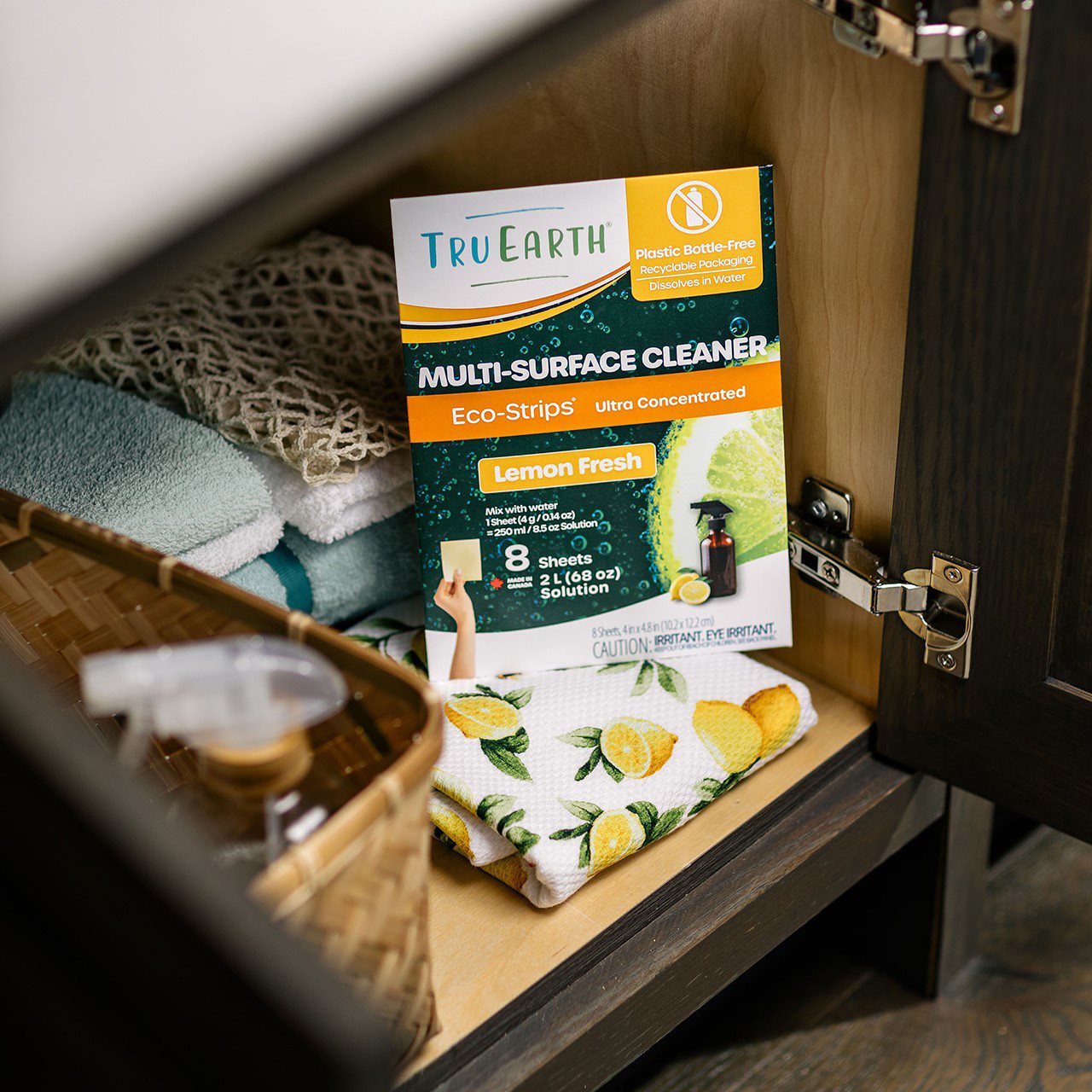
Ditch the plastic and instead use Tru Earth Eco-Strips Multi-Surface Cleaner. All you need to clean the surfaces in your home is one strip, a glass spray bottle and hot water. Just like the laundry strips, the multi-surface strips are made with cleaner ingredients free from harsh chemicals.

Need to mop your kitchen floors? No problem. Just toss a strip into a bucket of hot water and soon enough, you’ll have a clean, lemon-scented floor that you can be proud of.

3. Bathroom products

The multi-surface strips aren’t limited to kitchen use. You can also use them to clean your bathroom sink and floor. However, when cleaning your toilet, opt for Tru Earth Eco-Strips Toilet Bowl Cleaner.

Toss a strip into your toilet bowl. Wait a few minutes for it to dissolve, and then stir the water with your toilet brush. The ingredients are safer for the planet and its recyclable packaging means you’re helping prevent the need for unnecessary single-use and short-lived plastic in the home.

Tru Earth’s critical cause is to make true lasting change that helps save the planet. Not only are the products you buy good for the planet, but they also do good. For every $25 of Tru Earth products purchased anywhere in the world, online or in-store, the company will donate laundry detergent for 1 person in need for an entire month. To date, Tru Earth has donated nearly 40 million Eco-Strips®, or loads of laundry, to people in need.

Create a healthier home and environment for you and everyone else. By making smarter choices with the household products you use, you can make a difference. To learn more about Tru Earth and its critical cause, visit Tru.Earth.