Thinking about investing in a duplex? Think bigger.

2024-04-09T10:41:01

(BPT) – Investing in real estate can be a smart choice, but not all investments are created equal. There’s no denying rental properties are a surging market. Mortgage interest rates have risen dramatically over the past few years, high enough to price many people out of purchasing a home. It means the demand for rental properties is high. You don’t have to be an economist to see it — there’s a crane on every corner, and new apartment buildings are popping up everywhere.

For many investors, tapping into this surging market means buying duplexes, fourplexes or single-family homes. But with them comes the hassle of becoming a landlord. Fixing appliances when they break down, arranging for snow removal and yard work, dealing with tenant complaints or worse, going through the exhausting process of evicting someone when the arrangement just isn’t working. You’re suddenly the building’s maintenance technician in addition to being the owner.

Institutionally sized real estate projects like apartment buildings or condo developments don’t come with those kinds of hassles for their owners, as those responsibilities fall to property management companies. But in the past, they have been out of reach for individuals.

That’s not the case today. Investors who are thinking about getting into real estate can think bigger than a duplex. There’s an emerging investment model that gives private investors access to institutionally sized real estate projects, reaping returns and depreciation benefits without the management headaches.

Roers Companies is a national leader in real estate development, construction and property management that was founded to change the game for everyday investors. They’re on a mission to elevate multifamily housing by developing and operating market-rate, workforce, active 55+ and affordable housing in highly desired neighborhoods nationwide.

Rather than focusing on institutional equity to fund that mission, Roers Companies chooses to work with individuals.

Some quick facts about Roers Companies:

  • 17 completed projects sold since 2019 with an average hold time of 3.5 years
  • Nearly 12,000 rental units and 83 projects developed and under construction
  • $510M+ equity raised through 850+ investor partnerships
  • $2.9B in real estate since 2012

At a high level, to be considered an accredited investor, you need to meet one of the following:

  • Have a net worth over $1 million, not including their primary residence
  • Income over 200,000 (individually) or 300,000 (with spouse or partner) in each of the prior two years, and reasonably expect the same for this year

That kind of wealth criteria makes it possible for a whole tier of investors to buy into institutional-level real estate projects for the opportunity to receive high returns on that investment.

If you compare the performance of a $10,000 investment in stocks, real estate investment trust (REIT) and multifamily real estate over the course of 20 years, you can see that the growth in multifamily outperforms other asset types. Multifamily real estate investments also tend to offer less volatility than stocks or REITs.

Part of the reason for Roers Companies’ success lies in their business model. They don’t just manage properties or build them. Their internal capabilities include development, construction, leasing, property management and asset management. This vertical integration means that Roers Companies is able to achieve significant cost savings and efficiencies that companies with a single area of expertise cannot match. With a close watch on local markets, strong industry relationships, and a robust evaluation and approval protocol, their process refines and strengthens each opportunity offered to investors for consideration.

It’s an outgrowth of Co-Founder and Co-Owner Kent Roers’ recognition of what he calls “the missing middle” — everyday investors wanting access to institutionally sized real estate projects, but settling for buying houses or duplexes instead. Yes, they could buy into a REIT, but their performance is often correlated to the stock market — the highs and lows of stocks will follow for REITs. The business model Kent and his brother Brian built bridges that gap, giving private investors an opportunity for significant returns and a seat at the — much bigger — table typically reserved for large financial institutions.

Market conditions have pushed many companies out of the new-development arena in the past 18 months while Roers Companies’ private investors have made new projects possible. Because of that, their projects are under construction and will be ready to welcome residents and collect rent just in time for the institutional-reliant developers to hit reset on their projects in high-growth neighborhoods starved for supply.

The demand for rental housing shows no signs of subsiding, ensuring long-term stability and growth within the multifamily sector. This sustained demand, coupled with the anticipated cost reductions, presents a compelling opportunity for investors seeking attractive returns in the real estate market. To find out more about this unique direct-investment model, contact Roers Companies.

Photos by Spacecrafting

Rethinking teacher absenteeism: How to be more proactive and prepared

2024-04-09T08:01:00

(BPT) – By Nicola Soares, president, Kelly Education

Chronic absenteeism has become a pervasive issue across multiple employment sectors driven by several factors, including personal and family health challenges, stress and burnout. This problem is notable in the education sector, where consistent, strong educator-student relationships are crucial.

The 2023 Kelly Global Re:work Report revealed that nearly one-third (28%) of surveyed talent was ready to leave their jobs within a year, highlighting a mismatch between workforce expectations and organizational realities that may worsen absenteeism. This holds particularly true in the education sector — a field predominantly staffed by women, who often shoulder additional caregiving responsibilities for children or the elderly. Educators are increasingly taking time off to prioritize their personal responsibilities as well as their health and well-being. Such dynamics raise absenteeism risks and mark a pivotal moment for educational workforce stability.

A Heritage Foundation report illuminates the significant learning loss affecting students due to chronic teacher absenteeism, which impacts academic and nonacademic student development. This trend paints a troubling picture of the cascading effects of teacher absenteeism, highlighting the need for strategic, proactive measures to address this growing concern and safeguard the future of education.

For school administrators, it is challenging to find positive ways to address frequent absences, but adopting proactive strategies from the business sector can help mitigate absenteeism, underscoring the need for adaptability and preparedness in maintaining educational excellence amidst challenges.

Provide a culture of support

In an urgent call to combat the educator shortage, it is essential to highlight the critical role of a supportive work environment. Research across sectors underscores that employees, including teachers, are more engaged and consistently present when they feel valued by their organizations. Embracing a “whole educator” approach, akin to the holistic “whole child” perspective in education, schools should consider implementing comprehensive wellness programs, providing mental health resources and creating a more inclusive community that fosters a sense of belonging and participation in decision-making. Such measures bolster educator well-being and enhance the overall educational climate, leading to improved student outcomes.

Foster open communication

Open communication between school administrators and educators is critical in addressing the root causes of absenteeism. Encouraging educators to voice their concerns and challenges allows school leaders to identify patterns and implement targeted interventions. Regular check-ins and feedback sessions further nurture a sense of community and commitment. Moreover, adopting a supportive stance towards staff members’ personal hurdles, coupled with facilitating more compassionate and effective solutions, cultivates an environment of trust, effectively reducing stress and burnout. Such flexibility is vital, especially in today’s job market, where flex time is increasingly becoming standard. Employees should have access to both passive and proactive channels of feedback and communication.

Be prepared for absences

Even in the most positive, supportive workplaces, absences will happen. The Re:work Report underscores that resilience in businesses — and by extension, educational institutions — often hinges on the strategic employment of contingent workers to introduce much-needed flexibility.

Schools can tap into a vast pipeline of qualified substitute teachers, paraeducators, tutors and therapists by forming partnerships with specialized staffing providers such as Kelly Education. This eases the administrative strain of managing and recruiting specialized personnel and ensures the continuity of high-quality education. This approach addresses the immediate challenges posed by teacher absenteeism and contributes to a broader solution, emphasizing the urgent need for collaborative efforts between the education and private sectors to navigate the current educator shortage crisis more effectively.

Encourage continuous education and upskilling

The key to retaining and attracting talent is the investment in continuous professional development, which offers educators opportunities such as online training, collaborative projects and mentorship programs. These initiatives enhance educators’ skills and boost their job satisfaction and commitment, which is crucial in combating absenteeism and ensuring a dedicated workforce. Moreover, integrating stress management and resilience training prepares educators for how to handle professional pressures more effectively.

In an era where Artificial Intelligence (AI) is revolutionizing industries globally, lies another example of a lesson education leaders can learn from the business sector. By training educators to master AI tools, we can dramatically alleviate administrative tasks, thereby unlocking opportunities for deeper, more meaningful educational interactions. This approach does not only streamline operations but also fosters the adoption of innovative teaching techniques that significantly enhance student learning outcomes. This strategic focus on upskilling underscores the urgent need for a modernized professional development framework that aligns with the evolving demands of the education sector.

The challenge of teacher absenteeism is significant, but not insurmountable. It is paramount to recognize and value educators by creating an environment that respects their needs and addresses their challenges. Through such concerted efforts, we can build a more robust and adaptive educational workforce equipped to offer high-quality, uninterrupted learning experiences. In doing so, we not only safeguard our children’s futures, but also affirm our collective commitment to nurturing the next generation of leaders, thinkers and innovators.

Learn more about ways to make school administrators’ days easier at https://www.kellyeducation.com/youreasyday.

6 tips to take your spring DIY projects from weeds to blooms

2024-04-08T12:13:00

(BPT) – The spring is a great time of year to start tackling the DIY projects you’ve been putting off all winter. If you plan to roll up your sleeves this season, you’re part of a growing trend. DIY projects top many spring to-do lists this year and outdoor projects are a big priority for individuals across the nation. Home improvement leader Lowe’s has found that 34% of customers plan to take on projects related to outdoor living, from adding plants, flowers and seasonal décor to updating their patio furniture. Additionally, 40% say they plan to focus their time and efforts on their home’s exterior — including maintenance and lawn repair.

And now, DIY projects just got even easier thanks to DoorDash’s new partnership with Lowe’s. With over 1,700 Lowe’s stores available nationwide directly on the DoorDash app, you can now shop your favorite Lowe’s items from the comfort of your own home! This means less time running errands and more time making your dream home a reality.

Seasoned DIYers know that whether it’s freshening up your patio with a coat of paint, planting new blooms, or landscaping the backyard, there’s a right way and a wrong way to do the project. Most have learned from experience that a little planning at the outset can save you time and money in the long run.

Here are six tips from DoorDash and Lowe’s for making your outdoor DIY projects go smoothly.

Make a plan and prioritize. Before you start tilling up the yard and pulling out the weeds, sit down and create a detailed plan for the project. This should include a list of what projects you want to tackle, the tools and materials you need to get the job done, a realistic assessment of whether you can do it yourself or if you’ll need a pro, and roughly how long it’s going to take from start to finish.

Remember the little things. How much household disruption is the project going to cause? Do you need to send the dog to daycare while you dig up the lawn? Have you called the city about hidden power lines? Will you have to turn off the water, and if so, have you filled a gallon jug or two to get you by? Little things like this can derail a project if you don’t anticipate them beforehand.

Set a budget. It can be very easy to accidentally exceed the scope of the project — and the cost — if you’re not careful. First you’re simply sprucing up the garden, but a few bags of mulch and a pile of pavers later, you’re creating a whole new patio complete with a brand new outdoor furniture set. Avoid this landslide by deciding how much you can comfortably spend on the project, and stick to that number. Be sure to take advantage of promotions and deals whenever you can to help you stretch your budget. Lowe’s offers a lineup of great spring products at an outstanding value! From now through April 14, customers can get $20 off their first order of $45+ from Lowe’s with code LOWES20 on DoorDash.* Plus, DoorDash users can enjoy even more savings, with Lowe’s biggest annual SpringFest deals available nationwide, now through May 1, helping customers save on all the essentials needed to tackle spring — from power tools and lawn care to appliances and décor.

Keep the DoorDash app open. DIYers, rejoice! DoorDash’s newest partnership means the end of running to Lowe’s in the middle of the project when you inevitably find you forgot a crucial piece of the puzzle. Get everything from tools to garden supplies, to paint and much more delivered through DoorDash directly to your doorstep in an hour on average** — thanks to everyone’s favorite on-demand delivery platform. And, all participating Lowe’s stores will also be available on DashPass, DoorDash’s membership program that offers members a $0 delivery fee and reduced service fee on eligible orders from thousands of restaurants, grocery and convenience stores nationwide.***

Break it down into tasks. You know what they say, a long journey starts with a single step. This also applies to DIY projects. An enormous undertaking can feel overwhelming, but a series of smaller tasks? That’s doable. The best part? You can now schedule the delivery of all your essentials so that they’re at your doorstep before you start your project!

Ask for help. Bit off more than you can chew? Don’t have the expertise to do the job right? Circle back and get the help you need, whether it’s the handy guy down the street, or a licensed professional.

Follow these tips and your DIY projects will go quickly and smoothly, leaving you with more time to enjoy your spruced-up nest this spring and beyond.

For more information on the latest news and promotions, visit DoorDash.com and Lowes.com.

*Offer valid through 04/14/24 on your first order placed at participating Lowes locations. Valid only on orders with a minimum subtotal of $45, excluding fees and taxes. Maximum value of discount is $20. Discount applies to subtotal only; does not apply to fees, taxes, and gratuity. Not valid for pickup. Limit one per person. Fees, taxes, and gratuity still apply. Use promo code LOWES20 to redeem. See full terms and conditions at https://drd.sh/8ONpZP/.

**Based on average delivery time. Delivery times may vary and are not guaranteed.

***DashPass benefits apply only to eligible orders that meet the minimum subtotal requirement listed on DoorDash for each participating merchant. Other fees (including service fee), taxes, and gratuity still apply. After signing up for DashPass, you will be charged the then-current renewal price (plus applicable taxes) automatically on a recurring basis until you cancel. DashPass terms (including how to cancel) here.

New clinical egg study reveals egg-cellent results

2024-04-08T07:37:00

(BPT) – Americans are increasingly aware of the impact of cholesterol on heart health and overall well-being, but it’s not always easy to know which foods will truly have a positive effect. To add to the confusion, it can feel like research is always revealing something new, so it can be difficult to keep up.

Eggs, for example, have often received negative press related to cholesterol. However, new clinical research by a leading academic medical center showed eating fortified eggs, like Eggland’s Best eggs, did not negatively affect cholesterol levels. Additional findings suggest that eating 12 Eggland’s Best eggs a week can be part of a healthy diet, even for more high-risk individuals.

Research also suggested that consuming Eggland’s Best eggs could potentially reduce levels of “bad cholesterol” (LDL cholesterol) in older individuals and those with diabetes, and may help increase levels of “good cholesterol” (HDL cholesterol) in older individuals. The consumption of Eggland’s Best eggs may also increase Vitamin B12 levels, helping to support a healthier lifestyle.

Registered Dietitian and Nutritionist Dawn Jackson Blatner said this clinical study helps clarify the confusion regarding the nutrition of eggs and can help people feel more confident about including fortified eggs as part of a healthy diet, even for people who are at high risk for heart disease. Dawn also shared additional tips for people who may be looking to lower their cholesterol levels:

1. Eat more fiber: Fiber-rich foods are key for a healthy heart and lipid levels. Fiber-rich foods include whole grains, fruits, vegetables, beans, lentils, nuts and seeds.

2. Swap your fats: Switch to more heart-smart fats to add flavor such as olive oil, nuts, seeds, avocado and fish. Strive to decrease foods higher in saturated fat like butter, cheese, fatty meats and fried foods.

3. Choose eggs wisely: Not all eggs are created equal. Eggland’s Best eggs have more than double the omega-3s and Vitamin B12, 25% less saturated fat, 10 times more Vitamin E, and six times more Vitamin D compared to ordinary eggs.

Jackson Blatner shares her favorite recipe for a delicious toast that contains healthy fats and wholesome ingredients like salmon, avocado and Eggland’s Best eggs:

Salmon and Avocado Toast

Prep Time: 5 minutes
Cook Time: 5 minutes
Total Servings: 2 avocado toasts

Ingredients:
2 Eggland’s Best eggs, large
1 teaspoon olive oil
2 slices whole grain bread, toasted
1/2 avocado
1 cup raw spinach or arugula
2 ounces smoked salmon
Black pepper, to taste

Instructions:
1. In a skillet over medium heat, add olive oil, crack in Eggland’s Best eggs, and cook until eggs are over-medium.

2. Top each piece of whole grain toast with equal amounts of (in this order): sliced avocado, spinach, salmon, and top with a cooked Eggland’s Best egg and sprinkle of pepper.

Allergy Info: no added sugar (can be gluten-free if gluten-free bread is used)

To learn more about this study from a Leading Academic Medical Center, visit EgglandsBest.com/EggStudy.

Mindfulness tips to support early learners’ development now

2024-04-08T07:03:00

(BPT) – While mindfulness once felt like a wellness trend, it’s become a way of life for adults hoping to maintain healthier routines, be intentional in their work and handle daily stresses efficiently. According to the Centers for Disease Control and Prevention (CDC), mindfulness is the practice of being fully aware of your thoughts and feelings in a moment without judging them or negatively reacting.

But what about kids? Even at an early age, stress can lead to harmful brain development, potentially shrinking brain capacity, locking in fight, flight or freeze responses and escalating mental health disorders. A stressed brain is blocked, frustrated, over-reactive and anxious. The CDC recently published a policy report on youth mental health, which listed daily mindfulness practices as the #2 strategy to drive improvement. Mindfulness and self-regulation can impact a child’s ability to learn, and these skills are crucial for growth inside and outside the classroom. The CDC recommended K-12 classrooms practice mindfulness more regularly, but even early childhood education centers can attest to the positive impact of adopting this mindset.

Bright Horizons, a leading global provider of high-quality early education and child care, is naturally integrating mindfulness into the daily routines of early learners at hundreds of its child care centers. Utilizing Inner Explorer, a platform designed to support mental health and well-being, Bright Horizons centers implement this daily mindfulness program to help its children learn critical skills like self-awareness, self-regulation and empathy.

“Young children don’t know how to recognize and manage their emotions. They use coping tools available to them until they learn new strategies. Emotional recognition and regulation skills can and should be taught, just like any other set of skills. One of the most valuable strategies we can teach them is mindfulness,” said Bright Horizons Chief Academic Officer Rachel Robertson. “Mindfulness is paying attention on purpose, and we know it can play a crucial role in helping young children manage their emotions and actions. But, it requires intentional support from teachers and parents to develop it. Beginning mindfulness practices at an earlier age also boosts important cognitive skills. It has a significant impact on executive function, creating habits that carry into adulthood and nurturing several skills identified as essential for future success.”

Want to integrate more mindfulness practices into a child’s daily routine? Robertson has several tips and techniques parents and teachers can use:

  • The STOP Strategy: Stop, pause and focus. Take a deep breath. Observe what’s going on around you and inside yourself. Proceed.
  • Gratitude Moments: Spend a few moments each day sharing what you are grateful for.
  • Nature’s Symphony: Close your eyes and identify as many sounds as possible, from birds chirping to leaves rustling or cars nearby.
  • Starfish Breathing: Take five breaths as you trace your hand, one finger at a time.
  • Mindful Walk: Pick one sense like sight and notice how many different colors you can see.
  • Shake the Sillies Out: Pretend you’re a statue, take a deep breath and shake the energy out!

The possibilities of mindful activities for you and early learners are endless, and the benefits of more intentional practice cannot be denied. To learn more about Bright Horizons, visit brighthorizons.com.

Upgrade your self-care ritual: 5 expert tips for a refreshing ‘everything shower’

2024-04-05T07:01:00

(BPT) – Your shower can be more than just a way to get clean, and the viral “everything shower” trend proved just how easy it is to build a head-to-toe self-care routine that provides physical, mental and emotional benefits.

Researchers have studied the effects of showering and discovered the science behind its rejuvenating powers. Hot showers can signal your brain to release oxytocin, a feel-good hormone that helps reduce stress and anxiety. The heat from a shower also relaxes your muscles, clears your nasal passages and clears your pores of dirt and oil.

Beyond science, showers are a rare opportunity to take a break from your busy schedule to focus on your well-being. Are you ready to elevate your shower into a self-care ritual? Inspired by National Self-Care Day, Waterpik™ showers partnered with New York City Dermatologist Joshua Zeichner, MD, and Dr. Karen Litzy, PT, DPT, to help curate these five tips to transform your shower into a relaxing and refreshing experience.

1. Ditch your phone

Your self-care shower begins before you even step inside the bathroom. Leave your phone in your office, living room or bedroom to disconnect from the world and minimize distraction. This simple act helps you focus on yourself and your well-being, away from the stresses and responsibilities of your life. As you step into your bathroom, embrace a peaceful moment of solitude.

2. Create a relaxing ambiance

Harsh or bright lighting is counterproductive to relaxation. Set the mood by lowering the lights in your bathroom and lighting candles. Candles, whether scented or unscented, create a soft, glowing ambiance that can calm your racing thoughts and put your mind at ease.

Enhance your shower experience by playing soothing music. Play nature sounds like a tropical rain or burbling brook, instrumental music, singing bowls or whatever sounds you associate with calmness and tranquility. Guided meditations are also a fantastic choice for promoting mindfulness so you can stay present in this moment of self-care and gratitude.

3. Pamper your scalp and hair

Don’t rush through your hair care routine. Use your shower time to pamper your hair and scalp. In addition to letting a hair mask or deep conditioner nourish your locks, give your scalp a little attention with a gentle scrub and massage.

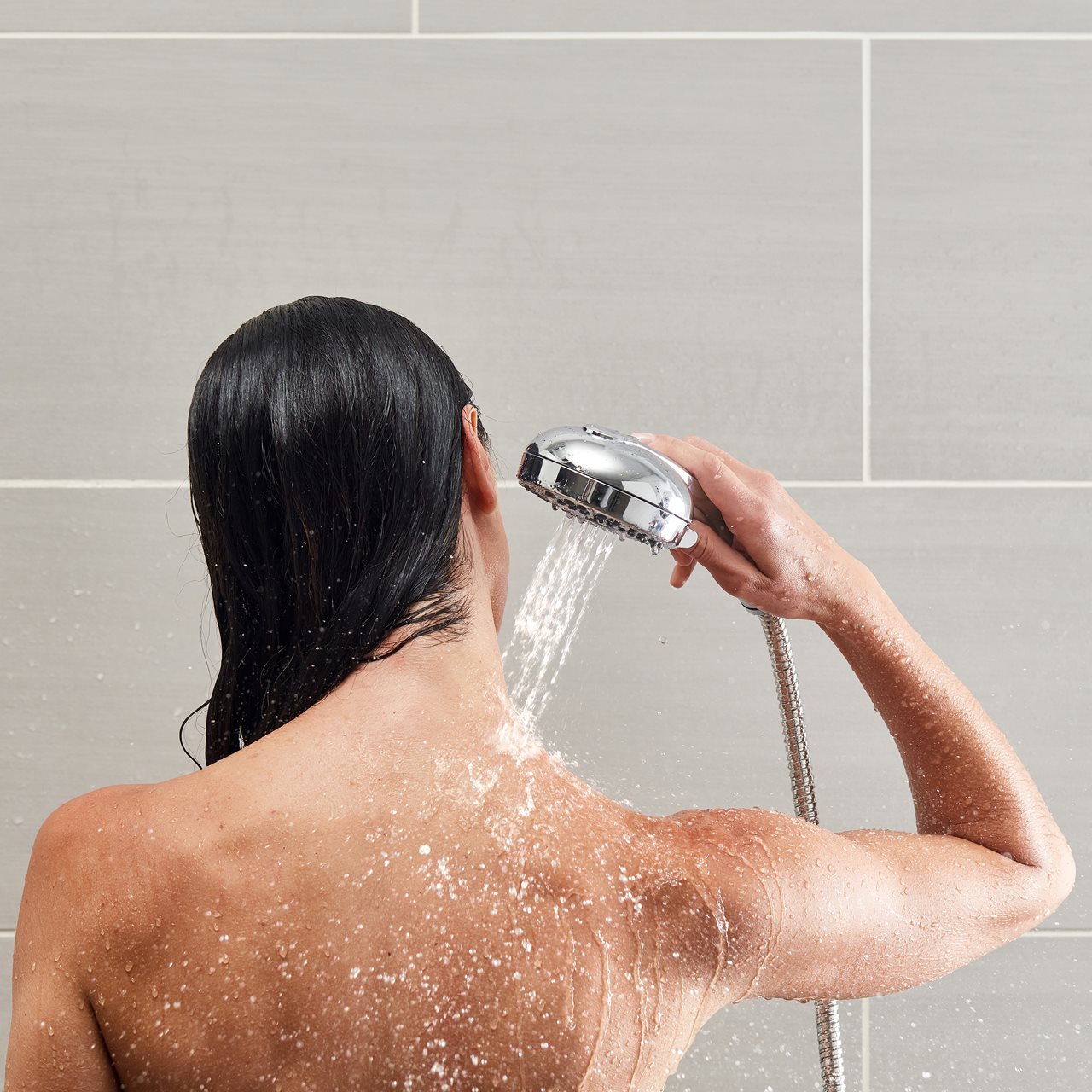
Scalp and hair care is effortless with the right tools. Consider getting the Waterpik™ HairWand Pulse spa system for a luxurious way to care for your hair and body right at home. The Waterpik HairWand Pulse spa system provides fast, effective rinsing. The pulsating comb shape spray of the Waterpik HairWand shower head delivers a relaxing scalp massage that reaches down to your roots and can help relax you, remove visible flakes, and leave your scalp feeling clean. New York City Dermatologist Joshua Zeichner, MD, says, “Clogged pores and scalp flakes are two of the most common complaints dermatologists get from patients. Proper showering is important for skin health, both to remove soiling that builds up on the skin as well as shampoos and body washes. Your shower head is more important than you may realize, as it provides the action for effective rinsing.”

4. Massage your muscles

Take advantage of the muscle-soothing power of a hot shower and give yourself a massage. If you haven’t already, invest in a shower head with massage settings to unwind your muscles and release tension.

Dr. Karen Litzy, PT, DPT, recommends choosing the Waterpik™ PowerPulse Therapeutic Massage shower head. “It is neither economical nor realistic to have a massage every time you have achy muscles. Although not quite the same as a hands-on massage, the Waterpik PowerPulse Therapeutic Massage shower head is the perfect alternative. With the handheld shower head feature, you can focus the massaging water stream directly over the muscles that need it most. It is an inexpensive way to get the benefits of water massage without the price tag of going to the spa.” The Waterpik PowerPulse Therapeutic Massage has two times the massage force* and is clinically shown to help soothe muscle tension, increase flexibility and promote restful sleep. The Waterpik shower head provides therapeutic benefits that transform your daily shower into a restorative wellness experience.

5. Enjoy the post-shower glow

Rushing to get dried and dressed after your shower defeats the purpose of your relaxing routine. Take your time after your shower to towel off, moisturize your skin and dry your hair. Bask in the glow of your self-care practice and carry the calm and peace of your shower into the rest of your day.

Self-care isn’t just about spoiling yourself. It’s essential for maintaining your well-being. Using these five simple tips, you can elevate your basic shower into a luxurious self-care ritual.

*Waterpik PowerPulse Therapeutic Massage shower heads have two times the massage force compared to Waterpik non-PowerPulse massage shower heads.

What every homeowner should know about the new clean energy tax credit

2024-04-04T23:01:00

(BPT) – Whether you are in the market for a new home or ready to upgrade your current residence, investing in energy-efficient home improvements could help you save money thanks to the Inflation Reduction Act.

Signed into law in August 2022, the federally funded Inflation Reduction Act includes a record $370 billion reserved spending for energy initiatives, including significant tax credits, rebates and other incentives for homeowners who replace or upgrade their HVAC systems, appliances and insulation. Combined with additional state, local and manufacturer’s programs, these energy-efficient home improvements can help you save considerably at tax time — and lower your utility bills in the long run.

When you’re ready to enhance your home’s efficiency, here’s what you need to know:

Energy-Efficient Home Improvement Credit: Beginning with products installed on Jan. 1, 2023, and extending through the end of 2032, energy tax credits have been expanded from previous programs with increased cost-saving values. They now offer homeowners a rebate up to 30% of eligible expenses up to $1,200 per year each year that the program is active. Homeowners considering an energy-efficient heat pump can save even more money with an additional rebate up to $2,000 available. Eligible upgrades include:

  • Home energy audits
  • Heat pump HVAC or water heaters
  • Biomass stoves and boilers
  • High-efficiency gas furnaces
  • High-efficiency central air conditioning
  • ENERGY-STAR certified doors and windows
  • Insulation enhancements
  • Electric panel and wiring upgrades
  • Clean energy equipment installation

High-Efficiency Electric Home Rebate Program: The High-Efficiency Electric Home Rebate Act, or HEEHRA, is a 10-year program that provides homeowners with rebates up to 100% of the cost of eligible projects up to $14,000. HEEHRA rebates are based on income and can help to fund home improvements such as switching to electric appliances, installing a heat pump or updating your home’s circuit panel. The value of each rebate varies by project and includes up to $8,000 for eligible households to install heat pumps.

State and local rebate programs: In addition to federally funded programs, many state, local and utility rebates are available to incentivize energy-efficient home improvements. These offers can vary so it’s best to speak to a local expert such as your HVAC contractor, or use this zip code-based HVAC savings database at York.com/residential-equipment/rebates-and-savings as a point of reference.

Manufacturer rebates and financing options: When it comes to your home’s efficiency, heating and cooling often account for the most energy consumption — and the highest utility bills. Because of this, upgrading the HVAC system can often provide the greatest payback.

Regardless of your home comfort needs, manufacturers such as YORK have an extensive offering of energy-efficient systems, including electric heat pumps, that may be eligible for certain rebates. Plus, your contractor can discuss available financing options to help with the upfront equipment costs to maximize savings.

Rate Your Preparedness: Insurance Coverages to Help Your Contracting Business Manage Financial Risk

2024-04-04T08:13:00

(BPT) – A single day in construction can prompt just about every emotion — the pride of seeing a project near completion, the frustration of project delays and the anxiety that comes with accidents and injuries. Safety controls help mitigate risk, but accidents can still occur. If something goes wrong, insurance can help protect your livelihood.

“Fluctuating material costs, weather changes and staff shortages are a few of the many things outside a contractor’s control,” says John Lack, former general contractor and current construction consultant at Acuity Insurance. “Given the industry’s unpredictability, it’s important to manage what you can. By not being adequately insured, many contractors are leaving themselves vulnerable to the potentially business-ending impacts of accidents and injuries.”

If it’s been a while since you’ve reviewed your insurance coverage or you are not sure what’s in your commercial policy, consider the following coverages and whether it’s time to call your agent to discuss.

Workers’ Compensation Insurance

When an accident occurs, you want to get your staff healthy and back to work. Choosing an insurance partner equipped with additional services can help your employees get back to work sooner, have better outcomes and save you money. Acuity Insurance offers a nurse helpline that helps streamline access to nonemergency care for injured workers. Acuity also reviews every bill incurred to make sure the treatment is applicable to the injury and charges are billed correctly. This means you’ll only be incurring costs for what you should. These services help ensure employees are cared for and reduce expenses.

Liability Insurance

General liability policies help protect a business when someone takes legal action against it. Acuity’s general liability policies apply the policy aggregate limit separately for each project and each location, satisfying your contract requirements and protecting your interests. Contractors’ errors and omissions coverage protects your business if someone sues you for work performed incorrectly. Voluntary property damage coverage applies to accidental damage to customer property you are not working on left in your care or control at a work site. These coverages provide financial protection if things go wrong.

Commercial Auto Insurance

Any business that owns or leases vehicles or has employees drive their personal vehicles for business purposes should have commercial auto insurance. Commercial auto insurance covers many business vehicle types, from cars to semitrucks. Commercial auto insurance covers your vehicle’s liability you assume while driving. Unfortunately, accidents happen, and they can get expensive quickly. Commercial auto coverage can help you get back to work after an accident.

Property Insurance

You have a lot of things worth keeping safe. Your building is your home base, and we know you rely on your tools and equipment to keep your work going. Working with your insurance company to tailor your coverages and limits should give you peace of mind that you can quickly return to work if something goes wrong.

Insurance is an important way to secure your business’s financial well-being. Choosing the right coverages and partner can make the difference between being able to rebound from financial loss and having to shut down.

“Construction is a challenging, rewarding and sometimes risky industry,” Lack says. “It’s wise to work with an independent insurance agent who understands your business and can help to ensure ongoing protection for your business.”

6 ways to smell fresher from your pits to your bits

2024-04-04T10:01:00

(BPT) – There’s a funny thing about body odor. It’s not confined to your underarms. It can affect your whole body, from your pits to your bits … and beyond. Ever get a whiff of your feet after a long day in sandals? How about your bra when you whip it off after you get home after work? Let’s be honest, ladies. We might want to smell like a delicate spring rain, but by the end of the day? Sometimes, the struggle is real.

Secret gets it. This industry leader that has been helping women get their good smell on for nearly 70 years recently found women often face unspoken concerns about whole body odor.

“Some people think body odor means you’re ‘dirty’ when body odor is completely normal and natural,” says OBGYN Dr. Wendy Goodall McDonald. “We all have bacteria that naturally exists on our bodies. If that bacteria is able to mix with sweat in tight spaces, it will emit an odor. Also many think body odor is only normal under the arms, when it can come from many more parts of the body.”

But, McDonald explains, the tactics they have been using to combat body odor have been less than effective — taking multiple showers a day, layering clothes, applying powder, using sprays or perfumes to mask the odor, even avoiding being close to or intimate with others.

Women have enough stress. Do we really need to worry about this, too? There’s got to be a better solution.

The good news? There is. Here are some tips that really work.

Watch what you eat … Far be it from anyone to suggest you give up garlic bread, hummus or a Caesar salad, but according to WebMD, foods with garlic, onions and other more aromatic spices can actually affect how your body smells. The aroma can be carried in your sweat. Try a fruit salad instead on a hot summer day.

… and drink. Alcohol and caffeine can make you perspire more than usual and overall hydration can really affect your scent. So drink those eight glasses of water each day. Bonus tip: It can help with bad breath, too.

Use a whole body deodorant. Didn’t know that was a thing? It’s new! Secret developed an innovation in deodorants, Secret Whole Body, that you can use from pits to bits. Groin, feet, thighs, the whole nine yards. It goes on clear and smells delicious, featuring Peach + Vanilla Blossom and Fresh Lilac + Waterlily scents that don’t simply mask your scent, they fight odor-causing bacteria at the source. It comes in three forms: a nitrogen-powered spray, a stick with coconut oil and shea butter, and a water-based cream, all of which give 72-hour clinically proven protection against odors. All three forms are free of aluminum, baking soda and dyes. And, four out of five gynecologists and dermatologists would recommend it, including Dr. Goodall McDonald. It’s a serious new breakthrough that gives women an easy way to smell fresh all day. Look for it at retailers nationwide.

Exfoliate. Showering every day is a given to get rid of the bacteria on your skin, but don’t forget to exfoliate, too. It can help remove the dead skin cells that can trap bacteria and cause odors. Another tip for your daily showering routine: towel off well, especially in areas where you tend to sweat later in the day. When you get dry right away, it’s harder for that bacteria to breed.

Wear loose, lightweight clothes. You may want to do the opposite and cover up more heavily if you’re concerned about whole body odor. But dressing in outfits that will keep you cool may help minimize body odor.

Replace your insoles. To help combat foot odor, replace those insoles often. New insoles won’t stop your feet from sweating, but old, stinky insoles certainly aren’t helping.

With these tips, you can ditch the stress about body odor, put on those tank tops and shorts and enjoy summer!

4 Ways Your Screen Time Could Be Costing You

2024-04-04T08:01:00

(BPT) – Screens are a necessary part of life today, particularly for those who rely on their computers or other digital devices for work. But did you know that spending long hours on screens can have negative physical, mental and financial impacts? A new report by the American Optometric Association (AOA) revealed that more than 104 million Americans are exposed to prolonged screen time, including 70% of those working office jobs, that could be affecting their quality of life.

According to the report, the impact of unmanaged excessive screen time (spending 7+ hours on screens per day and not visiting an optometrist in the past year) on eye health was found to be wide-ranging. Of the 32 million Americans who had unmanaged excessive screen time, 55% experienced vision-related symptoms that may have been improved or resolved from regular visits to the optometrist. The report indicated that symptoms related to excessive screen time exposure could cost a person around $702 per year.

Prolonged screen time, especially if you use a computer screen for work, can do more than just affect your wallet:

1. Health implications — As little as two hours of screen exposure per day can induce eye-related symptoms like myopia (nearsightedness) and digital eye strain, which can cause discomfort and impact your quality of life. Symptoms of digital eye strain include dry eyes, blurred vision, headaches, and back and neck pain.

2. Lower productivity — Symptoms related to excessive screen time can lead to decreased productivity and less time to do the things you love if you have difficulty concentrating on screen-based tasks and have to put in longer hours to keep up.

3. Missed work — Sometimes people have to miss work to recover from symptoms due to excessive screen time. In a four-week period, nearly 3 in 5 (57%) employed Americans with eye conditions miss full or partial days of work because of eye conditions or short-term symptoms, and nearly 1 in 10 (9%) miss more than a full work week.

4. Poor sleep — Too much screen time can also keep you up at night. Using phones or tablets during the hour before bedtime can affect your ability to fall and stay asleep, and poor sleep quality can cause difficulty concentrating and impact your mental health.

How to ease the effects of prolonged screen time

You can’t always reduce your screen time, so it’s important to implement healthy habits to keep your eyes and overall body healthy.

Get a comprehensive eye exam: To make sure your eyes are as healthy as possible, it’s vital to see an optometrist for a comprehensive eye exam annually, even if you don’t use corrective lenses.

Optometrists are trained to provide comprehensive eye and vision care, and they can detect over 270 serious health conditions, including diabetes, high blood pressure, autoimmune diseases and cancers from an in-person eye exam.

“Seeing a doctor of optometry even just once per year can help prevent and reduce the effects and symptoms caused by excessive screen time, improving your quality of life,” said AOA President Dr. Ronald L. Benner. “There’s no substitute for an in-person visit to detect and treat potential problems promptly, and to help you learn better eye health practices at work and at home.”

Try these tips to avoid digital eye strain at home and at the office:

Blink often: Screen time decreases your blink rate, but blinking helps create and spread tears across your cornea, which keeps your eyes hydrated. If you have trouble remembering to blink frequently, try setting a reminder every few minutes. For a fun way to learn more about keeping your eyes healthy while on screens, download the mobile game Blink Land, available on IOS and Android devices.

Take breaks: Shifting your gaze away from your screen can also give your eyes a much-needed break. Also, practice the 20-20-20 rule: For every 20 minutes of computer viewing, gaze at something 20 feet away for 20 seconds to relax the eye muscles.

Check your positioning: Your computer screen should be 15-20 degrees below eye level (about 4 or 5 inches) as measured from the center of the screen, and 20-28 inches from your eyes.

To learn more about eye health and find an AOA doctor of optometry near you, visit AOA.org/EyeDeserveMore and learn more tips from AOA’s User Guide Study Companion.