6 steps to a truly outstanding get-together

2021-10-20T20:02:08

(BPT) – After a year like no other, everyone is seeking ways to celebrate and enjoy those little things that make such a big difference. You don’t have to be a wine expert to know that the right wine or cocktail for the occasion can make any get-together truly outstanding. Whether you’re hanging out with friends around the grill or embarking on an epic road trip, here are tips for relearning how to enjoy the moment.

1. Stemware for everywhere

Or better yet — stemless wineglasses. Find unbreakable, shatterproof, insulated wineglasses online that are perfect for your next patio party or glamping trip. There are plenty of choices for insulated tumblers and coolers to keep wine and other beverages chilled and safe, no matter where you go.

2. Choose wines that are bright, light and just right

Whether relaxing with friends at home or around your backyard fire pit, enjoy a light, refreshing white wine that’s fragrant, vibrantly fruity and crisp, like the 2020 Wairau River sauvignon blanc from New Zealand. The vineyards are planted along the Wairau River’s edge, creating quality wines to help you enjoy the moment.

3. Keep cool

When you’re enjoying an outdoor get-together, you’ll want to prevent wine from getting too warm — even reds. One trick is to store wine bottles in a cooler or a bucket filled with ice, salt and water. The salt in the water helps bring the freezing point of water below 32 degrees Fahrenheit.

4. Inspire your inner mixologist

Did you know wines can be used to create refreshing drinks? Add seasonal fruit or herbs to transform a favorite wine into a delicious cocktail.

Create your own Moscato Moscow Mule with this easy recipe:

Ingredients

  • 5 ounces Seven Daughters Moscato
  • A few ounces club soda
  • Lime
  • Ginger ale

Instructions

Mix Seven Daughters Moscato and club soda.
Add squeeze of lime and top with ginger ale.
Garnish with lime wedge.
Makes 1 serving.

5. Rediscover wine country

When you’re itching to get away from it all, why not sip your way through a tasting flight at a winery? With over 11,000 wineries across the U.S., you have plenty to choose from. You can even find hidden gems in parts of well-known Napa, like the Maxville Winery in the Chiles Valley. This winery started as a summer camp, with its first grapevines planted back in 1974. Today, you can visit the winery and sample the Estate Maxville cabernet sauvignon, cabernet franc, sauvignon blanc, red blend and petite sirah.

6. Fire up the grill and chill

When you’re grilling outdoors, choosing a wine that complements whatever you’re barbecuing can be challenging, but when you find one that can really bring out the flavor of your food, everything tastes that much better.

Here’s an easy rule of thumb:

For traditionalists, burgers, ribs and steaks pair perfectly with a cabernet sauvignon, zinfandel or even a malbec. For lighter fare like grilled fish, chicken, pork chops or veggies, choose a lighter wine to pair with it, like a chardonnay, sauvignon blanc or a dry rose.

Looking for a more meaningful career? Educators are needed

2021-10-20T19:53:18

(BPT) – At age 62, Sandy Weber became unemployed when her customer service job was eliminated during the COVID pandemic. A friend encouraged her to give substitute teaching a try. “I didn’t realize I could work in a classroom without a teaching background,” Weber said. “It was the best decision I’ve made in years.”

U.S. workers faced unprecedented challenges this past year. Millions of Americans lost their jobs, were forced out of the labor force to care for dependents or resigned to re-evaluate what kind of career they really want. About 7.5 million workers quit their jobs in April and May, according to the Bureau of Labor Statistics.

Those who have lost, have left or are thinking of leaving their job might want to consider a career in the classroom.

Schools and daycares everywhere need new talent, as a record number of educators are among those who have left their jobs to care for their own children or choose early retirement. While this puts the education system under pressure, it presents an ideal opportunity for career changers wanting to make a difference in children’s lives.

“Because of this pandemic, people have had time to reassess what’s really important to them,” said Nicola Soares, president of Kelly Education. “The need for a career change, plus the desire to find greater purpose and flexibility are driving workers to seek meaningful employment in schools.”

Launching a fulfilling education career is easier than you might think. There are many ways to begin, even without teaching credentials. Schools are welcoming more candidates with diverse backgrounds, perspectives and work experiences than ever before. Weber was able to transfer her customer service skills to managing the classroom.

Options for starting a new position in the classroom

Here are four opportunities that could lead to a lifetime career.

1. Substitute teachers

Every school district needs hundreds of substitute teachers during a normal school year. Post-pandemic, that number is even higher. Credentials for substitutes vary by state, so job seekers should check their state’s department of education or local school district website. Pay varies according to levels of education and experience and can range anywhere from $100 to $200 a day.

2. Paraeducators

Even with virtual schooling, there is a strong demand for paraeducators across all grade levels. Also known as paraprofessionals, they often work with children who have special needs by providing support to students in and out of the classroom. Successful paraeducators are those who are team players, have good communication skills and are knowledgeable about children.

3. Tutors

The ongoing need for learning recovery from the pandemic is creating a surge in demand for tutors. Pay ranges from $20 to $50 an hour for math and science tutors. Tutoring is a great option for people with a variety of professional experiences and allows for flexibility with scheduling (more evening and weekend hours).

4. Early childhood educators

Working with infants and young children is fun and creative. While early childhood teacher positions may require certifications (varying by state), assistant, substitute or aide roles are accessible in these settings, offering steady part-time or full-time work with infants, toddlers and preschoolers.

How to get started

Many positions demand a high school diploma or G.E.D., but any work environment featuring children will also require a background check. Employers provide information about the vetting process or may arrange it for candidates.

Here are two resources to get started:

KellyEducation.com connects job seekers with classroom positions primarily in the Northeast, Southeast and Southwest, offering full-time opportunities and flexible schedules in early childhood settings and Pre-K-12th grade. Kelly Education also assists with alternative pathways to a long-term career in education, and hours worked in the classroom can be included toward future certification or degree programs.

In the western U.S., TeachersOnCall.com is a service that hires substitute teachers, paraeducators, tutors and early childhood education staff. Job seekers can choose their grade level, schools and days they want to work.

“Making a career change to help out in schools has been really satisfying,” said Weber. “And I feel like I’m making a difference.

How to stay connected when severe weather strikes

2021-10-20T19:44:21

(BPT) – Severe weather can cause major damage to homes, businesses and critical communications infrastructure. Storms can knock out cable and fiber connections, as well as cell towers, making it difficult to receive emergency updates, track community response and access critical financial and health information. While it’s hard to know where and when severe weather may strike, residents and businesses in disaster-prone areas can weather the storm with a few simple steps.

Here’s what you can do to stay connected when disaster strikes:

1) Protect your data

Electronic devices store a tremendous amount of vital personal and business information. A best practice anytime of the year, but particularly in advance of severe weather, is to back up your data to the cloud so it is safe, secure and easily accessible whenever or wherever you need it. Depending on the device, you can even set a reminder that enables it to upload your data automatically to the cloud on a regular basis.

2) Preserve battery power

Make sure your devices are fully charged at all times. Consider purchasing portable power banks so you can charge your devices even if the power is out. To preserve existing battery life, keep screens in low light mode and close out any non-essential apps. You may also want to consider investing in a standalone generator that kicks in when the power goes out.

3) Pre-download emergency information

In the wake of natural disasters, receiving emergency information in real-time is critical. Emergency notification mobile apps, such as those from the American Red Cross and FEMA, offer real-time weather updates, disaster assistance, safety preparation, recovery advice and more. Download them and your local government websites so you can access them quickly in an emergency.

4) Safeguard your internet

For businesses, an internet outage can hinder payment processing, security and communication with employees, customers and vendors. Consider an internet service that’s less susceptible to storm damage – like satellite internet – for a primary or back-up service.

Satellite internet provider HughesNet connects rural communities that fiber and cable providers don’t reach. Transmitting from space, satellite internet is less susceptible to storm damage than land-based services, reliably connecting millions of users to the internet.

Plus, it offers a satellite backup service for small businesses that takes over when land-based connections are damaged, keeping operations running seamlessly during unexpected outages. With its Automatic Failover Router, HughesNet Internet Continuity automatically switches to satellite internet whenever the primary service goes down – protecting businesses against costly downtime.

While it is hard to predict where the next hurricane will hit, you can control how you prepare and respond. For residents and business owners in storm-prone regions, prepping your tech this storm season is the best thing you can do to protect yourself, your loved ones and your livelihood – no matter what storms might come your way.

Check out internetcontinuity.hughesnet.com for more tips.

Easy Bookkeeping Help for Small Business Owners

2021-10-20T08:01:06

(BPT) – For many small business owners, even the mention of the words “bookkeeping” and “accounting” can cause undue stress and pressure. Most started their businesses to pursue their passions, not to get mired down in mundane financial tasks. But to run a successful business, managing your finances effectively is a must. The good news is, you don’t have to go it alone or be a spreadsheets expert to get it right.

Bookkeeping consists of keeping accurate records on incoming and outgoing cash (cash flow) for your small business. This means recording all financial transactions your business incurs, including all expenses and income. Accurate bookkeeping helps you gain financial confidence as well as maintain compliance with IRS tax regulations. It’s a key component of running your small business, and better understanding your financial statements will make you a more strategic, forward-thinking small business owner.

If you’re self-employed or own a small business, Block Advisors, a team within H&R Block, can manage your bookkeeping needs as well as help you with your small business taxes. The team of small business account managers can help get and keep you on track and ensure your books are accurate, which could save you time throughout the year.

“We offer monthly bookkeeping services for businesses like C corps, S corps and partnerships. We also have options for those with a business of one,” said Paul Ramos, director of small business tax for H&R Block. “We serve businesses of all sizes and at every stage. Let us do the heavy lifting so you can get back to doing what you love. And rest easy knowing we’re available if you need us.”

When Block Advisors’ small business tax client Empowered Center restructured as a single-owner LLC in 2018, they found themselves in need of bookkeeping assistance.

“Our initial business administrator tried her best but had little guidance from ownership who were simply therapists wanting to help clients, and thus had limited financial training,” said owner Nicholas A. Maio-Aether, MAMFT, MSPSY, LBA, BCBA. “Block Advisors was immediately helpful because they identified mistakes and helped us quickly rectify them. They also helped us pay some fines we didn’t even know about before they got out of hand. We also started to understand all the areas where we were spending money so we could start cutting costs and saving for the first time.”

He goes on to say, “This has made living life possible again for Empowered staff, who are no longer struggling because of our bleeding hearts. Rather, we can continue helping and serving intersectional clients while still putting bread on our own tables each night. Thank you to our Block Advisors tax pro Claudia Bradshaw and bookkeeper Laura Young.”

Working with Block Advisors is easy; get live help in-person, via phone, or video, and share all documents securely via the cloud. If you’re self-employed or own a small business, put your books in great hands with the Block Advisors 100% accuracy guarantee. Schedule a free consultation today.

Upgrading your bath? 6 reasons to go tankless for heated water

2021-10-20T15:05:00

(BPT) – If you’re one of the many homeowners renovating your house this year, you’re likely looking at a wealth of new products and features that could add beauty and/or functionality to your lifestyle.

Thanks in part to our trend of spending more time at home, a significant 59% of U.S. consumers will reallocate part of their pre-pandemic budgets toward home-improvement this year, according to a report by the Joint Center for Housing Studies of Harvard University. For many, that will mean upgrading their bathrooms (or adding new ones) to add comfort, versatility and/or efficiency.

One improvement to strongly consider if you’re designing or improving a bath is a switch to a tankless water heater. You may not be aware of these handy, compact and highly efficient appliances, but they’re already a staple in commercial spas and in homes across Europe and in Asia because they provide such a multitude of perks.

Switching out your conventional, storage-tank-type heater could provide a number of attractive benefits you may not have considered, which is why these modern and highly effective new tankless systems are growing so much in popularity. Here’s a round-up of the top six advantages.

Tankless heaters save energy. Rather than maintaining large, continually heated water supplies, tankless heaters are specifically engineered to heat input water only on demand, as you turn on your hot-water tap or shower. Between uses, they automatically shut down and stop using energy. Impressively Thermalux, a new and fast-emerging tankless heater brand, is credited with helping reduce up to 118,000 tons of CO2 emissions a year.

Tankless heaters ensure you never run out of hot water. Because you’re not storing your hot water supply, there’s no risk of running out if everyone in your household uses it at the same time. With the right-sized system for your home, you can access unlimited hot water all day, every day.

Tankless heaters take up less space. Despite their added power, tankless units are significantly smaller than the large, bulky conventional tanks that may be taking up unnecessary space in your home. Sized and shaped like a small suitcase, tankless water heaters are compact enough to be hung on the wall in your utility room, garage, attic, basement or closet to optimize the room you have for other amenities.

Tankless heaters maintain cleaner water. Because tankless heaters provide your water only on demand, they serve up fresh, clean water only as you need it. If you have hard water, you can alleviate scale build-up and maximize the longevity of your tankless system through regular water treatment and a simple annual descaling.

Tankless heater installation may come with tax credits or rebates. Since many local, state and federal agencies support the energy-efficiency of these compact machines, they offer various rebates and tax credits upon installation (see energystar.gov for more info). That could add to the savings you can expect over time as a result of reduced energy bills.

Tankless heaters are available for shipment now. In many cases, the materials and appliances needed for new construction and remodeling projects are on backorder right now due to supply chain issues. Happily, tankless water heaters are not subject to those hold-ups and are readily available for your renovation project; just go to Amazon or Home Depot online to see the excellent selection offered by top manufacturer Thermalux.

With smart design, remodeling can add years of functionality and enjoyment to one of the most-used rooms in your home. Consider how a tankless water heater might be part of your improvements as you move forward with your bathroom renovation (or bath addition) plans.

Supercharge your diet with foods rich in vitamin D

2021-10-20T07:01:01

(BPT) – When you think of healthy bones, calcium likely comes to mind. However, without another powerhouse nutrient, your body can’t absorb calcium. You need adequate amounts of vitamin D to keep your bones strong, which many people get from sunlight. The problem is, when shorter days arrive in the winter and people spend less time in the sun, vitamin D deficiency becomes a concern.

In addition to promoting bone health, vitamin D supports the body in many ways, from maintaining muscle and body tissue to boosting the immune system and supporting cognitive wellness. During cold weather months when there is less exposure to sun due to limited daylight hours and increased cloud coverage, the body may not obtain enough vitamin D. An easy solution is to adjust your diet and incorporate foods rich in vitamin D.

“As seasons change, our bodies can naturally crave comfort foods paired with seasonal produce,” said Marissa Meshulam, registered dietitian nutritionist and founder of MPM Nutrition. “As you enjoy these cozy recipes, try to be intentional about which foods you’re adding into your diet that are packed with vitamin D.”

Salmon

Americans tend to eat less fish than other countries around the world. Fish can be an important source of nutrients, and if you’re looking for fish with high amounts of vitamin D, salmon is your best bet. One 3.5-ounce serving of farmed Atlantic salmon contains 526 IU of vitamin D, or 66% of the recommended daily value, according to the U.S. Department of Agriculture. Try different preparations, from baking to poaching, to discover which you prefer. You can even purchase canned salmon and make salmon cakes or salmon salad — the same way you would make tuna salad — for a quick and easy lunch.

Mushrooms

For thousands of years mushrooms have been used in traditional medicine to treat a variety of ailments. Today, mushrooms are widely available at supermarkets, offering a nutrient-packed plant source of vitamin D. Enjoy trying different varieties including button, shitake and oyster. For a larger mushroom that some people use as a meat substitute, try portobello, which can act as sandwich buns or even a mushroom pizza base. Have fun choosing new recipes that incorporate mushrooms in a variety of ways to make meals interesting.

Eggs

Packed with vitamins and minerals, eggs are a versatile and delicious food. But keep in mind, not all eggs are created equal. Next time you’re at the grocery store, choose Eggland’s Best eggs with the bright red EB stamp, which provide superior nutrition compared to ordinary eggs. With six times more vitamin D, one Eggland’s Best egg is equivalent to 35% of the daily recommended amount. Plus, Eggland’s Best eggs have more than double the Omega-3s and vitamin B12, 10 times more vitamin E and 25% less saturated fat, making them a go-to ingredient to boost the nutrition in any recipe.

In addition to adding foods rich in vitamin D to your diet, explore recipes that bring these items together and explore tasty flavor combinations to keep mealtime enticing. Whether you’re looking for a twist on Sunday brunch or a crowd-pleasing appetizer, Egg Portobello Boats are a meatless option worth trying.

Egg Portobello Boats

Servings: 4

Ingredients

4 portobello mushrooms, cleaned, stemmed and gills removed
Juice and zest from 1 lemon
3 garlic cloves, minced
1/2 teaspoon kosher salt
1/4 teaspoon pepper
1 shallot, minced
4 large Eggland’s Best eggs
1 head hearts of romaine
1 cup grape tomatoes, quartered
1 tablespoon extra-virgin olive oil
1 tablespoon rice wine vinegar
1 teaspoon honey mustard
Salt and pepper
Asiago cheese
Store-bought french-fried onion

Directions

1. In a large zipper top bag, combine lemon juice, zest, garlic, salt, pepper and shallot with the mushrooms. Refrigerate for 45 minutes to 1 hour.

2. Heat a grill to medium/high heat. Brush grates with vegetable oil. Place marinated mushrooms on grates, gill/stem-side down. Grill for 6-7 minutes.

3. Flip mushrooms and crack one Eggland’s Best egg on top of each mushroom on the gill/stem-side. Close lid and grill until egg whites look solid, but yolks are still runny. About 6-7 minutes.

4. Whisk olive oil, rice wine vinegar, honey mustard and salt and pepper. Spoon over romaine and tomatoes placed on serving platter or plates.

5. Place the mushrooms on top of salad and top with shaved asiago cheese and crispy onions.

The new normal prioritizes routine breast screening

2021-10-20T08:47:01

(BPT) – In the early days of COVID-19 when recommendations to remain at home were rampant, routine health screenings were relegated to the long list of “non-essential” activities. In retrospect, delaying screenings may have been counter-productive. As of March 2021, the diagnosis rate for breast and several other types of cancer dipped 19% below pre-pandemic rates. At first blush, it sounds like an improvement, but unfortunately that statistic is widely considered to be a reflection of less screening — not less cancer — and delays in detection are associated with more advanced disease, more aggressive and costly treatment, and worse outcomes, according to AuntMinnie.com.

A recent Prevent Cancer Foundation survey revealed that 31% of respondents who did not schedule a breast or cervical screening say they were worried about being exposed to the coronavirus. Fortunately, the new normal appears to value routine health screenings because in the same survey, 65% said they plan to book an appointment for a breast or cervical screening before the beginning of 2022. The benefit of “getting back on the books” can’t be over-emphasized, because finding breast cancer early makes it easier to treat or cure, according to the American Cancer Society. As Dr. Nicole Priest, chief wellness officer at Merit Medical explains it, “One of the most important choices women can make is to adhere to mammography screening guidelines. Mammography saves lives and today women diagnosed with early-stage breast cancer have options.”

Women can opt for less invasive surgery and breast-conserving treatments, which focus on removing only the tumor and allowing women to keep their healthy breast tissue. These options exist as a result of technological advances in detection and new treatment approaches. For instance, the wire-free SCOUT® Radar Localization System uses safe, non-invasive, radar technology for precise guidance during the surgery. With SCOUT, a tiny, passive reflector about the size of a grain of rice is placed at the tumor site either at the time of biopsy, prior to neoadjuvant chemotherapy, or at any time prior to surgery. Then during the procedure, the surgeon uses the SCOUT system to activate the reflector, which enables the surgeon to precisely locate and remove the tumor. The precision provided by RADAR localization has been clinically proven to reduce re-excision rates, according to Merit Medical data.

When COVID-related restrictions stalled cancer screenings and surgeries, a patient backlog ensued. In response, some breast centers pivoted to a more advanced application of SCOUT by placing the passive reflector at the time of biopsy to minimize the number of visits to the hospitals. A prime example is Intermountain Healthcare, an integrated health system based in Salt Lake City, Utah, where Dr. Brett Parkinson, Imaging Director Breast Care Services, is embracing this technology in a forward-thinking way. By consolidating diagnostic exams, biopsy and radar localization of highly suspicious breast lesions into a single visit, Parkinson and his team have been able to reduce the number of required patient interactions by 50%, from four to two. Parkinson’s observations on how care has improved since his team started placing SCOUT reflectors at the time of biopsy — which in most cases is on the same day as the diagnostic mammogram — stress the benefits to patients. “Women who’ve had previous wire localizations comment on the ease of the procedure compared to traditional localization,” said Parkinson, “and they love that they don’t have to return to the breast center for biopsy, and then again for a localization procedure.”

Since its introduction, SCOUT has been used in the treatment of over 235,000 breast cancer patients, and in a multi-site survey 97% of women who opted for SCOUT-assisted surgery said they would recommend it to other women, according to a 2016 study. For women who require radiation therapy after surgery, Merit’s brachytherapy system, SAVI® Brachy, delivers radiation directly to the lumpectomy site where the radiation is needed most, helping to spare surrounding healthy tissue. Along with SCOUT, these technologies are helping to reduce the burden that cancer places on women and their loved ones.

For more information, visit https://www.merit.com/merit-oncology/. Dr. Parkinson is a paid consultant of Merit Medical.

It’s Time to Resume Routine Care: Chronic Diseases Like Osteoporosis Haven’t Stopped During the Pandemic

2021-10-20T09:01:02

(BPT) – This content is sponsored by Amgen.

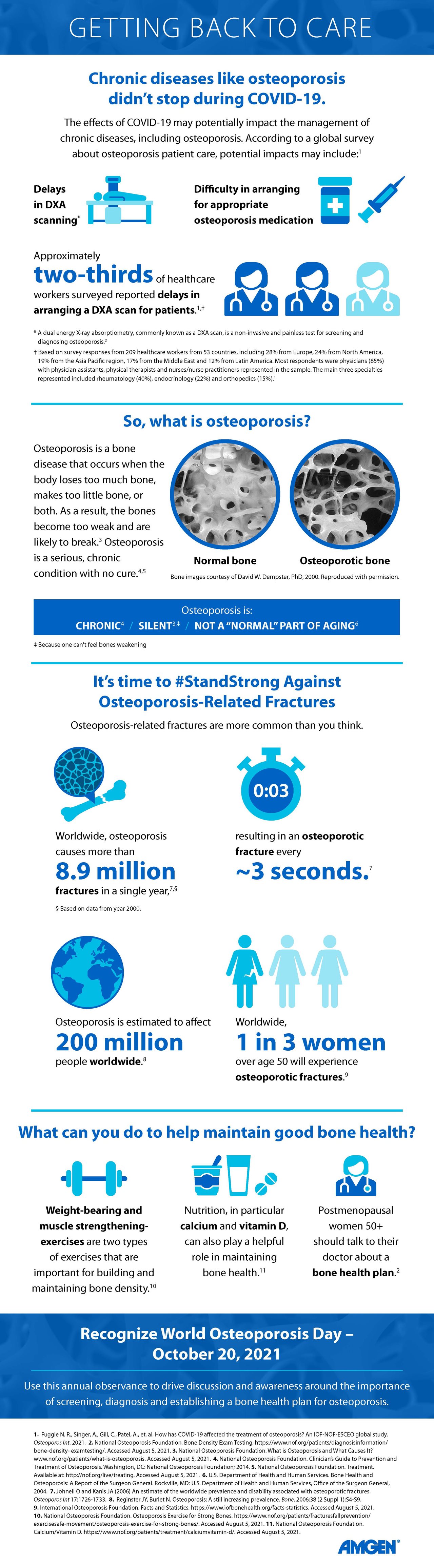
While many regular activities continue to be interrupted by the COVID-19 pandemic, one thing that hasn’t stopped is the need to screen, diagnose and treat chronic diseases such as osteoporosis. The pandemic has made it more difficult for people all over the world, including the United States, to see their doctors, but now it’s time to resume care, such as regular osteoporosis screenings, that can help keep serious diseases in check.

Evaluate Your Risk

A first step in knowing your risk for developing osteoporosis is becoming familiar with the risk factors of disease. For osteoporosis, a bone disease in which the bones become weak and more likely to break, some of the main risk factors include:1

  • Being age 65 or older2
  • Postmenopausal2
  • Tobacco use and excessive alcohol intake (>3 drinks per day)2,3
  • Low body weight2,3
  • Calcium deficiency2,3
  • Having a parent who suffered a hip fracture2,3

Screenings are important to help prevent the impact of serious diseases like osteoporosis.3

“It remains very important for patients to follow a bone health plan in consultation with a healthcare professional, such as their primary care physician or a specialist such as an endocrinologist, rheumatologist or gynecologist, depending on their specific situation,” said Henry G. Bone, MD, MACP, FRCP, FACE. “While COVID-19 persists, women already receiving treatment should discuss with their doctor any issues or concerns related to gaining access to care.”

Osteoporosis: A Refresher

Osteoporosis is estimated to affect about 200 million people worldwide, including about 10 million Americans.4,5 The impact of the disease and the related bone fractures is very significant.3 The disease causes more than 8.9 million fractures worldwide every year—or a bone break about every ~3 seconds.6 And it may surprise many people to know that a fracture related to osteoporosis can be a life-altering event that can lead to the loss of one’s mobility and changes in a person’s lifestyle.3

In New Jersey, more than 34,400 women have experienced at least one osteoporosis-related fracture, with 40% of those fractures being an index hip osteoporosis-related fracture.7,8*

It is important to be aware that osteoporosis is a serious, chronic condition with no cure that can cause bones to weaken and increase the risk of breaking a bone.9,10 Other important things to know about osteoporosis include:

  • Osteoporosis occurs when the body loses too much bone, makes too little bone, or both.1
  • It is often called a silent disease because one can’t feel bones weakening.1
  • A bone break is often the first sign of osteoporosis. Such breaks can occur from a minor fall or, if severe, even a strong sneeze.1
  • Bone breaks can make daily activities more difficult.11
  • Weight-bearing and muscle strengthening-exercises are two types of exercises that are important for building and maintaining bone density.12
  • Nutrition, especially proper levels of calcium and vitamin D, can be helpful in maintaining bone health.13

Your health isn’t guaranteed – take the necessary steps to look out for your well-being by visiting a healthcare professional to get screened for osteoporosis and to develop a bone health plan today.

Learn more at https://www.takechargeofosteo.com/what-to-know.html.

*A retrospective database analysis of women aged >= 66 years identified from 100% FFS Medicare data was conducted. The first occurring non-traumatic osteoporosis-related fracture between Jan 1, 2011-Dec 31, 2017 was used to identify women to be included in the analysis, and marked as their index fracture. Results may not represent the total number of fractures.

Index fracture: the first osteoporosis fracture measured during the analysis time period.

References

  1. National Osteoporosis Foundation. What is Osteoporosis and What Causes It? https://nof.org/patients/what-is- osteoporosis. Accessed October 5, 2021.
  2. Camacho PM, Petak SM, Binkley N, et al. American Association Of Clinical Endocrinologists/American College Of Endocrinology Clinical Practice Guidelines For The Diagnosis And Treatment Of Postmenopausal Osteoporosis-2020 Update. Endocr Pract. 2020;26(Suppl 1):1-46.
  3. Cosman F, de Beur SJ, LeBoff MS, et al. Clinician’s Guide to Prevention and Treatment of Osteoporosis [published correction appears in Osteoporos Int. 2015 Jul;26(7):2045-7]. Osteoporos Int. 2014;25(10):2359-2381.
  4. Reginster JY, Burlet N. Osteoporosis: A still increasing prevalence. Bone. 2006;38 (2 Suppl 1):S4-S9.
  5. National Osteoporosis Foundation. Fast Facts. https://cdn.nof.org/wp-content/uploads/2015/12/Osteoporosis-Fast-Facts.pdf. Accessed October 5, 2021.
  6. Johnell O and Kanis JA (2006) An estimate of the worldwide prevalence and disability associated with osteoporotic fractures. Osteoporos Int. 17:1726-1733.
  7. Data on file, Amgen; 2020.
  8. Lewiecki EM, Singer AJ, Rane PB, et al. Geographic Variation in Prevalence of Osteoporosis Diagnosis and Utilization of Anti-Osteoporosis Therapies in United States Female Medicare Fee-for-Service Beneficiaries With Fragility Fractures. Poster presented at: American Society for Bone and Mineral Research 2020 Annual Meeting; September 11-15, 2020; Virtual Event.
  9. National Osteoporosis Foundation. Treatment. Available at: http://nof.org/live/treating. Accessed October 5, 2021.
  10. National Osteoporosis Foundation. Clinician’s Guide to Prevention and Treatment of Osteoporosis. Washington, DC: National Osteoporosis Foundation; 2014.
  11. Fischer, S., Kapinos, K.A., Mulcahy, A. et al. Estimating the long-term functional burden of osteoporosis-related fractures. Osteoporos Int. 28, 2843–2851 (2017).
  12. National Osteoporosis Foundation. Osteoporosis Exercise for Strong Bones. https://www.nof.org/patients/fracturesfallprevention/exercisesafe-movement/osteoporosis-exercise-for-strong-bones/. Accessed October 5, 2021.
  13. National Osteoporosis Foundation. Calcium/Vitamin D. https://www.nof.org/patients/treatment/calciumvitamin-d/. Accessed October 5, 2021.

6 tricks and treats for kids to enjoy a healthier Halloween

2021-10-20T13:01:00

(BPT) – Kids love Halloween, and it’s no wonder — on what other occasion are they allowed to have so many treats at one time? While you love letting them enjoy the holiday, here’s a few tricks to treat kids — from healthy snacks to easy ways to keep them active. Check out these fun and festive candy alternatives to keep you from being spooked.

1. Use tangerines to create fun — and edible — decorations

You can use little tangerines in two different ways to create a festive Halloween atmosphere that doubles as a healthy snack.

  • Leave the peel on: Draw jack-o’-lantern faces on tangerines with markers. This is a fun activity for kids who are too young to help carve pumpkins. Let the marker face fully dry before handling (or peeling to eat!).
  • Peel but leave whole: Create stems with sticks of cut celery or raw green beans and stick them in the center of each tangerine. Arrange the mini “pumpkins” on a platter to admire, then let kids at ’em.

2. Hand out Halloween GoGo squeeZ Fruit pouches for a spooky treat on the go

Made from 100% real fruit in squeezable, re-closeable and BPA-free pouches, GoGo squeeZ is a healthy and delicious alternative to sugar-filled candies and snacks. These specially designed Halloween packs come in four unique designs and are perfect for trick-or-treaters, family parties, kids’ events, sports teams and classroom snacks.

Dani Lebovitz, MS, RDN shares that “it’s gluten free, nut free and non-dairy, with no added colors, flavors or high fructose corn syrup. It’s also free from the top 8 allergens.”

Check out the fun Halloween packages of applesauce in these spooky flavors: Creepy-Crawly Apple Strawberry, AHHHH! Apple Apple and Unbelievable Apple Banana, all available on GoGo squeeZ’s website and other select retailers.

3. Hold a mini pumpkin race

This is a great activity that uses energy while also calming kids down. Kids will need to focus and take their time as they balance a mini pumpkin on a large spoon to get to the finish line, indoors or out (depending on the weather).

Pumpkin fall off? You have to start over. For a large group of kids, set up as a relay race and play in teams.

4. Play pumpkin bean bag toss

Carve a big pumpkin with an extra-large mouth (think of a super surprised pumpkin!) and set out in the yard or on the porch. Provide kids with small bean bags (or make your own out of orange or black felt, filled with dried beans) and let them toss these into the pumpkin’s mouth. Let younger children stand closer to the target. Each bean bag in the pumpkin can earn the child a treat or small toy.

5. Let banana ghosts haunt your get-together

Cut bananas in half and stand them on a decorative plate with the pointed ends upward. You can create eyes and a mouth from many different edible items, from mini chocolate chips (push the pointed end of the chip into the banana) or sprinkles to your favorite cereal circles — to make your ghosts go “Oooh!”

6. Serve Halloween-themed sandwiches

Even ordinary sandwiches can seem extra special if you use Halloween cookie cutters — shaped like pumpkins, ghosts or witches’ hats — to cut pieces of bread, plus sliced cheese and meat if you’re not going the PB and J route. Decorate the plate around the sandwich with “eyeballs” made from grapes, olives or hard-boiled eggs, and “spiders” made of two round crackers filled with cheese spread or peanut butter in between, with pretzel sticks for legs.

With these tips, you can be sure your kids will have a fun-filled — and healthier — Halloween.

Why sleep experts recommend eliminating daylight saving time

2021-10-20T16:01:02

(BPT) – Nov. 7 is approaching, and with it the end of daylight saving time, when those in most of the U.S. will “fall back” to standard time by setting clocks back one hour. If the American Academy of Sleep Medicine (AASM) had its way, this would be the last time change in the U.S., and the switch to standard time would be permanent.

There is widespread support for the elimination of the biannual time change.

  • In a 2020 AASM survey, 63% of U.S. adults indicated they support the elimination of seasonal time changes in favor of a national, fixed, year-round time.
  • The AASM and other organizations representing health, safety and education recommended eliminating seasonal time changes and adopting permanent standard time for improved public health and safety in a 2020 AASM position statement.
  • In early 2021, Sen. Marco Rubio of Florida and several Republican and Democratic colleagues reintroduced in the U.S. Senate a bill that would make daylight saving time permanent across the U.S.

Eliminating seasonal time changes

There is ample evidence of the negative, short-term consequences of seasonal time changes. Studies have found an increase in car accidents during the week following the change to daylight saving time and an increase in patient-safety related incidents associated with human error in the week following the transition into and out of daylight saving time. Other negative effects of the time change in the spring include increased risk of stroke and hospital admissions, and increased production of inflammatory markers, one of the body’s responses to stress. Conversely, another study found that in the fall, during the shift from daylight saving time back to standard time, there was a reduction in the rate of cardiovascular events, suggesting that the risk of heart attack may be elevated because of chronic effects of daylight saving time.

“Light is the most powerful timing cue for the human body clock,” said Erin Flynn-Evans, who has a doctorate in health and medical science and is director of the NASA Ames Research Center Fatigue Countermeasures Laboratory and a consultant to the AASM’s Public Safety Committee. “Shifting to permanent daylight saving time in the winter would result in more darkness in the morning and more light in the evening, leading to misalignment between the body’s daily rhythm and the timing of routine social obligations, like work or school. That has the potential to make it harder for most people to fall asleep at night, disrupting sleep quality and leading to sleep loss, which can negatively impact health and safety.”

While there is debate about how the merits of permanent daylight saving time would compare with permanent standard time, the AASM position is that a change to permanent standard time is best aligned with human circadian biology and has the potential to produce beneficial effects for public health and safety.

Tips for managing the time change

For now, the November switch back to standard time is still a reality. As it begins to get dark earlier in the evening, it is the ideal opportunity to reset your body clock for an extra hour of sleep. To maximize the benefits of the hour gained from the fall time change on Nov. 7, the AASM recommends the following healthy sleep tips for anyone who is getting insufficient sleep:

  • Wait to change your clocks until it is time to get ready for bed.
  • Go to bed at your usual bedtime.
  • Just before getting into bed, set your clocks back one hour.
  • Wake up at your standard wake time.
  • Take note of how much better you feel after an extra hour of sleep.
  • On the Sunday after the time change, your normal bedtime will be an hour earlier. Go to bed at this earlier time to reset your sleep schedule to achieve longer sleep.

More information about sleep and sleep disorders is available from the AASM at www.SleepEducation.org. To get help for a sleep problem, use the AASM’s online directory on the SleepEducation.org homepage to find an accredited sleep center near you.