4 challenges for women entrepreneurs and how to overcome them

2021-11-05T15:01:00

(BPT) – While opportunities continue to grow for female entrepreneurs, women-owned businesses are still in the minority, and women still face many challenges when embracing the entrepreneurial life.

Starting a business is far from easy, and can be even more difficult for women, as they are often kept out of financial conversations, impacting their financial confidence as they age and preventing monetary discussion within their communities. While women face many obstacles in business, there are several powerful solutions that can take you far down the path of creating your own business.

Here are some of the common challenges women in business face and tips to help throughout the process.

Challenge 1: Work-life balance

Work-life balance can be a challenge for men and women alike, especially parents, who juggle both family and career responsibilities. Striking a healthy balance between business and family life may be one of the biggest barriers to success for many.

Solution: As an entrepreneur, creating the right balance is all about flexibility. Your schedule may look different than a typical nine-to-five job, and that’s OK. Focus on achieving balance — not perfection — and remember to ask for help and delegate tasks when necessary.

Challenge 2: Lack of funding

Lack of funding is one of the biggest issues facing entrepreneurs, especially those that are female. Sourcing capital is the first step to getting your business up and running.

Solution: Funding programs for female entrepreneurs are helping women break down the financial barriers to owning a business. The #DOVEInstaGrants program by Dove Chocolate is working to foster true financial equity and agency for women everywhere. Through the program, three women will be awarded a $10,000 prize and the opportunity to fulfill their small-business dreams.

For the past five years, DOVE has worked with CARE, an international humanitarian agency, and the DOVE InstaGrants program aims to expand these efforts to the U.S. The partnership with CARE empowers women in West African cocoa-growing communities through financially empowering Village Savings & Loan Association programs. In fact, 80% of members are women who lend and borrow microloans to build their own small businesses and define their financial voice.

To learn more about the DOVE brand’s partnership with CARE, visit DoveChocolate.com, or visit InstaGrants.DoveChocolate.com to submit a small business or entrepreneurial idea.

Challenge 3: Building a support network

In the U.S., despite undeniable commonalities in experiences with money, female entrepreneurs often lack a financial community where they can seek inspiration or counsel from other women like them. In fact, 58% of women report that they do not currently have another woman in their life to talk with about finances, according to an NBC news survey.

A robust network of supporters and connections is crucial for success as an entrepreneur. It can be difficult to forge a path through business networks, especially when success can be dependent on who you know.

Solution: Start by finding and attending women-focused networking events in your area. You can find in-person conferences as well as online forums created specifically for women in business. Once you’ve built your network of supporters, don’t hesitate to reach out for help.

Challenge 4: Lack of role models and representation

Although representation is growing when it comes to female entrepreneurs, it is still a male-dominated field.

Solution: Find women you admire and take inspiration from them. You can search for books, blogs, virtual talks, podcasts and so much more to learn about females in business and entrepreneurship. Additionally, work to build your network of women to help you feel more connected and supported.

By overcoming these challenges, women can feel empowered to define their financial voice and make their entrepreneurial dreams come true. Learn more at InstaGrants.DoveChocolate.com.

How are all-weather tires different from all-season tires?

2021-11-04T18:34:47

(BPT) – There’s a decent chance you drove the wrong tires last winter. But there’s still time to install the right set this year.

The wrong tires?

Many Americans enter the winter months not realizing their tires aren’t up to the task. And who can blame them? They’re called “all-season” tires, right?

All-season tires aren’t built to perform in snow, ice or temperatures below 45 degrees Fahrenheit. Their compounds are crafted to provide durability and high performance in warmth and rain, but when temperatures drop, they harden and lose much of their grip.

So what should I drive?

If you live in Arizona or South Florida or somewhere that is consistently warm in winter, all-season tires are fine. But if winter weather visits you — or if you often drive north or into the mountains — all-weather tires are an excellent year-round driving solution.

All-weather tires sound like all-season tires, but they have one major difference — they’re certified with the three-peak mountain snowflake, an emblem that affirms they’re suitable for winter driving. All-weather tires are versatile enough to thrive in rain and heat, but their flexible compounds are also well-suited for cold weather. And their tread patterns are often designed to carve through snow and slush, as is the case with the Nokian WR G4.

Why haven’t I heard of all-weather tires?

This type of tire is relatively new: Nokian Tyres invented the first all-weather tire two decades ago. Also the inventor of the winter tire, Nokian Tyres continues to recommend winter tires for drivers who experience sustained wintry weather.

But around 2000, the company began to recognize that drivers in unpredictable climates were looking for a compromise solution to stay safe when sun turned to snow. Now, many tire dealers in moderate winter locales swear by all-weather tires to balance year-round convenience with winter safety.

“Here in Connecticut and other parts of New England, we get all four seasons,” said Howie Fetzer, owner of Fetzer Tire in Fairfield, Connecticut. “An all-weather tire truly is the only product a customer can put on their vehicle year-round that can keep them safe in winter elements.”

It’s also the only tire Fetzer lets his family use.

How to learn more

Visit NokianTires.com/Weather to learn more about all-weather tires and decide whether they’re the right fit for your vehicles.

Washington Businesses Lean on Banking Partners for Post-Pandemic World

2021-11-02T09:05:00

(BPT) – American businesses of all sizes continue to cope with the economic fallout of the coronavirus pandemic. For 18 months, many have been forced to overhaul their business models to adjust to changing health and safety mandates, shifting consumer behaviors, and imbalances in supply and demand. In the West, problems have been exacerbated for some proprietors due to Mother Nature, with agricultural producers dealing with severe drought conditions in certain areas.

“We’re seeing local businesses trying to cope with not one challenge, but many challenges that are converging just as a post-pandemic environment comes into view,” reflects TJ Brill, Eastern and Central Washington market president of First Interstate Bank. Some of the most acute issues are related to the supply chain and labor shortages.

News of supply chain woes is nothing new, but reading headlines is one thing and living them is another. Many local businesses have been experiencing higher costs for raw materials and longer waiting periods for deliveries. Such conditions have put some niche companies out of business, but the fallout doesn’t end there. Rather, clients of those businesses have had to ferret out other sources, exerting additional pressure on remaining suppliers while needing to adjust their own schedules and earnings expectations.

Labor shortages mean that competition for qualified workers is high, and businesses are finding that they must enhance pay and benefits to attract applicants. That higher compensation comes at a price, and proprietors are rethinking how much money they will need on hand to fund their workforce appropriately moving forward.

Of course, some industries have been hit harder than others. On-again, off-again pandemic restrictions plagued hospitality businesses with instability, potentially discouraging individuals from working in the industry altogether. In commercial real estate, property owners lack clarity on future demand, as COVID-19 surges prompt businesses to rethink or postpone bringing employees back to the office.

Finally, on top of pandemic impacts, the West has also been dealing with severe drought conditions. Many businesses centered on agriculture are modifying their forecasts, as an extremely hot and dry summer took its toll on yields.

“Despite all the challenges out there facing our regional businesses, there is some hope,” says Brill. “Financial support is still available, and trusted banking partners can help get business owners connected to the programs and products that will keep them on track.”

Although the popular Paycheck Protection Program has long expired, other government programs remain available to business owners depending on their industry and their particular circumstances. For instance, the Small Business Administration offers Economic Injury Disaster Loans for small businesses and nonprofits experiencing lost revenue due to declared natural disasters, such as droughts or wildfires. The Shuttered Venue Operators Grant helps qualifying venues with revenue declines of at least 25% due to pandemic closures. Additional programs are available through the USDA and the Farm Service Agency, as well as through community development financial institutions (CDFIs), which concentrate on affordable lending to low-and-moderate-income communities.

Whether business owners want to access federal aid or simply access capital through traditional banking channels, their banker will be an important resource in easing the process. A trusted banker can help identify programs that are the best fit, navigate the application process and deadlines, and advise on prioritizing how funds are used.

Beyond accessing government aid, local commercial bankers are able to fully understand the unique nature of their clients’ needs and business goals. These financial professionals typically have an in-depth understanding of regional economic and competitive conditions, so they can help advise on making the most of capital within a particular market. They can also serve as a sounding board on how to build reserves and deploy them carefully and efficiently as a business grows.

Although the world is ready for the pandemic to be in the rear-view mirror, it’s a reality that will likely need to be addressed for some time to come. Local businesses don’t need to meet the associated challenges alone; with a trusted local commercial banker, they can fortify their companies and position them for growth ahead.

Wyoming Businesses Lean on Banking Partners for Post-Pandemic World

2021-11-02T09:05:00

(BPT) – American businesses of all sizes continue to cope with the economic fallout of the coronavirus pandemic. For 18 months, many have been forced to overhaul their business models to adjust to changing health and safety mandates, shifting consumer behaviors, and imbalances in supply and demand. In the West, problems have been exacerbated for some proprietors due to Mother Nature, with agricultural producers dealing with severe drought conditions in certain areas.

“We’re seeing local businesses trying to cope with not one challenge, but many challenges that are converging just as a post-pandemic environment comes into view,” reflects Victor Robbins, South Central Wyoming market president of First Interstate Bank. Some of the most acute issues are related to the supply chain and labor shortages.

News of supply chain woes is nothing new, but reading headlines is one thing and living them is another. Many local businesses have been experiencing higher costs for raw materials and longer waiting periods for deliveries. Such conditions have put some niche companies out of business, but the fallout doesn’t end there. Rather, clients of those businesses have had to ferret out other sources, exerting additional pressure on remaining suppliers while needing to adjust their own schedules and earnings expectations.

Labor shortages mean that competition for qualified workers is high, and businesses are finding that they must enhance pay and benefits to attract applicants. That higher compensation comes at a price, and proprietors are rethinking how much money they will need on hand to fund their workforce appropriately moving forward.

Of course, some industries have been hit harder than others. On-again, off-again pandemic restrictions plagued hospitality businesses with instability, potentially discouraging individuals from working in the industry altogether. In commercial real estate, property owners lack clarity on future demand, as COVID-19 surges prompt businesses to rethink or postpone bringing employees back to the office.

Finally, on top of pandemic impacts, the West has also been dealing with severe drought conditions. Many businesses centered on agriculture are modifying their forecasts, as an extremely hot and dry summer took its toll on yields.

“Despite all the challenges out there facing our regional businesses, there is some hope,” says Robbins. “Financial support is still available, and trusted banking partners can help get business owners connected to the programs and products that will keep them on track.”

Although the popular Paycheck Protection Program has long expired, other government programs remain available to business owners depending on their industry and their particular circumstances. For instance, the Small Business Administration offers Economic Injury Disaster Loans for small businesses and nonprofits experiencing lost revenue due to declared natural disasters, such as droughts or wildfires. The Shuttered Venue Operators Grant helps qualifying venues with revenue declines of at least 25% due to pandemic closures. Additional programs are available through the USDA and the Farm Service Agency, as well as through community development financial institutions (CDFIs), which concentrate on affordable lending to low-and-moderate-income communities.

Whether business owners want to access federal aid or simply access capital through traditional banking channels, their banker will be an important resource in easing the process. A trusted banker can help identify programs that are the best fit, navigate the application process and deadlines, and advise on prioritizing how funds are used.

Beyond accessing government aid, local commercial bankers are able to fully understand the unique nature of their clients’ needs and business goals. These financial professionals typically have an in-depth understanding of regional economic and competitive conditions, so they can help advise on making the most of capital within a particular market. They can also serve as a sounding board on how to build reserves and deploy them carefully and efficiently as a business grows.

Although the world is ready for the pandemic to be in the rear-view mirror, it’s a reality that will likely need to be addressed for some time to come. Local businesses don’t need to meet the associated challenges alone; with a trusted local commercial banker, they can fortify their companies and position them for growth ahead.

5 ways small businesses can prepare for the holiday season

2021-11-01T08:01:00

(BPT) – If you’re a small business owner, you know what the holiday season means for your bottom line. But with 2021 bringing a wave of unprecedented challenges, it’s hard to know if you’re prepared for the busiest time of year. Fortunately, there are resources available to help you stay on top of all the little things that need to get done — so you can focus on the big picture and end the year stronger than ever.

Here are five tips to help you save time, stay organized and reach your customers during the holiday season and beyond.

1. Get your technology ready

Whether you rely on online sales, in-store business or both, be prepared for a fast-paced selling season with technology that’s updated, protected by current security software and backed up. For products, support and services to conquer the holiday hustle and bustle, Office Depot offers everything you need to be up-to-date, including services for all your last-minute tech needs and 24/7 IT remote support from experienced technicians.

2. Choose time-saving services to get errands done

Time is extremely valuable in November and December, so don’t waste it — take advantage of same-day services to get what you need as soon as possible. Office Depot recently introduced a “20-Minute Pickup Promise,” offering customers the ability to order products online and get free in-store and curbside pickup in 20 minutes or get $20 off their next qualifying purchase.*

Office Depot also offers Same-Day Delivery. Customers can simply place a qualifying order, choose the delivery window that’s convenient for them, and the products will be delivered to their door in as little as one hour.

3. Market your seasonal events and promotions

Before big events or holiday promotions, make sure your customers know all about them. With small business solutions from Office Depot, you can plan an effective marketing strategy and print eye-catching materials to help make your business shine.

With Office Depot’s Same-Day Printing Services, you can also choose from a wide portfolio of print solutions including flyers, signs, posters, banners, marketing materials, cards and more – all ready for same-day pick-up. Qualifying orders must be placed in-store, or online for in-store pickup, by 2:00 p.m. local time, and Same-Day Service must be requested at the time of ordering.

4. Ship faster

For gifts, supplies or products you need shipped to yourself or others, take advantage of Office Depot’s free Next Business-Day Delivery on qualifying orders of $45 or more**.

5. Celebrate your staff

Finally, as 2021 draws to a close, make sure your employees know how much you appreciate their hard work, especially during the holiday rush. Office Depot offers a variety of gifts for every team member on your list this year. Consider creating and printing custom holiday cards or photo gifts too that show individual appreciation for staff as well as clients and vendors.

Find services and solutions to succeed this holiday season with savings all season long at OfficeDepot.com and in Office Depot and OfficeMax stores nationwide.

* Curbside pickup is available in most stores, subject to state and local regulations. Orders must be placed 1 hour before store closing. If your order is not ready in 20 minutes, you will receive an email, within 48 hours of placing your order, with a coupon for $20 off your next qualifying purchase. Certain exclusions apply. Excludes tax. No cash back. See email for coupon terms and conditions. Office Depot reserves the right to modify or cancel the offer at any time. Same-day print services are excluded form 20-minute promise.

** Free Shipping/Delivery: Minimum purchase required after discounts and before taxes. Orders must be placed by 5:00 P.M. local time (in most locations) via phone/online or 3:00 PM via fax. Orders outside our local delivery area and most furniture, oversized, bulk items, cases of bottled water and other beverages and special-order items do not qualify. Non-qualifying orders incur a delivery charge. Delivery fees will be noted prior to purchase. Other restrictions apply. See OfficeDepot.com/delivery, call 800.GO.DEPOT or ask a store associate for details

Three crucial considerations for millennials this open enrollment season

2021-10-28T14:15:00

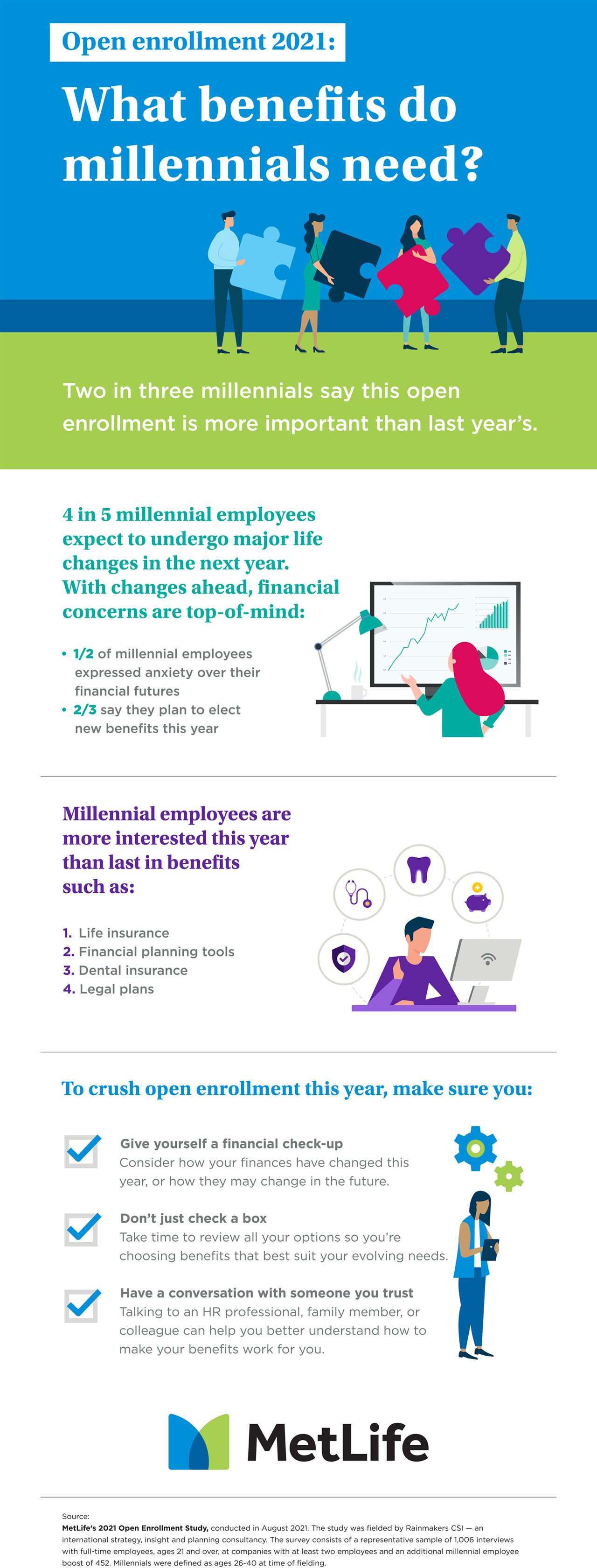
(BPT) – After more than year and a half of putting key aspects of their lives on hold as they dealt with the more immediate concerns of the pandemic, millennial employees are now putting their once-paused plans into play, eager to tackle everything from buying a new home (24%) to getting a pet (22%), according to a new MetLife survey.

However, even the most positive life changes involve finances to some degree, and with more than half of millennial employees feeling anxious about their financial futures, these changes — and anticipated changes — are leading many to view employer benefits in a new light.

If you are one of the many millennials planning a big life change this year, using employer benefits to help provide financial support and stability is a smart move. Here are three important considerations heading into open enrollment this year.

1. Ask yourself what changes lie ahead.

Each fall, open enrollment gives employees the opportunity to evaluate their employer benefits through a new lens and elect the insurance products that will offer them protection and financial peace of mind. As you take steps to recalibrate your plans over the next few months and prep for future changes, there’s a good chance you’ll require new benefits that match your shifting needs.

To decide which benefits might be the most useful in the near future, ask yourself:

  • Am I getting married or divorced, or adopting a child? A legal plan might be right for you.
  • Am I bringing home a pet? Pet insurance could protect your furry friend’s health and your finances.
  • If I had an accident or got sick tomorrow, do I have enough savings and insurance coverage to help me avoid dipping into my retirement funds? Critical illness can give you and your family financial stability so you can focus on healing during a difficult time.

Electing benefits that reflect your new priorities is key to supporting the changes you plan for — as well as the ones you don’t.

2. Consider benefits most likely to support you during times of change.

With MetLife’s survey finding one in five millennials is more interested in pet insurance this year than last year — likely due to the fact that this generation is 50% more likely to get a pet as to have a child in the next 12 months — it’s obvious that priorities and situations can change year-over-year. Paying close attention to how your needs have changed over the last few months, as well as how they may change in the year ahead, is important to electing benefits that will cover all aspects of your well-being year-round.

In some cases, this may include voluntary benefits outside of your core offerings that you hadn’t previously considered — like pet insurance, life insurance, or legal plans. To ensure you’re getting the most out of your benefits, carve out time to review all your options ahead of time. This is particularly important since one in four millennials (24%) admitted to spending more time scrolling through social media than choosing their benefits.

3. Get started on planning for open enrollment sooner than later.

This is the perfect time to learn about benefit options from your employer, and to make the most of them. To get started…

  • Ask your HR representative any questions you have about the benefits your company offers.
  • Talk with family and friends about choices they’ve made regarding benefits.
  • Seek out friends or family who have gone through major life events to learn what was (or would have been) helpful to them.

You can also visit www.MetLife.com/OpenEnrollment for useful resources, including the Make Your MatchTM benefit selection support tool, which offers tailored benefit suggestions — plus articles and videos highlighting real-life examples of how other workers have made benefit decisions based on their own life circumstances.

With a little knowledge and planning now, you can be ready for any of life’s important milestones over the next year, and in years to come.

How farmers can plan to increase income potential

2021-10-26T07:07:00

(BPT) – Post-harvest gives farmers a chance to finally sit down and take a break after a busy season. It gives them the time to track their inputs, meet with their trusted advisers, evaluate the decisions they made this year and see how those decisions ultimately affected their return on investment. Farmers must be both forward thinking and retrospective, understanding the big picture while still digging into the nitty gritty of each field, to produce the highest potential yield and drive profit.

According to Mark Callender, farm manager at Farmers National Company in Dighton, Kansas, optimistic growers have shifted from saving to spending — investing now to drive profits higher on good land. Callender encourages farmers to review input costs every year as they develop their plans. “We analyze all our farms annually for cost per acre and per bushel,” Callender explained. “By comparing production numbers with seed, fertilizer, weed control and other costs, growers learn their return on investment for quality products versus generics, for example.”

Callender said farmers know their break-even costs, using the data available today to provide better insight into individual fields. “Top producers spend more to achieve better weed control to drive top yields. By examining costs on a per-bushel basis, they can justify higher costs per acre when an agronomic practice delivers more bushels.”

Preparing for 2022

Many producers budget per acre for the whole operation, notes Lynn Sandlin, ag economist and business intelligence lead at Syngenta, but opportunity exists during more profitable times to budget directly at the field level — to maximize profit at the bushel level.

Sometimes it requires better tools, sound advice and a shift in thinking to manage each field’s potential at the bushel level. “Trusted advisers help growers increase field productivity with an eye on profit per bushel,” Sandlin said.

Fortunately, new tools are available to help farmers find growth opportunities. “Years of depressed prices pushed some growers to try to save their way to prosperity with cheaper inputs and generics,” says Paul Backman, commercial unit head for the West Heartland region, Syngenta. “Our Syngenta AgriEdge whole-farm management program lets growers see how better products can deliver higher productivity on a cost-per-bushel level.”

Reviewing 2021 decisions against actual yield helps growers understand real costs — shifting from a cost mindset to an investment mindset.

“Retailers also play vital roles across farm input decisions,” Backman says. “Our sales reps and AgriEdge specialists help growers see small gains in each field, adding up to more bushels. Good management plans evolve as more data drives greater field-by-field profits.”

Retailers trust agronomics

Syngenta sales representative Mark Dozler explained the input-cost-per-bushel method of thinking: “I worked with a retailer in Nebraska to build an input-cost-value spreadsheet, showing that if a grower removes a $30 fungicide from their plan, cost per bushel increases — because removing that fungicide reduces yield by at least 10 bushels per acre. The data proving that was eye-opening.”

Defining more yield-for-weed control challenges everyday thinking and requires digging into details beyond a $40-50 per acre herbicide budget.

Field-by-field profit

Technical advancements in corn and soybean genetics also play a critical role in productivity per field and cost per bushel.

“Many retailers take pride in knowing agronomic details so they can recommend the best hybrid for each field,” said Brent Rockers, a Syngenta district manager in Missouri, Kansas and Oklahoma.

“Our research provides growers with seeding rates, fertility and plant health advice that improves their ability to strategize and budget,” Rockers said. “And our Cropwise Seed Selector tool provides growers with a list of hybrids matching their soil classifications by field.”

Advisers help growers fine-tune their selections, following the crop through harvest — and use that data to help build more profitability.

Buyer beware: 4 tips for buying new products from online marketplaces

2021-10-25T08:01:00

(BPT) – During the holiday season, shoppers everywhere are hunting for great bargains and unique items online. Today’s online marketplaces — where anyone can buy or sell new items — are numerous, offering a wide variety of products. Examples include eBay, Facebook Marketplace, OfferUp and Swappa, just to name a few. But savvy buyers should be aware there are risks involved when buying from any of these types of marketplaces — including ending up with stolen or counterfeit merchandise, receiving an item that’s different from what you ordered, or never receiving it at all.

Unscrupulous sellers and fraudsters can show up on any of the many legitimate marketplaces, and they appear like any other seller. Because these sellers often hide behind fake accounts with fake names, and they aren’t required to provide or verify their contact information, it’s extremely difficult for law enforcement to catch them. Organized retail crime is a growing problem for all retailers, and for shoppers.

“Shopping online provides endless opportunities to find great products,” said Mike Combs, director of investigations for Home Depot Asset Protection. “Shoppers just need to know the potential pitfalls, and be careful with what types of new products they purchase at any online marketplace.”

Fortunately, there are consumer safeguards in place at many online marketplaces. Being aware of potential red flags can help you avoid problems. For example, here are signs that may mean you could be buying a stolen or counterfeit item:

  • It seems too good to be true — such as a new, brand-name item on sale for a drastically lower price.
  • The product is described as “brand new,” “new in box” or “new with tags.”
  • Large quantities of the same item/brand are available at the same time.
  • The seller indicates they can “get other products upon request.”
  • There are signs of box tampering or removal of security devices when you receive the item.

While just one of these is not a sure sign the item is stolen or counterfeit, these red flags should cause you to ask questions before buying and proceed with caution.

How can you protect yourself?

You can buy more safely online by following these tips.

1. Purchase from the retailer directly, even for gift cards. It’s always best to purchase gift cards on the website of the brand or in its stores. The original issuer of the gift card, like a retailer, is not responsible if the gift card was purchased on an online marketplace and there is no value on the gift card or the value is less than what you were expecting. If you need to check the balance of a gift card, always go to the website of the brand that is issuing the gift card. Do not ever enter the full gift card number and PIN onto any other website. You may be giving the value of the card to a fraudster.

2. Check out the seller. Ratings, reviews and comments from other buyers can help you sense if they are legit. Contact the seller directly to ask questions about the item, as well as their return and refund policies, and make sure you are satisfied with their responses before buying.

3. Research the item. Do a search for typical prices of the item. Does their pricing seem too good to be true? Check the photo carefully to see if it appears to be a real item or stock photo. Photos should show more than one angle, or both outside and inside the package. Ask the seller for additional photos if you’re not satisfied.

4. If you have a problem, contact the seller, the marketplace and your credit card company. Make sure to keep digital copies of all emails and text messages between you and the seller regarding the purchase. Your credit card company may be able to withhold payment if there is a problem.

Armed with these tips and a little caution, you can enjoy your online holiday shopping safely.

5 ways to enjoy the holidays without breaking your budget

2021-10-25T07:01:00

(BPT) – A new survey reveals that Americans say the holidays will give them something positive to look forward to, after many people had to curtail last year’s holiday celebrations due to the pandemic. In the new 2021 Coinstar Holiday Survey, respondents said that while gift buying may go down this year (one-third plan to buy fewer gifts), people overall are looking for more activities that bring them holiday joy — as they still manage their budgets.

Here are tips to help boost your holiday spirit, without breaking the bank.

1. Embrace regifting

If you’ve ever thought about regifting a present to someone who might actually enjoy it, you’re not alone. According to the survey, more than one-fourth (28%) said they’re likely to regift something this holiday season.

There’s nothing wrong with regifting, and here’s why:

  • It saves you money
  • Reusing is good for the environment
  • Your closet gets a little less cluttered
  • You may be giving the absolute perfect gift to someone else

Be sure to regift with care, and not give the gift back to the same person who gave it to you!

2. Use spare change to stretch your budget

When finances are tight, you may be surprised to learn that you have more spare change lying around than you think! Check your purse, couch cushions, car or change jar for loose change. Survey respondents estimate they have approximately $123 in spare change at home, and over half (52%) said they are likely to cash in or use their spare change this holiday season. This newfound cash can be used for buying gifts, decorations or donating to others.

It’s easy to cash in your spare change at a Coinstar kiosk in your local supermarket. At the kiosk, you can convert your spare change to cash, a no-fee eGift card — or even donate to charity, which makes it perfect for boosting the spirit of giving.

3. Deck the halls with holiday spirit

Nothing brings back your childhood sense of holiday wonder and magic better than beautiful colored lights and holiday decorations, whether at your own home or around your neighborhood. Over 90% of the people surveyed plan to decorate their homes this season, and three out of four say they will start or increase their tradition of driving around to enjoy decorations and lights nearby — a fun and no-cost activity to delight your whole family.

4. Bake a little joy for the holidays

Baking is one of the most fun and inexpensive ways to spend time with your family, as well as being a great way to create giftable treats. In the survey, 80% of Americans said they will start or increase their home baking this holiday season. Find festive tins, jars or holiday-themed plates to load up with goodies, wrap in foil, then stick on a colorful ribbon and voila! A tasty gift anyone would love to receive.

Baking not your strong suit? No worries. You can find pre-made refrigerated or frozen cookie dough in most stores, so you can still have the fun — and delicious aroma — of homemade cookies without all the fuss and muss.

5. Bring joy to others by giving

Giving to others can bring unexpected holiday joy. After more than a year of challenges, nearly two-thirds of Americans (61%) say they’ll start or increase their donations of money or volunteering time to charity this holiday season.

Another way to feel the warm glow of giving to others is by tipping service providers who help you throughout the year, from your childcare provider to your mail carrier. Well over half (57%) of Americans say they tip service providers during the holidays.

It doesn’t take a lot of cash to make the season bright. Revisit the traditions you have with friends and family and perhaps create a few new ones to make this year memorable. Approaching the holiday with an attitude of creativity and gratitude will go a long way toward capturing the joy of the holiday season.

Using Credit Wisely

2021-10-22T10:11:00

(BPT) – Credit is an essential part of any strategic financial plan, particularly when individuals are planning to make a major life change or reorganize their affairs. Whether you’re seeking to cover unexpected expenses, fund a major purchase like a new home, or make a long-term investment, leveraging debt can often be an essential tool for achieving your goals. Here are some of the ways different types of credit can be used wisely across different aspects of your financial life.

Choose a credit card that gives you a financial leg up

With so many modern card programs offering incentives and rewards, credit card users can find a card to boost their finances with savings on balances and more cash back on their biggest expenses. To earn cash back on everyday essentials, the AARP® Essential Rewards Mastercard® from Barclays card earns 3% cash back on gas station and drug store purchases (excluding Target® and Walmart®), 2% cash back on medical expenses like healthcare provider visits and eyeglasses, and 1% cash back on all other purchases

For those interested in travel, the AARP® Travel Rewards Mastercard® from Barclays earns 3% cash back on airfare, hotel stays and car rentals, 2% cash back on restaurant purchases and 1% cash back on all other purchases.

Both cards have:

  • No annual fee
  • 0% introductory APR for 15 months on balance transfers made within 45 days of account opening. After that, a variable APR will apply (16.74%, 20.74% or 25.74% based on your creditworthiness).
  • A $100 cash back bonus after spending $500 on purchases in the first 90 days of account opening

Terms apply.

The AARP® Essential Rewards Mastercard® from Barclays and AARP® Travel Rewards Mastercard® from Barclays are issued by Barclays Bank Delaware (Barclays) pursuant to a license from Mastercard International Incorporated. Mastercard, World Mastercard and World Elite Mastercard are registered trademarks, and the circles design is a trademark of Mastercard Incorporated.

Use personal loans to support your financial goals

Sometimes it makes more sense to obtain a personal loan to fund objectives such as home renovation and debt consolidation. Whatever the need, individuals need to understand the terms of the loan when researching options and ensure that they are a good match. Personal Loans from Marcus by Goldman Sachs offer no-fee personal loans ranging from $3,500 – $40,000 and have special pricing available for AARP members, ensuring that the loan supports users’ financial goals rather than detracting from them.

Secure your dream home through real estate benefits

Borrowing is often an essential step for funding the purchase of a new home, whether you’re a first-time buyer, looking for a vacation property, or settling into a new home for retirement. To help secure your dream home, real estate benefits are a great way to balance out a mortgage and the costs that come along with it. These costs can be offset by AARP Real Estate Benefits by Realogy, which offers members assistance and a benefit of between $300 – $5,500 based on the purchase price of a home. The program provides access to Realogy’s trusted real estate brands, there’s no fee to sign up, and depending on the home location members receive benefits as cash, a gift card or a commission reduction.

Debt plays an important role in any strategic financial plan, especially when it’s fully understood and managed effectively. Make sure you tick everything off on your checklist by evaluating your short- and long-term financial goals and capitalizing on the best possible options available — then, kick back and enjoy the rewards that come with using credit wisely.