6 simple tips to protect yourself from online crime

2021-09-16T07:01:00

(BPT) – Strange texts and curious emails requesting personal information. Unauthorized purchases on your credit card. New online accounts being opened in your name. Digital crime can vary greatly and is increasingly concerning as criminals get more sophisticated every day.

The Federal Trade Commission received 2.2 million fraud reports in 2020, including identity theft and imposter scams. The FBI’s 2020 Internet Crime Report stated losses exceeding $4.2 billion. Unfortunately, many experts predict digital crime to grow in the coming years, especially as large-scale data breaches become more common.

In fact, a recent survey from digital security company Aura in conjunction with Harris Poll revealed about three in four U.S. adults recognize that data breaches are serious. Further, 60% of people worry a lot about them and 53% are concerned about the safety of their personal information online.

“Today, Americans lose more money to digital crime than to home burglary,” said Hari Ravichandran, CEO and founder of Aura. “While we spend billions each year on home security systems, many people don’t even take the basic precautions to protect themselves online.”

Technology is an important part of daily life, so digital security should be taken seriously. According to the survey, eight in 10 people know they should be doing more to protect themselves online.

A proactive approach is the best way to keep you and your family safe. In honor of cybersecurity awareness month in October, Ravichandran shares six simple ways to keep yourself, your information and finances secure.

1. Use complex passwords

Update passwords so they consist of a random combination of letters, numbers and symbols. Use a password manager to store and remember them. Continue to set up two factor authentication for your accounts and, when possible, opt to use an authentication app over text verification codes.

2. Check financial and medical statements monthly

Your financial and medical statements are often the first signs that you’ve been involved in a breach. Set transaction alerts through your bank to flag large purchases and check your monthly bank and credit card statements for fraudulent activity.

3. Monitor your credit

Stay familiar with what’s in your credit reports. Order a free annual report from all three credit bureaus to make sure that data in each credit report is accurate and matches the others. Additionally, consider enrolling in a credit monitoring service that continuously sends you alerts of any changes. If you notice any suspicious activity, take action right away and freeze your credit through an application like Aura or by contacting the credit bureaus to avoid potential damage to your credit that could take years to resolve.

4. Don’t ignore software updates

Hackers exploit security flaws in phone and computer operating systems in order to steal consumers’ data. When a company discovers a security flaw in their operating system, they’ll develop and release a patch to users. Until that patch is installed, the user and their information remains vulnerable.

5. Tighten social media privacy settings

Many people provide personal information like their name, birthday, job and hometown on their social media profiles. Remove personal information like this from online profiles and update your user settings to increase privacy on who can view your full profile and posts. Further, children under the age of 18 are often the target of child identity theft, because their credit score is completely unmarked. Posting information about your children on social media, even just their full names and birthdays, can be just as dangerous as posting your own.

6. Don’t click on links in emails or texts

Scams can be difficult to identify. As a rule, don’t click on links that are emailed or texted to you from unknown sources. Don’t respond to emails that ask for your personal information, and always be discerning when receiving offers that seem too good to be true.

All of these steps can be overwhelming, but with Aura’s simple subscription and easy-to-use app, you can have access to proactive digital security that alerts you to potential threats and helps resolve any issues. Members benefit from an experienced team of customer service professionals and a $1 million insurance policy to cover any losses from identity theft and fraud.

Aflac Survey: Americans Across Ideologies Find Common Ground in Supporting Small Businesses

2021-09-10T09:40:08

(BPT) – Shutdowns, social distancing and debates, the coronavirus pandemic and social unrest in 2020 threatened to divide the country. But despite societal tensions, one thing brought people together: their commitment to small businesses. Aflac’s 2021 Business Culture Survey reveals support for small businesses in the community is near universal, even breaking through ideological divides that exist within the country.

“As people were dealing with the isolation of the pandemic and round-the-clock reports of its impact on communities at home and around the world, we expected a corresponding diminished sense of unity, but when it comes to support for small businesses, our survey found the opposite was true,” said Aflac Senior Vice President of Distribution Expansion and Consumer Markets, Jeramy Tipton.

Unity across ideologies

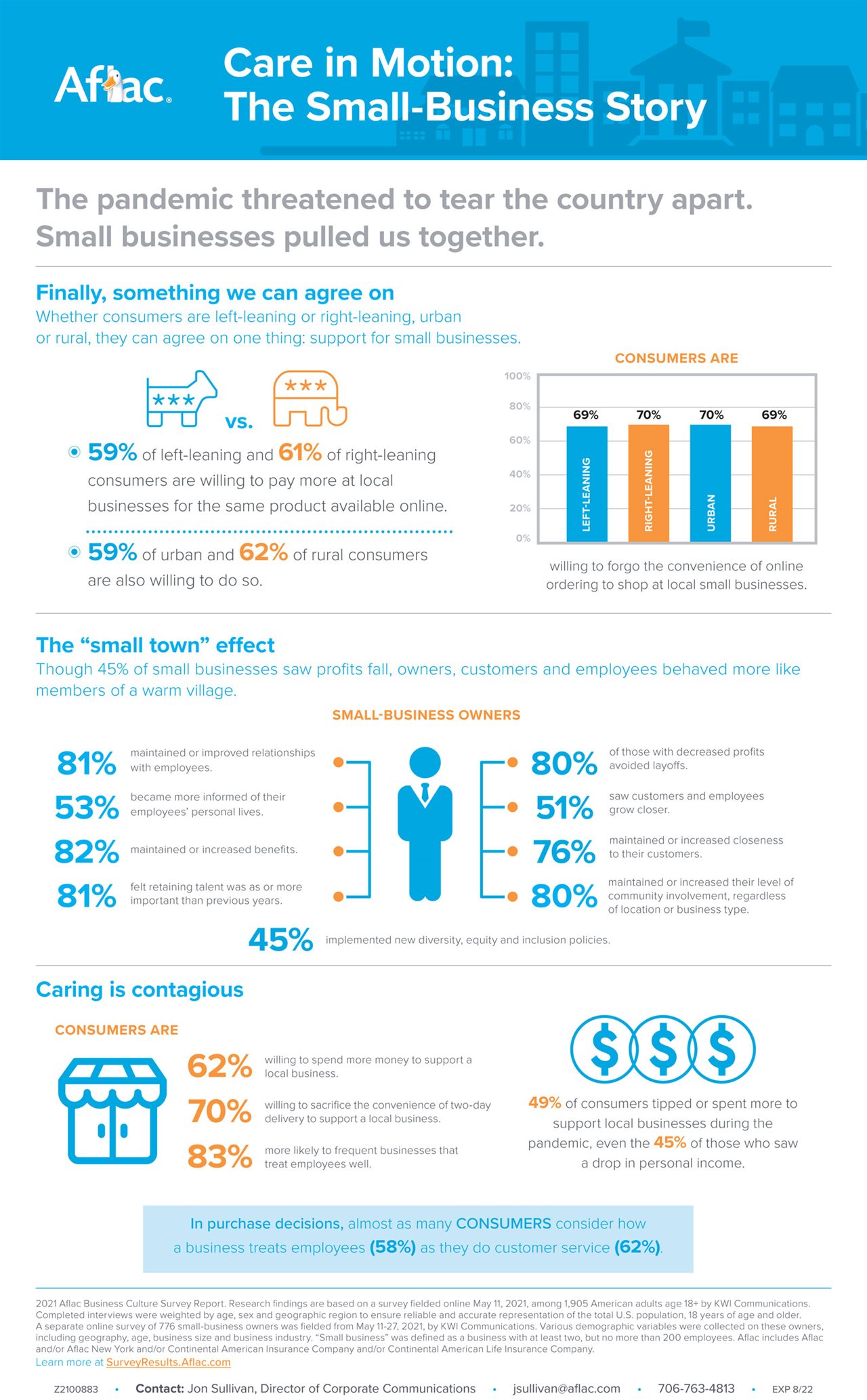
Whether left-leaning or right-leaning, urban or rural, consumers remain united in their support for small businesses: 59% of left-leaning and 61% of right-leaning consumers are willing to pay more at local businesses for the same product they can find online, with 59% of urban and 62% of rural consumers also willing to do so. Both groups are also more willing to forgo the convenience of online ordering to shop at local small businesses.

Small businesses grow closer to their communities

While the pandemic seemed destined to hurt relationships, Aflac’s 2021 Business Culture Survey reveals how business owners, customers and employees actually built community as parties pulled together to weather adversity: 81% of small-business owners reported that they maintained or grew closer to their employees and 53% became more informed of their employees’ personal lives.

The pandemic also emphasized the value of employees, their loyalty and efforts to remain engaged and productive in difficult times. In fact, 81% of small-business owners felt retaining talent was as or more important than previous years, and 82% maintained or increased benefits for their employees. Consumers are taking notice, too. In making purchase decisions, almost as many consumers consider how a business treats employees (58%) as they do customer service (62%).

Consumers up their appreciation for small businesses

Just as the pandemic produced greater appreciation by small-business owners for employees, consumers reciprocated, upping their appreciation for small businesses as well: 49% of small-business patrons tipped or spent more to support their local businesses, including 45% of those who also reported a decrease in personal income.

“We were encouraged to see that the small-town culture of care between local businesses and their communities was not severed, but actually strengthened, including small-business owners finding a renewed sense of care when it comes to the well-being of their employees and customers,” Tipton said.

The 2021 Aflac Business Culture Survey is part of Aflac’s Care in Motion: The Small-Business Story campaign, which will highlight small-business stories of resilience.

For the full findings from the 2021 Aflac Business Culture Survey, visit SurveyResults.Aflac.com. Watch a video of the findings here.

Here’s how to make sure you have the funds you need to start college

2021-08-31T17:01:00

(BPT) – Heading to college is an exciting adventure. While schools everywhere may look and feel a bit different than how they’ve been traditionally or family finances may be up in the air, it’s still important to explore your options.

“Make a plan to pay for college, so you’re ready when school begins,” said Brittany Mills, Assistant Manager of Education Lending at Navy Federal Credit Union. “That means knowing what’s available through scholarships and grants, work-study programs, federal student loans, and private student loans.”

Getting your finances in order

Funded by the federal government, federal student loans only have fixed rates and may come with different benefits than loans through private sources, such as income-driven repayment plans. You’ll first need to complete the Free Application for Federal Student Aid (FAFSA), which is available every year on October 1. Once processed, your college’s financial aid office will let you know how much federal aid you’ll receive.

Private student loans, on the other hand, are offered through financial institutions like credit unions and banks. There are fixed and variable rates available for private loans. The financial institution will decide if you qualify for the amount requested based on creditworthiness.

Choosing a co-signer

If you think you may not get approved for a student loan on your own, consider applying with a co-signer who’s willing to assume responsibility of the loan along with you. Having a creditworthy co-signer, such as an eligible family member or friend, can help increase your chances of loan approval.

“A cosigner may be released from their loan obligation once the borrower has graduated and made 24 consecutive, on-time payments,” added Mills.

Borrowing the right amount

“After you submit the FAFSA and know how much federal student aid you’ll qualify for, research private student loan options as a way to help fill any gap in funding for your education-related expenses,” said Mills. “Many colleges can give you a list of lenders they consider having a good track record too.”

It can be hard to know if you’re borrowing too much or too little, especially in the current environment. But, once your lender approves the loan, your school will certify your loan amount based on the cost of attendance, as well as any scholarships and financial aid that you were awarded.

Bottom line: Paying for your education can be doable with these expert tips in mind.

Navy Federal is federally insured by NCUA.

This sponsored article is presented by Brandpoint.

Take the Stress Out of Filing Your Small Business Taxes by the Extension Deadline

2021-08-24T10:15:00

(BPT) – Let’s be honest, owning a small business is hard work! On any given day, it can be full of unexpected rewards and challenges, because there’s just so much to do and so little time. While being your own boss is great, it also comes with responsibilities you may not enjoy and could end up procrastinating. Like financial paperwork and filing your small business taxes. That’s why so many small business owners opt to file for an extension to give themselves six more months to get their paperwork together.

In a typical tax year, the reasons for filing a business tax extension range from incomplete books to being too busy running the business to focus on getting taxes done in time. The 2020 tax year created another reason — confusion about the impact of COVID-relief aid and small business tax provisions from stimulus bills. Small business owner Carlos Davila is a prime example.

Carlos’ Miami-based business, Davila Law Firm, was unable to operate for more than three months during the first year of the pandemic. At the same time, his other company, PROSEC (a health care facilities security company based in Puerto Rico), was indirectly impacted when his Puerto Rico-based CPA was unable to complete paperwork on time due to pandemic-related policy changes, leaving Carlos waiting on an essential tax form. So, Carlos and his Block Advisors small business certified tax pro, Shrirang Talwalkar, came up with a plan to file for an extension.

“Shrirang’s team helped us manage the tax consequences, worked with our Puerto Rico-based CPA, and had meetings with us to make sense of it all,” said Carlos, who has trusted his small business taxes and financial tasks to Block Advisors for over a decade.

Filing Deadlines Are Around the Corner – But No Need to Panic

Unfortunately, additional time to file is almost over. Depending on your entity type and fiscal year set-up, the extension filing deadline is either Sept. 15 or Oct. 15. That means if you haven’t used the extra time to organize your books and collect all the necessary tax forms and paperwork, you might be feeling a little stressed right about now.

But there’s no need to panic. Regardless of where, or with whom, you filed your extension, Block Advisors small business certified tax pros can help you finish the filing process by the deadline.

“Let us do the heavy lifting so you can get back to doing what you love,” said Paul Ramos, director of small business tax for H&R Block. “In addition to small business tax expertise, we have the bookkeeping tools and services to help get your finances in order as well. As your small business partner, we’re always here to help.”

Carlos appreciates working with professionals at Block Advisors because it takes a weight off his shoulders and allows him to focus on what he loves — his businesses.

“The tax professionals at Block Advisors are competent, patient and genuinely care about our needs and concerns,” he said. “The ability to focus on what we do gives us the freedom to grow as a business and to take care of our clients.”

To learn more about small business tax filing and implications, or to start working with a Block Advisors small business certified tax pro, visit blockadvisors.com.

What the end of unlimited cloud storage means for you

2021-08-24T08:11:01

(BPT) – At first, some cloud storage platforms let users upload unlimited content for free. But now, some of the biggest cloud storage companies are tacking on monthly fees that can increase when you use more data. Others are cutting back on their cloud services as a whole, limiting free storage to lightweight items only, such as contacts, calendars and notes.

You might have benefited from unlimited data storage. But as cloud storage companies make changes, you may face a tough decision: Do you stick with your current provider and pay monthly storage charges? Or do you look for something that better fits your needs?

Finding another solution

Looking for alternatives to cloud storage can feel scary, especially if your whole photo and content library exists on its servers. However, making a change doesn’t have to be life-altering. There are options available where users can preserve their digital content without monthly storage fees, like a personal cloud storage device.

Here are a few of the benefits a cloud storage device can provide:

No monthly storage fees

With some corporate cloud storage platforms, you may pay additional storage fees to store content beyond a certain capacity threshold. With My Cloud™ Home from WD, the device’s price is based on the amount of storage you want, eliminating monthly storage fees. You can choose devices that store anywhere between 2 to 8 TB1 of data.

The My Cloud Home device from WD is an easy-to-use alternative to traditional cloud storage services. By plugging the My Cloud Home device into your home Wi-Fi® router, you can have more capacity and freedom when managing your digital information.

Easy file organization

A personal cloud storage device can help clean up messy desktops by separating and categorizing files, making it easier to find your content. Many cloud storage devices come with simple search tools, allowing you to access your personal and professional files with minimal hassle. In-home cloud storage also allows you to download your photos, videos, social media accounts and other information directly onto your storage device.

“The last thing you want is to be scrambling to find your vacation photos or tax documents right when you need them,” says Susan Park, vice president, Consumer Solutions, Western Digital. “You probably have a lot already across your computer, smartphone and other devices, so having your digital content in one searchable, specific place is important.”

Simplifies sharing and collaborating on content

As people spend more time at home these days, file sharing is crucial for sending loved ones content, like photos, personal documents and home videos. It’s also vital for collaborating with your colleagues on different work projects. When you store this information on a personal cloud storage device, you can grant file access to those who need it by sending them a private link. You can even add users to their own private space so they can store their own items.

By plugging the My Cloud Home device directly into your Wi-Fi router, you can keep your content files in one central place.

Compatible with multiple devices

Whether you use Mac or PC, you can store your content files in their original quality with the My Cloud Home device from WD. The My Cloud Home device also works well with iOS™ and Android™ devices, allowing you to sync and back up content from both mobile and desktop devices.2 You can find a list of operating systems compatible with My Cloud Home from WD here.

Take control of your cloud storage

The only thing constant in life is change, so if your cloud storage provider no longer meets your needs, it may be time to switch. Learn more about what the My Cloud Home personal cloud storage capabilities can do for you.

1 1GB = 1 billion bytes. 1TB = 1 trillion bytes. Actual user capacity may be less depending on operating environment.

2 Compatibility may vary depending on user’s hardware configuration, software version and operating system.

First-time homebuyers motivated to buy in 2021 [Infographic]

2021-08-11T07:01:01

(BPT) – Chase Home Lending’s new First-Time Homebuyer Study included more than 1,100 consumers who indicated that they are looking to purchase a home and are actively preparing to buy. Though the COVID-19 pandemic had a considerable impact, 60% of respondents said they were likely to purchase in the next 12 months, and 69% still see homeownership as an important part of building wealth.

Tips to lower stress – and budgets – getting ready for back to school

2021-08-03T07:01:00

(BPT) – Preparing to go back to school can be exciting as well as stressful for kids and parents, and this year is no exception. A recent survey found that nearly 9 in 10 parents (86%) are relieved or excited about their kids returning to in-person schooling this fall. However, the Coinstar Back-to-School Survey also showed that one-third of the parents (33%) felt nervous.

What are the main causes of back-to-school stress? One overwhelming stressor is back-to-school expenses, with 61% of parents expecting those costs to be higher than before the pandemic, according to the survey.

Stress can also be caused by changes this new school year may bring. Possible new routines and protocols, plus for some, adjusting to being back in a classroom after learning at home, could cause some anxiety.

Here are tips to help make some of the stress — and expenses — easier to handle.

1. Review changes to rules or policies

To help you and your child know what to expect this year, look up your school’s protocols and procedures well ahead of the fall start date. Your school district website or parent portal may be the best place to start.

Display important changes and items you need to remember where everyone can easily see it, like on a family wall calendar or the refrigerator door.

2. Address your children’s concerns

Ask your kids about any concerns or worries they may have about returning to school, as well as what they feel excited about. Listening and acknowledging their concerns is the most important thing. If you don’t have all the answers to their questions, discuss where you could find that information — such as from the school’s website or by asking their teachers.

3. Create a back-to-school budget

Create a budget to help you think through all your school costs. Make sure to include the typical expenses like school supplies and clothing, as well as items that may not have been on last year’s list, such as extracurricular activities, sports and school lunches — plus masks and hand sanitizer. Check to see what items you already have left over from previous years to avoid over-buying. Build in a cushion for unexpected expenses, so you’ll be ready for any surprises.

4. Get creative about funding back-to-school supplies

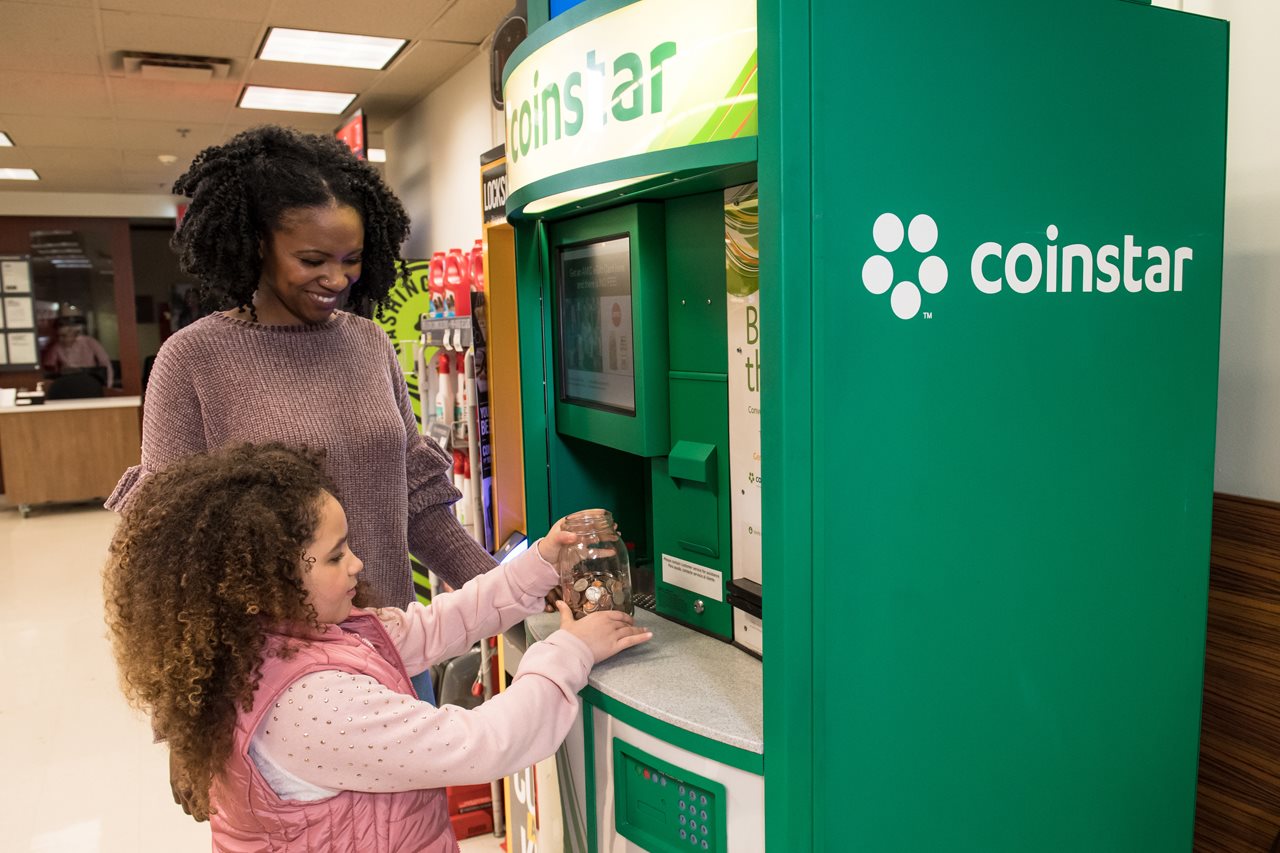
Boost your back-to-school budget by collecting spare change around your home. This can be a fun activity for kids, too. Have kids help gather change, and then you can all take it to a Coinstar kiosk as a family. In the Coinstar survey, two-thirds of the respondents believed that the amount of change they would find at home is the same or higher than it was a year ago.

You can convert your change to cash or a no-fee eGift card at Coinstar kiosks across the country. Find a kiosk near you at Coinstar.com/findakiosk.

Another way to stretch your budget is to visit online retailers for coupons and offers for the supplies and clothes your kids will need. Plan ahead, so you won’t be rushed at the last minute. That will also give you time to compare prices for any big-ticket items.

5. Look for ways to find balance

If you are one of the many parents who will have more free time with your kids back in the classroom, make the best use of this time so you can recharge. While you may be tempted to fit in chores, errands or extra work, make sure to carve out a little “me time” so you’ll be relaxed and at your best when the kids get back home from school.

How pet-friendly policies can ease the transition back to the office

2021-07-27T08:01:00

(BPT) – With many offices welcoming back employees over the next few months, employers and employees alike are wondering what their new workplace will look like, and how smoothly the transition will go. Working from home has had plenty of challenges over the past year, but also has offered many people the ability to spend more time with their beloved pets.

In a recent 2021 study, roughly 3 out of 4 (76%) pet owners said they’ve been happier working at home with their pets by their side. The survey, conducted on behalf of Purina, also found that 73% of pet owners currently working from home are worried about how their pets will react to their absence once they return to the office.

One way to address potential separation anxiety for both pets and pet owners is by cultivating a pet-friendly workplace. A pet-friendly office can help smooth this new transition, keep employees engaged, and help recruit — and retain — top talent. In the survey, 72% of pet owners working from home said they would accept a job offer from a pet-friendly employer over a non-pet-friendly employer, assuming salary and other benefits were equal. And nearly half (48%) of pet owners whose company doesn’t currently have a pet-friendly office thought that morale would improve if they did.

How can pets improve the workplace?

Studies have shown that employees who bring their pets to work tend to have a lower stress level by the end of the day and having pets by our sides can help reduce blood pressure, decrease loneliness, help to lower cholesterol levels and encourage physical activity with outdoor walks to break up the time spent sitting at a desk.

Pets can also have a beneficial impact on facilitating social interactions between employees who are looking to ease back in to reconnecting face to face with coworkers. In fact, 72% of C-suite leaders said that they believed a pet policy would either lead to — or already has led to — positive socializing in the workplace.

How do employers feel about a pet-friendly workplace?

Attitudes toward pet-friendly offices are changing, with many executives seeing the positive benefits of creating work environments more dedicated to employee happiness and well-being. In the survey, 65% of C-suite leaders whose office did not have a pet-friendly policy said that management would consider adopting one if 50% or more of their employees were in favor of it. And while some may worry about pets as a distraction, 56% of C-suite leaders said that a pet-friendly policy would lead to or has already resulted in increased productivity in the workplace.

“As a champion for pet-friendly workplaces and a pet-friendly employer for more than 20 years, Purina knows that such policies can lead to a clear increase in employee satisfaction and add a new dimension to the associate experience,” said Nina Leigh Krueger, CEO and President, Purina. “Now is the time to seriously consider the role that pets have had and will continue to have in the lives of employees. Introducing those pets into the workplace creates a cultural shift that brings people together, offers stress relief and fun, and increased productivity, all while helping the pets who have supported us throughout this time adjust to their own post-pandemic reality.”

Want to introduce a pet-friendly workplace?

For employees

Are you an employee interested in helping your office become pet-friendly? Visit Purina.com/Better-With-Pets/Pets-At-Work/Employee-Toolkit for resources and suggestions for how to bring up the topic with your employer. The toolkit includes information about how pets in the workplace reduce stress and other benefits, plus information about proper pet etiquette in your work environment.

For employers

Business owners and executives can check out the Purina.com/About-Purina/Better-With-Pets/Pets-At-Work/Employer-Toolkit for steps on how to make your workplace pet-friendly. It provides information about how to survey your employees on the topic, paperwork you may need to complete and ways to get your employees involved in the process.

For many people, pets are and will continue to be a huge part of their lives. Companies that encourage pets in the workplace show that they are committed to creating healthy work-life balances as we adjust to a new reality and continue to improve how we work and collaborate day to day.

5 finance tips to consider ahead of fall tuition deadlines

2021-07-23T07:01:00

(BPT) – The second half of summer brings a welcomed sense of familiarity for families across the country as back-to-school season approaches, and enthusiasm is particularly strong after more than a year of uncertainty upended the education system as we know it. While a widespread return-to-campus is a particularly exciting time at the college level, some families may also feel a sense of apprehension, especially in the wake of COVID-19.

In fact, affordability and dealing with the debt burden that often goes hand-in-hand with a degree is the top concern of both parents and students, according to the Princeton Review’s 2021 College Hopes & Worries survey. With many parents trying to balance daily expenses, savings progress and the cost of college simultaneously, supporting four years of higher education can be a struggle. Some may even be prioritizing college payments over their retirement contributions (not usually recommended by financial advisors), or other investments.

The good news is that with proper planning, parents can continue making progress toward saving for their own future while also helping ease the cost of college. In addition to long-term tools (like 529 College Savings plans), there are ways parents can get strategic about how they finance the remaining gap that exists when tuition comes due later this summer.

It’s possible to help a loved one achieve a better financial future without sacrificing yours. Here are a few tips to consider:

  • Consider the short- and long-term impacts of cosigning for a loan vs. taking out a parent student loan. The key difference is who takes responsibility for the loan, which can impact your finances for years to come.
  • Understand if your retirement savings can handle the increased expenses of paying for your child’s education out of pocket or by borrowing money. It is absolutely critical that you don’t derail your retirement.
  • Encourage your student to take full advantage of work-study opportunities if available as part of any financial aid package. Between class and extracurriculars their schedule might be extra busy, but many end up developing valuable relationships and/or work experience while minimizing the amount borrowed — both of which can benefit everyone’s financial posture in the long-term.
  • Resist the temptation to borrow extra money for discretionary spending. While tempting to take out an extra thousand here or a thousand there to help ensure your student can enjoy their college years, compounding interest can make these splurges very costly when you consider them over the lifetime of the loan.
  • Evaluate the repayment option on private student loans rather than simply defaulting to the deferred option. The key is to prioritize the amount you pay right now with the amount that you pay over the life of the loan. Deferring your payments might not always be the best option.

An added bonus: get your student involved in the decision-making process! Not only will they learn something, but providing them with the added context around any financial commitments made may inspire them to make healthy financial decisions along the way.

Don’t break the bank during wedding season in the ‘new normal’

2021-07-22T07:01:00

(BPT) – Weddings are back with a vengeance and with that comes spending time and money for gifts, travel, and maybe even being a part of the wedding party. A recent Zelle® consumer behavior report says that 52% of people are likely to attend a large gathering in 2021/2022. Yes, weddings will be a lot for the bride and groom, but what about the wedding crew and guests who are filling up their schedules with celebrations? How do you make sure to respect the happy couple and your wallet?

Here is a checklist of what to do and how to not get too caught up in celebrating that you put yourself into debt for the newly invigorated wedding season.

1) Prioritize your event schedule: Many postponed weddings are now back on, which means that your social calendar is way busier than it used to be — no more virtual bachelorette parties in your pajamas. However, please don’t feel pressured to do it all. Pace yourself and prioritize which weddings and social events you can attend based on your comfort level and funds.

Pro tip: Look at locations, dates, and times and be mindful of how you will be spending your money. Get this all on a calendar so you can keep track of critical dates, so they don’t sneak up on you.

2) Create a wedding spending budget: If you are part of a string of bachelorette duties and events, that can take a toll on your wallet. Estimate how much you will be spending for that wedding and if it doesn’t meet your budget, have a conversation about what you can be comfortable with and work together with your crew.

Pro tip: Be honest with the bride or groom and let them know that you are committed to helping them celebrate and honor their occasion, but that you need to be mindful of your finances. Ask them what the most important events are.

3) Give the newlyweds the gift of money: Through a pandemic and all the difficulties people have faced in the last year, physical gifts and registries have become less of a focus for brides and grooms. A Zelle® study says 76% of people across all generations prefer to receive money rather than an actual physical gift. To lighten the load for you and the bride and groom, send them money via a P2P service like Zelle® with a special congratulatory note in the memo line. If they are already enrolled with Zelle®, they get the money directly in their bank account within minutes and can use it for whatever they choose (and if not enrolled, it just takes a few minutes to quickly and easily enroll to receive the gift money).

4) Remember to celebrate: It’s been a challenging year, and the great news is that people are starting to gather together again to commemorate new beginnings safely. Try to take a deep breath, go through your checklist and enjoy this moment!

For more tips on dealing with spending for weddings in the new normal, check out Farnoosh Torabi’s So Money podcast with post-pandemic spending tips.

Sponsored by Zelle®