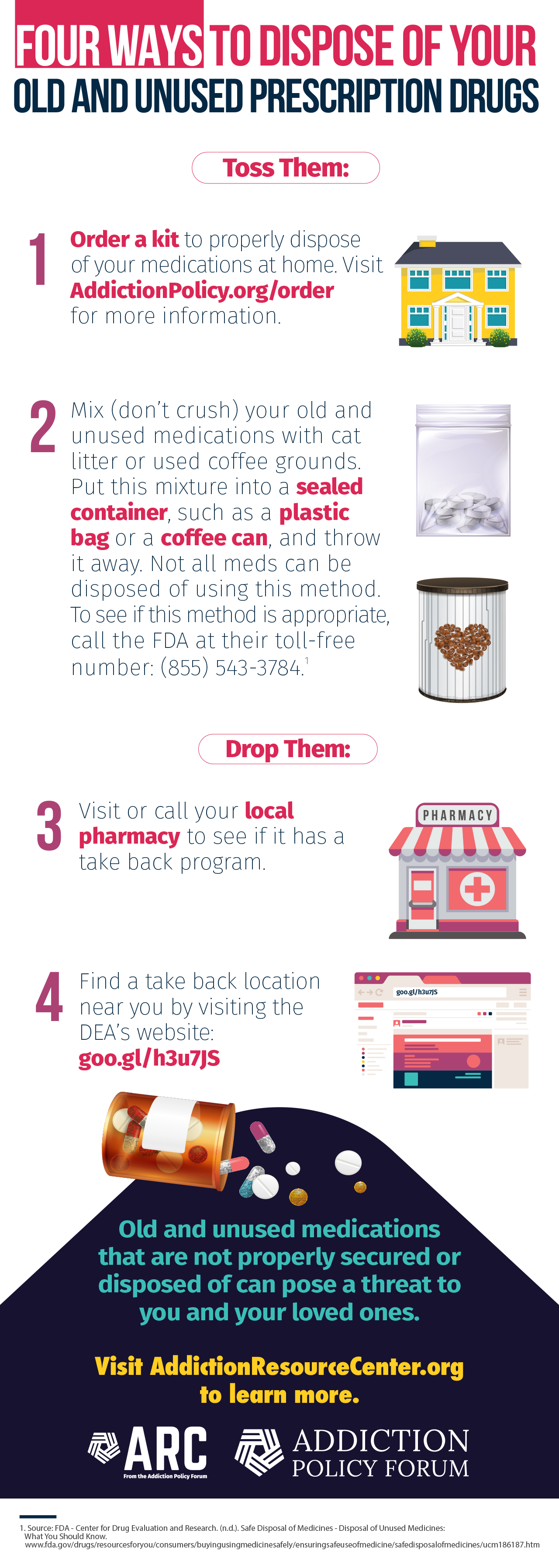
Spring into Action: Dispose of Your Old, Unused Prescription Drugs [Infographic]

2018-03-09T06:01:00

(BPT) – As you spring your clocks forward and jump into spring cleaning, take the time to clean out your medicine cabinet. Old and unused prescription medications commonly sit in medicine cabinets, sometimes for years, and can easily fall into the wrong hands.

Over 11.5 million Americans misused prescription painkillers in the last year and two in three people who use heroin started out misusing prescription painkillers.1 Every day 2,000 teenagers misuse prescription drugs for the first time.2

It only takes a moment to safely dispose of old and unused medications, but it can have a lifelong impact.

Order a free disposal kit today at www.addictionpolicy.org/order.


Results are clear: BPA is safe

2018-03-14T16:09:00

For more than 10 years, U.S. government scientists have been conducting an in-depth research program with the goal of answering key scientific questions and resolving remaining uncertainties about the safety of BPA.
This research so far has shown: that human exposure to BPA is low, that people quickly eliminate BPA from their bodies after exposure and that BPA is unlikely to cause health effects at the low levels to which we’re exposed.
If that’s not enough already, the U.S. National Toxicology Program (NTP) released the results of the capstone study of the full research program, known as the CLARITY Core study. It’s the largest study ever conducted on BPA, and the results indicate that BPA has little potential to cause health effects even when people are exposed to it throughout their lives.
In a statement released in conjunction with the report, Dr. Steven Ostroff, Deputy Commissioner for Foods and Veterinary Medicine at the U.S. Food and Drug Administration (FDA) noted: “… our initial review supports our determination that currently authorized uses of BPA continue to be safe for consumers.”
In the study, laboratory animals were exposed to a range of BPA doses from pregnancy, through early-life development and continuing through their entire lifetime. As stated in the conclusion of the study report, BPA produced minimal effects that were distinguishable from background.”
The study was conducted by scientists with FDA’s National Center for Toxicological Research with funding from NTP as part of the CLARITY program (Consortium Linking Academic and Regulatory Insights on BPA Toxicity). The report was issued in draft form and will next undergo peer-review by a panel of experts organized by NTP. The report will then be finalized and the results are expected to be published in the scientific literature.
Based on the body of U.S. government research already available, the consensus of government bodies around the world is that BPA is safe as currently used. Now with the results of the CLARITY core study, the results validate the FDA’s response to the question Is BPA safe? – Yes.


7 reasons not to wait to treat your hearing loss

2018-03-12T09:01:01

(BPT) – Hearing loss is often referred to as a silent disease. It doesn’t hurt and it often occurs so gradually over time that you barely notice the insidious damage it does. As a result, hard-of-hearing people often delay seeking treatment for their hearing loss.

Here are seven reasons you shouldn’t make that mistake.

1. Hearing loss can be a sign of a more serious illness

While in most cases hearing loss is a result of aging and excessive noise exposure, it can also be a symptom of a serious underlying medical condition. Some of these include tumors, cardiovascular disorders and diabetes. As such, hearing loss should never be dismissed.

2. Untreated hearing loss hurts your career and earning potential

Thinking about hiding your hearing loss at work because it makes you look incompetent and old? Think again! Misunderstanding instructions and asking people to repeat themselves all the time makes others question your ability to do your job. Minimizing communication breakdowns at work by wearing hearing aids will ensure that hearing loss doesn’t become a roadblock for your career.

3. Untreated hearing loss hurts your relationships with loved ones

Did your hearing loss cause you to miss out on a private joke with your pals? Or did you inadvertently hurt your grandchild’s feelings because you didn’t hear them calling you? Since good communication is vital to any close relationship, hearing loss can be hardest on the ones we love the most. Left unresolved, mounting resentment and frustration eventually strains your most cherished relationships.

4. Untreated hearing loss leads to rise in fall risk

Did you know that (along with vision) good hearing also helps you maintain spatial orientation and balance? This is why research has shown that those with even a mild untreated hearing loss are nearly three times more likely to have a history of falling than people with good hearing.

5. Untreated hearing loss has been linked to increased risk for cognitive decline and dementia

There is a growing body of evidence linking untreated hearing loss to physical changes in the brain, accelerated rate of cognitive decline, and cognitive disorders like dementia and Alzheimer’s disease. On the other hand, at least one long-term study shows wearing hearing aids reduces cognitive decline. Why would you take chances?

6. Untreated hearing loss can cause social isolation and depression

When you have a hard time hearing, social activities with friends and family start to become more embarrassing than fun. Your natural recourse may be slowly withdrawing from these activities that you once enjoyed. No wonder, then, that untreated hearing loss frequently leads to social isolation and even depression.

7. Treating hearing loss is easy and painless

Given all these reasons why untreated hearing loss is bad, here’s one piece of good news: Getting treated for hearing loss is easy! Unlike other serious medical conditions that may require surgeries or painful treatments, having your hearing loss evaluated and treated with hearing aids is easy and painless. In fact, most people who finally start to wear hearing aids regret that they didn’t seek treatment earlier.


6 tips to reduce confusion in older patients after surgery

2018-03-12T08:01:01

(BPT) – The longer you live the more likely you will develop a medical condition that requires surgery or a procedure. In fact, half of all people 65 and older will have at least one surgical procedure in their lifetime. And along with common potential side effects from anesthesia during surgery such as nausea, chills or muscle aches and itching, older patients are at risk for confusion or short-term memory loss. But, rest assured, there are steps seniors can take to minimize these side effects.

“The aging brain is more vulnerable to anesthesia and surgery, but there is research that provides guidance to decrease these risks,” said James D. Grant, M.D., M.B.A., FASA, president of the American Society of Anesthesiologists (ASA). “Older patients should talk with their physician anesthesiologist prior to surgery about their entire medical history and any memory problems they’ve had in the past, so an anesthesia plan can be developed that ensures their safety and reduces the chance of side effects or complications.”

Two anesthesia-related surgery risks more common in older people include:

Postoperative delirium — This is a temporary condition that causes the patient to be confused, disoriented, unaware of their surroundings and have problems with memory and paying attention. It may not start until a few days after surgery, comes and goes, and usually disappears after about a week.

Postoperative cognitive dysfunction (POCD) — This is a less well understood but more serious condition that can lead to long-term memory loss and make it difficult to learn, concentrate and think. Because some of these problems are already common in elderly people and may be the sign of an underlying long-term cognitive decline, the only way to determine if a patient actually has POCD is to conduct a mental test before surgery.

Researchers in anesthesia care continue to study and learn more about these conditions and how to prevent or reduce the effects.

During Patient Safety Awareness Week (March 11 to 17) ASA offers six tips for seniors to help limit confusion after surgery:

1. Ask your physician to conduct a pre-surgery cognitive test — an assessment of your mental function. The physician can use the results as a baseline for comparison after surgery.

2. Be sure your caregiver, a family member or friend stays or can visit with you as you recover, carefully observes your physical and mental activity after surgery and reports anything troubling to your physician.

3. Check with your physician before taking medications after surgery that can affect your nervous system, such as those for anxiety, seizures, muscle spasms or sleep aids.

4. If you wear hearing aids or glasses, ask that they be made available as soon as possible after the procedure.

5. Request a hospital room for recovery with a window if possible, so you can tell whether it’s day or night.

6. If you will be staying overnight in the hospital, pack a family photo, a clock and a calendar, or other familiar objects from home, to help you readjust.

In 2016, ASA launched the Perioperative Brain Health Initiative, which has engaged a multidisciplinary group to work with health care providers, payers and the public to create better access to care that minimizes the impact of pre-existing conditions that may impair mental thinking or intellectual abilities, and optimizes patients’ cognitive recovery and their experience before, during and after surgery for adults 65 and older.

To learn more about preparing for surgery, visit asahq.org/wscpreparingforsurgery. You also can download and print Preparing for Surgery: An Anesthesia Checklist to take with you to visit your physician anesthesiologist prior to surgery, as well as when you go to the hospital or outpatient clinic for the surgery. A brochure on seniors and anesthesia is also available for download. To learn more about the critical role physician anesthesiologists play before, during and after surgery, visit www.asahq.org/WhenSecondsCount.

THE AMERICAN SOCIETY OF ANESTHESIOLOGISTS

Founded in 1905, the American Society of Anesthesiologists (ASA) is an educational, research and scientific society with more than 52,000 members organized to raise and maintain the standards of the medical practice of anesthesiology.

ASA is committed to ensuring physician anesthesiologists evaluate and supervise the medical care of patients before, during and after surgery to provide the highest quality and safest care every patient deserves. For more information on the field of anesthesiology, visit the American Society of Anesthesiologists online at asahq.org. To learn more about the role physician anesthesiologists play in ensuring patient safety, visit asahq.org/WhenSecondsCount. Like ASA on Facebook; follow ASALifeline on Twitter.


10 easy ways to eat healthier

2018-03-08T15:01:00

(BPT) – If you’re indulging in too many break room snacks or swinging by the drive-thru after work, you’re not alone. With such a busy life, it’s easy to grab something quick and unhealthy on the go. But, the good news is, it’s also easy to make changes in your diet that will reap powerful health benefits in no time.

Here are 10 easy ways to eat healthier:

Start small. You don’t have to completely overhaul your diet in a day. Start with small things, like taking your lunch to work instead of eating out, cutting down on soda or getting a new cookbook of healthy recipes to inspire you.

Plan your meals. On the weekend, plan your breakfasts, lunches and dinners for the upcoming week, and then head out to the grocery store, and do your shopping so you’ll have everything you need on hand.

Cook at home. When you eat out, even when opting for the “healthy” items on the menu, you could be getting hidden doses of salt, sugar and fat. When you cook at home, you can control exactly what you’re eating, down to the nutrient. It’s healthier for your pocketbook, too.

Explore your health insurance discounts. Many health plans offer resources, discounts and incentives for leading a healthier life. Participating Blue Cross and Blue Shield (BCBS) companies, for example, have the Blue365 program, which features a variety of health and wellness products and services. Members can save everyday on online deals, including discounts on Retrofit private weight-loss programs, Jenny Craig, Nutrisystem, healthy cookbooks by Holly Clegg, and more.

Eat the rainbow. Colorful foods are packed with nutrients. Red foods help heart health and improve memory. Orange foods are good for your eyes, yellow foods help with digestion and brain function, purple foods are powerful antioxidants and green foods are good for your eyes, musculature, bones and teeth. All fight cancers. And they’re pretty on the plate. Win-win!

Slash the sodium. Lowering your sodium intake can help lower your blood pressure and get rid of water weight. But it’s not as easy as putting down the salt shaker. Sodium lurks in places you’d least expect it. Some surprisingly high-sodium foods: raw chicken (if it’s been pumped up with a solution), pre-cooked frozen shrimp (usually processed with salt), condiments like ketchup and mustard, smoked anything and cottage cheese.

Watch your sugar. Too much sugar leads to weight gain, abdominal obesity, low HDL and high LDL, elevated blood sugar and a whole host of other problems. But like salt, sugar can hide in foods you might think are healthy, including instant oatmeal, jarred pasta sauce, smoothies, flavored yogurt and salad dressing. A good rule of thumb: Read the label, and if it has a double-digit sugar count, ditch it.

Meatless Mondays! Going vegetarian one day a week is a great way to get more veggies into your diet. Swap the burger for a plate of grilled or roasted veggies drizzled with balsamic vinegar or a big, colorful salad. Just don’t pack on the refined carbs like white bread, pasta or potatoes in place of the meat.

Eat anti-inflammatory, antioxidant-rich foods. Antioxidants protect your cells from free radicals, and eating foods rich in them slows aging, gives you healthier skin, a longer lifespan and reduces cancer risk. Berries, nuts and seeds, fish, olive oil, broccoli and green leafy veggies are antioxidant powerhouses.

Practice mindful eating. Go all Zen with your food. Focus on what you’re eating, how you’re nourishing your body, and how much you enjoy the taste of the food. Eating at your desk, in the car or in front of the TV makes it more likely you’ll overeat.

For more information about how Blue365 can help you get healthier, visit www.blue365deals.com.

About Blue Cross Blue Shield Association

The Blue Cross and Blue Shield Association is a national federation of 36 independent, community-based and locally operated Blue Cross and Blue Shield companies that collectively provide health care coverage for one in three Americans. BCBSA provides health care insights through The Health of America Report series and the national BCBS Health Indexsm. For more information on BCBSA and its member companies, please visit BCBS.com. We also encourage you to connect with us on Facebook, check out our videos on YouTube, follow us on Twitter and check out our blog.

Blue365 offers access to savings on health and wellness products and services and other items that may be purchased from Blue365 Vendors, which are different from covered benefits under your policy(ies) with your local Blue Company, its contracts with Medicare, or any other federally-funded healthcare program. To find out what is covered under your policy(ies), contact your Blue Company. The products and services described on Blue365’s website are neither offered nor guaranteed under your Blue Company’s contract with the Medicare program. In addition, these products and services are not subject to the Medicare appeals process. Any disputes regarding your insurance products and services may be subject to your Blue Company’s grievance process. BCBSA may receive payments from Blue365 Vendors. Neither BCBSA nor any Blue Company recommends, endorses, warrants, or guarantees any specific Blue365 Vendor’s product or service available through the Site.

*Note to Editors: Blue Cross and Blue Shield companies participating in Blue365 are in the following states: AZ, AR, DC, DE, FL, IL,IA, KS, LA, MA,MD, MI, MO, MT, NC, NE, NJ, NM, NY,OK, PA, SC, SD, TN, TX, VA, WV, Puerto Rico and the Virgin Islands. The Blue Cross and Blue Shield Federal Employee Program® also participates in Blue365.


Kidney disease is more common than you think

2018-03-13T08:01:00

(BPT) – Suffering from high blood pressure and diabetes, Gloria Stephens became extremely bloated and could barely walk, so she knew something else was wrong. She soon learned that her kidneys were failing, and she joined the ranks of the 1 in 7 people with kidney disease. Often called a “silent killer,” kidney disease can cause a person to lose up to 90 percent of kidney function and not even know it.

For National Kidney Month this March, Fresenius Kidney Care — a leading dialysis provider with more than 2,400 centers nationwide caring for more than 190,000 people — urges people to understand the symptoms of kidney disease and what to do if you suspect you may be at risk.

“I tell all of my friends and anyone I meet — you’ve got to ask questions,” recommends Gloria, 69, of Jacksonville, Florida, who now goes to a Fresenius Kidney Care center to receive her life-saving dialysis, which filters her blood because her kidneys no longer function effectively. “You’ve got to know what’s going on in your body.”

Here’s what you should keep in mind to protect yourself from kidney disease:

1. Know Your Risk. As Gloria learned, the two leading causes of kidney disease are high blood pressure and diabetes. Other risk factors include family history of kidney failure, kidney stones, smoking, obesity and cardiovascular disease. Your age — especially if you are over 50 — overall health and even ethnicity can also put you at greater risk for kidney disease. If you are African American, Hispanic or Native American, you may be more prone to the risk factors that lead to kidney disease.

2. Recognize the Symptoms. Signs and symptoms of kidney disease often occur after the condition has progressed, so early detection is key to maintaining kidney health. Talk to your doctor immediately if you notice any changes in your urine, or if you’re experiencing fatigue, itching, swelling in your hands or feet, shortness of breath or pain in the small of your back. Make sure your loved ones are aware of the symptoms, too, because they may notice something you don’t.

3. Get Screened Regularly. If you are at risk for kidney disease, you should be screened by your doctor at least once a year, including blood and urine tests like glomerular filtration rate (GFR). Your estimated GFR (eGFR) is calculated using blood as well as taking into consideration age, weight, body size and gender. The earlier kidney disease is detected, the greater the benefit of treatment.

4. Focus on What Matters Most. While there are many reasons to get healthy, you should focus on what’s important to you, whether it’s spending time with family and friends or doing an activity you love. You’re more likely to stick with a care plan if you have a goal.

“There are a number of things you can easily do to get healthier and decrease your risk of kidney disease, starting with regular testing,” says Dr. Jeffrey Hymes, chief medical officer at Fresenius Kidney Care.

After Gloria was diagnosed with kidney disease, she didn’t expect to walk, drive or live alone again. But she draws strength from her family, stays active and is able to do all of those things. “I get myself to do something every day. If you don’t let negative things turn you around, you’ll be successful,” said Gloria, who is active in her sorority and church and volunteers with children. “The person who I think gives me the greatest amount of encouragement is my little 7-year-old grandniece named Kendall. It’s wonderful when you have a little person in your heart and in your life to keep you going.”

“Patients like Gloria show that focusing on what you love is a powerful factor in coping with kidney disease,” says Dr. Hymes. “Kidney patients and their care teams should address both the physical and emotional aspects of their health and focus on their ‘why’ as part of their treatment plan.”

Learn more about kidney disease by visiting www.freseniuskidneycare.com.


Have 5 minutes? Easy tips for finding moments of Zen

2018-03-08T08:01:00

(BPT) – From work to working out, kids’ activities to household tasks and so much more, modern life has never been busier. The problem is hectic schedules can lead to unnecessary stress.

If you’re one of the many people who feel frazzled on a regular basis, you’re probably longing for a vacation or a day at the spa. Fortunately, there are plenty of easy ways to cut stress that you can sneak into everyday life. From mealtime to bedtime, if you start embracing small moments to be more mindful, you’ll be surprised how fast you can cut down on overall stress.

Here are five simple examples of how you can find your own moments of Zen today:

1. Take a 5-minute walk.

Whether it’s getting fresh air or just getting yourself moving, a change of place and pace can reduce stress and give you a few moments to relax, especially during hectic times. For example, take a 5-minute break while dinner’s cooking to walk around the block. Weather not right for a walk? Give your body a quick stretch with an at-home yoga session.

2. Find quick-and-easy solutions.

If making dinner for your family seems like a daunting task, choose quick-and-easy options designed to take the hassle out of meal prep, like SeaPak’s Shrimp Scampi or Popcorn Shrimp. The frozen food aisle is a great place to begin your journey toward finding your happy place in the kitchen. Here, you can find a variety of products that taste great and require minimal prep work, so you can dedicate more time to doing the things you love, like spending quality time with your family.

3. Choose quality over quantity.

Make the most of your time each day by being intentional with your activities. Whether it’s playing a new board game with the kids after dinner or watching a TV show with your spouse, small quality moments can help you relax and enjoy yourself and your family when at home.

4. Take time to reflect.

When using great-tasting, low-hassle products like SeaPak to make dinner, you’ll be spending way less time in the kitchen. Take those extra moments to reflect on everything you accomplished during your day or week. This will help give you a sense of pride and is a real confidence-booster.

5. Break from technology.

Take a break from technology, even if it’s only for 5 minutes. Set down your phone, turn off the television and step away from all electronics. Just giving your mind a break from the active world of technology can reduce stress and help you mentally reset, especially during mealtimes, where being present is particularly important.

These are just five simple examples, but moments of Zen can be found anywhere if you take the time to look for them. Remember, the little moments are what make the biggest impact in life, and by embracing mindfulness, you’re setting the stage to be able to focus on what really matters.


Tired of being tired? Here’s what you need to know

2018-03-19T12:01:00

(BPT) – It’s no surprise that we all feel the need to get more sleep. However, for some people who feel tired all the time, it may be a sign of a bigger problem. If the urge to sleep during the day is overwhelming and irresistible, it may be excessive daytime sleepiness (EDS).

Roughly 20 percent of Americans have EDS. It is one of the most common complaints people make to a sleep specialist and a symptom that can be seen in a variety of sleep disorders. Being able to recognize the difference between normal sleepiness and EDS is important to your health, but more than 60 percent of Americans find it difficult to do, according to a new survey of 3,000 people conducted by Jazz Pharmaceuticals.

“Occasionally feeling tired is normal,” says Dr. Raj Dasgupta, pulmonary and sleep specialist at the University of Southern California’s Keck School of Medicine. “People with EDS have a hard time staying awake or alert during the day and may doze off during inappropriate times such as during meals, in the middle of a conversation or even when in a car stopped for a few minutes in traffic.”

EDS is a hallmark symptom of narcolepsy. Not everyone who has EDS has narcolepsy, but everyone who has narcolepsy has EDS. Narcolepsy affects approximately 1 in 2,000 Americans. It is a chronic neurological disorder in which the brain can’t control sleep-wake cycles normally. A narcolepsy diagnosis can be tricky because many disorders, such as depression, insomnia and sleep apnea, have some of the same symptoms. This may be why it is estimated that half of those with narcolepsy are undiagnosed.

Narcolepsy has five major symptoms, but you don’t need to experience them all to have it.

1. Excessive Daytime Sleepiness: This is when you have an uncontrollable urge to sleep during the day.

2. Cataplexy: The weakening of muscles when you feel strong emotions like embarrassment, laughter, surprise or anger. Cataplexy can cause your head to drop, your face to droop, your jaw to weaken or make your knees give way.

3. Sleep disruption: This is when you often fall asleep quickly but wake up frequently throughout the night.

4. Sleep paralysis: Feeling unable to move or speak for a short time when falling asleep or waking up. You may also feel like you can’t breathe deeply.

5. Vivid dreaming: Often frightening dreamlike experiences that seem real and happen when falling asleep or waking up. You may experience hearing sounds or words when drifting to sleep or have unwanted visions. Sleep paralysis often accompanies these vivid dreams.

The survey also revealed that a majority of Americans don’t feel they know enough about sleep disorders. Less than 50 percent report being familiar with narcolepsy and only 70 percent report being familiar with sleep apnea. Approximately 60 percent of Americans said that they find it difficult to know when they need to talk to a doctor about daytime sleepiness.

Dasgupta adds, “If you’re having trouble staying awake during the day or experiencing other sleep-related problems, it may be time to talk to your doctor.”

To learn more about narcolepsy, take the Narcolepsy Symptom Screener or to find a sleep specialist near you, visit MoreThanTired.com.

This content is provided by Jazz Pharmaceuticals.


Tips to get you in the baby-making mood

2018-03-23T17:01:00

(BPT) – “For many women, getting pregnant can be a frustrating and anxiety-filled experience. It certainly was for me, which is why I was inspired to write ‘The Impatient Woman’s Guide to Getting Pregnant,'” said Jean M. Twenge, Ph.D, whose book offers tips for women trying to conceive (TTC) so they are empowered to effectively navigate the fertility journey.

Try the following tips:

1. A good rule of thumb is to get off the pill three months before trying to conceive if you have been on it for less than a year, and six months prior if you have been on it for over a year.

2. Make friends with your ovulation cycle. Between a third and two-thirds of women under age 35 who are aware of their five-day fertile window are able to conceive in their first month of trying. Find this window by using a fertility monitor, ovulation predictor kits, charting or by leveraging all three. Consider a test like the First Response Ovulation Test so you’ll know exactly when to get busy.

3. If you’ve been having ovulation-focused sex for over three months and still haven’t conceived, keep calm and consider convincing your partner to get a quick and easy sperm analysis. This “male factor” or sperm issue comprises nearly half of all fertility issues.

4. Adjust your diet for optimal fertility. Incorporate fertility-boosting foods such as vegetables, fruits, whole grains, fish, soy foods and olive oil. Avoid trans-fats and partially hydrogenated oil, found in frosting and some baked goods. These are so bad that the FDA just outlawed them. Food companies have three years to comply, so, for now, you have to police yourself.

5. Many studies show that taking prenatal vitamins, with important nutrients like folic acid, vitamin B6 and DHA, increases your chances of getting pregnant quickly. Omega 3 fatty acids (fish oil) have been linked to better embryos in IVF, positive brain development and higher IQs. There is also strong evidence that prenatal vitamins lower the chance of birth defects of the brain and spinal cord, so begin taking them immediately, even if you’re just thinking about becoming pregnant. Ask your medical provider about a prescription vitamin like OB Complete Petite since the variety of over-the-counter vitamins can be confusing. It’s sugar-, gluten- and lactose-free and has 1,000 mcg or 1 mg of folic acid.

6. Contrary to popular belief, having sex every day doesn’t lower sperm count, so, feel free to have as much sex as you please, and enjoy it. But, if you are dry, use Pre-Seed, a sperm-safe lubricant developed specifically for couples who are trying to conceive. Pre-Seed is pH balanced and isotonic to mimic a woman’s fertile fluids and the pH of sperm, allowing them to swim freely on their journey to fertilization.

7. Cut the caffeine. Non-smoking women who consume about 2-5 cups of coffee per day cut their fertility by 12 percent. Consuming caffeine has an even worse effect on male fertility, where having 5 cups of coffee a day will cut his fertility in half. An alternative to getting more energy? Try getting a full eight hours of sleep — it will enhance your mood and your health.

8. Soak up the sun. Sunlight causes your skin to generate vitamin D, which has been linked to fertility. Sit outside for 15-30 minutes without sunscreen a few times a week in the afternoon. This will also help you sleep.

9. When you think you may be pregnant — the earlier you know, the better. Several scientific studies show that the First Response Early Result Pregnancy Test detects the smallest amount of the pregnancy hormone HcG — so it can tell you sooner than any other test. The sooner you know you’re pregnant, the faster you can begin making healthy pregnancy choices for yourself and your baby that include diet and limiting exposure to hazards. To be extra sure of the result when it matters most, First Response Triple Check offers three unique pregnancy tests all over 99 percent accurate in one convenient combination kit.

If you are feeling anxious or overwhelmed about getting pregnant, more information lies within “The Impatient Woman’s Guide to Getting Pregnant.” Besides planning on incorporating these tips into your daily life, here are two things that you can do right now: Take a supplement of 1,000 mg of fish oil a day and learn the relaxation technique of deep breathing to ease anxiety. You’re about to start your trying to conceive (TTC) journey. Enjoy the ride.