
2018-06-21T12:01:00
(BPT) – –


2018-06-21T12:01:00
(BPT) – –
2018-06-21T14:11:00
(BPT) – For many Americans, summer is a time for creating memories with kids by embarking on trips to fun destinations.
The balmy weather and the fact most students are academically unencumbered over those precious few months combine to present fantastic opportunities for visiting the nation’s many attractions and events. And the advantages can last into the future.
“These shared experiences promote family bonding, which is priceless,” notes Dr. Leigh Vinocur on TakeBackYourTime.org. “Studies have found people place a higher value on the shared experiences they have on vacations than the material goods they have acquired during their lifetime.”
When it comes to traveling successfully with kids, you’ll thank yourself if you come prepared with a few essential tools for taking care of common contingencies such as hunger, boredom, grime, stickiness, minor injuries, changes in temperature or exhaustion. Here’s a short list of items to keep in your trunk, tote bag or carry-on luggage anytime you leave on a family excursion. You’re welcome.
1. Wipe ’em off, rawhide.

Disposable wipes can be like manna from heaven when it comes to keeping busy kids comfortable and reasonably clean while out and about. Use them on ice-creamy fingers, sandy feet, juice-dribbled shirts, car seat spills, swatted mosquitoes, smudged sunglasses or any other surface that looks like it could use a fresh start.
2. Be ready for snack attacks.

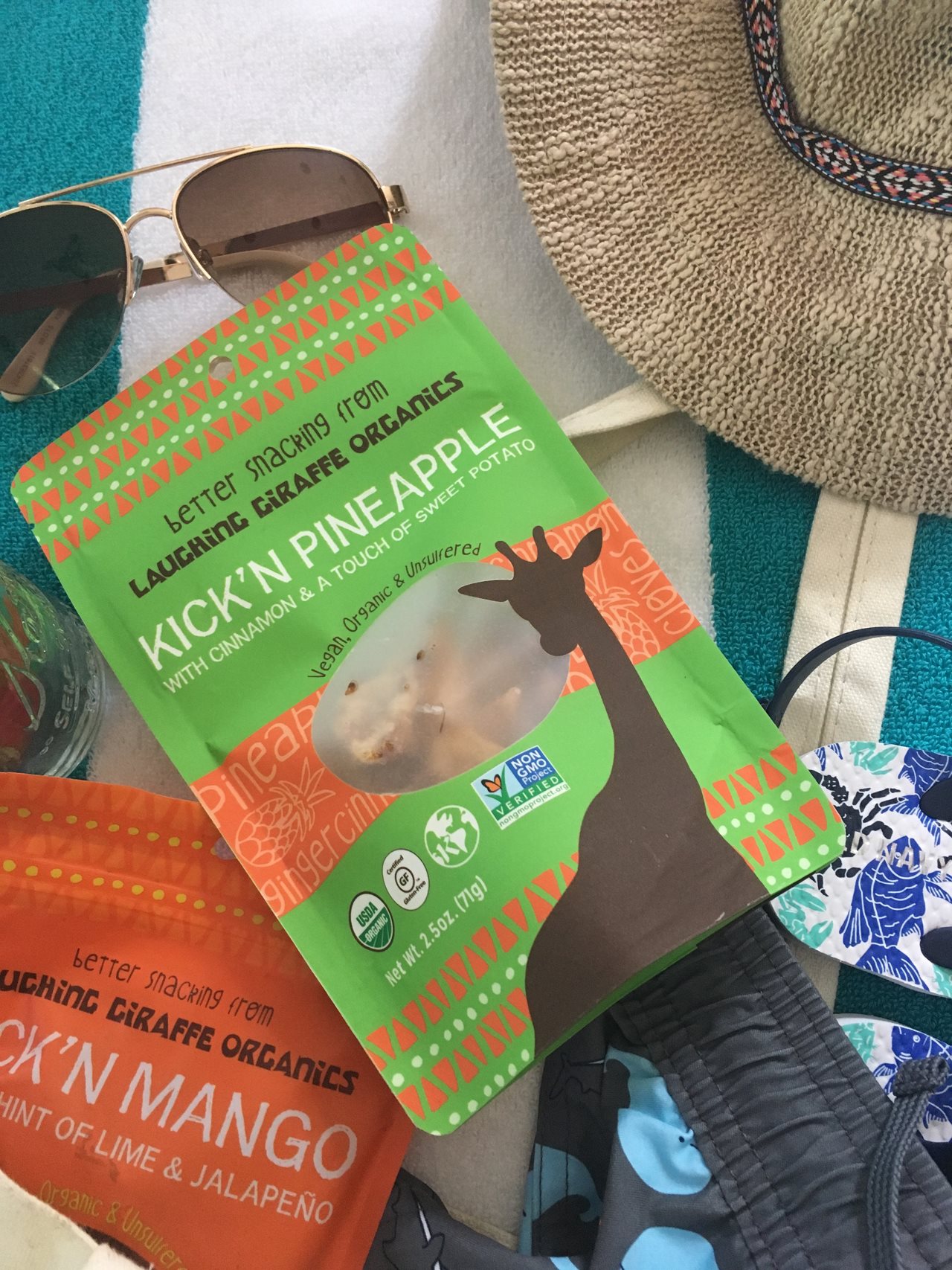
Avoid hunger-induced grouchiness at all times by keeping feel-good, clean-label treats like Laughing Giraffe Organics Kick’n Dried Fruits on hand. Serve them up with confidence and enjoy the smiles all around. These ready-to-go, deliciously spiced fruit slices are vegan, gluten-free and made with all natural ingredients. And because they come in fun flavors such as Kick’n Pineapple with cinnamon and Kick’n Mango with jalapeno and lime, they’re equally enjoyable for kids and adults.
3. Stay on your game.

To help kids deal with being confined to their car seats while you get to your destination, it’s always wise to stash away a few special games, toys, books, tablets or gizmos you can take out as needed to distract and delight. You may even wish to limit your children’s screen time to car trips so it serves as a special treat.
4. Collections of cures.
As any experienced parent knows, the slightest injury can be a big deal to a kid, inducing tears and making even the shortest car ride or beach trip seem interminable. In addition to keeping snacks at the ready, it’s always wise to keep basic first aid supplies on hand— bandages, gauze, a child-friendly pain reliever, a cleansing solution, antibiotic cream, aloe, tweezers, instant cold packs, instant hand warmers, a bucket for nausea, etc. And don’t forget the kid-friendly sunscreen for continual reapplications — you’ll thank yourself later.
5. Warm fuzzies.

The weather forecast may well be 89 degrees and sunny when you leave your house. But in many areas of the U.S. the weather can turn on a dime, leading family outings to quickly turn uncomfortable. If you leave seldom-used raincoats, hats, umbrellas and warm blankets in your trunk, you’ll always be prepared for last-minute rain or sudden drops in temperature that could otherwise spoil even your best-laid plans.
Looking for more nutritious, portable snacks you can feel good about packing for family trips? Check out the wide variety of delicious organic options at LaughingGiraffe.com.
2018-06-21T07:01:24
(BPT) – Should I lease or should I buy?
It’s a question everyone eventually stumbles upon. Most of the time there is no one-size-fits-all answer.
With the pace of technology moving faster than ever, and leasing options becoming more available, the prevailing wisdom is changing. The sharing economy makes leasing (or renting) easy and affordable.
Beyond considering leasing options for your personal car, residence and more, entrepreneurs and small business owners are taking advantage of leasing’s newfound prevalence for their business needs.
Hotel and accommodation

Technology has made the world feel small. You can do business with people across the world in real-time. More and more, small businesses are exporting their offerings around the globe. The US Small Business Administration even encourages doing so and provides counseling to start exporting.
But sometimes, you’ve got to go in person. For small businesses on a shoestring budget, the cost of traditional hotel rooms for you and your employees is a bill many would like to avoid.
Companies like Airbnb are now offering “business options” for business travelers. This can save money over a traditional hotel room.
Furthermore, for small businesses that may operate in two or more cities with employees frequently traveling between the two, startups can lease corporate apartments, permanent accommodations available to employees who are in town from another business location.
For many small businesses, corporate apartments make sense financially. They alleviate the hassle of booking hotels, minimize costs and allow employees to feel more at home when they are on the road.
Offices, conference rooms, meetings rooms and more

The word “co-working” has made its way into the startup community and taken a permanent place there. Co-working is leasing an office from a co-working group where many other businesses operate sharing the same facilities and community areas.
“Co-working just makes sense for entrepreneurs. It’s collaborative, it improves productivity. For me, starting the Lemon Collective was a natural extension of my work as an entrepreneur. I knew myself and others like me would work better and succeed more in the environment we envisioned and created,” said Kate Zaremba, co-founder of The Lemon Collective.
Organizations like WeWork, the world’s fastest-growing co-working space, provide small businesses a host of benefits from more affordable office space options to professional meeting rooms in locations all over the world, to the opportunity to work and collaborate next to like-minded innovative thinkers.
The icing on the co-working cake? Ninety percent of those surveyed in a co-working space said they felt more confident when co-working.
Technology for freelancers and small business owners

Whether you’re a freelancer, work as part of the gig economy, own a small business or have a side hustle that makes your laptop your office, leasing a computer might be an option you never considered.
Technology keeps changing and improving, and an outdated computer can put you at a disadvantage.
Software as a service, or SaaS, is a software delivery model where software is a subscription charge rather than one-time fees and is then centrally hosted. This is especially advantageous for small businesses that aren’t ready for an IT department.
The same holds true for hardware, as leasing laptops and other vital technology is an increasingly popular option for small businesses.
A study by Techaisle showed 36 percent of SMBs had PCs four years old or older. Many use old PCs as a cost-saving measure, not recognizing that outdated PCs lead to additional bottom line costs and significant productivity loss — outdated PCs result in an average of 42 lost productive work hours per year.
The big advantage: Costs remain consistent in a lease contract and your business can always afford to use up-to-the-minute technology. It also leaves capital available to invest elsewhere.
Small business breaks for leasing
“Each small business should check with their tax accountant right away to determine how leasing can be a benefit,” recommends Rick Stipe, VP of Dell’s Financial Services.
The IRS’ Section 179 permits a business to deduct the full price of either purchased or leased equipment in the current tax year — up to $1 million in 2018. And though both leased and purchased tech can offer tax benefits, remember to weigh the costs of depreciation on purchased goods.
The IRS considers a laptop an information system, with a reasonable lifespan of five years. Hardware retains its value, by IRS standards, for the length of its life. The latter includes monitors, scanners and computers. Leveraging these categories can help small businesses optimize their yearly taxes.
If you want to know more about how technology leasing can help your company or lifestyle, contact Dell’s Small Business advisor team and discover new possibilities for your bottom line.
2018-06-21T07:01:24
(BPT) – If you’re planning to create an outdoor living space, advanced decking enables you to show off your creativity. For years, complex deck designs have been difficult to achieve with traditional lumber. But, with advances in today’s decking materials, you have the flexibility to create virtually any design to reflect your style. The possibilities of creating a bold deck design are only limited by your imagination. For example, did you love hopscotch while growing up? Build a hopscotch board into your deck. Maybe you are an avid musician; why not design your deck in a giant guitar shape?
Let your imagination run wild with these four features of composite decking that will help your bold designs come to life.
1. Durable above ground
When you are considering a bold backyard design, an important factor is the durability of your building materials. If you are going to create a design that you enjoy, you will want it to last a long time. Think about the use a deck gets in the course of the year; from weather exposure to food stains, traditional decks lose their luster in areas of high traffic or exposure. The maintenance time investment of keeping your deck in tiptop shape could be spent enjoying your creation rather than working on it. Composite decking is manufactured for durability against the elements and frequent use so you have less work in the long term.
2. Bend it like Beckham…
Chances are, a quick look at social media, TV or even a magazine will flood your vision with vivid images of beautiful outdoor living spaces anchored by large, curved decking. No, these decks are not Hollywood magic or an optical illusion. Such decks are possible due to a building technique called “deck bending.” Composite boards, like MoistureShield composite decking, are made, in part, with recycled plastic, which makes them flexible when heated properly. This flexibility makes your wildest design ideas possible for a truly bold and personalized look.
3. Installation on the ground
For those who enjoy the natural serenity of your backyard, consider the benefits of composite boardwalks in your backyard oasis. Installing low-lying composite boardwalks on the ground in order to tie in naturally with your yard’s landscaping is an increasingly popular option for homeowners seeking a backyard escape from the hustle of the day. With the use of advanced decking in your boardwalk, you can take a relaxing stroll through your backyard without the worry of rotten boards and splinters, and you can create a path to the garden without tracking mud back to the house.
4. Underwater installation
This may sound like a feature only Aquaman would use for his deck, but it is still relevant to those of us who live above the sea floor. Docks and marinas are frequently bombarded by weather, water and foot traffic that take their toll on the surface. Often, this weathering makes the surface an eyesore that doesn’t complement the beautiful scenery. “Dock surfaces tend to rot, warp and splinter after extended exposure to the sun, water, and elements, whereas high-performance composite boards will resist common issues found with traditional materials; even if they are fully submerged,” said Josh Landis, senior manager at MoistureShield. High-performance composite decking can be installed over water as a durable dock surface or even underwater as a boat launch or water access ramp for your lake house or oceanfront home.
With the availability and features of advanced composite decking materials today, your design can be as unique and personalized as you want it to be. Whether you are considering building a new deck or renovating an existing one, you can create a design that is a reflection of your personality. Take a chance, build boldly.

2018-06-21T07:01:24
(BPT) – Haiti has among the highest rates of elephantiasis (lymphatic filariasis), which attacks the lymphatic system, leading to abnormal enlargement of body parts, disfigurement, pain, disability and social ostracism. The World Health Organization estimates that 856.4 million people in 53 countries remain threatened by elephantiasis. The Haitian population also suffers from widespread iodine deficiency. The Haitian Ministry of Health has established a goal to completely eradicate elephantiasis and iodine deficiency disorders in Haiti by 2020. Fortunately, there is a simple cure for these conditions: salt fortified with iodine and diethylcarbamazine citrate (DEC).
Iodine is an essential element for healthy human life, enabling the function of thyroid glands to produce needed hormones for proper metabolism. When children in the womb don’t get enough iodine from their mother, fetal brain development is impaired. During pregnancy, iodine deficiency can cause a child to develop learning and intellectual disabilities as well as developmental problems affecting speech, hearing and growth.
“Iodine deficiency disorder (IDD) is the single greatest cause of preventable mental retardation,” says Kul Gautam, the former deputy executive director of UNICEF. “Severe deficiencies cause cretinism, stillbirth and miscarriage. But even mild deficiency can significantly affect the learning ability of populations. Scientific evidence shows alarming effects of IDD. Even a moderate deficiency, especially in pregnant women and infants, lowers their intelligence by 10-15 IQ points.”
Kiwanis International, a worldwide service organization in more than 82 nations and geographic areas, partnered with UNICEF in a global effort to eliminate iodine deficiency disorders (IDD). In just 10 years, starting in 1990, the percentage of the world population consuming iodized salt went from 20 percent to 70 percent. Kiwanis ultimately provided nearly $105 million to protect children from preventable mental and physical disabilities.
“There is no reward greater in life than helping children, and seeing them live healthy, vibrant lives. Our clubs and members understand the importance of helping children in their communities, and in communities around the world, and have proudly contributed to protecting more than 80 million children from the devastating effects of iodine deficiency,” said Stan D. Soderstrom, executive director of Kiwanis International, during a Kiwanis sponsored presentation at the 2018 World Salt Symposium in Park City, Utah.
Iodine deficiency was a problem in the United States as well, until American salt producers started adding iodine to table salt more than a century ago. Today, about 70 percent of the table salt sold in the United States is iodized. In fact, salt has been and remains the primary source for iodine in the American diet. The effect of this public health initiative has been to virtually eliminate the incidence of thyroid related illness, including goiters. “Iodized salt has been one of the greatest and most economical public health successes and it continues to help raise healthy, smart children,” said Lori Roman, President of the Salt Institute, which hosted the 2018 World Salt Symposium.

2018-06-21T07:01:24
(BPT) – Each year, at least 1.7 million Americans develop sepsis, and nearly 270,000 die as a result. While anyone can get an infection, and almost any infection can lead to sepsis, only 55% of Americans have heard of sepsis.[1]
Sepsis is the body’s extreme response to an infection. It is life-threatening, and without timely treatment, sepsis can rapidly lead to tissue damage, organ failure, and death. Sepsis happens when an infection you already have — in your skin, lungs, urinary tract, or somewhere else — triggers a chain reaction throughout your body.
Start the conversation about sepsis today with your doctor or nurse using these five questions:
1. How can I protect myself from sepsis? It’s important to know the signs and symptoms of sepsis, and act fast if sepsis is suspected. Signs and symptoms of sepsis can include one or a combination of any of the following: confusion or disorientation; shortness of breath; high heart rate; fever, or shivering, or feeling very cold; extreme pain or discomfort; and clammy or sweaty skin. An infection that’s not getting better or is getting worse can lead to sepsis. Get medical care immediately if you suspect sepsis.
2. How can I prevent infections? Talk to your doctor or nurse about steps you can take to prevent infections that can lead to sepsis. To prevent infections, take good care of chronic conditions and get recommended vaccines. Also, practice good hygiene like washing your hands and keeping cuts clean and covered until healed.
3. Who is at higher risk for developing sepsis? Certain people are at higher risk, including adults 65 or older; people with chronic medical conditions, such as diabetes, lung disease, cancer, and kidney disease; people with weakened immune systems; and children younger than one.
4. How do I know if my infection could be leading to sepsis? If you or your loved one suspects sepsis or has an infection that’s not getting better or is getting worse, ask your doctor or nurse, “Could this infection be leading to sepsis?” ACT FAST and get medical care IMMEDIATELY.
5. How can sepsis be treated? A person who develops sepsis should be treated with antibiotic(s) as soon as possible, in addition to other therapies that the doctor or nurse decides are appropriate for that patient, such as maintaining blood flow to organs or receiving intravenous (IV) fluids. A doctor or nurse should also check on the patient frequently and reassess antibiotic therapy within 24-48 hours to stop or adjust therapy as needed.
Remember, sepsis is a medical emergency. Improved recognition and timely treatment of sepsis increases your chances of survival and decreases the likelihood of long-term effects.
To learn more about sepsis and how to prevent infections, visit www.cdc.gov/sepsis. To learn more about antibiotic prescribing and use, visit www.cdc.gov/antibiotic-use.

2018-06-20T14:15:00
(BPT) – Summer’s here and millions of folks are gearing up for the Great American Road Trip. Instead of hitting the highway, how about taking a sharp turn off-road instead? That’s the suggestion of 79-years-young Jim Brightly, a still-active off-road and outdoor journalist who has a vast array of publications on his resume, including Four Wheeler, Truckin’, Trailer Life and Field & Stream.
Brightly, an off-roader for more than 50 years, says “Off-roading is always challenging and fun. You never know what’s going to happen on the trail or what you can see over the next hill.”
The best part of off-roading, says Brightly, is that it’s ageless. “It’s a great vacation for all ages, old and young. Our three kids grew up in a Jeep’s backseat, and now our grandkids are continuing the sport. You can get away from the crowds or take your personal crowd with you in their own rigs. You can smell the campfire, see the stars, enjoy the adrenalin from playing in the dunes or finding that perfect campsite.”
For beginning off-roaders, Brightly has a few tips for a memorable experience:
1. Slow down: Enjoy the scenery and watch for the challenges so you can approach them correctly and safely.
2. Safety first: Always carry plenty of water and never go off-road alone. Just like swimming, you always want to have a buddy along.
3. Fluid situation: Check all your vehicle’s fluids (oil, brake, coolant, wiper) to make sure they are at the right levels.
4. Don’t trash it: Respect the outdoors and trail you’re on by not leaving any trash behind.
5. Nice spare: Along with a matching spare tire, keep a spare fan belt as well (and the tools needed to change it). Your rig will never break down in the driveway, but a fan belt could snap or slip at any time.
6. Be careful: Know your off-road driving skill level and limitations: don’t do more than you can safely handle.
7. Know your tires. Choose a tire that’s appropriate for the terrain you’ll be on most of the time. For off-roading, you’ll need something extremely durable, with great traction.
“Good tires are super essential on- or off-road,” Brightly says, “because they play a vital role in braking, steering, comfort and handling.”
For off-roading, Brightly says choices include a versatile all-terrain tire (A/T), or a durable mud-terrain (M/T) tire like Yokohama Tire’s rugged GEOLANDAR M/T G003 or GEOLANDAR X-MT. “These tires are also designed for highway use and daily driving, too — they are on my rig for my upcoming 2,700-mile Continental Divide expedition.”
Maintaining your off-road tires for daily use is essential, too. This includes taking five minutes a month to check your tire pressure. Keeping them properly inflated will give you a better ride and save fuel.
Other tire tips include:
* Check your tread depth by placing a penny upside down into a tread groove. If you can see all of Lincoln’s head, your tire’s tread has worn down to the legal limit and you need to buy new tires.
* Tires must be replaced when the tread is worn down to 2/32 of an inch (the lowest legal limit). It’s best to replace them before they reach 2/32, depending on your climate and driving conditions.
* Rotating your tires regularly promotes even wear of the tread. Tires should be rotated every 5,000 to 8,000 miles.
For more tire care and safety tips, visit www.yokohamatire.com/tires-101 or www.USTires.org.

2018-06-20T16:01:00
(BPT) – It’s summertime, and you’ll want to spend many sun-drenched hours in the great outdoors. But while Mother Nature is flourishing, it feels like you’re wasting too many precious summer afternoons and evenings doing chores in the yard and garden.
Give some of these labor-saving tips a try so you have more time for your favorite summer activities.
1. Get organized
Nothing wastes time like having to search around for misplaced trowels, seed packets and garden rakes. It’s worth the time and effort to create a zone in your garage or shed that’s just for gardening and yard care tools. Use organizing tools like pegboards and repurposed containers to keep like items grouped together. A dollar-store photo album is perfect for keeping seed packets and plant care sticks organized for future use.
2. Harness perennial power
Instead of planting a new set of annual flowers and plants in the ground each spring, opt for more perennials. These hardy plants will leap back to life without needing much attention. Talk to the university extension office in your area or a local nursery to discover the beautiful blooms that thrive and renew in your region.
3. Lighten your container pots
Larger container pots add color and dimension to any yard or patio. Trouble is, they can get heavy and hard to move. Before planting, fill the bottom half of the empty container with packing peanuts. Then, fit a piece of landscaping fabric on top. This lets the water drain through, but still barricades soil. Fill the rest of the container with soil, add the plants, and, voila! Your containers are now several pounds lighter and much easier to move.
4. Automate your watering
Watering your lawn and garden is not only physically taxing, it’s easy to forget. Between over-watering and under-watering, it can also be tough to get just right. Luckily, there’s a new generation of irrigation tools that let you customize and automate your watering schedule for the entire yard with a smartphone app.
The Gro 7-Zone Controller is an easy-to-install smart irrigation system that uses real-time weather data to tailor watering schedules to your lawn’s needs. Add Gro Water Sensors to container pots and gardens to measure the moisture content in your soil; when plants get thirsty, you get a smartphone alert. Finally, Gro precision watering kits feature one-time, easy installation for hands-free watering while delivering water precisely where and when plants need it most. Even if you’re on vacation or getting through a hot dry spell, these tools will greatly streamline your watering routine while keeping your turf lush and blooms beautiful.
5. Use “instant” lawn fertilizer
Emptying the grass catcher wastes precious time when mowing the lawn. Save yourself some labor and simply let grass clippings fall right onto the turf. They break down relatively quickly, providing the perfect food for your lawn.
6. Win the war on weeds
If unwanted weeds start surfacing in garden beds, try this easy, chemical-free fix. Start by placing newspaper and cardboard on top of the soil, leaving a little space around the stems of the garden plants. Then, cover the entire surface with a layer of mulch. This barrier blocks weeds from emerging at the surface and lets you cross that chore off your list for the rest of the season.
The summer season is all too brief. But with these tips, you can spend less time on chores and more time enjoying yourself outside!

2018-06-20T11:03:00
(BPT) – Every guy wants his own man cave, right? But an amazing bathroom is rarely part of that equation. Instead, too many men see a bathroom for its functionality when it could be about luxury, too. Why can’t you have both?
It is possible to create a bathroom worthy of every modern gent and the tips below will show you how to make your bathroom into a space you will love to use.
* A fresh coat of paint. Switch out that drab white or brown with a soothing blue or another color that catches your attention. And don’t be afraid to hang some art or photographs on the wall. Having something to look at besides the mirror will make you want to spend more time in the bathroom.
* Finally, a throne. Comfort and luxury should be staples in every facet of your bathroom, including your toilet. Luckily, the right upgrades can turn any toilet into a throne, especially with TOTO’s WASHLET S550e with EWATER+. This highly advanced personal cleansing system leads to a new level of luxury and hygiene. A unique, self-cleaning wand offers comfortable warm water to cleanse. You can adjust the temperature and pressure as you see fit for total control. Once the washing cycle is complete, gentle warm air follows to dry. No need for toilet paper, which saves money and benefits the planet.
In addition, TOTO’s WASHLET features high-tech innovations such as an auto-open/close seat and lid, electrolyzed water to keep your toilet bowl fresh and clean, an ergonomically-contoured heated seat for maximum comfort and in-bowl catalytic deodorizer, taking your luxury bathroom experience to the next level.
* Warm up the floors. Your toilet seat needn’t be the only thing in your bathroom that’s heated. In fact, installing heated floors in your bathroom can provide a much-appreciated dose of comfort once cooler temperatures kick in. Many homeowners have shied away from this project in the past because of cost concerns, but additional options on the market have increased affordability.
* Reinvent the shower experience. Guys generally prefer showers to taking a bath, but preferring the former doesn’t mean you have to give up the comfort of the latter. TOTO’s versatile G Series Rain Shower will transform your shower into a luxury experience and — most importantly — get you clean and feeling refreshed. The G Series Rain Shower offers touch button multimode water technologies, allowing you to choose the kind of shower you desire. From the restorative Comfort Wave to the fully enveloping Warm Spa, you control the spray mode for a completely customizable shower experience. It’s the perfect choice whether you’re just beginning or ending your day.
* A fan of the fan. If you’ve ever dealt with moisture issues in your bathroom, taking on this cleaning project even once should be all the motivation you need to install the proper bathroom fan. The market is flooded with options and finding the right one for your bathroom can take a little bit of research. Understand how often you’ll need to run your fan and how large your bathroom is and you’ll be on your way to a drier bathroom with more relaxing moments and fewer cleaning necessities in the future.
Start recreating your bathroom today
Your man cave deserves a great bathroom, and this vital room in your house doesn’t need to be a functional afterthought. Complete the scene and build the bathroom of your dreams easily with the tips above. It’s a surefire way to complete your cave in no time.

2018-06-20T07:01:15
(BPT) – When we think about what we know about history and the events that led to the formation of the United States, key dates like 1492 and 1776 come to mind. Many people don’t know that 1619 was another of those pivotal years that continue to shape our lives.
In 1619 English women were recruited in large numbers to settle in Virginia’s Jamestown colony. The purpose of bringing them to the colony was to fill the roles of wives and mothers, because leaders thought family life was key to developing permanence that would make the colony strong.
Not only was 1619 the year for recruiting women to stabilize Jamestown, but it was the year when the first African men and women arrived by slave ship to English North America. These pivotal events from 400 years ago led to the convergence of three distinct cultures in Virginia for the first time — English, African and Native American.
Though marginalized for more than three centuries, Virginia women persevered and established their own extraordinary legacy. You don’t always see the incredible women who helped shape Virginia in the pages of history books. But there are plenty of places to visit around Virginia where their inspiring stories can be heard and remembered.
Pocahontas

We all grew up with the myth of Pocahontas, the story of a brave Powhatan tween who stood up to her father to save John Smith from execution. (In reality, that was more likely a ritual, not a real threat.) Experience the rest of her groundbreaking life at Jamestown Settlement. For example, as a young woman, Pocahontas was traded to the English settlers, where she changed her name to Rebecca. Eventually, she married and traveled across the Atlantic to meet with English dignitaries to help promote the Virginia colony.
Clementina Rind

When Clementina Rind took over as editor and publisher of her husband’s newspaper in Colonial Williamsburg, the Virginia Gazette, it matured into a publication that gave voice to women and offered its readers expanded new worlds of thought and ideas. She published articles about scientific discoveries and education, along with literary essays and poems — some of which celebrated women. She also printed a key pamphlet of Thomas Jefferson’s that went down in history as critical to the independence movement. Discover more about her story at the Virginia Museum of History and Culture.
Margaret Corbin

Did you know female patriots have served our country since the American Revolution? The U.S. Army Women’s Museum in Fort Lee, Virginia, is the only museum dedicated to women in service and offers a look at their lives of bravery and sacrifice. One of these women was Margaret Corbin, America’s first servicewoman. When her husband was killed in the American Revolution, she took his place on the battlefield, firing cannons at the enemy.
Dolley Madison

As the wife of a U.S. President, Dolley Madison’s role was that of a supporter, hostess and first lady. But these labels of the day undermine her strengths and accomplishments. The modern term “influencer” suits her better, and she embodies that title in more ways than one. She was the most powerful woman in Washington, D.C., and she also led the way in establishing a sense of style in furniture and dress for a new nation that was still forging its own identity. When she died a widow at age 82, she was arguably the most famous woman in the U.S. The power couple’s plantation house, Montpelier, is an essential Virginia destination that celebrates her accomplishments.
Maggie Lena Walker

Born to freed slaves, Maggie Lena Walker was a powerful community leader and advocate for women and African Americans, at a time when Jim Crow laws, designed to roll back hard-won rights in the wake of the Civil War, were in full force. Walker emerged as a leader of local causes, published a newspaper and was the first African American woman in the U.S. to establish a bank. She championed civil rights, education and financial independence for African Americans — and all women. Visit her former home at the Maggie Lena Walker National Historic Site and learn all about her inspiring life.

This Richmond suffragist split her time between art and activism, sometimes managing both in the same afternoon. When she set up her easel on a busy street corner, she drew crowds of onlookers. Those onlookers became her audience as she rose to give impassioned speeches about granting women the right to vote. Discover how Clark and other key women of Virginia faced the uphill battle of bringing a reluctant public around to the idea of granting women these rights as fellow Americans.
Barbara Johns

The Civil Rights movement is known for its iconic leaders with their heart-stirring speeches and protests that inspired and motivated the nation to make the U.S. a place of equality. The revealing stories about the people who launched the movement to make Moton Museum in Farmville, Virginia, and the Virginia Civil Rights Memorial, Richmond, must-see destinations. Barbara Johns, for example, was a 16-year-old who led a strike on April 23, 1951, to protest the poor conditions of her school. That single protest sparked a lawsuit that later made it to the Supreme Court as Brown v. Board of Education.
Virginia’s 2019 Commemoration, American Evolution, inspires a modern personal connection to the formative 1619 Virginia events that indelibly influenced and continue to shape today’s America. We have partnered with notable Virginia institutions and national partners to launch a series of education programs, signature events and legacy projects of national and international significance that commemorate the 400th anniversary of key historical events that occurred in Virginia in 1619 and continue to influence America today. These 1619 events include the first representative legislative assembly in the New World; the arrival of the first recorded Africans to English North America; the recruitment of English women in significant numbers; the first official English Thanksgiving in North America; and the entrepreneurial and innovative spirit of the Virginia colony.
For a complete list of American Evolution programs and events that mark the pivotal year of 1619, visit AmericanEvolution2019.com.