5 Meaningful Holiday Gifts That Give Back All Year

2026-09-30T07:31:00

(BPT) – The holidays are approaching, which means it’s time to start thinking about what you’ll give your loved ones. This year, go beyond traditional presents and give your friends and family a thoughtful gift with a lasting impact.

For over three decades, World Vision — a Christian humanitarian organization — has helped redefine what holiday giving looks like. Through its annual World Vision Gift Catalog, the organization offers meaningful gifts that help meet real needs and equip children, families and communities with resources to help lift themselves out of poverty.

From handcrafted gifts featured by celebrity supporters to donations that enable sustainable, community-led solutions, these creative gift ideas will make your loved ones smile and help others worldwide.

“Faithfully Woven” travel pouch by Melissa Joan Hart

This silk and leather travel pouch, featured by actor, director and producer Melissa Joan Hart, carries beauty and purpose wherever your journey leads. Each pouch’s intricate pattern is handwoven by fair-trade artisans in Guatemala.

“Called to Light” brass earrings by Alexa PenaVega

Featured by actor and producer Alexa PenaVega, these brass and cow horn earrings reflect the beautiful contrast of light and dark. Each gorgeous pair is handcrafted by fair-trade artisans in Kenya.

“Patchwork of Promise” Kitenge apron by Kel Mitchell

null

This vibrant African Kitenge apron, featured by actor, producer and author Kel Mitchell, brings beauty and purpose to everyday moments. Each apron is lovingly handcrafted by fair-trade artisans in Kenya and turns the work of your hands into an act of gratitude and joy.

Gifts That Multiply

When you give to one of World Vision’s Gifts That Multiply initiatives, your donation goes farther when combined with corporate product donations and public grants. For example, if you donate to the Lifesaving Healthcare Good initiative, your gift will have five times the impact thanks to public grants, ensuring that more kids get a healthy start and thrive in life. Other initiatives you can fund include hunger relief, disaster relief, food kits for refugees, clothing, school supplies and more.

Give a gift that grows

Some gifts grow over time and can help put a family on the road to self-sufficiency — like a goat! Gifting a goat can make a bigger impact than you may expect. In fact, one healthy dairy goat can provide up to 16 cups of milk a day, providing calcium, protein and other essential nutrients for growing children. Plus, goats are well suited for harsh climates and produce valuable fertilizer for crops and vegetable gardens. Your gift of a goat will be a much-celebrated blessing for a family in need and can even help them make lasting change in their community.

Give a gift with purpose

This year, give a gift that does more. To order from the World Vision Gift Catalog, visit WorldVisionGifts.org or call 1-855-WV-GIFTS (1-855-984-4387). Donate by Dec. 9 for delivery by Christmas.

Why the best home upgrades aren’t always visible: Invest behind the walls before remodeling

2026-09-28T09:17:00

(BPT) – While many homeowners are eager to kick off a renovation with cosmetic upgrades, the less visible systems behind the walls typically deserve attention first. From plumbing and electrical systems to heating, cooling and water heating equipment, these essential components play an important role in a home’s comfort, efficiency and everyday performance.

Prioritizing home systems like heating, ventilation, air conditioning (HVAC), plumbing and electrical wiring before aesthetic updates can help homeowners avoid costly disruptions later. Behind every wall are systems hard at work to keep homes running smoothly.

Hidden systems: Air and water quietly shape everyday life.

Did you know that, according to the U.S. Energy Information Administration, water heating and HVAC systems account for roughly 65% of an average home’s energy usage?

These systems work together to support nearly every daily activity, even though homeowners may not think about them until a repair or upgrade is needed.

HVAC determines whether the house feels comfortable when you wake up, work, relax and sleep, while water heating supports showers, laundry, dishes and other everyday needs. Homeowners don’t necessarily see either system working, but they experience the difference they make every day.

Upgrade before remodeling.

Renovation planning is an ideal time to consider whether a home’s existing systems can support what’s changing. Expanding a living space could alter heating and cooling needs, while adding a bathroom or accommodating a growing family will likely increase hot-water demand. Evaluating these needs before construction begins can help homeowners choose equipment suited to how they’ll use their newly renovated space.

Additionally, it’s important to source equipment from a well-established, highly regarded manufacturer, such as Rheem®, a leader in the HVAC and water heating industry for more than 100 years, when selecting heating, cooling and water heating solutions.

Air and water: Modern technology makes whole-home comfort and efficiency more connected.

Although heating, cooling and water heating perform different jobs, homeowners ultimately experience them as parts of the same thing: a comfortable, efficient home.

HVAC and water heating systems are getting smarter. Today’s connected HVAC and water heating systems can also give homeowners greater visibility into system performance, maintenance needs and energy use.

As the HVAC and plumbing industries continue to evolve, so do homeowner expectations. Homeowners increasingly want efficient, sustainable home systems that offer greater visibility and control. Rheem’s EcoNet® Smart Monitoring System, for example, connects select heating, cooling and water heating equipment, allowing homeowners to manage support systems from one platform. At the same time, homeowners are looking for connected equipment that can fit seamlessly into their increasingly smart homes.

Before you remodel, ask yourself:

  • Will my current systems support my renovation plans?
  • Is my HVAC system keeping every room comfortable?
  • Does my water heater consistently meet my household’s needs?
  • Are my energy bills increasing?
  • How might my household’s comfort or hot water needs change in the next few years?

Invest in how the home lives, not only how it looks.

A beautiful renovation can transform how a home looks, but investing in the systems behind the walls transforms how it feels. By prioritizing heating, cooling and water heating before cosmetic updates, homeowners can create a more comfortable, efficient and dependable home that’s built to perform no matter what comes next.

Data without context: Why enterprise contract data is failing AI

2026-09-28T09:01:00

(BPT) – Key takeaways:

  • Enterprises are rapidly adopting AI agents for contract management. But when contract data lacks context, the answers AI produces can be difficult to trust.
  • Contract data is often fragmented and disconnected from the commercial context teams need to make decisions. This creates contract blindness.
  • Agents can deliver quickly, but incomplete contract knowledge can produce fast, confident and costly mistakes. The answer is contract awareness: connection contract data with the context behind it so teams and AI can with relevant context.
  • Contract-aware enterprises don’t start from zero. They use the learnings, negotiations and commitments buried in the contract history to act with the right commercial context during the decisions that matter.
  • To learn more about what it takes to become a contract-aware enterprise, visit https://www.sirion.ai/library/reports/contract-aware-enterprise/.

Enterprises are racing to integrate AI agents into their contract processes, with 42% of organizations already actively adopting or implementing AI within contracting processes.* However, in many organizations, contract data is scattered, incomplete and disconnected from the business context that gives it meaning. The information exists, but it isn’t always available to the teams that need it to make decisions. Imagine a major supplier renewal is due tomorrow, and multiple departments need information as soon as possible. Procurement needs price adjustment information, legal needs contract terms, finance needs the budget and forecasting, and operations needs performance metrics.

The answers may all exist somewhere in the enterprise. The challenge is bringing that information together and understanding it in the context of the business relationship.

This condition is best recognized as contract blindness.

A contract-blind organization has the terms, obligations and leverage negotiated, but no person, system or AI agent can contextualize or reliably use them when decision time arrives. Over time, that gap translates into value leakage, slower decisions and weaker control over risk and performance. WorldCC highlights that poor contract management can cost an enterprise 9% of its annual revenue.

And the arrival of AI makes the problem harder to ignore.

Why contract blindness persists

Enterprises don’t necessarily lack contract data. They lack a connected view of it, because data is still siloed by function. Legal owns the language, procurement owns the supplier, finance sees spending and revenue, and business owners manage performance. In fact, contract data in a typical enterprise is often scattered across 24 systems.

Research highlights the scope of the fragmentation across global enterprises. Only 27% of organizations globally store all executed contracts exclusively in a contract lifecycle management (CLM) platform, with the majority operating in fragmented environments.*

And in any case, having a repository is not enough. Even with a CLM, contract data can remain fragmented and disconnected across systems, limiting data flow and deepening contract blindness. In fact, 54% of organizations report no automated data flow between systems and only 9% have bidirectional data flow where systems stay in sync.*

Disconnected data makes it harder for teams to bring together the information they need to make informed decisions. The emerging challenge is that same fragmentation can limit the context available to AI agents when they act. AI agents are designed to do more than retrieve information. They can review contracts, answer questions, recommend actions and initiate workflows. That makes the quality and context of the underlying contract data more important than ever, because AI will deliver the best outcome it can — based on the information it has access to.

Consider the supplier renewal.

An agent asked whether a supplier can raise its prices might find the relevant clause and confidently provide an answer. But what if an amendment changed the pricing mechanism? What if a negotiated exception applies to this supplier? What if the supplier agreed to a performance commitment in exchange for the increase?

The agent may have found the right clause. It may even have interpreted that clause correctly. But without the surrounding contract context, its answer could still lead the business in the wrong direction.

The problem isn’t that the AI cannot read the contract.

The problem is that it does not know what else it needs to read.

That distinction matters. AI can only create context from the information it can access. But when relevant contract data is fragmented across systems, an agent does not have enough information to understand the full commercial picture. An agent working from an incomplete contract record can produce an answer that sounds authoritative while missing the exception, obligation, negotiation or commercial condition that changes what the business should do.

The stakes change when AI moves from reading contracts to acting on them. The question is no longer whether AI can find the right clause, but whether it understands what that clause means for the business.

The goal is no longer just to find, summarize or draft contracts faster. It is to make the full story of a contract accessible, from its terms and obligations to the negotiations and relationships behind them.

Turning contract data into usable knowledge

A contract-aware enterprise treats its agreements as a connected business asset rather than a collection of documents. By making contract data continuously accessible, contextual and actionable across the business, leaders can perform analyses, surface real-time insights, build high-leverage agreements and instantly answer commercial questions that were previously impossible to ask.

So, what does contract awareness look like in practice?

In the supplier-renewal scenario above, procurement can see the price adjustment alongside previous negotiations, legal can identify exceptions and fallback language, finance can forecast the monetary impact, and operations can compare service with actual performance. Each team works from the same connected contract knowledge, allowing the enterprise as a whole to make informed decisions with its obligations and leverage intact.

Each team is working from connected contract knowledge rather than an isolated piece of the agreement. The result is not simply better visibility. It is better decision-making.

Creating contract awareness requires more than adding AI to an existing repository.

An AI-native CLM can create a connected contract intelligence layer by structuring agreement data around counterparties, deals, obligations and other contract elements while preserving the relationships and context between them.

This new approach enables AI agents to act on what you need, not on what you click. By combining context and intent, an agent can answer questions like, “Which suppliers have price increases without corresponding service improvements?” and “Which obligations are at risk of being missed?” The result: A workflow that can move from question to insight to action without losing the commercial context.

From contract knowledge to commercial action

The next phase of enterprise AI won’t be defined by access to powerful models. It will be defined by whether those models can act within the right business context.

By moving from contract blindness to contract awareness, enterprises can give both people and AI agents a more complete view of the agreements that shape their commercial relationships. To learn more about the contract-aware enterprise, visit https://www.sirion.ai/library/reports/contract-aware-enterprise/.

*Sirion and World Commerce & Contracting, “Trusted Contract Data: From Repository to System of Record,” 2026.

Sequoia Grove Winery’s playbook for elevating game day entertaining

2026-09-24T10:31:00

(BPT) – For decades, hosting a football game meant the same thing: buffalo wings, a bowl of dip and a cooler of canned beer. But as the sport has evolved over the past 30 years, your Sunday spreads can evolve, too.

This season, Sequoia Grove Winery is bringing a fresh Napa Valley perspective to game day entertaining with “Game Day, Elevated,” a collection of chef-crafted recipes and wine pairings designed to make hosting feel special without making it complicated.

Duck confit tacos with Crème Fraîche, shallots and cilantro pairs well with Sequoia Grove Cabernet Sauvignon, Napa Valley

Developed by Sequoia Grove Executive Chef Bryce Palmer, the program brings together four elevated yet approachable dishes and three nationally distributed Sequoia Grove wines: the newly available 2025 Sauvignon Blanc, Napa Valley Chardonnay and Napa Valley Cabernet Sauvignon. Designed with game day hosting in mind, the recipes can be prepared in advance, giving hosts the freedom to enjoy the food, wine and company from kickoff through the final whistle.

“Our goal was to create appetizers that feel special without requiring a professional kitchen. This is the kind of food that can largely be made ahead of time, so the host actually gets to watch the game,” said Palmer. “Each dish is paired with one of our wines, though they’re versatile enough to work with either a red or a white, depending on how you want to entertain.”

“Game Day, Elevated” coincides with a milestone for the winery, as Sequoia Grove recently made its 2025 Sauvignon Blanc available nationally for the first time in the brand’s almost 50-year history, joining the winery’s Napa Valley Chardonnay and Cabernet Sauvignon as the three wines featured for game day pairings.

Instead of defaulting to expected game day menu items, elevate your spread with these chef-created appetizers, each paired with a Sequoia Grove wine:

Brioche Buns with Chuck-Short Rib Patties, Cheese, Pickles pairs well with Sequoia Grove Cabernet Sauvignon, Napa Valley


Click
HERE to view the recipes, pairings and images anchoring “Game Day, Elevated” this season.

Please drink responsibly. Learn more at Responsibility.org.

Inside Disasterville: The Army National Guard brings hometown disaster relief missions to high school gyms this fall

2026-09-24T11:31:00

(BPT) – Key takeaways:

  • Disasterville, a mixed-reality experience, shows students how Army National Guard Soldiers respond to natural disasters in their home states.
  • Students spend time inside three of the missions Guard Soldiers train for: containing a wildfire, rescuing flood survivors by boat and racing to free people from a collapsing train after an earthquake.
  • Disasterville draws on the experiences of Soldiers like Capt. Carter Phung, who helped lead disaster response efforts after storms and flooding in his home state of South Carolina, to show students that the Soldiers who show up in a crisis may be their own neighbors, teachers or coaches.

When Capt. Carter Phung was handed the keys to a 50-vehicle convoy during Hurricane Florence in 2018, he had been an officer in the South Carolina Army National Guard for only a few weeks. Despite being new to this level of responsibility, he understood the stakes: The storm bearing down on the South Carolina coast was headed straight for his hometown of Conway — where his own family still lived.

“You don’t get to choose when disaster hits, and you don’t get to wait until you feel ready,” Phung said. Over the next month, he helped coordinate the movement of equipment that would become the “Great Wall of Conway,” a barrier made up of sandbags and plastic sheeting built to hold back rising floodwaters and protect critical local infrastructure and vital traffic access across the county.

Throughout this experience, he saw how communities can come together during times of crisis and uplift one another in need. Neighbors he’d grown up with brought coffee and home-cooked meals to Soldiers pulling 24-hour shifts, and a mother introduced her two young kids to the unit, telling them, “These are our Army people. They’re the reason we’re still here.”

Experience the Guard’s most common missions

Phung’s story is one of thousands playing out across the Army National Guard every year. Soldiers serve part-time — often in the towns they live in — and are called upon when disaster strikes to provide resources and support during a community’s most vulnerable time. Over the past several months, Army National Guard Soldiers have waded into flooded counties in Texas, flown rescue helicopters over rising water in West Virginia, and helped communities in Indiana and Wisconsin dig out after tornadoes. In Washington state, more than 200 Soldiers spent weeks fighting wildfires that eventually burned through over 200,000 acres.

Three kids playing a virtual game with tyep in background

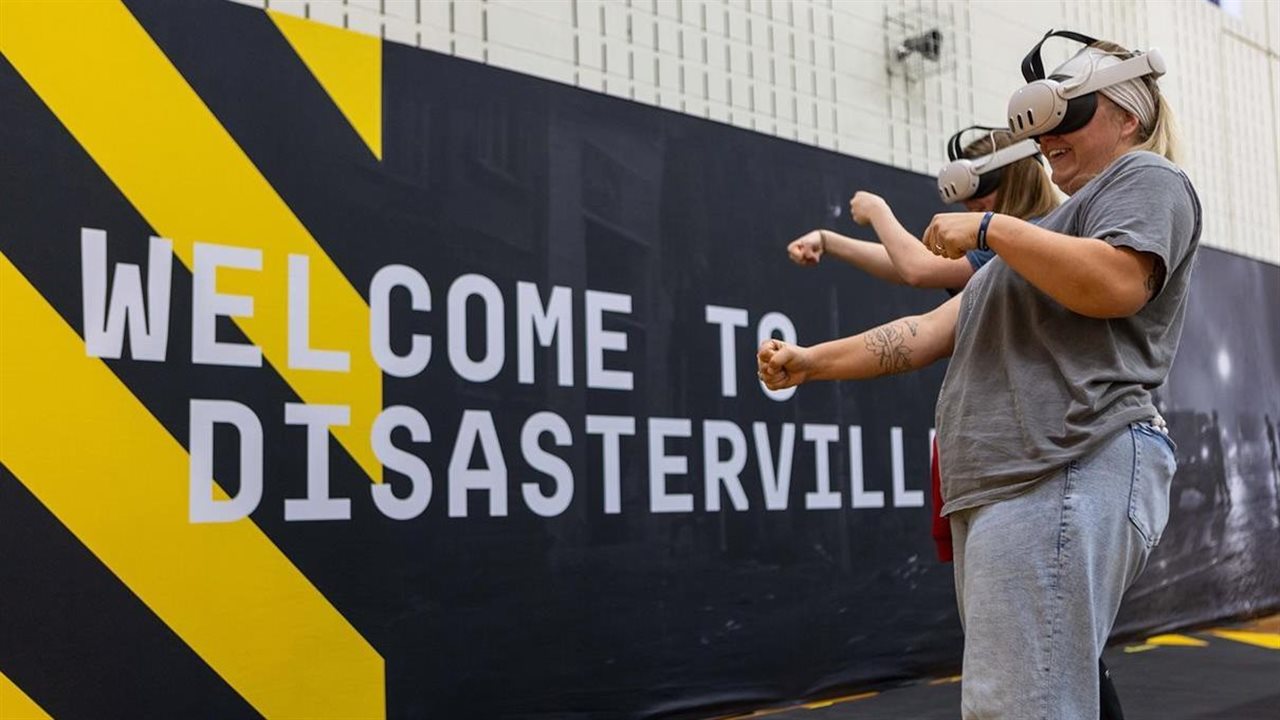
Disasterville transforms high school gyms into virtual disaster zones where students work together to tackle each mission the same way as the Guard.

Many young Americans are unaware of the Guard’s critical role in disaster response, which is why Disasterville, the Guard’s mixed-reality experience, is back for a second nationwide tour. Disasterville gives students the opportunity to experience this same impact by transforming high school gymnasiums into full-scale, mission-oriented disaster zones, showing them firsthand how National Guard Soldiers respond to natural disasters and emergencies. Students are guided through virtual missions, working together in teams to tackle three disaster zones — wildfire, flood zone and earthquake — the same way as the Guard, by combining communication, physical endurance and ingenuity to save lives, landscape and their communities.

“Natural disasters are not slowing down, and Army National Guard Soldiers are playing a critical role in response efforts across the country,” said Lt. Col. Sabrina Zowada, Chief of the National Guard Bureau’s Marketing and Advertising Branch. “Disasterville is a one-of-a-kind perspective for students to see how and when the Guard is showing up in their communities and experience the real skills and impact of these important missions.”

Lessons of disaster response for a new generation

Reflecting on his disaster response experience, Phung credits it with teaching him resilience, adaptability and confident leadership under pressure — qualities he hopes to convey to students through the program. “What I want kids walking through Disasterville to understand is that the person showing up to help isn’t some far-off Soldier — it’s their neighbor, their teacher, their coach,” he said. “That’s who the Guard actually is.”

A woman wears a VR headset in front of a sign reading
As natural disasters are sweeping across the country, Disasterville gives students a firsthand look at how the Guard is showing up their communities when they need it most.

Following a spring debut that reached more than 2,000 students, Disasterville is expanding to more high schools this fall, with tour stops running from late September through early November in Memphis, Tennessee; Chicago, Illinois; Hagerstown, Maryland; Philadelphia, Pennsylvania; Long Island, New York; Richmond, Virginia; and Atlanta, Georgia. For more information on Disasterville and the opportunities available in the Army National Guard, visit NationalGuard.com.

Expert debunks 8 of the most common power shutoff myths

2026-09-24T10:01:00

(BPT) – Most households underestimate two things about a public safety power shutoff: how long it typically lasts and how fast it can cost them a full refrigerator and freezer. When a utility company shuts off electricity to reduce wildfire risks, the interruption can stretch well beyond an afternoon. In California specifically, the average public safety power shutoff (PSPS) lasts almost two days, with some outages extending longer than six days.

If you’ve just gone grocery shopping, a single average-length shutoff is long enough to force you to throw out everything perishable in your fridge. In fact, the U.S. Department of Agriculture (USDA) advises discarding refrigerated perishables such as meat, poultry, fish, eggs and leftovers after just 4 hours without power. A full freezer is at risk of spoiling, too. According to the agency, a full freezer can only maintain a safe temperature for approximately 48 hours.

A potential shutoff doesn’t have to mean hundreds of dollars lost or days without power. The key is to know the facts and stay prepared. To make preparedness feel more manageable, Beau, Jackery’s in-house former licensed electrician, debunks the eight most common myths about energy shutoffs and offers practical advice on how to keep your fridge cool and your home running with home battery backup when the rest of the block goes dark.

Myth: I’ll find out I’m having a shutoff when the lights go out.

Reality: If conditions allow, the utility company actually notifies you in advance when your circuit’s being considered, usually a day or two out. That window is when you want to make sure your home battery backup is topped off so you’ll have power before a shutoff begins.

Myth: My phone and laptop batteries will get me through a shutoff.

Reality: Your phone and laptop batteries will only last a few hours, not a few days. Since shutoffs can run 24-48 hours (or longer), you’ll have to do without these important electronics. You’ll also have bigger things to worry about, like keeping your fridge, Wi-Fi router or anything else that needs to stay connected powered on.

Myth: If the power is shut off, I’ll just wait it out. It’s usually only a few hours.

Reality: This is sometimes true, but shutoffs are called based on wind and fire risk, not a fixed schedule, so they can run longer than expected. Just last October, due to fire weather concerns, Southern California Edison de-energized 1,215 customers across seven counties, leaving them without power for over a week. Having a home battery backup means you’re not gambling on a timeline you can’t control.

Myth: Backup batteries are only for people trying to go off-grid.

Reality: Most people adding home backup batteries are staying on the grid full time. By adding a home backup solution, they’re giving themselves peace of mind for days when the power’s out. It’s not a lifestyle change, it’s a spare tire. And once you have a portable power station to safeguard your necessities, you realize how many practical applications portable power at your fingertips can unlock: from outdoor entertaining, to road trips, to projects around the house.

Myth: If the power’s out, my only real option is a gas generator.

Reality: That may have been true at one point, but not anymore. Home battery backup solutions like Jackery’s portable power stations and solar generators can power the same essentials as a generator without the noise, fumes or trips to the gas station. All you have to do is charge them in advance. And there’s always the option to replenish them with solar power through Jackery’s portable solar panels.

Myth: A home backup battery can’t handle anything more than charging my phone.

Reality: People are often surprised by what a portable power station can handle. The right-sized unit can run a fridge, a Wi-Fi router, some lighting and charge devices all at once for a full day or more.

Myth: Setting this up is a big electrical project.

Reality: Portable solar power generators like Jackery’s are plug-and-play units that don’t require you to rewire your home but are ready right out of the box. You do have the option to connect a unit to specific circuits so they can switch over automatically or at the flip of a switch, and that’s a quick job for an electrician.

Dad and daughter in kitchen using a a Jackery 3600 plus for power during a storm.

For example, the Jackery HomePower 3600 Plus and Explorer 5000 Plus can connect to home circuits via a Manual Transfer Switch and Smart Transfer Switch, respectively, for multiroom essential home backup. That said, plenty of people just plug in the electronics and appliances they need directly into the power station, so a solution like the HomePower 1000 Plus V2 is a lighter, more affordable option for smaller households or apartments to weather a shutoff.

Myth: If I have solar, my power never really goes out.

Reality: This is an incredibly common misconception. Federal interconnection safety standards require a standard grid-tied residential solar system to shut down when the grid does to protect utility line workers. That means if you have rooftop solar panels but no battery, the shutoff will hit your solar home exactly like every other home on the block without that energy stored somewhere.

A simple solution to this problem is to use portable solar panels. These panels aren’t tied to the grid, giving households with solar an independent way to actually use that power during a shutoff. Jackery’s portable solar panels work with all of our brand’s backup power solutions so that you can capture, store and use solar power during a shutoff or any time you want to create free, renewable energy.

When the power shuts off, you don’t need to shut down

When it comes to power shutoffs, it’s important to separate fact from fiction. To learn more about how to prepare for a potential shutoff and explore backup power solutions for your home, visit Jackery.com.

Online college for working adults: What to look for

2026-09-23T23:01:00

(BPT) – Sponsored by University of Phoenix

Key takeaways:

  • Key factors to consider when comparing online colleges include: recognized institutional accreditation, schedule flexibility, transparent tuition information, transfer-credit policies, career-relevant curriculum and student support.
  • These factors can help prospective working adult students evaluate whether an online university, like University of Phoenix, fits their educational goals and real-life responsibilities.

The World Economic Forum reports that technological change remains one of the biggest forces reshaping jobs through 2030. At the same time, higher education itself is confronting the post-2025 enrollment cliff, as the number of traditional-age students begins to decline. These two realities mean that working adults are now the future of education and must choose a college that helps them keep pacing with rapidly changing technology.

For adults balancing jobs, family responsibilities and financial pressure, the question is not only whether higher education still matters. It is whether a degree program will fit their busy life without overwhelming it, whether their education connects to skills that matter in today’s workplace and whether their school provides support that can help them make progress toward their educational and career goals.

Experts at University of Phoenix share what working adults should look for when evaluating an online university, including how to assess legitimacy, flexibility, career relevance and support.

A family in the livingroom as dad works on laptop.University of Phoenix offers degree programs in 300 occupations,


How can you tell if an online college is legitimate?

A legitimate online university should have recognized institutional accreditation. It might also offer visible student support, transparent tuition, transfer-credit policies, and evidence that its programs are aligned to real occupations and skills.

University of Phoenix, for example, has been continuously accredited by the Higher Learning Commission, hlcommission.org, since 1978.

Adult learners should also look beyond accreditation and ask how the school is designed for completion. Does it offer schedules that work for adults with jobs and families? Does it help students transfer eligible prior credit? Does it connect learning to career-relevant skills? And does it provide support that continues beyond enrollment?

Useful questions to evaluate an online college include:

  • How is the program structured for working adults?
  • What kinds of academic, advising and career support are available?
  • How does the curriculum connect to job-relevant skills?
  • Can my prior eligible credits or experience reduce time and cost?
  • Are there alumni using the degree in fields similar to mine?

When evaluating an online university, working adults should look for recognized accreditation, transparent information, student support and a learning model built for real life.

John Woods, Ph.D., Provost, University of Phoenix

What should working adults look for in an online college?

Many adults worry that their age, life circumstances or family obligations could keep them from succeeding in a degree program. In reality, adult learners are already a major part of higher education and that population is only expected to grow. Let’s look at University of Phoenix again: The average age of UOPX students is 38, with 75% of them working while attending school and 52% with dependents.

That is why fit matters so much. A school built for working adults should reduce friction, not add to it. University of Phoenix emphasizes a model built for working adults, including one five- to six-week course at a time, multiple opportunities to start throughout the year and support designed for adults balancing work, family and school.

Do employers respect online degrees?

While an online college degree has become more widely accepted, some students still question whether employers respect degrees earned online. A 2026 University of Phoenix survey found that the answer is “yes.” According to the survey, 98% of hiring leaders at large U.S. employers in four industries said that online education credentials are more credible than they were 10 years ago.

The survey was conducted online within the United States by The Harris Poll on behalf of University of Phoenix from Jan. 14-30, 2026, among 502 U.S. adults ages 21 and older who are employed full-time, have a job level of manager/supervisor or higher, work in the human resources or learning and development function, are employed at a company with at least 1,000 employees, and operate in the manufacturing, financial services, information technology or health care industry.

The survey also found that 78% of those hiring leaders said workers with these credentials stand out because they bring new and emerging skill sets. Surveyed hiring leaders reported increased productivity (63%), employees picking up skills more quickly to respond to changes in the job market (62%), and more qualified candidates (60%) as a result of employees having online education credentials.

At University of Phoenix, program curriculum maps are informed by labor-market data, faculty expertise, external standards such as accreditation and industry advisory council feedback. That skills-first design supports digital badging, helping learners turn completed coursework into shareable, verified signals of skill development while they are still progressing through a degree.

A woman smiles as she sits in her office, studying on her laptop.

More recent research offers a University-specific perspective. In a separate 2026 survey conducted by The Harris Poll on behalf of the University, 98% of 204 managers who directly supervise at least one University of Phoenix graduate reported being satisfied overall with the graduate at their organization, and 97% said they are likely to hire someone with a University of Phoenix degree in the future. The findings reflect the reported experiences of managers who have direct supervisory experience with University graduates.

How to find an online degree program aligned with your career goals

Today’s working adults need higher education that does more than putting classes online. They need learning designed around evolving workplace skills, supported by clear student services and recognition of prior learning, and responsive to how AI is changing both jobs and education.

University of Phoenix offers degree programs aligned to more than 300 occupations, reflecting the institution’s broader, skills-mapped, career-focused model. To help learners show progress before graduation, University of Phoenix issues digital badges that translate assessed learning into verified skill signals that can be added to their digital profiles as demonstrated skills, even before graduation. Since 2021, the University has awarded over one million digital badges as part of the University’s skills-aligned, career-focused learning model.

Adult learners returning to higher education often bring valuable prior learning with them. University of Phoenix demonstrates the scale of an institutional model designed to help students preserve eligible academic credit and avoid unnecessary repetition, with more than 7 million transfer credits applied toward degree requirements over the past eight years and up to 87 transfer credits accepted for many bachelor’s programs.

AI literacy is another factor working adults may consider when evaluating an online degree program. University of Phoenix established a framework of academic AI pillars that integrates AI tools and applications into its learning model, including a newly established Center for AI Resources. The University embeds AI literacy and skill-building into its curriculum, expanding AI-enabled learning supports and strengthening policies and workflows that guide responsible, effective use across the academic experience.

Schools serving working adults should also provide career support services. University of Phoenix provides Career Services for Life® resources for active students and graduates beginning on day one, through degree completion and beyond, offering lifetime access to personalized career coaching, webinars, resume guidance, interview preparation and other resources.

“Working adults are looking for education that fits the realities of their lives and builds skills they can use in a rapidly changing economy,” said University of Phoenix Provost and Chief Academic Officer John Woods, Ph.D. “For 50 years, University of Phoenix has designed flexible education for adults balancing work, family and change. When evaluating an online university, working adults should look for recognized accreditation, transparent information, student support and a learning model built for real life.”

Learn more about University of Phoenix degree programs, transfer-credit opportunities and student support resources at Phoenix.edu.


The secret to longevity is all about maintaining movement

2026-09-23T09:11:00

(BPT) – Longevity has become a buzzword in recent years, focusing the conversation around living longer. However, there’s another part of the conversation to consider: health span, or the quality of those additional years. It’s not just adding years to your life; it’s about maintaining the movement, mobility and independence to live those years to the max.

The human body was made to move, and movement is part of nearly every moment of daily life. You walk from place to place, bend to pick something up, lift groceries, climb stairs, work at your desk, exercise, care for your family and make time for the hobbies you love. How you move today can heavily influence how active, independent and capable you are years from now.

When pain, stiffness or limited mobility get in the way, those everyday movements can feel harder or out of reach — affecting not only how you move, but also how you’re able to participate in life. Over time, these limitations can negatively impact strength, flexibility, balance, posture, confidence and independence — all of which play an important role in long-term health and longevity.

Movement supports healthspan by helping maintain daily function, including stamina, strength, mobility, balance and recovery. So, how can you support healthy movement and maintain a good quality of life? One answer may be chiropractic care.

Why chiropractic care may be the secret to longevity

Chiropractic care can be a proactive and holistic way to support your body over time. That’s because it aims to benefit the musculoskeletal system, the body’s framework for posture, stability and movement, which consists of bones, muscles, ligaments, tendons and joints.

By supporting the musculoskeletal system through chiropractic care, patients may be able to restore and maintain better mobility, reduce recurring stiffness and stay more comfortable through daily activities that help them stay active and independent as they age.

Chiropractic care may also help relieve pain. In fact, one of the most common reasons people seek this type of treatment is for pain from old or existing injuries, as well as discomfort that can develop from the demands of everyday life, including prolonged sitting, driving, lifting and repetitive activities. When pain gets in the way, it can affect more than how you feel physically, changing how much you move, what you feel comfortable or confident doing and how fully you participate in daily life.

Move long and live fully

Living longer is only part of the goal. Staying active and moving well can help you maintain independence and quality of life as you age, and chiropractic care may be one way to support that. When movement patterns stay efficient, activity feels easier and recovery tends to improve. Supporting healthy movement may make a lasting impact, helping you stay active and maintain your independence as you age.

That said, to get the most benefit from chiropractic care, consistency is key. Just like going to the gym, eating a balanced diet and going on daily walks, routine chiropractic care becomes valuable when aligned with goals and lifestyle demands. Routine means establishing a consistent schedule for care, whether that means weekly, biweekly or another frequency decided on by you and your chiropractor. Over time, this consistency may help support healthy movement and mobility rather than waiting until pain or discomfort gets in the way.

The advantages of chiropractic care may include helping with comfort, range of motion, flexibility, muscle coordination, physical performance, circulation supported by easier movement, sleep quality and mental clarity. When chiropractic care is incorporated into daily life with a regular cadence, it may help the body feel less restricted and more settled.

To learn more about how chiropractic can help you invest in your long-term mobility and find a convenient, affordable clinic near you, visit TheJoint.com.

Embrace the bots: Today’s students are the first-generation AI workforce

2026-09-23T08:01:00

(BPT) – Why the incoming college class must trade control for oversight to thrive in the age of AI.

By Arvind Nithrakashyap, CTO and Co-Founder, Rubrik

As you step onto campus this fall, the prevailing narrative about the job market likely feels like a ghost story. You’ve heard that AI is coming for entry-level roles, that coding is dead and that the degree you’re working toward might be obsolete before you cross the stage at graduation.

As a parent of a teen coming of age, and co-founder of a tech startup that went public in the past two years, I’m here to tell you that the reality is far more interesting, and the opportunity is far more compelling.

College students should not see AI as a threat to the jobs they hope to hold. Rather, you should view AI as an opportunity to enter the workforce already knowing and understanding how to direct, evaluate and improve the work of AI agents. Technology skills are no longer reserved for those pursuing tech degrees. Professionals across every industry will need to build them, and now is your time to rise to the challenge.

If you listen to the “AI-washers” in Silicon Valley, you’d think every company is already a perfectly oiled AI machine. The “flying cars” of AI haven’t arrived yet because the bottleneck isn’t the technology; it’s the people. To succeed in this world post-graduation, you don’t need to fear the bot. Your advantage will come from combining human judgment with the ability to direct the bot effectively.

From doer to manager of agents

Today’s college students are essentially the first generation to enter the workforce already prepared to lead with AI. You have an advantage; you do not have to unlearn decades of workplace habits that your predecessors did prior to AI.

The most profound shift you can make during your college years is adopting a change management mindset. Historically, an individual contributor was expected to be a doer who personally touched every line of code or every page of a legal brief.

In the agentic era, you must learn to operate like a manager.

Across the industry, we are seeing people use AI to move beyond the traditional boundaries of their jobs. Meanwhile, some historically technical roles have struggled because they refuse to let go of direct control. They feel they must personally review every step an agent takes, moving only at the speed of a human rather than the speed of a machine.

To succeed, you must get comfortable with acceptable risk. You have to be willing to let an agent run for hours, what I call “YOLO (you only look once) mode,” and audit the results after the fact rather than micromanaging the process.

The proof is in the transformation

All of this is not just theory. At Rubrik, we are deep in the throes of our own AI transformation. We’re seeing these mindset shifts drive meaningful results across every department. For example:

  • Legal: Our data privacy legal team, without any engineering help, built an agent that reads and analyzes product code for privacy and data governance gaps. Using this tool moved the team from a block-and-review model to an inform-and-audit model, allowing innovation to move fast while they oversee the stream of activity and maintain portfolio-wide activity.
  • Product Management: Our PMs are now building functional prototypes to show customers directly, bypassing the engineering backlog entirely by using AI to bridge the technical gap.
  • Operations: A single program management leader automated a manual task that used to require every team to build 10–15 slides for quarterly reviews, turning it into a dynamic dashboard.
  • Engineering: We’ve seen roadmap capabilities pulled forward by four months simply because our teams embraced coding agents.

The common thread with these examples is not technical expertise alone. The people creating the greatest value know how to define a problem, give an AI system appropriate boundaries, evaluate its work and remain accountable for the result.

Your mission: Reframe the college experience

During college, the fundamentals of your expertise area are still critical; you still need to learn how to write, analyze, build and reason without relying on AI. Then learn how AI can extend those abilities. Practice breaking large problems into clear assignments. Learn to test outputs, identify weak reasoning and recognize when a decision requires human judgment and taste.

Don’t spend the next four years trying to protect your domain from AI. Spend them learning how to govern it. Students who develop foundational expertise and AI leadership skills will not simply be prepared for the future of work. They will help define it.

The job market isn’t shrinking; it’s evolving. The door is wide open for those who enter their professions not as laborers, but as architects of autonomous systems.

Welcome to the agentic era.

How to keep pets fed and families together this September and beyond

2026-09-23T09:41:00

(BPT) – Food insecurity can affect anyone, from seniors living on a fixed income to parents managing increasing grocery costs. And when humans face hunger, their pets often do, too.

Nearly 48 million people in the U.S. experience food insecurity and roughly 30 million pets live in homes with people experiencing food insecurity. Despite the prevalence of pet hunger, awareness remains low. According to a new PetSmart Charities survey, only 31% of people say they are very aware that pet hunger in the home exists at all*, while more than one-third (36%) report having little to no awareness of the issue.

The reality is that pet hunger is not siloed from the growing issue of human food insecurity, but is often deeply connected. And when people don’t have enough to feed themselves or don’t know where their next meal will come from, they may have to make difficult decisions for the sake of their pets.

An impossible choice

A woman hands a bag of pet food to another woman out of the back of a truck.

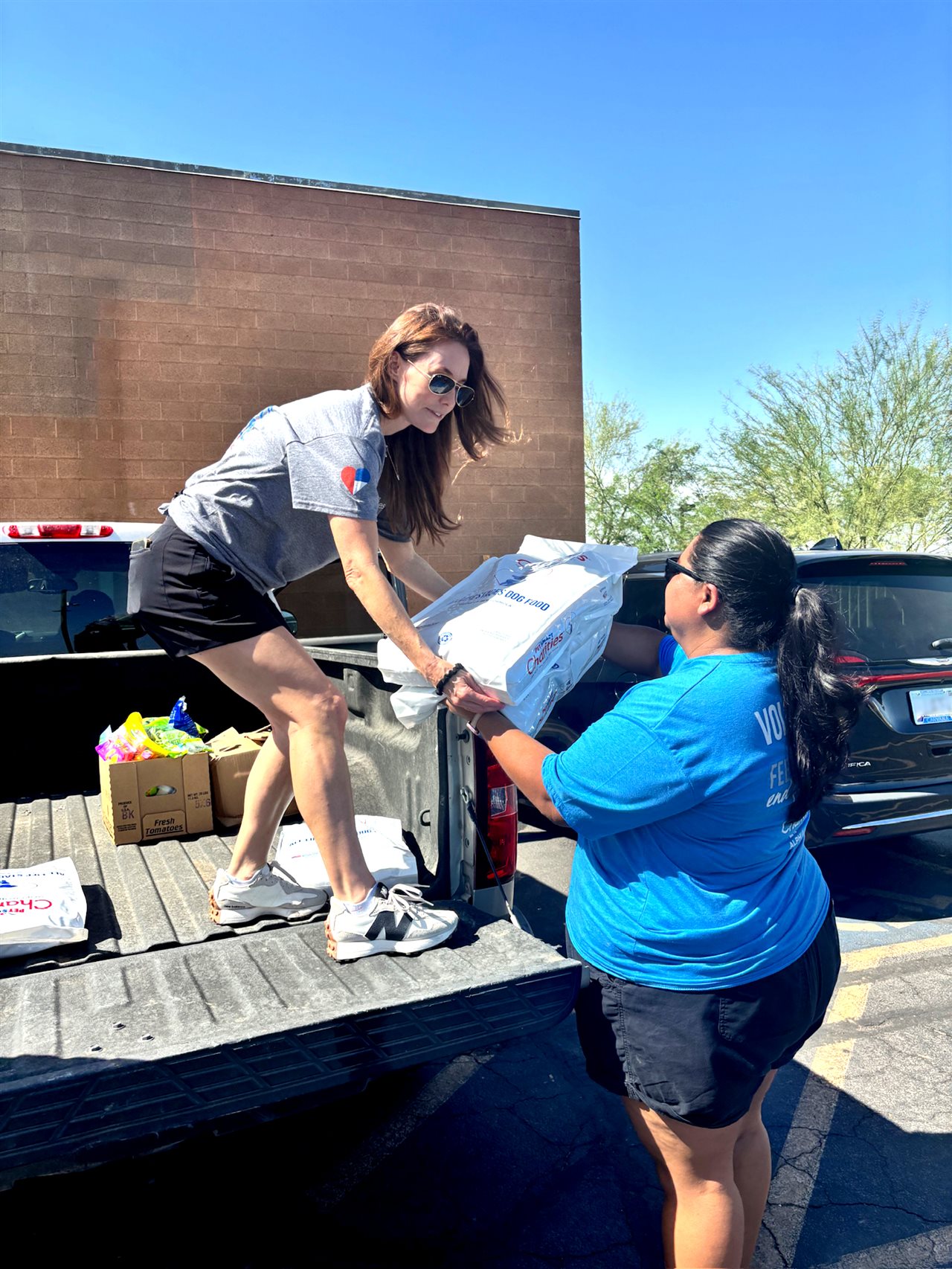
Pets aren’t just companions. Many people consider their pets to be family members, so it should come as no surprise that humans are willing to make personal sacrifices to keep their pets fed.

According to Meals on Wheels America, one in five seniors will forgo their own meals, filling their pets’ bowls first. Additionally, many Meals on Wheels volunteers have discovered that the food trays they delivered to clients were often left on the floor as pet parents shared their meals with their pets.

But when sharing food is not enough, pet parents have to make even more difficult decisions — 56% report having had to reduce other costs in their life to afford pet food, and 13% of pet parents who’ve experienced difficulty affording pet food have considered rehoming or surrendering their pet, crowding already full animal shelters.

Helping fill bowls for humans and pets

A man holds a bag of pet food in one hand, and a black pug in the other hand.

When human services organizations can meet pet parents where they’re at, it may help reduce preventable surrenders. Among pet owners who have personally struggled to afford pet food, 87% place pet food availability at community food banks or mobile food pantries among their top forms of support, followed closely by free or low-cost pet food distribution programs (86%). While available pet food at food banks can vary by community, there are organizations and social services who are making strides in addressing hunger on both ends of the leash.

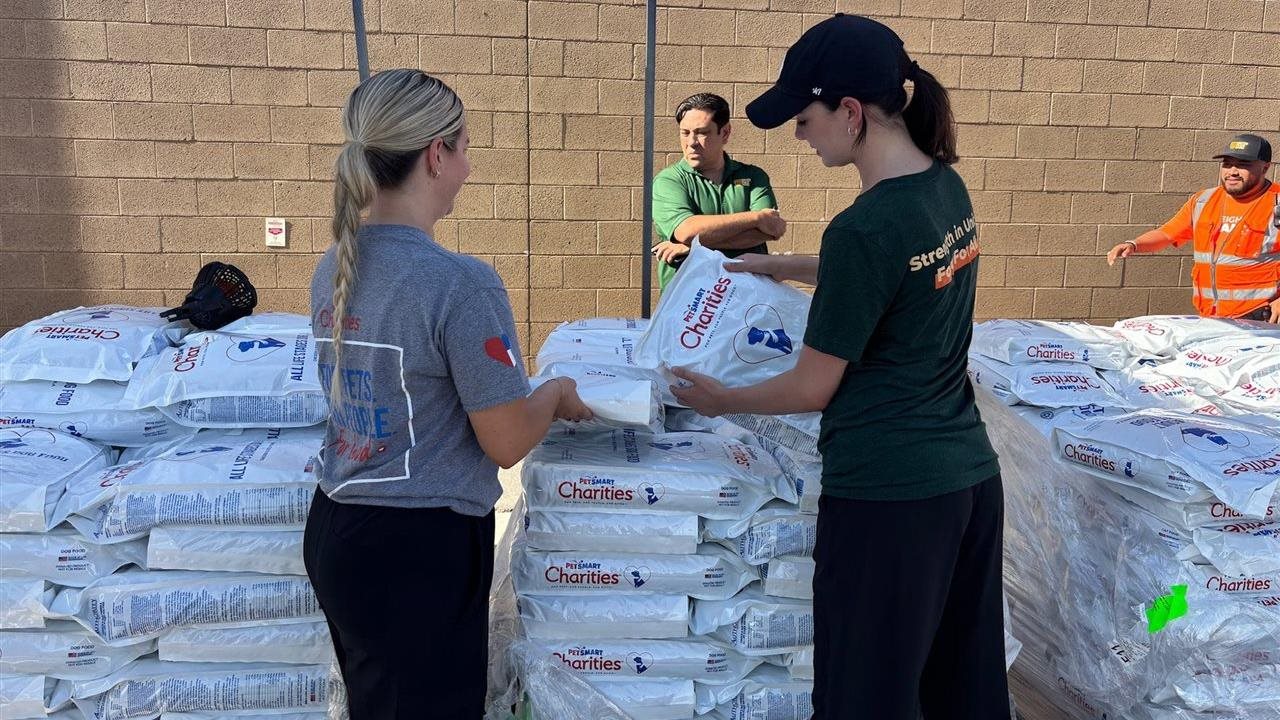
For the past few years, PetSmart Charities has partnered with Feeding America® and Meals on Wheels America to distribute pet food to the families they serve year-round. Since the beginning of this initiative, the organizations have helped provide hundreds of millions of pet meals to families in need.

“Love for our pets isn’t measured by our bank account balances,” said Aimee Gilbreath, president of PetSmart Charities. “When times are tough, we want to ensure people have access to the resources they need to make sure their pets can stay in their homes doing what they do best — giving unconditional love and companionship. Our partnerships are rooted in addressing the connection between human and pet hunger, and we’d encourage all social services agencies to consider adding services for pets, too.”

If you need support to keep yourself and your pet fed, know that you are not alone. You can visit the Meals on Wheels and Feeding America websites to learn more about how you can access pet food along with food assistance.

In honor of PetSmart Charities Pet Hunger Awareness Day® (Sept. 29), PetSmart customers can contribute funds directly at checkout or donate PetSmart Treats Rewards points to support the programs that help keep humans and pets fed.

To learn more about Pet Hunger Awareness Day or to donate, visit PetSmartCharities.org.