5 ways to care for and comfort your sick child

2018-03-01T11:23:00

(BPT) – If you’re a parent, a big part of your job is making sure your children feel well. No matter how many times you wash their hands, sterilize their toys or keep a sparkling clean house, inevitably the germs will win. All parents know that taking care of a sick child can be a stressful experience that can leave you feeling helpless — especially when they have a cough that is keeping them up at night.

On top of that, if you’re trying to juggle a job, keep the house in order and get enough sleep yourself, the experience can feel overwhelming.

Emily Schuman, founder of the popular lifestyle parenting blog Cupcakes and Cashmere, has had more than her fair share of days spent taking care of her toddler when she is sick. The following are some of her best cough and cold remedies to help care for your little one when they’re sick.

1. Sleep is great medicine

Parents know that a sleepy child is a crabby child. Just as sleep is vital for a child’s mood, it is also a crucial step in combating coughs and colds. Naps and early bedtimes should be a priority. To help your sick child sleep better and longer, you might have to give them more cuddles than usual!

2. Reduce their coughing

One of the worst parts of taking care of a sick child is hearing them cough, which is also uncomfortable for the child. In fact, a recent Vicks VapoRub survey* found that nearly all (94 percent) moms say coughing from being sick makes sleeping difficult for their child, and 92 percent say finding symptom relief to improve their child’s sleep is top priority. Fortunately, Vicks VapoRub, a cough remedy moms have used for over 100 years, is safe, effective, has long-lasting vapors and is fast-acting for children ages 2 years and up. When applied on the chest or throat, the medicated vapors in Vicks VapoRub last up to eight hours, to help quiet the cough, which in turn helps moms and their children sleep better and get the rest they need.

3. Bring out the humidifier

With winter comes dry air, and when you add in central heating, the air is even dryer. This is particularly uncomfortable when you have a cold or cough. Placing a humidifier near your child’s bed can do wonders as far as allowing them to breathe more comfortably and sleep better.

4. Feed them nutrient-rich foods

When you’re sick, it’s easy to gravitate toward comfort food like mac and cheese or sweets. But it is important to make sure your child gets plenty of nutrients from food like fresh fruits and veggies. Soups and smoothies are perfect ways to get your little ones to eat these foods.

5. Provide them with activities and distractions

Being sick is not fun, and not just because your child feels lousy. They’re also cooped up, bored and incredibly restless. Make sure you have plenty of rainy-day activities, like coloring books and special toys, ready for them. If they feel up to it, encourage them to make a fort out of the couch cushions. It’s also the perfect time to let them have extra screen time.

It’s hard to have a sick child at home, but getting ample sleep, having Vicks VapoRub on hand, using a humidifier, eating well and being prepped with some creative distractions can go a long way toward comforting your child and making things easier for the entire household. And remember as stressful as it can be caring for a sick child, nearly nine in ten (87 percent) moms say it can be a bonding experience.*

* This content is based on an online survey conducted by Kelton in October 2017 among a sample of 1,016 American mothers with children between the ages of 2 and 17.


How to keep your seafood wild

2018-03-05T10:01:01

(BPT) – Every day, consumers are bombarded with buzzwords when selecting groceries — natural, organic, non-GMO, gluten-free and so on. Coupled with news headlines about the environmental impacts of growing, raising and catching food, it’s no wonder many of us are becoming more confused about which choices are right for our diets, our budgets and the environment. And nowhere is this issue more confounding, perhaps, than in the seafood section.

Fish and seafood are flavorful sources of protein, and the variety and versatility of the ocean’s bounty is no mystery. What may be considered a mystery is whether all the options in front of us are sustainably sourced. Some are labeled wild, others farm-raised, but questions remain given the limited information provided and the fact that mislabeling can occur (an independent study of the open global market found an average mislabeling rate of 30 percent for all fish and seafood).

With the world’s growing demand for seafood, ocean environments are increasingly strained. The livelihoods of approximately 10 percent of the global population are supported by the oceans through artisanal and commercial fishing careers. Overfishing — when too few adult fish remain to breed for a healthy population — has been an issue for some species, and it can decimate fish stocks and habitats as well as the fishing communities and economies that rely on a healthy supply.

Illegal, unregulated and unreported (IUU) fishing continues to occur around the world and can exacerbate overfishing problems. IUU fishing generally disregards quotas and the environment, as does destructive fishing, which may expose delicate ecosystems to explosives or chemicals.

Fortunately, industry groups have developed standards and certifications to help us navigate the murky waters and find some clarity. For 20 years, the Marine Stewardship Council (MSC), for instance, has been refining its science-based standards for certifying sustainable fisheries and introducing traceability in its efforts to keep the oceans wild and teeming with life for generations to come. And, seafood that has been determined to meet the MSC’s stringent standards is marked with an easily identifiable blue fish label.

By looking for the trusted blue fish label, seafood shoppers can be assured that their purchase:

* Represents only wild fish or seafood from fisheries assessed by an independent third party to meet strict science-based criteria.

* Supports sustainable fishery practices and good management that adapts to changes in the environment.

* Traces back to a certified sustainable fishery and is kept separate from non-certified fish and seafood.

* Features correct labeling, providing peace of mind while selecting food for the dinner table.

Of course, not all certification labels are the same. To make a truly informed choice, you might consider doing a little homework before deciding which label to seek and support with your shopping and dining-out dollars. Several well-regarded international organizations maintain best practices for food production, sustainability and traceability, providing recognition of certification and ecolabeling programs that meet them. Organizations like the United Nations Food and Agriculture Organization (UNFAO), ISEAL Alliance (the global memberships association for sustainability standards) and the Global Sustainable Seafood Initiative (GSSI) are all considered reputable sources for more information.

With a little research, you can gather information that helps ensure the seafood you put on the table can be traced to its source and verified as wild and sustainable. At the same time, its enjoyment can be guilt-free: each purchase provides incentive for more fisheries, retailers and restaurants to join the movement to support transparency, traceability and sustainability in our food system. By speaking with their wallets, consumers have the power to track their seafood from ocean to plate and keep it wild.


Ideas to help you reap big rewards from your garden

2018-03-05T11:41:00

(BPT) – Get active outdoors with a hobby more satisfying than binge-watching another television series. As a pastime, gardening can help you eat delicious, more flavorful food while transforming your patio or yard into a colorful hangout for butterflies and bees.

Many people don’t realize how easy it is to have a fresh supply of crisp veggies, fragrant herbs or fresh-grown flowers. Whether you have a balcony, rooftop or patio, gardening is a hobby that quite literally allows you to harvest big rewards.

One of the most exciting parts of gardening is deciding what to grow. With thousands of plants to choose from — flowers, vegetables and herbs — a small pot of soil can be a canvas for creativity.

To find the most popular flowers and plants this year, we checked in with Ball Horticultural Company, a global leader on all things gardening, to see what the top trends are in 2018.

Strong and colorful

When spring arrives, we all crave color and warmth to celebrate the end of winter. To get that wow factor — and get it fast — try planting flowers that grow and fill in quickly and thrive in extremes. The Megawatt Begonia brings magnetic color even in shaded spaces. It’s also a low-maintenance option if you’re new to gardening. Likewise, the Echinacea Sombrero Sangrita is a perennial flower that returns each year with stunning red blossoms.

For foodies who want to show off

Every chef knows the secret to tasty cooking is great ingredients. For many gardeners, the truly magical combination is finding that edible veggie that looks as good as it tastes. Take 2 Combos combine two sweet pepper plants with a touch of heat and beautiful orange and yellow fruit. There’s also a combo of a slicer and cherry tomato perfect for small spaces and for snacking and cooking. Speaking of peppers, a new, attractive variety is Candy Cane Red Pepper. It has green fruit striping that ripens to red and offers up crisp, sweet flavors, much like a candy cane!

A refuge for bees, butterflies and beyond

There are dozens of reasons people choose to garden: fresh food, interior and exterior decoration, relaxation, stress reduction and more. One emerging trend is that people want to make their garden a destination for pollinators like bees, butterflies and hummingbirds. A few captivating flowers that attract these beautiful and helpful creatures are:

* Lucky Star Pentas — Provides butterflies summer-long flower clusters in eye-catching colors

* Copper Prince Ornamental Millet — This thriller makes a dramatic statement with foxtail plumes that birds feast upon

* SuperBlue Lavender — A deeply colorful and fragrant bee magnet

Gardening helps you relax and decompress. What’s more, there is a huge amount of satisfaction involved in seeing your vegetables and flowers grow. Follow these trends and watch your plants blossom and beautify your home and yard. After all, we could all use a little more color in our lives.


Childhood vaccine rates increase but more parents also are refusing

2018-03-06T08:01:01

(BPT) – Childhood and adolescent vaccination is considered by many to be one of the greatest public health accomplishments of the 20th century, but based on the results of a new study by the Blue Cross Blue Shield Association (BCBSA), there is still more work to do to ensure children and teens are protected against the diseases vaccines were developed to eradicate.

The Blue Cross Blue Shield: Health of America Report shows childhood vaccination rates climbed 12 percent among young commercially insured members. Data shows 69 percent of young BCBS members born in 2010 were up-to-date on their CDC-recommended vaccinations by the age of 2 years and 3 months compared to 77 percent of children born in 2013.

The study also found that the rate of documented vaccine refusal — in other words, doctors charting parental refusal of vaccines for their children — went up by nearly 70 percent for children born in 2013 compared to those born in 2010 (4.2 percent versus 2.5 percent, respectively).

The result of vaccine refusal can be dangerous, not only for the child who is vulnerable to diseases like measles and diphtheria, but for the community at large.

It played itself out in Minnesota last year, when a measles outbreak in the Twin Cities exceeded the total number of cases reported in the entire U.S. the year before. Health officials didn’t have to look far for the cause. Spread of the highly infectious disease started in the state’s Somali-American community.

According to the Minnesota Department of Health, the vaccination rate among Somali-American children dropped from the high 80s to a low of 42 percent last year in response to the anti-vaccine movement’s targeting efforts, fueling the outbreak. But the disease wasn’t confined to the Somali community. It spread throughout the Minnesota public school system as well, infecting non-vaccinated children.

The disease is nothing to take lightly. At the low end, it causes fever, runny nose, cough, sore throat and a rash, but it can be deadly, spawning pneumonia, blindness and even encephalitis. One especially alarming complication lurks in the brain for years after a person has recovered and mysteriously reawakens, causing seizures, coma and death. No one who has contracted that complication has survived.

Low uptake of HPV vaccine

It’s not just childhood vaccines that parents are refusing. According to the BCBSA report, only 29 percent of adolescents received a first dose of the human papilloma virus (HPV) vaccine before their 13th birthday.

The HPV vaccine rates lag far behind other adolescent vaccines, meningococcal and Tdap, which have rates of 72 percent and 82 percent, respectively.

And that’s a problem. According to estimates from the Centers for Disease Control and Prevention, 31,500 people die every year from cancers caused by HPV.

It’s a heartbreaking statistic, especially because the American Cancer Institute estimates that, if all teens were vaccinated against HPV, cervical cancer would be eliminated within one generation.

What parents can do

The key to protecting children and teens from diseases like measles, rubella and HPV is vaccination, according to the CDC.

Talk to your child’s doctor about the safety and benefits of vaccination, if you have any doubt.

Vaccinate your children according to the CDC-recommended Seven-Vaccine series: Diphtheria, Tetanus and Pertussis (DTaP), Heamophilus Influenza (Hib), Hepatitis B (Hep B) Polio (IPV), and Measles, Mumps and Rubella (MMR).

Vaccinate your adolescent against HPV, Meningitis and DTaP.

For more information, or to download the Health of America report, visit www.bcbs.com/healthofamerica.


With matters of the heart, don’t wait to take action

2018-03-07T11:31:00

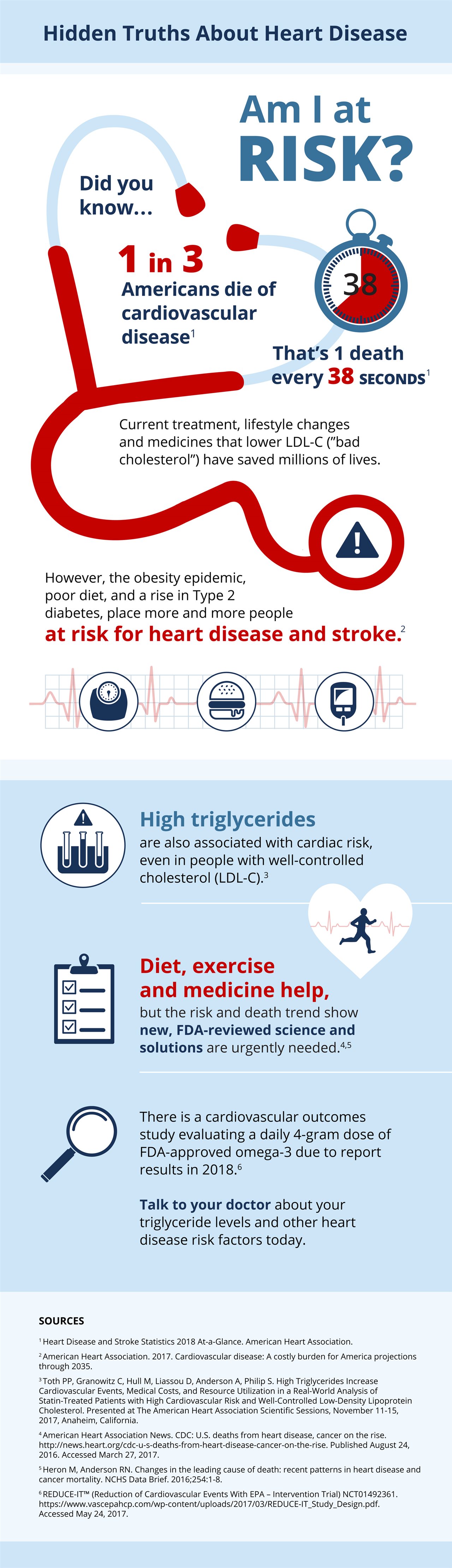
(BPT) – The majority of Americans wouldn’t think that walking to their car after work is a difficult task, but that wasn’t the case for Michele Norris. Before her heart failure diagnosis and treatment, Michele found herself leaning on a co-worker while walking to her vehicle, taking frequent breaks along the short route.

She knew something wasn’t right. Michele, a 62-year-old budget director, noticed shortness of breath and swelling in her legs, limiting her daily routines. She decided to take action and talk to her doctor. After a few conversations, Michele was eventually diagnosed with heart failure with reduced ejection fraction, or HFrEF, a chronic and progressive condition affecting millions of Americans, though few know much about it. After discussions with her cardiologist, Michele was prescribed ENTRESTO® (sacubitril/valsartan), a heart failure medicine that helps improve the heart’s ability to pump blood to the body.

“Being diagnosed with heart failure was terrifying, but I learned how to trust my gut, and raise a flag when something feels off,” said Michele. “Taking steps to change my diet and stay active, and adding ENTRESTO to my regimen has helped me stay out of the hospital, although everyone’s experiences are different.”

Michele is passionate about helping others with HF and encourages them to keep all of their doctor appointments, and to be an active partner with their doctors when choosing a treatment plan – which includes medication and lifestyle changes.

Learn more at www.entresto.com

What is ENTRESTO?

ENTRESTO (sacubitril/valsartan) tablets 24/26 mg, 49/51 mg, 97/103 mg is a prescription medicine used to reduce the risk of death and hospitalization in people with certain types of long-lasting (chronic) heart failure. ENTRESTO is usually used with other heart failure therapies, in place of an ACE inhibitor or other ARB therapy.

IMPORTANT SAFETY INFORMATION

What is the most important information I should know about ENTRESTO?

ENTRESTO can harm or cause death to your unborn baby. Talk to your doctor about other ways to treat heart failure if you plan to become pregnant. If you get pregnant while taking ENTRESTO, tell your doctor right away.

Who should not take ENTRESTO?

Do not take ENTRESTO if you

  • are allergic to sacubitril or valsartan or any of the ingredients in ENTRESTO
  • have had an allergic reaction including swelling of your face, lips, tongue, throat (angioedema) or trouble breathing while taking a type of medicine called an angiotensin-converting enzyme (ACE) inhibitor or angiotensin II receptor blocker (ARB)
  • take an ACE inhibitor medicine. Do not take ENTRESTO for at least 36 hours before or after you take an ACE inhibitor medicine. Talk with your doctor or pharmacist before taking ENTRESTO if you are not sure if you take an ACE inhibitor medicine
  • have diabetes and take a medicine that contains aliskiren

What should I tell my doctor before taking ENTRESTO?

Before you take ENTRESTO, tell your doctor about all of your medical conditions, including if you have kidney or liver problems or a history of hereditary angioedema; are pregnant or plan to become pregnant; are breastfeeding or plan to breastfeed. You should either take ENTRESTO or breastfeed. You should not do both.

Tell your doctor about all the medicines you take, including prescription and over-the-counter medicines, vitamins, and herbal supplements. Especially tell your doctor if you take potassium supplements or a salt substitute; nonsteroidal anti-inflammatory drugs (NSAIDs); lithium; or other medicines for high blood pressure or heart problems such as an ACE inhibitor, ARB, or aliskiren.

What are the possible side effects of ENTRESTO?

ENTRESTO may cause serious side effects including:

  • angioedema that may cause trouble breathing and death. Get emergency medical help right away if you have symptoms of angioedema or trouble breathing. Do not take ENTRESTO again if you have had angioedema while taking ENTRESTO. People who are Black or who have had angioedema and take ENTRESTO may have a higher risk of having angioedema
  • low blood pressure (hypotension). Call your doctor if you become dizzy or lightheaded, or you develop extreme fatigue
  • kidney problems
  • increased amount of potassium in your blood

The most common side effects were low blood pressure, high potassium, cough, dizziness, and kidney problems.

Please see full Prescribing Information, including Boxed WARNING, available at: https://www.pharma.us.novartis.com/sites/www.pharma.us.novartis.com/files/entresto.pdf.

Patients are encouraged to report negative side effects of prescription drugs to the FDA. Visit www.fda.gov/medwatch, or call 1-800-FDA-1088.


Your Rx for answers and savings: Ask a pharmacist

2018-03-07T16:01:00

(BPT) – There’s no denying that prescription drug coverage and medications can be complex territory.

Enter UnitedHealthcare Medicare & Retirement’s Chief Pharmacy Officer Mike Anderson, PharmD, who has spent his career navigating the ins and outs of the Rx world.

Below, Anderson answers some common questions people ask about drug coverage and prescriptions.

Q. What’s the difference between PDP and MA-PD plans?

A. Original Medicare doesn’t provide coverage for most prescription drugs, so for help paying for medications, you have two options: a standalone Part D prescription drug plan (PDP) in addition to Original Medicare or Original Medicare and a Medicare supplement plan; or a Medicare Advantage plan with prescription drug coverage (MAPD). Medicare Advantage plans can include additional benefits like dental, vision and hearing coverage, and combine your coverage into a single plan. Both plans are offered by private insurance companies contracted by Medicare.

Q. How do I know if my prescriptions are covered by my Medicare plan?

A. Whether you get coverage through Medicare Advantage or a standalone Part D plan, each has a formulary, a list of prescription drugs covered. You’ll want to look closely to make sure your medications are covered. Health insurers post plan formularies online, or you can call your plan to request a printed version. Keep in mind that plans can change from year to year, so don’t assume that prescription drugs covered this year will always carry over.

Q. How can I save money while remaining on my medications?

A. There are many ways to do that:

Home-delivery pharmacy benefits can save money and a trip to the pharmacy. Some mail-order pharmacies offer the convenience of ordering a three-month supply of drugs delivered to your home for less than purchasing at a retail location.

If you prefer to visit a pharmacy, check if your plan offers programs or preferred pharmacy networks to help you save on prescriptions.

Switching to generic drugs or drugs on a lower tier of the formulary is another step that could save money. If you are taking brand-name medications now, discuss generic alternatives with your doctor.

Q. Can I split my pills in half?

A. Talk to your doctor about whether pill-splitting for your medication is medically advised. Also, consult your pharmacist on whether the actual pill form presents risks. Some pills are dangerous when split, because splitting affects how quickly the drug is released into your body. Other pills become ineffective when split, because the pill contains a coating to protect it from stomach acid, and splitting the pill breaks that coating.

Q. I take a lot of pills daily. One I take three times a day. Some I just take once. I get busy and forget to take my pills. Can I just take them all in the morning?

A. It’s important to take your medicine as your doctor prescribed it. Some medications need to be taken at specific times to be effective. Plus, taking all your medications at one time can be dangerous as you run the risk of potential adverse interactions, side effects and even overdosing.

Q. I drink smoothies with supplements and take vitamins. Can these have a bad interaction with my prescriptions?

A. That’s a great question. If an iron supplement was added to the smoothie, for example, that could reduce the effectiveness of thyroid medication and medication for reflux disease. Talk to your pharmacist and doctor about vitamins and supplements to learn if they could cause a reaction or make your medications less effective.

Q. I just got my medication refilled. It used to be a different color and shape. Why does it look different?

A. More than likely, the pharmacy you use bought their supply from a different manufacturer. Drug companies that make the same medication must keep the chemical formula the same but may change the shape or color. As long as you verify it’s the same medication and dose, it should work just like before. If you have concerns, talk with your pharmacist.

For more information to help you navigate prescription drug coverage, visit MedicareMadeClear.com.


Have 5 minutes? Easy tips for finding moments of Zen

2018-03-08T08:01:00

(BPT) – From work to working out, kids’ activities to household tasks and so much more, modern life has never been busier. The problem is hectic schedules can lead to unnecessary stress.

If you’re one of the many people who feel frazzled on a regular basis, you’re probably longing for a vacation or a day at the spa. Fortunately, there are plenty of easy ways to cut stress that you can sneak into everyday life. From mealtime to bedtime, if you start embracing small moments to be more mindful, you’ll be surprised how fast you can cut down on overall stress.

Here are five simple examples of how you can find your own moments of Zen today:

1. Take a 5-minute walk.

Whether it’s getting fresh air or just getting yourself moving, a change of place and pace can reduce stress and give you a few moments to relax, especially during hectic times. For example, take a 5-minute break while dinner’s cooking to walk around the block. Weather not right for a walk? Give your body a quick stretch with an at-home yoga session.

2. Find quick-and-easy solutions.

If making dinner for your family seems like a daunting task, choose quick-and-easy options designed to take the hassle out of meal prep, like SeaPak’s Shrimp Scampi or Popcorn Shrimp. The frozen food aisle is a great place to begin your journey toward finding your happy place in the kitchen. Here, you can find a variety of products that taste great and require minimal prep work, so you can dedicate more time to doing the things you love, like spending quality time with your family.

3. Choose quality over quantity.

Make the most of your time each day by being intentional with your activities. Whether it’s playing a new board game with the kids after dinner or watching a TV show with your spouse, small quality moments can help you relax and enjoy yourself and your family when at home.

4. Take time to reflect.

When using great-tasting, low-hassle products like SeaPak to make dinner, you’ll be spending way less time in the kitchen. Take those extra moments to reflect on everything you accomplished during your day or week. This will help give you a sense of pride and is a real confidence-booster.

5. Break from technology.

Take a break from technology, even if it’s only for 5 minutes. Set down your phone, turn off the television and step away from all electronics. Just giving your mind a break from the active world of technology can reduce stress and help you mentally reset, especially during mealtimes, where being present is particularly important.

These are just five simple examples, but moments of Zen can be found anywhere if you take the time to look for them. Remember, the little moments are what make the biggest impact in life, and by embracing mindfulness, you’re setting the stage to be able to focus on what really matters.


10 easy ways to eat healthier

2018-03-08T15:01:00

(BPT) – If you’re indulging in too many break room snacks or swinging by the drive-thru after work, you’re not alone. With such a busy life, it’s easy to grab something quick and unhealthy on the go. But, the good news is, it’s also easy to make changes in your diet that will reap powerful health benefits in no time.

Here are 10 easy ways to eat healthier:

Start small. You don’t have to completely overhaul your diet in a day. Start with small things, like taking your lunch to work instead of eating out, cutting down on soda or getting a new cookbook of healthy recipes to inspire you.

Plan your meals. On the weekend, plan your breakfasts, lunches and dinners for the upcoming week, and then head out to the grocery store, and do your shopping so you’ll have everything you need on hand.

Cook at home. When you eat out, even when opting for the “healthy” items on the menu, you could be getting hidden doses of salt, sugar and fat. When you cook at home, you can control exactly what you’re eating, down to the nutrient. It’s healthier for your pocketbook, too.

Explore your health insurance discounts. Many health plans offer resources, discounts and incentives for leading a healthier life. Participating Blue Cross and Blue Shield (BCBS) companies, for example, have the Blue365 program, which features a variety of health and wellness products and services. Members can save everyday on online deals, including discounts on Retrofit private weight-loss programs, Jenny Craig, Nutrisystem, healthy cookbooks by Holly Clegg, and more.

Eat the rainbow. Colorful foods are packed with nutrients. Red foods help heart health and improve memory. Orange foods are good for your eyes, yellow foods help with digestion and brain function, purple foods are powerful antioxidants and green foods are good for your eyes, musculature, bones and teeth. All fight cancers. And they’re pretty on the plate. Win-win!

Slash the sodium. Lowering your sodium intake can help lower your blood pressure and get rid of water weight. But it’s not as easy as putting down the salt shaker. Sodium lurks in places you’d least expect it. Some surprisingly high-sodium foods: raw chicken (if it’s been pumped up with a solution), pre-cooked frozen shrimp (usually processed with salt), condiments like ketchup and mustard, smoked anything and cottage cheese.

Watch your sugar. Too much sugar leads to weight gain, abdominal obesity, low HDL and high LDL, elevated blood sugar and a whole host of other problems. But like salt, sugar can hide in foods you might think are healthy, including instant oatmeal, jarred pasta sauce, smoothies, flavored yogurt and salad dressing. A good rule of thumb: Read the label, and if it has a double-digit sugar count, ditch it.

Meatless Mondays! Going vegetarian one day a week is a great way to get more veggies into your diet. Swap the burger for a plate of grilled or roasted veggies drizzled with balsamic vinegar or a big, colorful salad. Just don’t pack on the refined carbs like white bread, pasta or potatoes in place of the meat.

Eat anti-inflammatory, antioxidant-rich foods. Antioxidants protect your cells from free radicals, and eating foods rich in them slows aging, gives you healthier skin, a longer lifespan and reduces cancer risk. Berries, nuts and seeds, fish, olive oil, broccoli and green leafy veggies are antioxidant powerhouses.

Practice mindful eating. Go all Zen with your food. Focus on what you’re eating, how you’re nourishing your body, and how much you enjoy the taste of the food. Eating at your desk, in the car or in front of the TV makes it more likely you’ll overeat.

For more information about how Blue365 can help you get healthier, visit www.blue365deals.com.

About Blue Cross Blue Shield Association

The Blue Cross and Blue Shield Association is a national federation of 36 independent, community-based and locally operated Blue Cross and Blue Shield companies that collectively provide health care coverage for one in three Americans. BCBSA provides health care insights through The Health of America Report series and the national BCBS Health Indexsm. For more information on BCBSA and its member companies, please visit BCBS.com. We also encourage you to connect with us on Facebook, check out our videos on YouTube, follow us on Twitter and check out our blog.

Blue365 offers access to savings on health and wellness products and services and other items that may be purchased from Blue365 Vendors, which are different from covered benefits under your policy(ies) with your local Blue Company, its contracts with Medicare, or any other federally-funded healthcare program. To find out what is covered under your policy(ies), contact your Blue Company. The products and services described on Blue365’s website are neither offered nor guaranteed under your Blue Company’s contract with the Medicare program. In addition, these products and services are not subject to the Medicare appeals process. Any disputes regarding your insurance products and services may be subject to your Blue Company’s grievance process. BCBSA may receive payments from Blue365 Vendors. Neither BCBSA nor any Blue Company recommends, endorses, warrants, or guarantees any specific Blue365 Vendor’s product or service available through the Site.

*Note to Editors: Blue Cross and Blue Shield companies participating in Blue365 are in the following states: AZ, AR, DC, DE, FL, IL,IA, KS, LA, MA,MD, MI, MO, MT, NC, NE, NJ, NM, NY,OK, PA, SC, SD, TN, TX, VA, WV, Puerto Rico and the Virgin Islands. The Blue Cross and Blue Shield Federal Employee Program® also participates in Blue365.


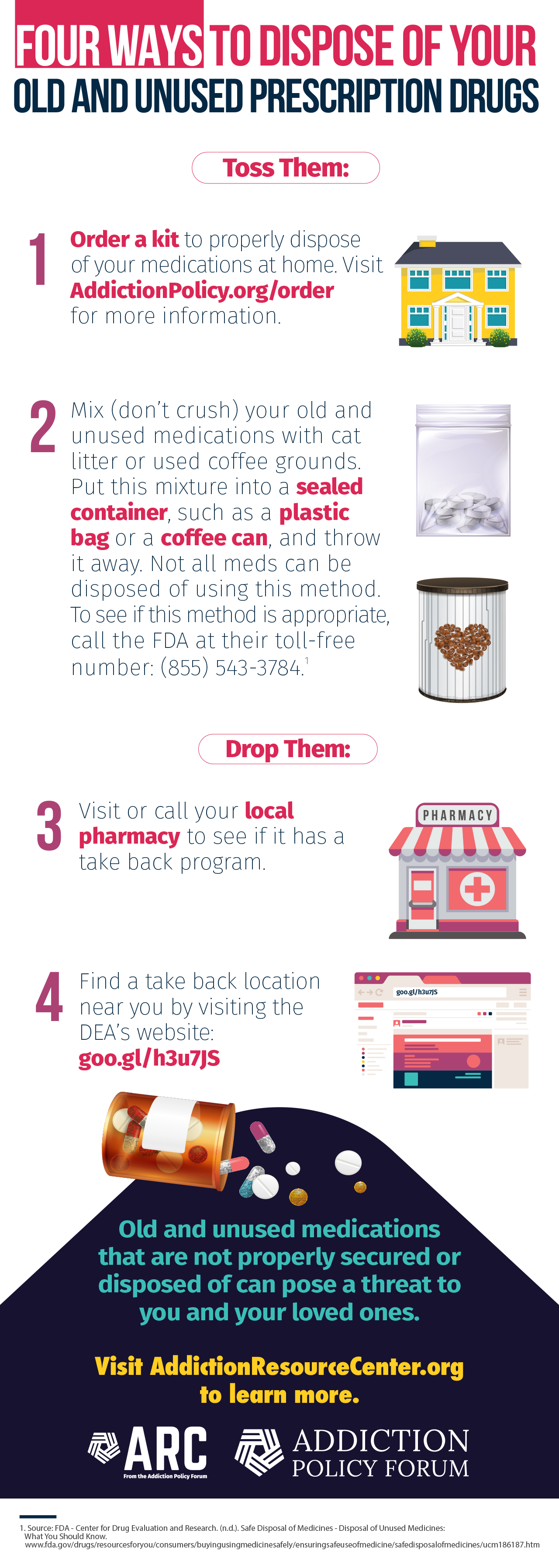
Spring into Action: Dispose of Your Old, Unused Prescription Drugs [Infographic]

2018-03-09T06:01:00

(BPT) – As you spring your clocks forward and jump into spring cleaning, take the time to clean out your medicine cabinet. Old and unused prescription medications commonly sit in medicine cabinets, sometimes for years, and can easily fall into the wrong hands.

Over 11.5 million Americans misused prescription painkillers in the last year and two in three people who use heroin started out misusing prescription painkillers.1 Every day 2,000 teenagers misuse prescription drugs for the first time.2

It only takes a moment to safely dispose of old and unused medications, but it can have a lifelong impact.

Order a free disposal kit today at www.addictionpolicy.org/order.