Entertain Like Martha Stewart: 5 Deck Decorating Ideas for the Ultimate Gathering

2026-10-06T12:01:00

(BPT) – Few people have shaped the art of American entertaining quite like Martha Stewart. Known for her impeccable eye for detail and thoughtful approach to hosting, Martha believes the best gatherings are all about creating a space where guests feel comfortable, connected and welcome.

That philosophy extends to her outdoor spaces, too. For her Bedford, New York, backyard, Martha chose Trex® composite decking and railing to create a beautiful, durable foundation for outdoor entertaining.

Ready to give your own deck a little Martha-inspired polish? Take your backyard gatherings to the next level with these five ideas.

A furnished outdoor dining table on a patio.

1. Create Zones That Keep Guests Comfortable

The best outdoor gatherings have an easy flow, with dedicated spaces for drinks, dining and relaxing. Set up a self-serve beverage station near the entrance so guests can help themselves, then place appetizers somewhere accessible without blocking the main walkway.

After dinner, transition to a comfortable lounge area where guests can linger. Define each zone with an outdoor rug, arrange furniture to encourage conversation and use planters as subtle dividers. As Martha puts it, “If guests are comfortable, they’ll stay longer.”

2. Make Shade Part of the Plan

Even the most carefully prepared meal can suffer under a hot afternoon sun. Overhead shade keeps guests comfortable while helping food and drinks stay more enjoyable throughout the gathering.

For a polished, permanent solution, consider a Trex® Pergola over your dining or seating area. Retractable canopies offer flexibility as the sun moves, while umbrellas provide movable shade where you need it most. Tall planters can also add greenery and soften the light.

3. Make the Most of the Space Below

If your deck is elevated, don’t overlook the entertaining potential underneath it. The Trex RainEscape® Under-Deck Drainage System uses a network of troughs and downspouts to divert rainwater away from the deck, creating a dry area below. That means the space underneath can become more than just storage — it can be an extension of your outdoor living area, with room for seating, lighting, a ceiling fan or even an entertainment setup.

Think of it as getting more out of the deck you already have: a sheltered lounge for rainy-day gatherings, a place to relax away from the midday sun or a second entertaining zone when you have a crowd.

4. Set the Mood From Day to Night

Don’t let sunset signal the end of the party. Layered lighting can transform your deck as the evening unfolds while helping guests safely navigate steps and walkways.

Trex® Lighting can add a warm glow at multiple levels, from post cap lights and riser lights to under-rail illumination. Add lanterns or candles to the table for atmosphere, then bring the entertainment outdoors with speakers, a TV or a projector for movie nights and big-game gatherings.

5. Add Personal Touches

The right accessories can make a deck feel like a true extension of your home. Take a cue from Martha with fresh flowers, outdoor-friendly glassware, colorful linens and cozy cushions. A basket of lightweight throws is another simple touch that helps guests feel cared for when temperatures dip.

Host Like Martha in Your Own Backyard

A beautifully decorated deck isn’t just for entertaining. It’s where you’ll enjoy quiet mornings, late-summer dinners and crisp fall afternoons long after the guests have gone home. Create a space that’s comfortable, welcoming and unmistakably yours. Then invite people over and enjoy the kind of gathering that might even convince Martha to stay past dessert.

For more outdoor living inspiration, visit Trex.com.

This holiday, give the gift of wireless charging

2026-10-06T12:01:00

(BPT) – The holidays are here. That means it’s time to worry about whether you’ll nail your gift-giving this year. If you have teens or young adults you’re shopping for, don’t leave Qi2 (pronounced chee two) wireless charging off your list (though you may be tempted to buy a Qi2 charger for yourself, too!). It will quickly become your favorite gift to give — and a useful and stylish accessory your loved ones won’t be able to live without.

As you’re shopping for the perfect wireless charger, there are two important points to keep in mind. First, make sure that it is Qi2 Certified. Qi2 is the latest version of the Qi wireless charging standard. Qi2 uses a magnetic attachment between the phone and charger so the two devices snap perfectly in place, providing a more reliable, more efficient connection. And Qi2 is much faster than older wireless chargers. In fact, the Qi2 25W version can charge some smartphone batteries as fast as 0% to 50% in just 30 minutes. Qi2 Certified means it has undergone rigorous testing in independent test labs to ensure that it’s fully compliant with the Qi2 specifications for safety, reliability, and interoperability.

Second, for the best user experience, make sure the version of Qi2 is the same for the phone and charger. Pair a Qi2 25W Certified phone with a Qi2 25W Certified charger. Pair a Qi2 phone with a Qi2 charger. Mixing a Qi2 device with a Qi25W device will work, but charging will not be at the optimal speed.

Most flagship smartphone brands are Qi2 or Qi2 25W Certified, including those from Apple, Samsung, and Google.

Don’t know where to start? There are many great Qi2 wireless chargers to choose from. We’ve selected some of the best to get you started with your gifting needs.

Figure touching the Nomad Stand One 2-in-1

The Desktop Organizer: Nomad Stand One 2-in-1

The Nomad Stand One is perfect for those who love an aesthetic moment. It’s an elegant, upright stand that can charge both your smartphone and earbuds — and look good, too. Compatible with iPhone StandBy mode, it looks great as a display on a nightstand or desk.

Image of Baseus PicoGo

For On the Go: Baseus PicoGo AM52 Qi2.2 Magnetic Power Bank 10000mAh 45W

If your student (works for a spouse, too) is constantly on the move (and running out of charge), a Qi2 power bank is a great gift. It magnetically snaps to the back of their phone, making it easy to keep doing the things they love to do, like attending festivals, camping or ignoring your phone calls. And you can feel confident that you can reach them when you need to. The Baseus PicoGo is equipped with a triple cooling system, which helps the device stay cool and the charging work more efficiently. Qi v2.2 is the technical name for Qi2 25W, so you’ll get fast, smooth wireless charging on the go at up to 25W with this power bank, plus wired charging at 45W if plugging into an electric outlet is desired and available.

ESR CryoBoost 3-in-1 on table

Image of Belkin UltraCharge
Caption here

The Stocking Stuffer: Belkin UltraCharge Magnetic Charger with Qi2 25W

The UltraCharge Magnetic charger from Belkin makes for a surprisingly fun stocking stuffer. It’s small but mighty, giving your gift recipient fast, cool charging at home, at work, or on the go. The ChillBoostTM feature helps prevent overheating while the device charges, too, for quiet efficiency you can trust.

Satechi Desk Setup with phone, earbuds, and smartwatch charging on it.

ESR CryoBoost 3-in-1 on table
Caption here

The Ultimate 3-in-1: CryoBoost 3-in-1 Magnetic Charging Station from ESR

Charge your phone, smartwatch, and earbuds at the same time with the CryoBoost 3-in-1 charging station from ESR. With 25W output and air-cooling technology, it’s the ultimate status symbol. Gift it for home or as a college dorm essential. Your kid will thank you!

There are thousands of Qi2 and Qi2 25W Certified devices available. So, if the products mentioned in this article don’t meet your needs, you can easily find one that does. Make sure to look for the Qi2 logo either on the product or packaging, or check for it in the tech descriptions or on the Wireless Power Consortium’s Certified Product Database. That way, you can know you’ve picked up a certified device that’s been tested and is fully compliant with the Qi2 standard.

With the holidays coming up quickly, there’s no time to second-guess your gift list. Give the gift of Qi2 wireless charging, and your holidays are sure to be merry and bright.

What are typical mistakes homeowners make when refinishing hardwood floors?

2026-10-06T06:01:00

(BPT) – Key takeaways:

  • Homeowners value hardwood floors because of their warmth, beauty and endurance.
  • It’s important to protect the appearance, value and lifespan of hardwood floors by refinishing.
  • Bona’s “Floor Doctor,” Zack Clavin, recommends hiring an expert to do the job correctly, and using warterborne floor finishing products.
  • Bona’s Waterborne System provides durable, low-odor, low-VOC products (including finishes, sealers, stains, cleaners and more) that are designed to work together to restore, beautify and protect hardwood floors.

Beautiful, durable and unique, hardwood floors have an enduring appeal few other flooring materials can match. Each floor brings the warmth and character of natural wood into a home, creating a surface that can evolve and last for generations. In a 2026 Bona survey, 87% of homeowners ranked flooring among the home features they’re most willing to invest in.

However, over time, even well-maintained hardwood floors may show signs of everyday wear, especially in high-traffic areas. Scratches, fading, worn areas or a dull finish regular cleaning can’t address may mean it’s time to consider refinishing. Refinishing restores the floor’s appearance and protective finish, bringing new life to the natural beauty of the wood and helping withstand years of use.

“Refinishing floors helps preserve their durability and restores their beauty, making it an investment in the long-term value of this vital part of your home,” said Zack Clavin, Bona’s “Floor Doctor.” “You can even use Bona waterborne finishes to adjust the color and sheen of the floor while breathing new life into them.”

Where to begin if you want to refinish your hardwood floors

Ready to restore your worn hardwood floors, but don’t know where to start? You’re not alone. Bona found that nearly two-thirds (62%) of homeowners experience at least moderate anxiety about floor refinishing.

With autumn being a prime time to refresh hardwood floors, Clavin shares five common refinishing mistakes homeowners make — and how to avoid them.

Refinishing floors helps preserve their durability and restores their beauty, making it an investment in the long-term value of this vital part of your home.

1. Thinking refinishing can be DIYed

While you’ll find countless TikTok and YouTube videos about refinishing floors, this is one home improvement project where DIYing can quickly become a costly mistake. Improper sanding, uneven stain application or rushing drying times can all lead to disappointing results that take even more time and money to fix.

Instead, work with a trained flooring professional who understands the precision and craftsmanship refinishing requires, and knows how the right products and techniques work together to get the job done right the first time, saving homeowners stress, time and expense.

2. Hiring any random contractor

Deciding to hire a professional is the first step. Finding the right one is just as crucial. Not all contractors bring the same level of skill and expertise to a refinishing project, so Clavin recommends using a flooring professional with proven experience, proper training and a track record you can trust. Bona Certified Craftsmen, for example, are hand-selected, highly skilled professionals trained in the latest refinishing techniques, giving homeowners confidence their floors are in experienced hands from start to finish.

Man testing stain on a wood floor. A Bona Certified Craftsman ensures your floor will be properly and beautifully refinished.

Find a Bona Certified Craftsman near you to ensure your floor will be properly and beautifully refinished.

3. Choosing the wrong products

Using the right product to refinish your hardwood floors can make all the difference in how they look, perform and hold up over time. Rather than selecting a stain, sealer or finish in isolation, Clavin recommends using a complete waterborne system that’s designed to work together throughout the refinishing process.

“It’s a common misconception that waterborne finishes aren’t as durable as oil-based finishes,” said Clavin. “However, Taber tests prove Bona waterborne finishes withstand wear and tear better than oil-modified finishes.”

Bona has pioneered durable, sustainable waterborne floor finish technology, with the complete Bona Waterborne System combining stains, sealers and finishes designed to work together to restore, beautify and protect hardwood floors. The system delivers durable performance even in high-traffic areas while preserving the natural beauty and color of the wood without ambering over time.

“Homeowners don’t have to choose between performance and a comfortable refinishing experience,” added Clavin. “Bona waterborne finishes are low-odor, low-VOC and GREENGUARD certified, so there’s less disruption during the process.”

From refinishing through ongoing maintenance, the Bona Waterborne System provides a complete approach to bringing worn hardwood back to life and protecting that investment for years to come.

4. Using the least expensive materials

Cheaper refinishing options may save money upfront, but that choice can come at the expense of durability, leading to refinishing again sooner than expected. Homeowners recognize the tradeoff: Bona found 60% prioritize balancing cost and durability in home improvement decisions, and 55% are willing to spend more upfront for long-term quality.

High-quality products can help that investment go further. Bona’s waterborne finishes can provide durable protection for well over a decade with proper care, reducing the frequency of refinishing projects.

“A waterborne finish may cost more upfront, but is better for your home and the environment,” Clavin said. “Investing in properly refinishing your hardwood floors today will pay off in the long run.”

5. Not factoring in drying and cure times

A refinishing project doesn’t end when the final coat goes down. Dry and cure times determine when you can safely walk on your floors, move furniture back and return to everyday life. In addition, temperature, humidity and the type of finish can all impact timing, which is why fall is typically the best season to refinish floors.

Which products you choose also makes a significant difference. Oil-modified and acid-cured finishes can take two to three times longer to dry and cure than waterborne options. For instance, Bona Traffic HD dries within two to three hours before floors can be walked on in socks, and fully cures in just three days, so homeowners can return to enjoying their space sooner.

Understanding these timelines can help you plan around furniture, family, pets and guests while giving the floor time to properly cure.

FAQs:

  • Are waterborne finishes durable? High-quality waterborne floor finishes often last well over 10 years, depending on use and maintenance. Bona waterborne finishes are so durable that they’ve been chosen for use on some of the world’s top sport floors.
  • How can I change my floor’s color when refinishing? Refinishing lets you update your home with a stain color and sheen level reflecting your design style. Bona Chroma comes in 9 base shades which can be custom mixed to create your desired hue.
  • Why do I need to leave the house during refinishing? If your contractor uses a waterborne finish, you can stay in your home during the process.
  • Is fall the best season for refinishing? Humidity levels are often lower in the fall, making it easier for the finish to dry and cure. This timing also gives you a beautifully refreshed home for holiday hosting.

Visit Bona.com to learn more about hardwood floor care and refinishing.

From Loss to Learning: Understanding the Risks of Flu and Why You Should Prioritize Your Flu Vaccination This Year

2026-10-05T16:19:00

(BPT) – At 16 years old, Terese “Reese” Termulo was a healthy, active honors student and dancer with a bright future ahead of her, when she suddenly became ill with the flu.

On Jan. 9, 2020, her father, Dr. Cesar Termulo, a pediatrician in Dallas, Texas, received a call from her school that she was feeling sick. Termulo — who suspected she could have contracted the flu — quickly brought her to his office, where she tested positive for influenza B, was given antivirals, and went home to rest and recover.

“Reese wasn’t as sick as many of my other patients who had influenza B,” said Termulo. “She seemed to be improving — no fever, and she didn’t show signs of pneumonia or other serious flu complications.”

The next morning, Reese felt ready to go to school, but her father insisted she stay home. Before he left for work, Termulo used his stethoscope to listen to his daughter’s heart and lungs so that he could check for serious complications and concluded she was on the mend.

“The last thing I ever said to Reese was that I thought she would get better,” said Termulo.

No one could have suspected that Reese’s symptoms would rapidly progress, and her condition would take a turn for the worse. Later that morning, Reese’s mother found her upstairs, passed out, and she had stopped breathing. The flu virus had quickly attacked her lungs, and she eventually became septic. Reese passed away less than 24 hours after her diagnosis.

null


Serious flu complications

Influenza (or flu) is a contagious respiratory illness caused by flu viruses that infect the nose, throat and sometimes the lungs.1 People can begin spreading the flu to others one day before symptoms start and up to a week after symptoms appear — and some, especially young children, might be contagious to others for even longer.1

The flu can impact every person differently. Symptoms can appear suddenly and can include fever (or feeling feverish/chills), cough, sore throat, runny or stuffy nose, muscle or body aches, headaches and fatigue.2

While most people who get the flu will recover within a few days to less than two weeks, some may develop complications like pneumonia and even death.2

The 2025-2026 flu season followed one of the most severe flu seasons in recent U.S. history, with record-breaking pediatric deaths and overwhelming levels of illness and hospitalization.3 In fact, from Oct. 1, 2025, through May 9, 2026, the Centers for Disease Control and Prevention (CDC) estimated that there were at least 32 million illnesses, 390,000 hospitalizations and 24,000 deaths from the flu in the U.S.4

“The harsh reality is that anyone can get sick from the flu — even people who are or feel healthy — and serious problems related to flu can happen at any age,” said Dr. Luis Romano, GSK’s US Medical and Clinical Affairs Lead for Flu Vaccines. “That said, some people are at higher risk of developing serious flu-related complications if they get sick.”

Groups at higher risk of serious flu-related symptoms include1:

  • People 65 years and older
  • People with certain chronic health conditions (such as asthma, diabetes or heart disease)
  • Pregnant women
  • Young children

The flu does not affect all communities equally, and the 2025-2026 season once again exposed deep and persistent disparities in flu-related outcomes among racial and ethnic minority groups.5 According to the CDC, Black and Hispanic communities consistently experienced higher rates of flu-related complications and death, often due to lower vaccination rates and delayed access to care.6

Why you should speak to your provider about annual flu vaccination

The flu is a serious illness and should be taken seriously. The best way to help protect yourself and your loved ones from the flu every season is to vaccinate everyone 6 months of age and older annually.3

“Decades of data confirm that flu vaccines have an excellent safety record,” said Romano. “In fact, hundreds of millions of Americans have received flu vaccines over the past 50 years, and ongoing monitoring consistently reinforces their strong safety profile.”7

Since Reese’s passing, Termulo and his family have made it their mission to educate families on the potential dangers of the flu and urge people to get vaccinated against the flu every year.

Now is a good time to think about flu vaccination

Fall can be a busy season for many people, but it’s vital to make time to get your flu shot. The CDC recommends that most people receive their flu vaccine in September or October, ideally by the end of October.8 The good news is that getting a flu shot is typically quick and convenient.

If you already have a yearly wellness visit scheduled, ask your primary care provider about receiving your flu shot during your visit. You can also get a flu shot in pharmacies, urgent care clinics, college health centers and even some schools or workplaces.9 Some locations like your local pharmacy may accept walk-ins, so you can help protect yourself and your loved ones from the flu with minimal time commitment.

To learn more about the flu and flu prevention, visit CDC.gov/Flu.

“The flu can disrupt your life and your family’s lives,” said Termulo. “Losing my daughter is a heartbreaking reminder that the flu can have devastating consequences. As both a father and a physician, I hope our family’s experience encourages others to recognize the seriousness of the flu and the profound impact it can have on families.”

null


Sources

1. About Influenza (Flu). Centers for Disease Control and Prevention. Reviewed Feb. 26, 2026. Accessed July 17, 2026. https://www.cdc.gov/flu/about/index.html

2. Symptoms and Signs of Flu. Centers for Disease Control and Prevention. Reviewed Aug. 26, 2024. Accessed July 17, 2026. https://www.cdc.gov/flu/signs-symptoms/index.html

3. Influenza Activity in the United States During the 2024-25 Season and Composition of the 2025-26 Influenza Vaccine. Centers for Disease Control and Prevention. Reviewed Sept. 26, 2025. Accessed July 17, 2026. https://www.cdc.gov/flu/whats-new/2025-2026-influenza-activity.html

4. Weekly U.S. Influenza Surveillance Report: Key Updates for Week 18, Ending May 9, 2026. Centers for Disease Control and Prevention. Published May 15, 2026. Accessed July 17, 2026. https://www.cdc.gov/fluview/surveillance/2026-week-18.html

5. Weekly U.S. Influenza Surveillance Report: Key Updates for Week 25, Ending June 27, 2026. Centers for Disease Control and Prevention. Published July 6, 2026. Accessed July 17, 2026. CDC FluView Week 25

6. Flu and Healthy Lives for All. Centers for Disease Control and Prevention. Published Jan. 17, 2025. Accessed July 17, 2026. https://www.cdc.gov/flu/healthy-living/index.html

7. Influenza (Flu) Vaccine Safety. Centers for Disease Control and Prevention. Reviewed October 2023. Accessed July 17, 2026. https://www.cdc.gov/vaccine-safety/vaccines/flu.html

8. Interim Estimates of 2025-26 Seasonal Influenza Vaccine Effectiveness—United States, September 2025-February 2026. MMWR Morb Mortal Wkly Rep. 2026;75(9):116-123. Published March 6, 2026. Accessed August 6, 2026.

9. Where to Find Vaccines. Centers for Disease Control and Prevention. Published July 10, 2024. Accessed July 17, 2026. https://www.cdc.gov/vaccines-adults/recommended-vaccines/vaccine-planning.html

How to spot and avoid AI scams

2026-10-05T09:01:00

(BPT) – Artificial intelligence (AI) has quickly become part of many people’s everyday lives. Unfortunately, that includes scammers. The good news? You don’t need to be a tech expert to protect yourself.

When you slow down, ask questions and double-check what you’re seeing or hearing, their schemes often fall apart. Here are 9 tips from Navy Federal Credit Union to recognize and avoid AI scams.

  1. Pause and verify. When you get an urgent message — especially one asking for money or personal information — stop and take a breath. Scammers want you to act fast without thinking. Instead, contact the person or company directly using a phone number or website you already know and trust. Don’t use any contact info from the message.
  2. Use a code word. Set up a secret word or phrase with family members that only you know. If someone calls claiming to be your grandson in trouble, ask for the code word. Real family members will know it. Scammers won’t. This simple step can help stop voice cloning scams in their tracks.
  3. Avoid requests for immediate or risky payments. Pay attention to red flags, such as anyone demanding you send money right away, especially through wire transfer, cryptocurrency, gift cards or payment apps. Legitimate organizations give you time to think and offer multiple payment options.
  4. Inspect the sender. Look closely at email addresses and phone numbers. Scammers often use addresses that look almost right but have small changes. If something looks off, don’t engage.
  5. Check the media. Look for unnatural facial movements, weird lighting, voices that sound slightly robotic or backgrounds that don’t quite match up. If you’re on a video call and something feels off, trust your gut.
  6. Don’t click. Never click links in unexpected emails or texts, even if they look legitimate. Instead, open your browser and type in the company’s website yourself. Or, use a phone number you’ve saved or found on an official site. This can help protect you from fake websites designed to steal your login information.
  7. Lock down your accounts. Turn on two-factor authentication for your important accounts — especially banking, email and social media. This adds an extra security step. Use strong, unique passwords for each account.
  8. Limit your footprint. Be careful what you share on social media. Voice cloning scams work because criminals find audio clips of you or your loved ones online. Check your privacy settings and think twice before posting videos with clear audio. The less scammers know about you, the harder it is for them to target you.
  9. Document and report. If you spot a scam, report it to the Federal Trade Commission (FTC) at ReportFraud.ftc.gov and contact your financial institution immediately. Save any emails, texts or voicemails as evidence. Reporting helps protect others and can assist law enforcement in tracking down scammers. Even if you didn’t lose money, reporting matters.

For more tips on staying safe online, explore Navy Federal’s MakingCents cybersecurity articles.

This content is intended to provide general information and should not be considered legal, tax or financial advice. It is always a good idea to consult a tax or financial advisor for specific information on how certain laws apply to your situation and about your individual financial situation.

Building the cyber workforce: Why hands-on, AI-ready education matters

2026-10-05T08:01:00

(BPT) – Cyber-enabled crimes are on the rise, posing significant threats to organizations’ data, proprietary technology and financial assets. Whether cybercriminals aim to disrupt operations by wiping data, as was the case with the medical tech company Stryker, or to steal millions of dollars, as in the Arup AI deepfake incident, the need for robust cybersecurity has never been more urgent. However, finding trained professionals with the skills needed to prevent and resolve cybersecurity issues is easier said than done.

The importance of closing the skills gap

According to the Fortinet 2026 Cybersecurity Skills Gap Report, 86% of surveyed organizations reported at least one breach in the past year, with breaches costing more than $1 million and taking months to recover. When asked about the causes of the breaches, 56% of organizations surveyed attributed them in part to a lack of cybersecurity skills and trained IT security staff.

As more cybercriminals use AI to automate attacks and increase their speed and sophistication, up-to-date cybersecurity education and training are crucial to preparing students to hit the ground running upon hire.

“The cyber workforce gap is real, and AI is changing what entry-level jobs look like,” said Dr. Jingdi (Rebecca) Zeng, senior professor and curriculum chair of Colleges and Curriculum at DeVry University, member of the Institute of Electrical and Electronics Engineers (IEEE) and ABET program evaluator. “That means part of the learning that used to happen on the job now needs to happen earlier, in the classroom.”

Cybersecurity education and training must also evolve with the changing landscape and emerging technologies, equipping students to tackle the challenges of today and tomorrow.

“The speed at which cyberattack methods change is staggering, and they’re changing almost daily,” said Dr. Jude Lamour, senior professor and faculty chair in the College of Engineering and Information Sciences at DeVry. “Changes that used to take months or years now happen on the same day or as little as four hours. That’s why it’s vital to have curriculum that is adaptable to keep up with what’s happening in the field.”

The inextricable link between the cybersecurity workforce and education

If what worked today to protect an organization against a cyberattack may not work tomorrow, how can future cybersecurity professionals keep up? According to Lamour, it starts with the fundamentals.

“Every cybersecurity student should master the fundamentals, including networking, basic software systems, web applications, database applications and key security principles,” he said. “At the end of the day, even with the many daily changes in the cybersecurity landscape, a computer is a computer. The fundamentals don’t change. That’s why DeVry’s cybersecurity programs focus on instilling these fundamentals and marrying them with practical hands-on learning, so students can enter the workforce and respond to changing threats with agility.”

Zeng echoes Lamour’s sentiment and adds that cybersecurity education should draw on industry needs.

“Our cyber programs are designed around a clear learning pathway, with a strong focus on practical cyber skills and emerging technologies including AI,” she said. “In the age of AI, I see DeVry University playing an even more important role in preparing students with practical skills and helping close the cyber workforce gap.”

Practical experience that mimics real-world challenges

Beyond knowledge of fundamentals and exposure to emerging technologies, future cybersecurity professionals need practical experience, and that starts with faculty experience.

“There are plenty of folks with degrees in cybersecurity who have never worked in the field,” Lamour added. “They don’t know how to apply what they’re teaching in a practical setting. That’s why DeVry’s Cybersecurity Center of Excellence is led by industry professionals and instructors who are experienced in this dynamic and ever-evolving field.”

With these experienced professionals guiding them, students can begin working on challenges that mirror real-world cybersecurity needs, not just in theory. By practicing with technologies like Cyber Range — a Cloud Range-powered platform that offers interactive simulations and hands-on training — DeVry students can learn to use the tools needed in the cybersecurity workforce.

“The Cyber Range gives students a place to practice individual skills within a realistic workflow,” Zeng said. “It helps them connect the dots, see the bigger picture and develop stronger critical thinking skills. Combined with AI literacy, we’re helping students fill knowledge gaps that might otherwise slow down their learning and problem-solving process, preparing them for today and tomorrow’s cyber workforce.”

The cybersecurity workforce gap will not close through technical knowledge alone. By aligning curriculum with industry needs and emphasizing hands-on learning, DeVry is preparing graduates to adapt quickly, think critically and help organizations meet the cyber threats of today and tomorrow.

To learn more about the university’s cybersecurity programs and the future of the field, visit DeVry.edu.

Your Child’s Future is Unpredictable: These 5 Steps Can Help You Prepare Anyway

2026-10-04T23:01:00

(BPT) – Today’s children may pursue careers and education pathways that look very different from the ones their parents knew. These five practical steps can help families keep more possibilities within reach.

Key takeaways

  • Families do not need to know a child’s future career to begin preparing for it.
  • A flexible approach can support a range of education and training pathways.
  • Small, consistent steps can make future choices feel more manageable.

Ask a young child what they want to be when they grow up, and the answer may change by the week. Even older students are exploring a rapidly evolving mix of careers, credentials and training options. For parents, that uncertainty can make planning feel intimidating. How do you prepare when you cannot know whether your child will choose a university, a technical program, an apprenticeship or a career that does not exist yet?

The good news is that families do not need a perfect prediction. They need a practical plan that can grow and adapt along with their child. These five steps can help parents focus less on choosing a path today and more on creating options for tomorrow.

1. Start with possibilities, not one destination

New parents happly encouraging their toddler to walk.

Instead of building a plan around a single school or career, think broadly about the kinds of learning your child may need after high school. That could include a two-year or four-year degree, career and technical education, industry credentials or another eligible training program. A broader mindset can reduce the pressure to have every detail figured out now.

2. Turn a big goal into a repeatable habit

Future education costs can feel overwhelming when viewed as one large number. A more approachable strategy is to choose a contribution into a savings vehicle such as a 529 Investment Plan that fits your current budget and make it consistent. Consider automating deposits after payday, redirecting part of a tax refund or adding a portion of a raise. The amount can change as your circumstances change. The habit is what creates momentum. The elementary school years can be an especially valuable time to begin because families often have more years to save, allowing small contributions to accumulate over time.

3. Give family and friends an easy way to help

Dad and little daughter with her backpack hugging in the kitchen.

Birthdays, holidays and milestones often bring more toys and gifts than a child can use. Let grandparents, relatives and close friends know that contributing toward future education is another meaningful option. Even occasional gifts can complement what parents are already saving and help loved ones feel connected to a child’s long-term goals.

4. Check your plan once a year

Choose one annual reminder, such as your child’s birthday or the start of a new school year, to review your progress. Ask whether the contribution still fits your budget, update family information and consider whether your goals have changed. A short yearly check-in can help keep the plan current without making it another monthly task.

5. Choose tools that leave room for change

When comparing education savings options, look beyond the name of the account. Ask where the funds may be used, what expenses may qualify, whether the beneficiary can be changed and what happens if plans shift. Understanding those choices from the start can help families select an approach that supports multiple routes after high school.

For Miami parent Ann Fonts, opening an education savings account wasn’t about having all the answers. It was about getting started. “Like a lot of parents, I thought I had more time,” Fonts said. “Then one day I was registering my son for kindergarten and wondering where the years had gone. We didn’t start with a large amount. We just started with what we could afford and made it part of our routine. For me, the biggest lesson was that you don’t have to be perfect. You just have to start.”

As children grow, their interests and ambitions will change. A flexible plan gives families room to respond without waiting for certainty before they begin.

The most important first step is not choosing the perfect path or saving the perfect amount. It is starting with what is realistic, building a routine and revisiting the plan over time. Those actions can help turn an unpredictable future into one filled with more opportunity. Whether today’s dream is becoming a teacher, welder, nurse, entrepreneur, engineer or a career that hasn’t been invented yet, parents don’t need to know exactly where their child is headed to help them prepare. Starting early and taking manageable steps today can help keep more opportunities within reach tomorrow.

To explore education savings options and build a plan around your family’s goals and budget, visit MyFloridaPrepaid.com/plans/build-your-plan.

Your dog’s microbiome is the secret to good dental health

2026-10-02T06:05:00

(BPT) – Your dog’s breath may not always smell fresh, but persistent bad breath can be a sign that their oral health could use some extra attention. Just like the gut, the mouth has its own microbiome, a complex community of bacteria and other microorganisms that live together.

Understanding your dog’s oral microbiome can help pet parents better understand the importance of daily dental care and keeping plaque and tartar under control.

What is the canine oral microbiome?

Not all bacteria are harmful. Your dog’s mouth is home to hundreds of bacterial species and other microorganisms that form a living ecosystem, known as the oral microbiome.

“A healthy oral microbiome is about balance. When that balance is maintained, different microorganisms can coexist in the oral environment. When that balance changes, certain bacteria can become more prevalent and may contribute to oral health problems,” says Sara Ahlström, Global Marketing Manager at Swedencare.

This balance is one reason why the oral microbiome and dental health are closely connected.

How are plaque and tartar connected to the microbiome?

Plaque isn’t random or unavoidable. This thin biofilm that sticks to your dog’s teeth and gums is actually a microbial community that builds up every day.

Without regular oral care, plaque can eventually harden into tartar. Unlike plaque, tartar cannot simply be brushed away and may require professional veterinary scaling to remove. Controlling plaque before it builds up and mineralizes is an important part of maintaining good dental health.

What happens when plaque and tartar take over?

Plaque and tartar buildup can contribute to bad breath, gum inflammation and periodontal disease. Advanced periodontal disease has also been associated with health effects beyond the mouth. A study published in the Journal of the American Veterinary Medical Association, for example, found an association between advanced periodontal disease and heart disease in dogs.

This is why dental care is about more than keeping your dog’s breath fresh. Oral health is an important part of your dog’s overall health, which is why preventing and controlling plaque and tartar matters.

How can I safely prevent and control plaque?

Regular veterinary dental checkups and a consistent home dental care routine are important for keeping plaque under control. Depending on your dog, this can include brushing their teeth with a soft toothbrush and dog-safe toothpaste, providing appropriate dental chews or toys, and using dental supplements as part of their daily routine.

Next, make sure to build a home dental care routine for your dog and stick with it.

The key is consistency. Plaque starts to build up again after it is removed, so regular oral care is important for maintaining your dog’s dental health.

What kind of dental supplements should I give my dog?

With so many dental supplements available, it can be difficult to know which option is right for your dog. Look for products that are backed by research and clinical studies, with clearly defined benefits for your dog’s dental health.

“Pet parents have many options when it comes to supporting their dog’s dental health, so it’s important to choose a product and format that fits easily into their daily routine and has evidence to support its specific benefits,” says Sara Ahlström, Global Marketing Manager at Swedencare.

Pet parent feeding black lab a plack-off bone while walking in the woods.

A great choice that is convenient for pet parents and delicious for their pups is the ProDen PlaqueOff® line of dental products. Each product is formulated with A.N. ProDen®, a 100% natural kelp ingredient that has been clinically studied. Studies have demonstrated significant reductions in plaque and tartar, as well as improvements in bad breath.

Try giving your furry friend a daily treat of ProDen PlaqueOff® Crunchy Dental Bites for Dogs, a convenient dental supplement that they’ll love to take every day. If your pup loves to chew, lean into their natural inclination and offer them a ProDen PlaqueOff® Dental Care Bone. This dental treat pulls double duty by mechanically reducing plaque while keeping them deliciously engaged.

Close up of a happy dog with a plack-of bone in his mouth.

If you have an older canine who has trouble chewing, don’t worry. You can still care for their dental hygiene by giving them a tasty treat with ProDen PlaqueOff® Soft Chews or by mixing an oral health Powder for Dogs. These oral supplements offer convenient options for supporting your dog’s daily dental care routine and helping to control plaque and tartar.

Taking care of your dog’s dental health, preventing plaque and tartar, and maintaining a healthy oral environment doesn’t have to be difficult. To learn more about how you can take care of your dog’s dental and overall health, visit Swedencare.com/en.

Breathe easier at home: The smart way to improve your indoor air quality

2026-10-02T15:01:00

(BPT) – Key takeaways

  • Homeowners are seeking to make their homes more efficient, including indoor air quality solutions.
  • Improving a home’s IAQ typically requires homeowners to install multiple products that don’t work together.
  • Panasonic OASYS® solves this problem by continuously bringing in fresh, filtered outdoor air that is balanced with indoor air to improve IAQ, temperature and humidity, creating a healthier living environment.

The modern home has technology layered in practically every corner. Whether it’s a smart thermostat, voice assistants, connected security, EV chargers or app-controlled appliances, homeowners are looking to make home life easier and — in some cases — healthier.

Take indoor air quality (IAQ), for example. According to the U.S. Environmental Protection Agency (EPA), Americans spend on average about 90% of their time indoors, where the concentration of some pollutants is often two to five times higher than typical outdoor air. Although you can’t see them, these air pollutants can have very real visible effects on your health and have been associated with:

  • Irritation of the eyes, nose and throat.
  • Headaches, dizziness and fatigue.
  • Respiratory diseases, heart disease and cancer.

There are numerous smart devices on the market to improve IAQ, including monitors, purifiers, dehumidifiers and more. However, these separate IAQ technologies don’t work together, requiring homeowners to monitor and adjust the settings themselves.

Seeing the need for connected and efficient IAQ technology that works in concert, Panasonic created OASYS®, a whole-home air quality management solution that aligns comfort, air quality and energy management, providing homeowners with a true set-it-and-forget-it IAQ system.

Designing IAQ tech with whole-home integration from the start

Panasonic OASYS® creates a house that breathes as intentionally as it was designed. The energy-efficient system manages indoor air quality, temperature and humidity without homeowner intervention. The result? Cleaner air, balanced humidity, fewer indoor allergens and pollutants, and consistent temperature control throughout the house from the moment you walk in.

This isn’t Panasonic’s first foray into IAQ management. The brand’s bathroom exhaust fans and energy recovery ventilators (ERVs) have helped homeowners across the country breathe cleaner indoor air. The addition of OASYS® completes this family of IAQ solutions.

So, how exactly does OASYS® work to improve IAQ? It all begins with its fresh-air-first approach.

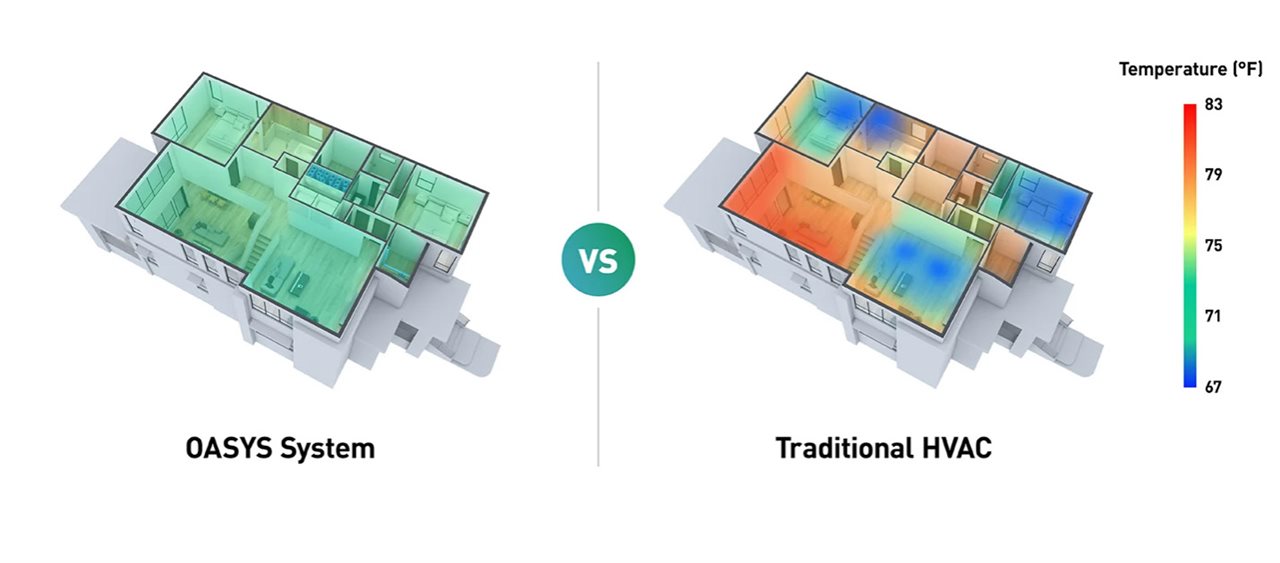
Improving ventilation with outdoor air is one of the fundamental strategies for reducing concentrations of indoor air pollutants. However, most home heating and cooling systems do not mechanically bring in fresh air. By flipping the traditional HVAC logic, OASYS® provides homeowners with balanced airflow to every room, including hard-to-reach areas, supporting the consistent comfort and well-being of families in their home environment.

Illustration compares OASYS to HVAC. The Panasonic OASYS™ changes indoor air quality, temperature and humidity.

The result? Cleaner air, balanced humidity, fewer indoor allergens and pollutants, and consistent temperature control throughout the house from the moment you walk in.

Bringing in fresh air is especially important for homeowners who are moving into a new build. Construction materials, paint, new furnishings and cleaning products emit chemical vapors known as volatile organic compounds (VOCs), a common source of air pollution. By incorporating OASYS® into building plans from the beginning, the whole-home air quality management system can reduce exposure to harmful chemicals by removing VOCs from paints, cleaning products and furnishings before you even move in.

Another benefit of OASYS® is that it uses significantly less energy than conventional HVAC technologies. This isn’t theoretical. In fact, Panasonic built the Panasonic OASYS® Concept Home in Houston, Texas, as a proving ground for the system. By actively removing pollutants, allergens and excess moisture accumulation in Houston’s challenging climate and air quality environment, OASYS® supports better respiratory health and reduces energy consumption by up to 53% compared to traditional HVAC systems.*

Homeowners aren’t the only ones who can benefit from installing OASYS® technology in their homes. For builders and developers, it provides a compelling alternative to standard HVAC, combining energy efficiency, resilience and occupant wellness in a single solution that doesn’t require users to monitor and adjust settings constantly.

Other OASYS® features that contribute to whole-home wellness include:

  • Continuous ventilation: Provides a steady flow of fresh air, reducing indoor air stagnation and airborne pollutants and improving overall air quality.
  • Dehumidification: Steady, balanced humidity levels to prevent mold, mildew and structural damage.
  • Allergen reduction: Filters out pollen, pet dander, dust mites and other asthma triggers — ideal for sensitive individuals.
  • Low maintenance: Designed for reliability and ease of use, with intuitive smart controls that require minimal upkeep.

Because OASYS® combines multiple products into one cohesive system, ongoing maintenance is simple, predictable and designed to support long-term, whole-home air quality management. Best of all, it operates in the background, reflecting a growing preference for homes that are not just connected but thoughtfully integrated.

The modern, high-performance home deserves whole-home comfort

A cleaner, more comfortable home that supports holistic wellness doesn’t happen by accident. It’s built that way from the start, with smart technology that works together and does the work for you. For more information on the benefits of Panasonic OASYS®, visit: iaq.na.panasonic.com/oasys.

*Based on a July 2024 analysis commissioned by Panasonic comparing the OASYS solution against conventional system designs, using a two-story, 4-bedroom, 3.5-bathroom house with light concrete tile roofing and a ventilated crawlspace underneath the first floor as the model home. Energy savings compare a Panasonic high-efficiency design, including an OASYS high-efficiency custom HVAC system and high-performance envelope, to a code minimum house design utilizing a standard gas furnace. Energy demand was converted and standardized to kilowatt hours (kWh), with the model estimating 5,932 kWh annual energy consumption for the OASYS system compared to an estimated 12,744 kWh annual energy consumption for the conventional system, a reduction in annual energy consumption of 53%. The U.S. Department of Energy’s IES Virtual Environment software was used to produce an HVAC load sizing report, while the building’s energy usage was assessed with the National Renewable Energy Lab’s BEopt tool.

Rediscover the lost secrets of history, one mystery at a time

2026-10-01T11:01:00

(BPT) – Where is Alexander the Great really buried? What led to the disappearance of the dodo? And how much do we truly know about the Neolithic cultures that shaped the earliest chapters of human history?

These are just a few of the mysteries explored in Sam Kean’s The Museum of Lost Things: True Tales of Fabled Treasures, Legendary Cities, and Mythical Creatures That Vanished From History.

For anyone drawn to historical mysteries, lost civilizations, extinct species, and the artifacts that help explain the past, Kean’s latest book offers a smart, entertaining guide. The New York Times bestselling author and host of The Disappearing Spoon takes readers on a globe-spanning journey through vanished worlds, legendary treasures, forgotten knowledge, and the discoveries that continue to reshape what we know about human history.

What connects these stories, even across millions of years? Loss. Over 13 chapters, Kean explores a wide range of disappearances and rediscoveries, from missing tombs and lost cities to stolen art, ancient technology, vanished species, and entire bodies of knowledge erased by time.

The result is history writing that feels both deeply researched and highly accessible. Kean has a gift for blending big ideas with vivid detail, surprising context, and moments of humor that make the material feel alive. In the section on Leonardo da Vinci, for example, readers not only encounter the mystery of lost and recovered works, but also a more personal glimpse of the artist, including his habit of clashing with Michelangelo over Dante.

Among the many fascinating subjects covered in The Museum of Lost Things are:

  • The lost city of Troy
  • The hidden tomb of Genghis Khan
  • The destruction of the Library of Alexandria
  • The near loss of the Mona Lisa and other priceless works of art
  • The decipherment of ancient Egyptian hieroglyphs
  • The extinction, and possible revival, of dodos, mammoths, and other iconic species

Along the way, readers will pick up plenty of unforgettable stories and surprising facts, including the creation of the Antikythera mechanism, often described as the oldest known analog computer, and the remarkable story of deciphering the Mayan language.

Why The Museum of Lost Things stands out

More than a collection of history stories, Kean’s book explores how fragile human knowledge can be—and how much effort it takes to recover it. Archaeologists, historians, linguists, and scientists all appear in these pages as part of a larger story about curiosity, persistence, and the challenge of reconstructing the past from whatever survives.

That makes The Museum of Lost Things especially appealing for readers interested in archaeology, ancient history, lost artifacts, forgotten civilizations, and the enduring mysteries that still shape our understanding of the world. It’s the kind of book that invites you to look backward—and then wonder what traces of our own era will remain for future generations.

If you’re looking for a compelling history book about lost treasures, legendary cities, extinct animals, and the search for the past, The Museum of Lost Things is well worth adding to your reading list. Find it on Disney Books or wherever books are sold.